
Learning to operate your vehicle's lighting and climate control systems correctly is a fundamental requirement of the RSA Rules of the Road. This guide details the specific conditions under which you must use dipped headlights, fog lamps, and demisters to ensure you remain visible to others and maintain a clear view of the road ahead. Proper use of these features is not only critical for your safety but also a common topic tested in the Irish Driver Theory Test.
Article content overview
Driving in Ireland presents a unique set of challenges, with unpredictable weather patterns often reducing visibility in a matter of seconds. Whether you are navigating a coastal road in heavy rain or encountering dense morning fog on an M-way, understanding your vehicle's lighting and climate control systems is non-negotiable. Not only does this knowledge ensure your safety and that of other road users, but it is also a fundamental requirement for passing your RSA Driver Theory Test.
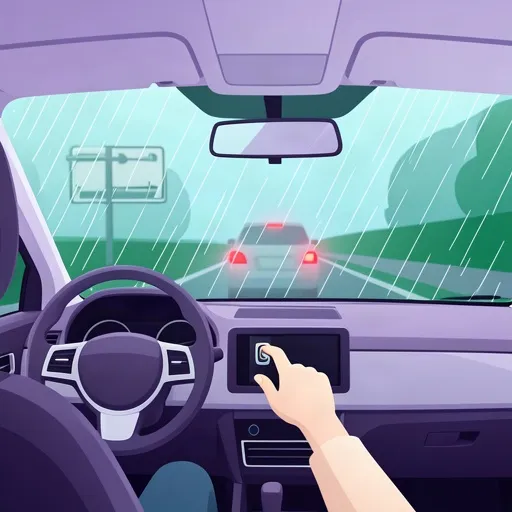
Under the Irish Rules of the Road, your vehicle must be equipped with specific lighting systems to ensure you are visible to others and can see the road ahead clearly. Dipped headlights are essential during the hours of darkness and during daytime periods of poor visibility, such as heavy rain, falling snow, or mist.
It is a common point of confusion for learners to know when to transition between sidelights, dipped headlights, and full-beam headlights. Sidelights are intended to make your vehicle visible to others when you are parked or in low-light conditions where full illumination is not yet required. However, as soon as visibility drops significantly, you must switch to dipped headlights to avoid dazzling oncoming traffic while ensuring you have a clear view of the road markings and potential hazards.
Never use your full-beam headlights when there is traffic ahead of you or approaching from the opposite direction. Doing so can cause temporary blindness to other drivers, significantly increasing the risk of a collision.
Many learners mistakenly believe that fog lamps should be used as soon as it begins to rain. In reality, the Rules of the Road state that front and rear fog lamps must only be used when visibility is seriously reduced—typically to less than 100 metres. Using these high-intensity lights in normal weather conditions is not only inconsiderate but can also be illegal, as it may distract or dazzle other road users.
When driving in dense fog, remember to switch off your fog lamps immediately once visibility improves. A common exam trap in the Driver Theory Test involves identifying the correct sequence of light usage during changing weather conditions. Always prioritize being seen, but exercise caution to ensure your lights do not cause a nuisance to others.
Clear visibility is about more than just your exterior lights; it is also about maintaining a clear windscreen. In the damp Irish climate, condensation and interior misting are common, especially on colder mornings. Your vehicle's heating, ventilation, and air conditioning (HVAC) system is equipped with specific settings to tackle this efficiently.
If your vehicle has a heated rear window, ensure it is activated to clear frost or condensation that could obscure your view of following traffic. Never start driving until your entire windscreen and all side mirrors provide an unobstructed view of the road.
The following table provides a quick reference for when to use specific lighting controls, which is a frequent area of focus in RSA theory assessments.
| Light Type | When to Use | Key Requirement |
|---|---|---|
| Sidelights | Parking at night or in low-light | Must be used at night in built-up areas |
| Dipped Headlights | Normal night driving or poor visibility | Do not dazzle oncoming drivers |
| Full-Beam Headlights | Unlit roads at night | Switch to dipped when traffic is present |
| Fog Lamps | Visibility reduced below 100m | Turn off when visibility improves |
The distance at which an object can be clearly identified; in the context of the Rules of the Road, this refers to the driver's ability to see obstacles, road signs, and other road users clearly.
This article covers the RSA Rules of the Road requirements for vehicle lighting in Ireland, including the correct use of sidelights, dipped headlights, full-beam headlights, and fog lamps based on visibility conditions. A critical rule to remember is that fog lamps must only be used when visibility drops below 100 metres. The article also provides a practical step-by-step procedure for effective windscreen demisting, which involves using fresh air, maximum heat, and air conditioning to remove condensation. Understanding these lighting transitions and the 100m visibility threshold will help learners answer theory test questions and drive safely in Ireland's frequently poor weather conditions.
A short set of high-value points that capture the most important ideas from this article.
Dipped headlights must be used when visibility drops significantly, even during daytime in heavy rain, fog, or snow
Fog lamps are restricted to seriously reduced visibility, typically less than 100 metres, not just when it rains
Never use full-beam headlights when traffic is present, as it can cause temporary blindness to other drivers
Switch between sidelights, dipped, and full-beam based on lighting conditions and traffic presence
Never drive until your entire windscreen and all mirrors provide a completely unobstructed view
Front and rear fog lamps: only when visibility is below 100 metres and must be switched off immediately when visibility improves
Dipped headlights prevent dazzling oncoming traffic while still illuminating the road ahead
Sidelights are for parking and low-light visibility only; they do not replace dipped headlights when driving
Effective demisting requires fresh air (recirculation off), maximum heat, and air conditioning as a dehumidifier
The correct sequence in changing weather: assess visibility, choose the appropriate lighting, reassess, and adjust accordingly
Using fog lamps at the first sign of rain instead of waiting for seriously reduced visibility below 100m
Forgetting to switch off fog lamps once conditions improve, potentially dazzling following drivers
Starting to drive before the windscreen is fully demisted, creating a major safety hazard
Using full-beam headlights when approaching or following other vehicles
Confusing sidelights with dipped headlights and driving with insufficient illumination in poor visibility
Article content overview
A short set of high-value points that capture the most important ideas from this article.
Dipped headlights must be used when visibility drops significantly, even during daytime in heavy rain, fog, or snow
Fog lamps are restricted to seriously reduced visibility, typically less than 100 metres, not just when it rains
Never use full-beam headlights when traffic is present, as it can cause temporary blindness to other drivers
Switch between sidelights, dipped, and full-beam based on lighting conditions and traffic presence
Never drive until your entire windscreen and all mirrors provide a completely unobstructed view
Front and rear fog lamps: only when visibility is below 100 metres and must be switched off immediately when visibility improves
Dipped headlights prevent dazzling oncoming traffic while still illuminating the road ahead
Sidelights are for parking and low-light visibility only; they do not replace dipped headlights when driving
Effective demisting requires fresh air (recirculation off), maximum heat, and air conditioning as a dehumidifier
The correct sequence in changing weather: assess visibility, choose the appropriate lighting, reassess, and adjust accordingly
Using fog lamps at the first sign of rain instead of waiting for seriously reduced visibility below 100m
Forgetting to switch off fog lamps once conditions improve, potentially dazzling following drivers
Starting to drive before the windscreen is fully demisted, creating a major safety hazard
Using full-beam headlights when approaching or following other vehicles
Confusing sidelights with dipped headlights and driving with insufficient illumination in poor visibility
Explore related topics, search based questions, and concepts that learners often look up when studying Vehicle Lighting and Visibility. These themes reflect real search intent and help you understand how this topic connects to wider driving theory knowledge in Ireland.
Find clear and practical answers to common questions learners often have about Vehicle Lighting and Visibility. This section helps explain difficult points, remove confusion, and reinforce the key driving theory concepts that matter for learners in Ireland.
You should only use front fog lamps when visibility is seriously reduced, such as in heavy fog or falling snow, and you must switch them off immediately once visibility improves to avoid dazzling other road users.
Yes, the Rules of the Road state that you must use your dipped headlights during the day if visibility is poor, such as during heavy rain, to ensure your vehicle is visible to other motorists.
Use the vehicle's heating and ventilation system effectively by selecting the demist setting, ensuring the air is directed at the windscreen, and using the air conditioning if available to remove moisture from the cabin air.
After searching, continue your DTT preparation by exploring related articles, practicing questions, or reviewing specific road sign categories. Deepen your understanding of Irish road rules and ensure you're fully prepared for your Driver Theory Test.