
This lesson guides you through the crucial adjustments needed when riding a motorcycle on wet or slippery Irish roads. As part of our comprehensive safety unit, it helps you understand how weather-related surface changes impact your stability and control, ensuring you are prepared for both the theory exam and real-world road challenges.

Lesson content overview
Riding a motorcycle requires a continuous assessment of the relationship between your tyres and the road surface. In dry conditions, modern motorcycle tyres provide an exceptional level of grip, allowing for confident cornering, rapid acceleration, and highly effective braking.
However, when Irish weather takes its inevitable turn and rain begins to fall, the dynamics of motorcycle control shift dramatically. Water on the road acts as a lubricant, reducing the coefficient of friction between your tyres and the tarmac.
For riders preparing for their Category A, A1, or A2 theory exams, understanding how to adapt your riding style to wet and slippery conditions is not just a requirement for passing the test—it is a fundamental survival skill for navigating Irish roads.
To understand why wet roads are dangerous, you must first understand how a motorcycle maintains traction. Unlike a car, which distributes its weight across four wide tyres, a motorcycle relies on two incredibly small contact patches. At any given moment, the actual area of rubber touching the road for each tyre is roughly the size of a standard credit card.
When the road is dry, the rubber of the tyre conforms to the microscopic texture of the tarmac, creating mechanical grip. When water is introduced, it fills these microscopic crevices, creating a barrier between the rubber and the road.
The primary job of a motorcycle tyre’s tread pattern is to channel water away from this contact patch, allowing the rubber to make direct contact with the road. However, a tyre's ability to displace water is not limitless. It is highly dependent on:
The "First 15 Minutes" Danger Zone The most hazardous time to ride is immediately after a dry spell when it first begins to rain. Light rain mixes with accumulated oil, grease, diesel spillages, and rubber dust on the road surface, creating an incredibly slick, soapy film. Always exercise extreme caution during the initial stages of a rainfall.
Hydroplaning—often referred to as aquaplaning—is one of the most hazardous phenomena a motorcyclist can encounter.
Hydroplaning occurs when a layer of water builds up between the motorcycle tyre and the road surface, lifting the tyre off the tarmac entirely. When this happens, the tyre is literally floating on a film of water, resulting in a complete loss of steering, braking, and stability.
While passenger cars can often recover from brief moments of aquaplaning without spinning out, a motorcycle relies entirely on active balance and tyre grip to remain upright. If your front tyre hydroplanes, you lose all steering control and the ability to keep the bike balanced. If the rear tyre hydroplanes, it can spin up rapidly under power or slide sideways, leading to a violent high-side or low-side crash when grip is suddenly regained.
Because wet roads severely limit the friction available for stopping, your braking distances will increase significantly. On a perfectly dry, clean tarmac road, a rider can typically achieve a rapid stop within a safe, predictable distance. In the wet, however, stopping distances can easily double or even triple.
In dry conditions, the Road Safety Authority (RSA) recommends maintaining a minimum following distance of two seconds behind the vehicle in front. In wet weather, you must increase this to a minimum of four seconds.
To calculate this, watch the vehicle ahead pass a fixed object (such as a road sign, lamp post, or bridge). Count "one-thousand-and-one, one-thousand-and-two, one-thousand-and-three, one-thousand-and-four." If you pass the same object before you finish counting, you are following too closely.
Heavy rain and wet roads mean that larger vehicles ahead, such as trucks, buses, and SUVs, will throw up a massive cloud of dirty water spray. Following too closely not only robs you of stopping distance but also completely blinds you, coating your helmet visor with road grime and water droplets. Increasing your following distance keeps you clear of this hazardous spray zone.
Braking on a wet road requires an entirely different physical approach than braking in the dry. Any sudden, aggressive grab of the brake levers will break the fragile bond of traction, leading instantly to a wheel lock-up and a subsequent fall.
Set Your Line and Straighten Up: Avoid braking while leaning. Ensure the motorcycle is completely upright and moving in a straight line before applying any significant braking force.
Use Progressive Brake Pressure: Gently squeeze the front brake lever to shift the motorcycle's weight forward. This "loads" the front tyre, compressing the contact patch and increasing its grip before you apply firmer braking pressure.
Balance the Front and Rear Brakes: While the front brake still provides the majority of your stopping power, utilize the rear brake smoothly to help stabilize the chassis and distribute the braking load across both tyres.
Anticipate Stops Early: Scan the road far ahead. Begin deceleration much earlier than you would in dry conditions, using engine braking (closing the throttle) to shed speed naturally before applying the physical brakes.
If your motorcycle is equipped with ABS, it serves as an invaluable safety net. ABS monitors wheel speed and momentarily releases brake pressure if it detects an impending wheel lock-up, helping you maintain steering control.
However, you must never ride faster or brake more aggressively simply because your bike has ABS. ABS cannot create grip where none exists, nor can it bypass the laws of physics. Your stopping distances will still be significantly longer on a wet surface, even with ABS fully active.
When negotiating corners in wet weather, you must actively minimize the lateral (side-to-side) forces acting on your tyres. Because traction is limited, your tyres cannot handle simultaneous heavy braking/acceleration and sharp cornering forces.
Imagine your tyre's total grip as a budget. If you spend 80% of your grip budget on leaning over to take a corner, you only have 20% left for braking or accelerating. On a wet road, your overall grip budget is cut in half. To corner safely, you must reduce your speed before the turn so that you require very little lean angle to complete the corner.
Every control input—throttle adjustments, steering inputs, and gear changes—must be executed with extreme smoothness.
A road surface that is perfectly safe when dry can become as slippery as ice when wet. A major component of defensive riding in the rain is scanning the road specifically for these high-hazard zones and adjusting your lane position to avoid them.
Road paint, including white lane dividers, yellow yellow-box junctions, pedestrian crossings (zebra crossings), and directional arrows, is highly non-porous. When wet, the paint acts like a sheet of plastic, offering virtually zero traction.
Manhole covers, drainage grates, utility access plates, and tram tracks (especially prevalent in urban centers like Dublin) become incredibly slick when wet.
On many older Irish regional and local roads, heavy commercial vehicles cause the tarmac to deform over time, leaving deep ruts running parallel to the lane. During rainstorms, water pools deeply in these ruts.
Road maintenance crews often use rubberized bitumen sealant to fill cracks in the tarmac. These lines, known as "tar snakes," lose almost all grip when wet. Avoid placing your tyres on them, particularly during cornering.
Riding in wet conditions is not just about physical bike control; it is also about mental adaptability and adjusting to the specific environment around you.
To prepare for your theory exam and protect yourself on the road, memorize these common riding errors that lead to dangerous situations in wet weather:
Riding a motorcycle in wet conditions requires fundamentally different techniques because water reduces the friction between your tyres and the road, shrinking the already small contact patches that keep you upright. Hydroplaning is particularly dangerous for motorcyclists since losing front tyre contact means losing all steering ability. The RSA recommends maintaining a minimum four-second following distance in wet weather and emphasises smooth, progressive braking applied only when the bike is upright and straight. High-risk areas include painted road markings, metal manhole covers, ruts where water pools, and tar snakes—all of which become extremely slippery when wet and should be approached with minimal lean angle or crossed at 90 degrees. Defensive riding in rain also means anticipating reduced visibility from spray, pedestrian unpredictability in urban areas, and the particularly treacherous 'first 15 minutes' period after rainfall begins.
A short set of high-value points that capture the most important learning from this lesson.
Wet roads dramatically reduce tyre grip because water acts as a lubricant between the rubber and tarmac, forcing you to adjust all riding inputs
Hydroplaning occurs when a water layer lifts the tyre off the road completely, causing instant loss of steering and balance on a motorcycle
Increase your following distance to a minimum of four seconds in wet conditions—double the standard two-second dry gap
Avoid riding on painted road markings, metal manhole covers, and tar snakes when wet; cross them at 90 degrees while upright
The first 15 minutes of rainfall after a dry spell are the most dangerous due to oil, grease, and rubber dust mixing into a slick film
Explore all units and lessons included in this driving theory course.
The four-second rule: count 'one-thousand-and-one' to 'one-thousand-and-four' to check your following distance in wet weather
Brake only when completely upright and straight; never brake while leaned over on wet surfaces
The traction circle concept means wet roads cut your grip budget in half, so reduce speed before corners to require less lean angle
First 15 minutes of rain creates the most treacherous conditions before rainwater washes away accumulated road grime
ABS cannot create grip where none exists—your stopping distances will still be significantly longer even with anti-lock brakes
Riding at dry-weather speeds without reducing speed to match reduced road grip
Maintaining only a two-second following gap, leaving insufficient stopping distance when brakes are applied
Grabbing the front brake lever abruptly, causing immediate wheel lock-up and loss of traction
Attempting to corner or change direction while positioned on wet painted road markings
Applying heavy throttle before the motorcycle is fully upright when exiting a wet corner, causing rear wheel spin-out
Lesson content overview
A short set of high-value points that capture the most important learning from this lesson.
Wet roads dramatically reduce tyre grip because water acts as a lubricant between the rubber and tarmac, forcing you to adjust all riding inputs
Hydroplaning occurs when a water layer lifts the tyre off the road completely, causing instant loss of steering and balance on a motorcycle
Increase your following distance to a minimum of four seconds in wet conditions—double the standard two-second dry gap
Avoid riding on painted road markings, metal manhole covers, and tar snakes when wet; cross them at 90 degrees while upright
The first 15 minutes of rainfall after a dry spell are the most dangerous due to oil, grease, and rubber dust mixing into a slick film
Explore all units and lessons included in this driving theory course.
The four-second rule: count 'one-thousand-and-one' to 'one-thousand-and-four' to check your following distance in wet weather
Brake only when completely upright and straight; never brake while leaned over on wet surfaces
The traction circle concept means wet roads cut your grip budget in half, so reduce speed before corners to require less lean angle
First 15 minutes of rain creates the most treacherous conditions before rainwater washes away accumulated road grime
ABS cannot create grip where none exists—your stopping distances will still be significantly longer even with anti-lock brakes
Riding at dry-weather speeds without reducing speed to match reduced road grip
Maintaining only a two-second following gap, leaving insufficient stopping distance when brakes are applied
Grabbing the front brake lever abruptly, causing immediate wheel lock-up and loss of traction
Attempting to corner or change direction while positioned on wet painted road markings
Applying heavy throttle before the motorcycle is fully upright when exiting a wet corner, causing rear wheel spin-out
Explore search topics learners often look for when studying Adapting Riding Techniques for Wet and Slippery Conditions. These topics reflect common questions about road rules, driving situations, safety guidance, and lesson level theory preparation for learners in Ireland.
Browse additional driving theory lessons that cover connected traffic rules, road signs, and common driving situations related to this topic. Improve your understanding of how different rules interact across everyday traffic scenarios.
Learn the principles of proactive hazard perception and risk management to increase safety. This lesson covers how to anticipate the actions of other road users and maintain protective space to minimize danger during diverse riding conditions.

This lesson teaches how to cultivate a proactive defensive riding mindset, focusing on situational awareness and constant hazard scanning. It describes the system of motorcycle control, encouraging riders to anticipate potential mistakes from other drivers, pedestrians, and cyclists. Motorcyclists will learn to position themselves defensively, leaving clear escape routes in all driving environments.

This lesson analyzes the crucial role of rider attitude, mental focus, and psychological factors in preventing motorcycle collisions on Irish roads. It addresses how overconfidence, fatigue, and peer pressure can negatively impact a rider's decision-making process and elevate risk levels. Motorcyclists will explore strategies to maintain a defensive mindset, exercise patience, and practice active situational awareness under all traffic conditions.

This lesson teaches riders how to create and preserve a protective safety envelope around their motorcycle under various traffic densities. It explains the two-second rule for dry conditions and how to expand this buffer zone in adverse weather or heavy traffic. Motorcyclists will learn to manage tailgaters by gradually increasing their following distance from the vehicle ahead to prevent sudden braking.
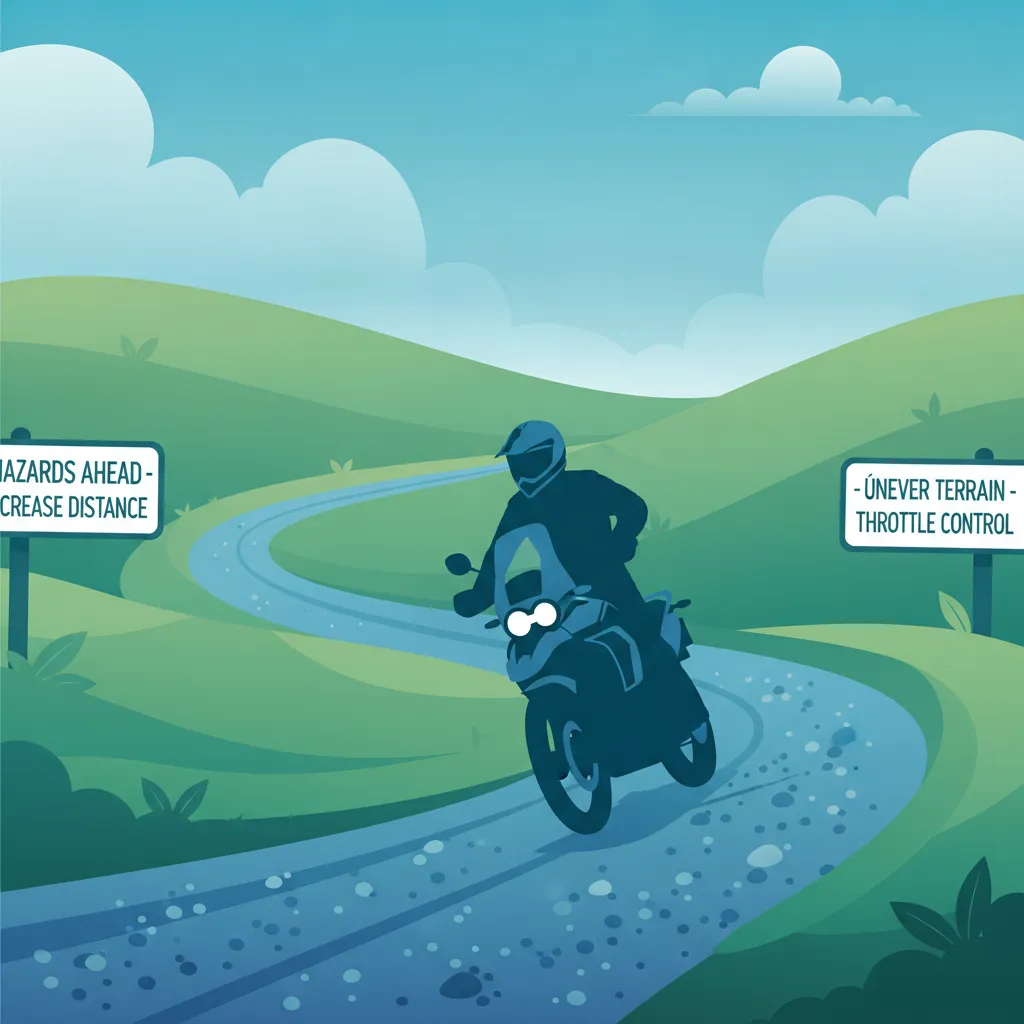
This lesson focuses on riding techniques suited for gravel, loose surfaces, and rural roads. Learners will understand how to maintain stability, adjust braking and cornering approaches, and anticipate hazards such as potholes and farm vehicles, following RSA guidance for safe riding in the Irish countryside.

This lesson covers the strategic aspects of journey management, emphasizing the safety benefits of proactive route planning and weather checks. It teaches riders how to select safer roads, avoid high-congestion zones during rush hour, and schedule regular rest intervals. Motorcyclists will learn to pack essential tools, emergency contacts, and spare safety gear to remain prepared for any roadside situation.

This lesson teaches riders how to manage extreme weather conditions such as high crosswinds, thick fog, and low sun glare. It details how wind forces can push a motorcycle off course and how to use minor body adjustments and lane placement to maintain stability. Riders will learn how to manage visibility limits in dense fog, utilizing specialized riding gear and reducing speeds safely.
This lesson explains how to choose the safest riding position within a traffic lane, considering the standard left-side driving rule in Ireland. It details the concept of dominant positioning to prevent other vehicles from crowding your space, while remaining visible to oncoming traffic. Riders will learn to adjust their track constantly to avoid road surface hazards, oil deposits, and wind currents.

This lesson outlines how motorcyclists should respond when permanent road signs are dirty, damaged, or hidden by overgrown trees and hedges. It introduces the temporary signage, warning cones, and detour markers commonly deployed at active roadwork zones in Ireland. Riders will learn to read the road ahead defensively, reducing speed when visual information is incomplete or compromised.

This lesson focuses on the critical techniques required to ride safely during severe rain or heavy fog in Ireland. It teaches riders how to handle aquaplaning risks, use headlights correctly, and significantly increase their following distances. Adapting speed to visibility ensures that riders can brake safely when road conditions deteriorate.

This lesson teaches riders how to actively identify and eliminate blind spots through proper mirror adjustment and physical shoulder checks. It explains the concept of a safety cushion, which represents the defensive space maintained around the moped at all times. Managing these zones ensures adequate reaction time and mitigates the impact of sudden braking.
Understand how to spot high-risk road surface conditions and environmental threats common to Ireland. This guide explains how to identify diesel spills, uneven road surfaces, and seasonal hazards to adjust your speed and lane position accordingly.

This lesson identifies prevalent risky behaviours among motorcyclists, including speeding, tailgating, and reckless riding under the influence of alcohol or drugs. Learners will understand the associated penalties, legal implications, and the impact of fatigue and peer pressure on decision-making, following RSA and Irish legal frameworks.
This lesson covers the strategic aspects of journey management, emphasizing the safety benefits of proactive route planning and weather checks. It teaches riders how to select safer roads, avoid high-congestion zones during rush hour, and schedule regular rest intervals. Motorcyclists will learn to pack essential tools, emergency contacts, and spare safety gear to remain prepared for any roadside situation.
This lesson teaches how to cultivate a proactive defensive riding mindset, focusing on situational awareness and constant hazard scanning. It describes the system of motorcycle control, encouraging riders to anticipate potential mistakes from other drivers, pedestrians, and cyclists. Motorcyclists will learn to position themselves defensively, leaving clear escape routes in all driving environments.
Find clear answers to common questions learners have about Adapting Riding Techniques for Wet and Slippery Conditions. Learn how the lesson is structured, which driving theory objectives it supports, and how it fits into the overall learning path of units and curriculum progression in Ireland. These explanations help you understand key concepts, lesson flow, and exam focused study goals.
Painted road markings often become extremely slippery when wet, similar to ice. Even at low speeds, hitting these markings while braking or cornering can cause your tires to lose grip instantly, leading to a slide.
Water reduces the friction between your tires and the road, significantly increasing your braking distance. You must double your standard following distance in wet conditions to allow enough time to react and stop safely.
If possible, avoid riding through deep standing water as it can hide hazards like potholes or cause hydroplaning. If you must cross it, keep the motorcycle upright, maintain a steady throttle, and avoid sudden braking.
Yes, you should corner more conservatively. Use smoother, more gradual inputs, lean the bike less, and increase your entry speed margin to ensure you have maximum traction throughout the turn.
Use the practice question search tool to pinpoint specific topics, road signs, or rules you need to master for your official Driver Theory Test. Refine your study strategy and ensure comprehensive preparation for all aspects of the Irish driving exam. Start your focused revision now and build confidence for your learner permit test.