
Effective route planning and hazard anticipation are vital skills for every motorcyclist in Ireland. This lesson helps you master pre-ride checks, strategic path selection, and risk management, ensuring you are fully prepared for the Category A, A1, and A2 theory exam.

Lesson content overview
Riding a motorcycle in Ireland requires more than technical control of your machine; it demands strategic planning and a high degree of foresight. Unlike drivers wrapped in a protective steel cage, motorcyclists are directly exposed to the environment, road surface variations, and the unpredictable actions of other road users. Developing a proactive mindset toward journey planning is a vital skill for Category A, A1, and A2 riders.
By strategically selecting your route, timing your journeys to bypass heavy traffic, monitoring Ireland's rapidly changing weather, and packing the correct safety and maintenance gear, you can dramatically reduce your exposure to risk before you even start your engine. This lesson focuses on the strategic planning phase of riding, teaching you how to anticipate hazards, plan around them, and maintain control when the unexpected occurs.
Safe riding begins at home, long before you swing a leg over your motorcycle saddle. The Road Safety Authority (RSA) emphasizes that proactive journey management is a fundamental component of a rider's defensive strategy.
The systematic process of planning, preparing, and assessing a journey before departure to minimize exposure to hazards, optimize rider comfort, and ensure both the machine and rider are fully prepared for the trip.
Rather than reacting to hazards as they appear, proactive journey management seeks to eliminate or bypass them entirely. For example, instead of navigating a notorious bottleneck during peak Friday evening traffic, a proactive rider will adjust their departure time or select an alternative, less congested route. This approach preserves cognitive energy, reduces stress, and keeps you out of situations where low-speed collisions are common.
A dynamic risk assessment is an ongoing mental process where you identify potential hazards, evaluate their severity and likelihood, and implement control measures. This begins during the planning phase. If your route includes regional (R) or local (L) roads known for poor resurfacing or agricultural activity, your risk assessment should prompt you to lower your planned average speed, increase your following distance, and prepare for mud or gravel on bends.
Unpreparedness is a significant catalyst for accidents. A rider who is shivering from inadequate clothing, running low on fuel in a remote area, or stranded due to a minor, preventable mechanical fault is a compromised rider. Ensuring that your motorcycle is mechanically sound and that you have the tools, safety equipment, and clothing necessary for the worst-case scenario keeps you focused on the road ahead rather than your discomfort.
The shortest line between two points on a map is rarely the safest or most enjoyable route for a motorcyclist. When planning your route, you must evaluate the class of road, surface conditions, and potential traffic conflicts.
Ireland's road network is highly varied, ranging from multi-lane motorways to single-track boreens. Each road type presents distinct risk profiles:
When planning a journey, particularly if you are a novice Category A1 or A2 rider, favor roads with high-quality surfaces, clear sightlines, and predictable traffic patterns. If you must use rural roads, actively reduce your speed to compensate for the reduced visibility and potential for sudden hazards.
Congestion increases the density of vehicles, which in turn increases the frequency of lane changes, sudden braking, and driver distraction. Rush hour in major urban hubs like Dublin, Cork, Limerick, and Galway can be incredibly taxing on a motorcyclist.
Stop-and-start traffic requires continuous clutch control, increases engine temperature, and forces you into close proximity with distracted commuters. Planning your departure to fall outside of morning (07:30–09:30) and evening (16:30–18:30) peak times reduces the risk of rear-end collisions and low-speed filtering incidents.
If you must ride during peak commuter hours, remain highly visible, avoid lingering in blind spots (especially of heavy goods vehicles), and do not make sudden, unpredictable filtering maneuvers.
Ireland's weather is notoriously unpredictable. A dry, sunny morning can easily transition into a wet, windy afternoon. Checking an up-to-date weather forecast before setting off is not just a matter of comfort; it is a critical safety step.
Different weather conditions require distinct changes in your riding strategy, speed, and safety margins:
| Weather Condition | Primary Hazard | Operational Adjustment |
|---|---|---|
| Heavy Rain | Aquaplaning, reduced tyre grip, poor visibility | Reduce speed by at least 20-30%, double your following distance to at least 4 seconds, and use smooth, progressive control inputs. |
| Strong Winds | Lateral gusts destabilizing the motorcycle | Grip the tank firmly with your knees, loosen your upper body grip on the handlebars, and steer into the wind to maintain your lane position. |
| Dense Fog | Severe loss of visibility and depth perception | Significantly reduce speed, use dipped headlights (and fog lights if equipped), and use road markings to guide your positioning. |
| Low Temperatures / Ice | Extreme loss of traction, black ice | Avoid riding if sub-zero temperatures are forecast. If caught, avoid lean angles, use the rear brake with extreme gentleness, and ride in the tyre tracks of preceding vehicles. |
On exposed sections of motorways or coastal routes (such as the Wild Atlantic Way), strong crosswinds can push a lightweight motorcycle off its path. Anticipate sudden gusts when passing gaps in hedges, coming out from behind large vehicles, or crossing bridges. Give yourself plenty of lateral space within your lane to absorb these sudden movements.
Fatigue is an insidious hazard. It slowly degrades your reaction times, impairs your spatial awareness, and clouds your decision-making. On a motorcycle, where physical inputs and constant balance are required, fatigue is significantly more dangerous than it is in a car.
The RSA advises taking a break of at least 15 to 20 minutes for every two hours of continuous riding. When planning a long journey, identify suitable service stations or rest stops along your route beforehand.
Use these breaks to step away from the bike, hydrate, eat a light snack to maintain blood sugar levels, and stretch your muscles. If you begin to experience symptoms of fatigue—such as heavy eyelids, difficulty maintaining lane position, or missing road signs—pull over safely at the next available opportunity. Do not attempt to "push through" the tiredness.
A self-sufficient rider is a safe rider. When traveling away from well-populated areas, you should carry a compact emergency kit designed for basic roadside repairs and emergencies.
Puncture Repair Kit & Puncture Sealant: Tubeless tyre repair kits with CO2 canisters can temporarily fix a nail puncture, allowing you to ride slowly to the nearest tyre specialist.
Basic Tool Set: Include multi-tools, Allen keys specific to your motorcycle, zip ties, and electrical tape for minor fasteners or fairing adjustments.
High-Visibility Reflective Vest: Essential if you break down on a dark national road or motorway, ensuring other drivers can spot you from a distance.
Compact First-Aid Kit: Containing sterile dressings, bandages, antiseptic wipes, and medical tape for minor injuries.
Spare Fuses and Bulb Kit: A blown fuse can disable your lighting or ignition; carrying spares can turn a potential tow-truck recovery into a five-minute fix.
Your strategic planning must translate into physical adjustments to your riding style based on real-time observations. This is where your planning meets execution.
When water mixes with oil, rubber residue, and dust on the road surface, it creates a highly slippery film. The hazard is greatest during the first 15 minutes of a rainfall after a dry spell, as the oils are lifted to the surface before being washed away.
Your tyres rely on their tread patterns to disperse water. If your tread depth is low, or if your speed is too high, a wedge of water can build up beneath the tyre contact patch, causing aquaplaning (a complete loss of steering and braking grip).
If you are touring or carrying heavy gear, your motorcycle's handling dynamics will change significantly. Luggage adds weight, which shifts the motorcycle’s center of gravity and increases your stopping distances.
Your route selection might bring you into close proximity with pedestrians, cyclists, and equestrians, particularly on rural lanes or in suburban villages.
Safe riding is not just best practice; it is a strict legal requirement enforced by An Garda Síochána under Irish Road Traffic Legislation.
Under the Road Traffic Acts, all road users have a statutory duty to drive or ride with "due care and attention." This means you must adapt your riding to the prevailing weather, traffic, and road surface conditions. If you choose to maintain the maximum legal speed limit on a wet, foggy night and cause a collision, you can be prosecuted for dangerous or careless driving, regardless of whether you were technically within the posted speed limit.
Under Irish vehicle lighting regulations, motorcycles must ride with their headlights illuminated at all times—even during bright daylight hours.
Understanding the theory of route planning is best illustrated by analyzing common mistakes and examining how defensive principles are applied in real-world Irish driving scenarios.
Effective motorcycle journey planning in Ireland combines strategic route selection, weather awareness, and equipment readiness to minimize risk before departure. Riders should favor higher-quality roads (motorways and national roads) during poor conditions, adjust speed and following distances based on quantified weather guidance (20-30% speed reduction in rain, wind-specific positioning techniques), and schedule mandatory rest breaks of 15-20 minutes every two hours to combat fatigue. Legal requirements including always-on dipped headlights and the statutory duty of "due care and attention" mean riders must adapt to conditions regardless of posted speed limits. Carrying essential emergency equipment—puncture repair kit, first-aid supplies, high-visibility vest, and spare fuses—ensures minor breakdowns do not become dangerous situations.
A short set of high-value points that capture the most important learning from this lesson.
Proactive journey management eliminates or bypasses hazards before departure, reducing cognitive load and stress during the ride
Route selection should prioritize road quality over speed: favor motorways and national roads over regional and local roads in adverse conditions
Weather adaptations are quantifiable: reduce speed by 20-30% in heavy rain and double following distance to at least 4 seconds
Fatigue degrades motorcycle riding disproportionately; RSA recommends a 15-20 minute break every 2 hours of continuous riding
Motorcycles in Ireland must use dipped headlights at all times, even in daylight, to maximize conspicuity
Explore all units and lessons included in this driving theory course.
Aquaplaning occurs when tyre tread cannot disperse water; reduce speed to prevent the water wedge from separating tyre from road surface
Peak urban congestion in Ireland typically runs 07:30-09:30 and 16:30-18:30; plan departures outside these windows when possible
When overtaking cyclists, allow at least 1.5m lateral clearance on roads over 50 km/h and 1.0m on lower-speed roads
Heavy items must stay low and centralized; top-heavy loading compromises low-speed balance and cornering stability
The legal speed limit is not a target in poor conditions; "due care and attention" requires adjusting speed downward to match hazards
Assuming scenic rural shortcuts are safer or faster; R-roads and L-roads have highest hazard concentration with poor surfaces and obscured sightlines
Failing to check weather before departure; Ireland's conditions can change rapidly from dry to wet or windy within minutes
Attempting to "push through" fatigue rather than stopping; exhaustion severely impairs the balance, reaction time, and judgment critical for motorcycle control
Using main beam when approaching other vehicles or in built-up areas; dazzling oncoming traffic creates serious collision risk
Riding aggressively through congestion to save time; this increases exposure to low-speed collisions and side-swipes in heavy traffic
Lesson content overview
A short set of high-value points that capture the most important learning from this lesson.
Proactive journey management eliminates or bypasses hazards before departure, reducing cognitive load and stress during the ride
Route selection should prioritize road quality over speed: favor motorways and national roads over regional and local roads in adverse conditions
Weather adaptations are quantifiable: reduce speed by 20-30% in heavy rain and double following distance to at least 4 seconds
Fatigue degrades motorcycle riding disproportionately; RSA recommends a 15-20 minute break every 2 hours of continuous riding
Motorcycles in Ireland must use dipped headlights at all times, even in daylight, to maximize conspicuity
Explore all units and lessons included in this driving theory course.
Aquaplaning occurs when tyre tread cannot disperse water; reduce speed to prevent the water wedge from separating tyre from road surface
Peak urban congestion in Ireland typically runs 07:30-09:30 and 16:30-18:30; plan departures outside these windows when possible
When overtaking cyclists, allow at least 1.5m lateral clearance on roads over 50 km/h and 1.0m on lower-speed roads
Heavy items must stay low and centralized; top-heavy loading compromises low-speed balance and cornering stability
The legal speed limit is not a target in poor conditions; "due care and attention" requires adjusting speed downward to match hazards
Assuming scenic rural shortcuts are safer or faster; R-roads and L-roads have highest hazard concentration with poor surfaces and obscured sightlines
Failing to check weather before departure; Ireland's conditions can change rapidly from dry to wet or windy within minutes
Attempting to "push through" fatigue rather than stopping; exhaustion severely impairs the balance, reaction time, and judgment critical for motorcycle control
Using main beam when approaching other vehicles or in built-up areas; dazzling oncoming traffic creates serious collision risk
Riding aggressively through congestion to save time; this increases exposure to low-speed collisions and side-swipes in heavy traffic
Explore search topics learners often look for when studying Planning Safe Routes and Anticipating Hazards. These topics reflect common questions about road rules, driving situations, safety guidance, and lesson level theory preparation for learners in Ireland.
Browse additional driving theory lessons that cover connected traffic rules, road signs, and common driving situations related to this topic. Improve your understanding of how different rules interact across everyday traffic scenarios.
Learn how to actively identify potential hazards on Irish roads and apply defensive riding principles to minimize risk. This explanation covers situational awareness, managing space around your motorcycle, and adapting your riding style to changing traffic conditions to ensure safer travel for all road users.

This lesson teaches how to cultivate a proactive defensive riding mindset, focusing on situational awareness and constant hazard scanning. It describes the system of motorcycle control, encouraging riders to anticipate potential mistakes from other drivers, pedestrians, and cyclists. Motorcyclists will learn to position themselves defensively, leaving clear escape routes in all driving environments.

This lesson outlines how motorcyclists should respond when permanent road signs are dirty, damaged, or hidden by overgrown trees and hedges. It introduces the temporary signage, warning cones, and detour markers commonly deployed at active roadwork zones in Ireland. Riders will learn to read the road ahead defensively, reducing speed when visual information is incomplete or compromised.

This lesson details the location of blind spots on passenger cars, commercial trucks, and buses, explaining how to avoid staying in these danger zones. It teaches the vital importance of the lifesaver glance or physical shoulder check before executing any lateral lane change or turn. Motorcyclists will learn how to monitor other drivers' mirrors to verify if their motorcycle is visible.

This lesson focuses on practical strategies for maximizing a motorcyclist's visibility to other road users in day and night scenarios. It details the effective placement of retro-reflective materials, high-visibility jackets, and the constant use of dipped headlights. Riders will examine how road positioning within their lane dramatically reduces the likelihood of being obscured by other vehicles.

This lesson identifies prevalent risky behaviours among motorcyclists, including speeding, tailgating, and reckless riding under the influence of alcohol or drugs. Learners will understand the associated penalties, legal implications, and the impact of fatigue and peer pressure on decision-making, following RSA and Irish legal frameworks.
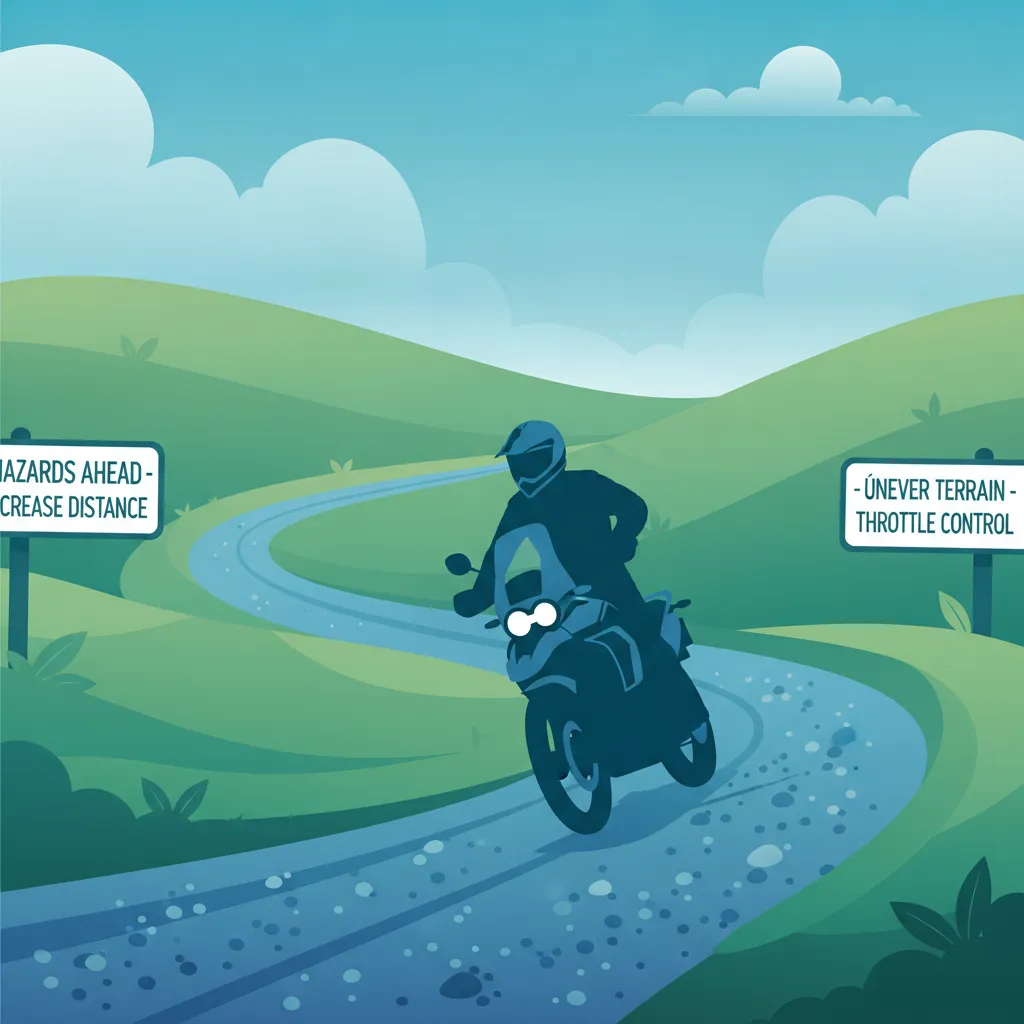
This lesson focuses on riding techniques suited for gravel, loose surfaces, and rural roads. Learners will understand how to maintain stability, adjust braking and cornering approaches, and anticipate hazards such as potholes and farm vehicles, following RSA guidance for safe riding in the Irish countryside.

This lesson teaches riders how to create and preserve a protective safety envelope around their motorcycle under various traffic densities. It explains the two-second rule for dry conditions and how to expand this buffer zone in adverse weather or heavy traffic. Motorcyclists will learn to manage tailgaters by gradually increasing their following distance from the vehicle ahead to prevent sudden braking.

This lesson covers the specific categories of Irish traffic signs, including regulatory, warning, and information signs under official RSA rules. It teaches riders to instantly recognize speed limits, prohibited directions, and upcoming road hazards based on sign shapes and colors. Motorcyclists will understand how to adjust their speed and lane positioning proactively when reading signs in advance.

This lesson analyzes the crucial role of rider attitude, mental focus, and psychological factors in preventing motorcycle collisions on Irish roads. It addresses how overconfidence, fatigue, and peer pressure can negatively impact a rider's decision-making process and elevate risk levels. Motorcyclists will explore strategies to maintain a defensive mindset, exercise patience, and practice active situational awareness under all traffic conditions.

This lesson outlines the rules and procedures for riding safely on dual carriageways and motorways in Ireland. It covers merging from slip roads, maintaining lane discipline, and executing high-speed overtaking manoeuvres in accordance with RSA standards. Motorcyclists will learn to anticipate turbulence from large commercial trucks and recognize the safety signs used on high-speed routes.
Understand how to adapt your motorcycle control for wet weather, slippery road surfaces, and low visibility conditions. This guide provides theoretical insight into managing grip limits, identifying hazards like black ice or loose gravel, and maintaining stability during strong winds on various Irish road types.

This lesson explains how to modify riding techniques when navigating wet tarmac, focusing on the heightened risk of hydroplaning and reduced tire grip. It details the necessity of increasing following distances, avoiding painted road markings, and executing smoother control inputs. Riders will understand how surface water accumulates in ruts, presenting severe hazards during heavy rainstorms.

This lesson teaches riders how to manage extreme weather conditions such as high crosswinds, thick fog, and low sun glare. It details how wind forces can push a motorcycle off course and how to use minor body adjustments and lane placement to maintain stability. Riders will learn how to manage visibility limits in dense fog, utilizing specialized riding gear and reducing speeds safely.

This lesson focuses on the critical techniques required to ride safely during severe rain or heavy fog in Ireland. It teaches riders how to handle aquaplaning risks, use headlights correctly, and significantly increase their following distances. Adapting speed to visibility ensures that riders can brake safely when road conditions deteriorate.
This lesson focuses on riding techniques suited for gravel, loose surfaces, and rural roads. Learners will understand how to maintain stability, adjust braking and cornering approaches, and anticipate hazards such as potholes and farm vehicles, following RSA guidance for safe riding in the Irish countryside.
This lesson focuses on practical strategies for maximizing a motorcyclist's visibility to other road users in day and night scenarios. It details the effective placement of retro-reflective materials, high-visibility jackets, and the constant use of dipped headlights. Riders will examine how road positioning within their lane dramatically reduces the likelihood of being obscured by other vehicles.
This lesson outlines how motorcyclists should respond when permanent road signs are dirty, damaged, or hidden by overgrown trees and hedges. It introduces the temporary signage, warning cones, and detour markers commonly deployed at active roadwork zones in Ireland. Riders will learn to read the road ahead defensively, reducing speed when visual information is incomplete or compromised.
This lesson teaches how to cultivate a proactive defensive riding mindset, focusing on situational awareness and constant hazard scanning. It describes the system of motorcycle control, encouraging riders to anticipate potential mistakes from other drivers, pedestrians, and cyclists. Motorcyclists will learn to position themselves defensively, leaving clear escape routes in all driving environments.
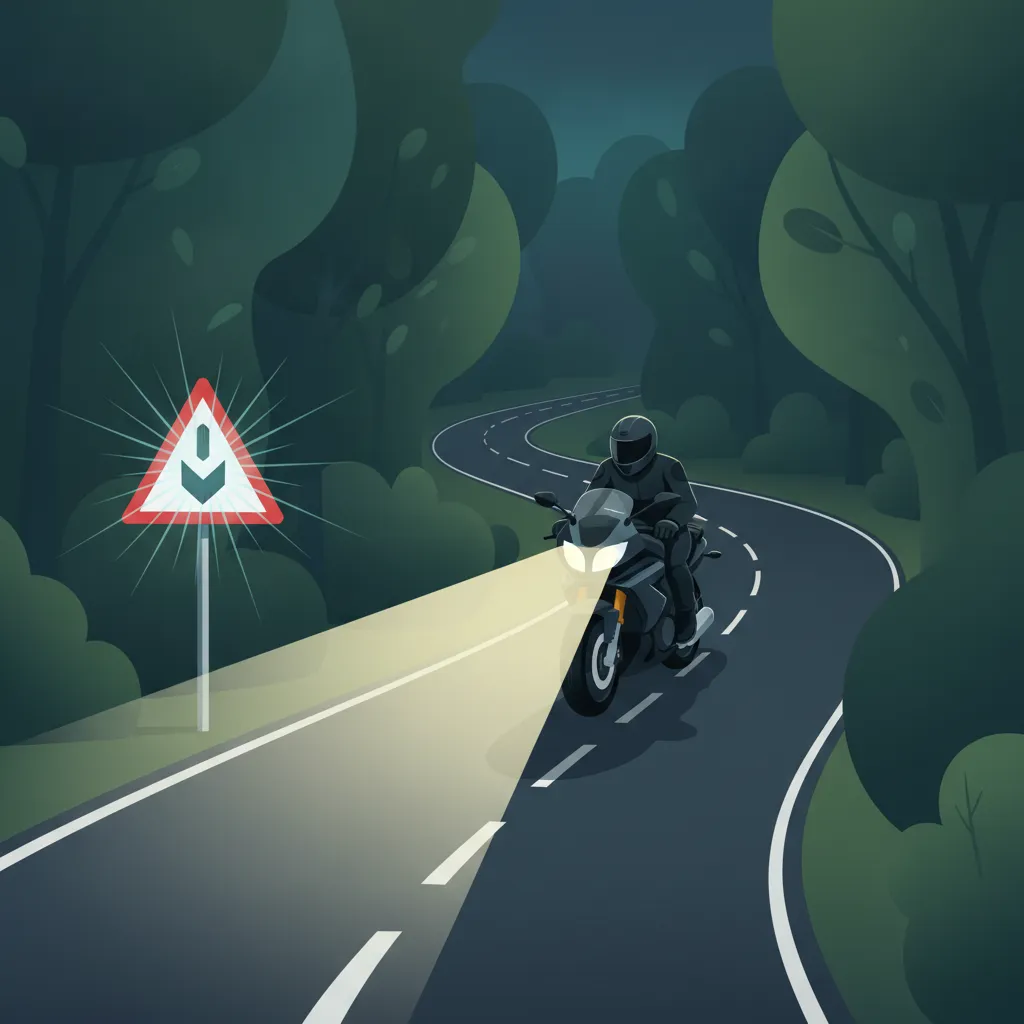
This lesson details safety strategies for riding in dark or poorly illuminated environments, focusing on headlight management and visibility limits. It explains when to use dipped and high beams to avoid blinding other motorists while maximizing your own view of the road. Riders will learn how to scan for reflective markers, manage oncoming glare, and adapt their speed to their headlight range.

This lesson analyzes traffic flow characteristics in dense municipal areas and teaches safe riding methods for congested gridlock situations. It covers the maintenance of adequate safety cushions, scanning for opening car doors, and monitoring pedestrians stepping from between parked cars. Riders will learn to manage frequent stopping, constant clutch wear, and the stress of urban commuting.
Find clear answers to common questions learners have about Planning Safe Routes and Anticipating Hazards. Learn how the lesson is structured, which driving theory objectives it supports, and how it fits into the overall learning path of units and curriculum progression in Ireland. These explanations help you understand key concepts, lesson flow, and exam focused study goals.
Route planning is tested because a prepared rider is a safer rider. The RSA looks for your ability to anticipate challenges like high-congestion zones or adverse weather, which are critical components of defensive riding.
Anticipation involves scanning the road far ahead, checking your mirrors constantly, and predicting the potential mistakes of other road users. This lesson teaches you how to maintain a mental 'buffer zone' to give yourself more reaction time.
While you won't be checking the weather during the test, you will be asked questions about how different weather conditions affect your control and visibility. Knowing how to adapt your route and riding style to these conditions is a core learning requirement.
You should always carry a basic toolkit, a first-aid kit, a mobile phone with emergency contact details, and appropriate rain gear. Being prepared helps you manage unexpected breakdowns or minor issues without putting yourself at risk.
Use the practice question search tool to pinpoint specific topics, road signs, or rules you need to master for your official Driver Theory Test. Refine your study strategy and ensure comprehensive preparation for all aspects of the Irish driving exam. Start your focused revision now and build confidence for your learner permit test.