
This lesson teaches you to adopt a proactive approach to motorcycle safety by maintaining constant situational awareness and identifying potential hazards early. It is a critical component of your Category A, A1, or A2 theory preparation, helping you move beyond basic vehicle control to become a safer, more observant rider on Irish roads.

Lesson content overview
Earning a motorcycle licence in Ireland (Category A, A1, or A2) requires more than just mastering physical controls like the clutch, throttle, and brakes. To survive and thrive on Irish roads, you must develop a proactive defensive riding mindset.
Defensive riding is a systematic approach to road safety where the motorcyclist constantly predicts, identifies, and mitigates potential hazards before they escalate into dangerous situations. Unlike car drivers, motorcyclists lack the protective cocoon of a metal cabin, crumple zones, and airbags. This vulnerability means you must rely on your mental sharpness, situational awareness, and strategic positioning to protect yourself.
This lesson explores how to cultivate this mindset. It details the safety psychology, physical principles, and road strategies mandated by the Road Safety Authority (RSA) and Irish road traffic legislation to keep you safe in all environments.
At its core, defensive riding combines safety psychology (how we perceive and evaluate risk) with physics (the limits of motorcycle grip, traction, and braking). A defensive rider does not simply react to what happens; they actively anticipate what could happen.
A proactive, systematic strategy of operating a motorcycle that minimises risk by anticipating hazards, maintaining optimal road positioning, and leaving reliable escape routes at all times.
This approach is highly connected to other modules of the Irish motorcycle curriculum, building directly upon basic lane positioning, blind spot awareness, and cornering physics. By adopting this mindset, you ensure that you always have a safety margin, regardless of how unpredictably other road users behave.
Situational awareness is the continuous process of observing, understanding, and projecting what is happening around you. To ride defensively, you must train your eyes to scan the road systematically rather than fixing your gaze on a single point.
Effective situational awareness is divided into three distinct visual horizons:
A common mistake among learner riders is focusing only on the immediate horizon. This leads to abrupt, panic-induced braking and swerving. By continuously scanning all three horizons—as well as checking your mirrors every few seconds—you grant yourself the necessary time to make smooth, controlled adjustments.
Your position on the road dictates what you can see, and more importantly, who can see you. In Ireland, motorcyclists generally categorise their lane position into three distinct sections:
Defensive positioning requires you to dynamically move between these positions depending on the immediate hazard. For example, when approaching a blind summit or a sharp right-hand bend on a rural road, moving towards Position 1 prevents a collision with an oncoming vehicle that may have crossed the centre line.
The System of Motorcycle Control: Always use the systematic approach to hazards: Information (Gather and Give), Position, Speed, Gear, and Acceleration. This ensures you are always in the correct gear and road position before you enter a hazard zone.
A fundamental rule of defensive riding is to assume that other drivers have not seen you. You must actively anticipate that other road users, pedestrians, and cyclists will make mistakes.
The Road Traffic Act establishes a general Duty of Care, but as a motorcyclist, you must take active responsibility for your own safety. Do not assume a driver will yield right-of-way simply because you have a green light or are on a priority road.
To anticipate errors, look for subtle cues in your environment:
Large vehicles like buses, heavy goods vehicles (HGVs), and agricultural machinery have vast blind spots where a motorcycle can completely disappear from the driver's view.
If you ride in these blind spots, you are invisible. To protect yourself:
To ensure you have adequate time to react and a clear escape route, you must maintain a safe following distance behind the vehicle ahead.
A safety standard used to measure following distances by counting the seconds between when the vehicle ahead passes a fixed object and when your motorcycle passes the same object.
Identify a fixed marker ahead, such as a road sign, lamppost, or bridge shadow.
As soon as the rear bumper of the vehicle in front passes the marker, begin counting: "One thousand and one, one thousand and two..."
If your front wheel crosses the marker before you reach "one thousand and two" (in dry conditions), you are following too closely. Ease off the throttle to increase the gap.
Understanding where riders frequently fail to apply defensive concepts helps you avoid making the same critical errors.
Defensive riding is dynamic; your strategies must change depending on the environment, weather, and road conditions.
Understanding the direct physical and safety consequences of your actions is key to cementing a defensive mindset:
Developing a defensive riding mindset is a life-saving skill that requires continuous practice. By scanning for hazards, positioning yourself for maximum visibility, anticipating the mistakes of others, and maintaining safe margins, you ensure a safe and enjoyable journey on Irish roads.
Looking to learn more about safe road positioning or managing risks on faster roads? Explore our related guides below.
To put your knowledge to the test and prepare for your Irish Category A, A1, or A2 theory exam, try our targeted practice modules.
A defensive riding mindset combines safety psychology with motorcycle physics to help you predict and avoid hazards before they become dangerous. The three visual horizons (immediate, near-term, and long-term) guide continuous road scanning, while lane positioning (Positions 1, 2, and 3) must be adjusted dynamically based on visibility needs and surface conditions. The time-gap rule requires at least a 2-second following distance in dry conditions, doubling to 4 seconds in wet weather and extending to 10 seconds in icy or greasy conditions. Critical to survival is assuming other road users have not seen you, checking blind spots using the mirror rule, and maintaining an escape route at all times.
A short set of high-value points that capture the most important learning from this lesson.
Defensive riding means actively anticipating what could happen rather than simply reacting to what has already happened
Continuously scan three visual horizons: immediate (2-3 seconds), near-term (4-10 seconds), and long-term (beyond 10 seconds)
Dynamically adjust your lane position (1, 2, or 3) based on immediate hazards and visibility needs
Always assume other road users have not seen you and position yourself to maintain a clear escape route
Use the System of Motorcycle Control for every hazard: Information, Position, Speed, Gear, and Acceleration
Explore all units and lessons included in this driving theory course.
If you cannot see the driver's face in their side mirrors, they cannot see you (Mirror Rule)
The centre of the lane (Position 2) contains an oil strip that drastically reduces tyre grip, especially when wet
Large vehicles swing wide before turning and their rear wheels cut tight corners; never squeeze between a turning HGV and the kerb
Watch front wheels of stationary cars at junctions, not just the driver's face, to anticipate pulling-out maneuvers
Maintain minimum 2-second gap in dry conditions, 4 seconds in wet, and up to 10 seconds in adverse conditions like ice or summer ice
Riding alongside HGVs in their blind spots on dual carriageways instead of passing swiftly and safely
Following too closely (tailgating) to prepare for an overtake, eliminating reaction time and escape routes
Incorrectly positioning at junctions by hugging the far kerb, which limits visibility and confuses other drivers
Failing to scan mirrors regularly, especially before braking, changing position, or turning
Assuming pedestrians at crossings or footpaths will wait for you rather than watching their body language for signs of stepping out
Lesson content overview
A short set of high-value points that capture the most important learning from this lesson.
Defensive riding means actively anticipating what could happen rather than simply reacting to what has already happened
Continuously scan three visual horizons: immediate (2-3 seconds), near-term (4-10 seconds), and long-term (beyond 10 seconds)
Dynamically adjust your lane position (1, 2, or 3) based on immediate hazards and visibility needs
Always assume other road users have not seen you and position yourself to maintain a clear escape route
Use the System of Motorcycle Control for every hazard: Information, Position, Speed, Gear, and Acceleration
Explore all units and lessons included in this driving theory course.
If you cannot see the driver's face in their side mirrors, they cannot see you (Mirror Rule)
The centre of the lane (Position 2) contains an oil strip that drastically reduces tyre grip, especially when wet
Large vehicles swing wide before turning and their rear wheels cut tight corners; never squeeze between a turning HGV and the kerb
Watch front wheels of stationary cars at junctions, not just the driver's face, to anticipate pulling-out maneuvers
Maintain minimum 2-second gap in dry conditions, 4 seconds in wet, and up to 10 seconds in adverse conditions like ice or summer ice
Riding alongside HGVs in their blind spots on dual carriageways instead of passing swiftly and safely
Following too closely (tailgating) to prepare for an overtake, eliminating reaction time and escape routes
Incorrectly positioning at junctions by hugging the far kerb, which limits visibility and confuses other drivers
Failing to scan mirrors regularly, especially before braking, changing position, or turning
Assuming pedestrians at crossings or footpaths will wait for you rather than watching their body language for signs of stepping out
Explore search topics learners often look for when studying Developing a Defensive Riding Mindset. These topics reflect common questions about road rules, driving situations, safety guidance, and lesson level theory preparation for learners in Ireland.
Browse additional driving theory lessons that cover connected traffic rules, road signs, and common driving situations related to this topic. Improve your understanding of how different rules interact across everyday traffic scenarios.
Learn how to effectively scan for hazards and manage risks in various Irish driving environments. This guide explains the systematic approach to situational awareness, helping you identify threats from other road users and environmental factors before they escalate into dangerous situations while riding your motorcycle.

This lesson outlines how motorcyclists should respond when permanent road signs are dirty, damaged, or hidden by overgrown trees and hedges. It introduces the temporary signage, warning cones, and detour markers commonly deployed at active roadwork zones in Ireland. Riders will learn to read the road ahead defensively, reducing speed when visual information is incomplete or compromised.

This lesson covers the strategic aspects of journey management, emphasizing the safety benefits of proactive route planning and weather checks. It teaches riders how to select safer roads, avoid high-congestion zones during rush hour, and schedule regular rest intervals. Motorcyclists will learn to pack essential tools, emergency contacts, and spare safety gear to remain prepared for any roadside situation.

This lesson explains the sequential steps for executing safe overtaking manoeuvres on single and dual-carriageway roads in Ireland. It focuses on assessing speed differentials, establishing clear lines of sight, and evaluating oncoming traffic before committing. Riders will learn the correct signaling routine, safe abort procedures, and how to return smoothly to their lane without cutting in.

This lesson outlines the rules and procedures for riding safely on dual carriageways and motorways in Ireland. It covers merging from slip roads, maintaining lane discipline, and executing high-speed overtaking manoeuvres in accordance with RSA standards. Motorcyclists will learn to anticipate turbulence from large commercial trucks and recognize the safety signs used on high-speed routes.

This lesson covers the specific categories of Irish traffic signs, including regulatory, warning, and information signs under official RSA rules. It teaches riders to instantly recognize speed limits, prohibited directions, and upcoming road hazards based on sign shapes and colors. Motorcyclists will understand how to adjust their speed and lane positioning proactively when reading signs in advance.

This lesson details the location of blind spots on passenger cars, commercial trucks, and buses, explaining how to avoid staying in these danger zones. It teaches the vital importance of the lifesaver glance or physical shoulder check before executing any lateral lane change or turn. Motorcyclists will learn how to monitor other drivers' mirrors to verify if their motorcycle is visible.

This lesson focuses on practical strategies for maximizing a motorcyclist's visibility to other road users in day and night scenarios. It details the effective placement of retro-reflective materials, high-visibility jackets, and the constant use of dipped headlights. Riders will examine how road positioning within their lane dramatically reduces the likelihood of being obscured by other vehicles.

This lesson identifies prevalent risky behaviours among motorcyclists, including speeding, tailgating, and reckless riding under the influence of alcohol or drugs. Learners will understand the associated penalties, legal implications, and the impact of fatigue and peer pressure on decision-making, following RSA and Irish legal frameworks.
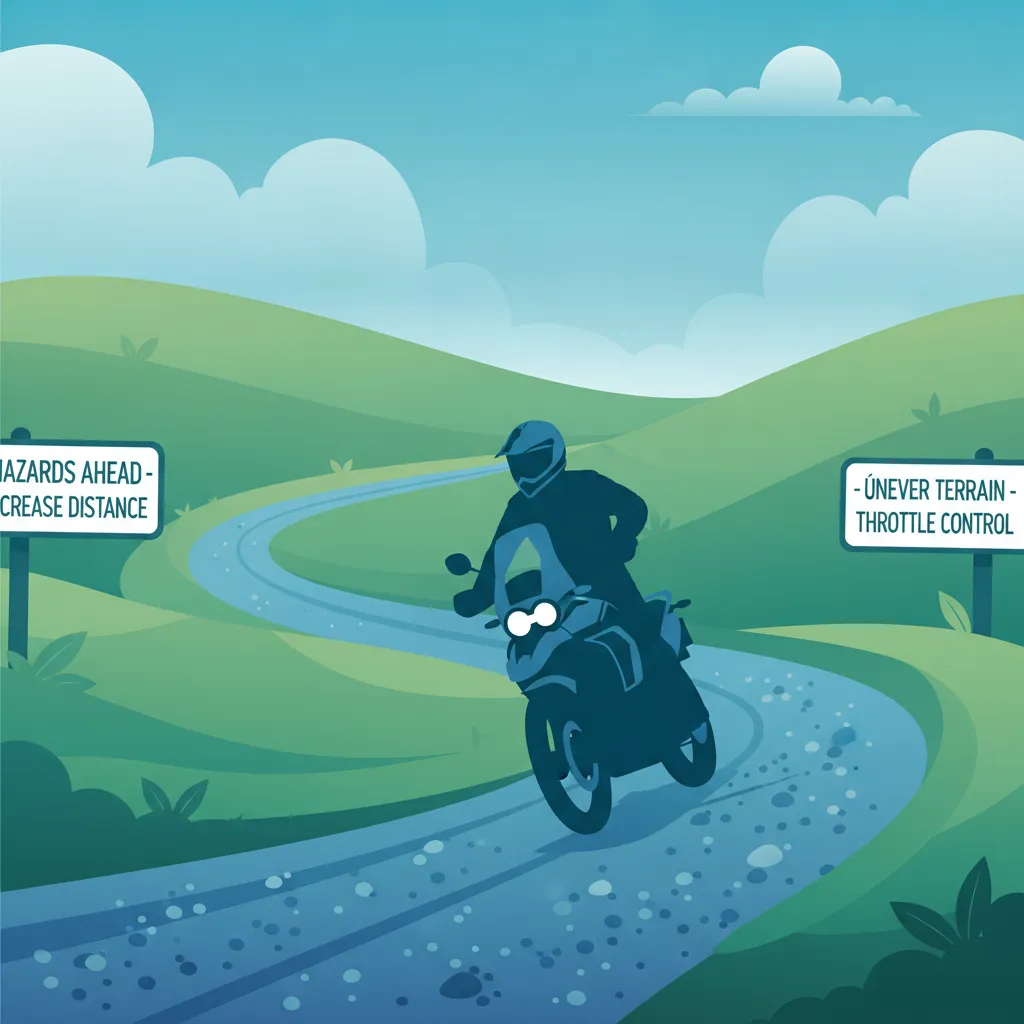
This lesson focuses on riding techniques suited for gravel, loose surfaces, and rural roads. Learners will understand how to maintain stability, adjust braking and cornering approaches, and anticipate hazards such as potholes and farm vehicles, following RSA guidance for safe riding in the Irish countryside.
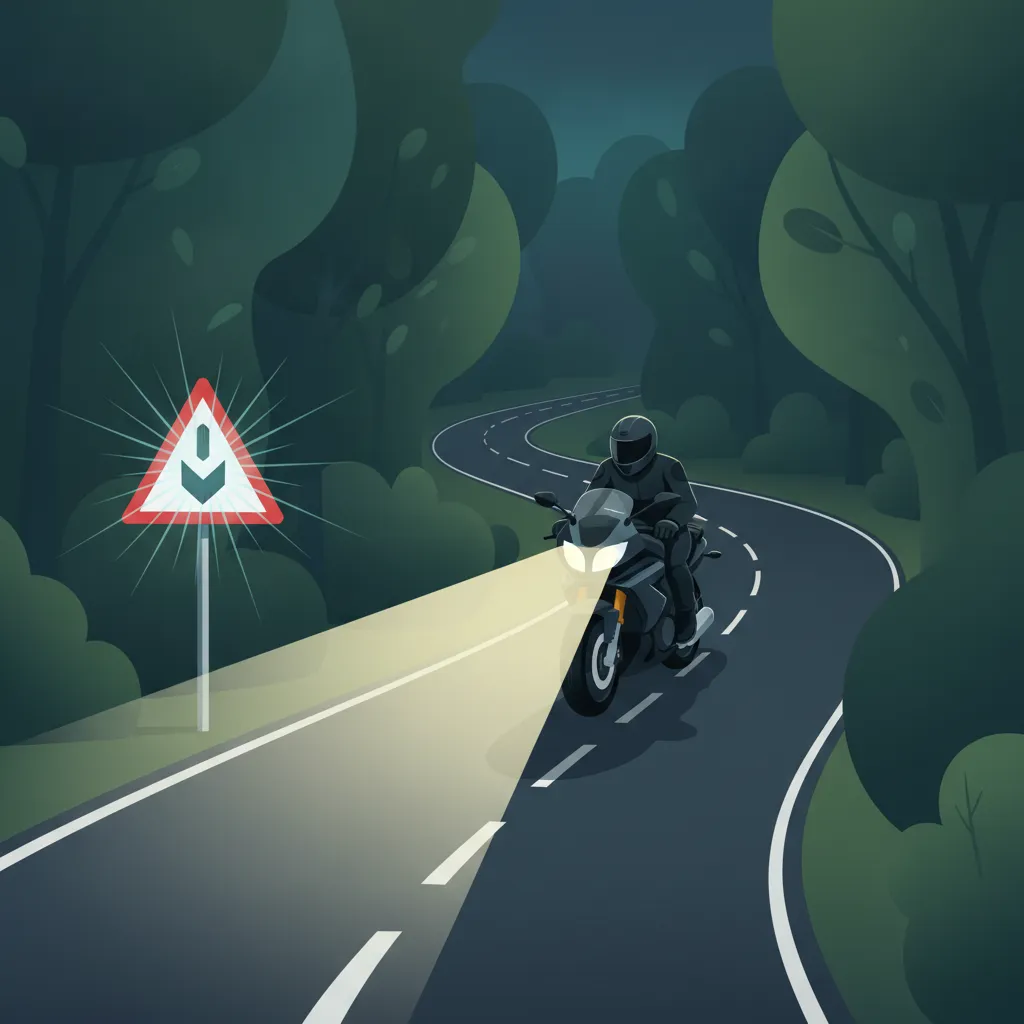
This lesson details safety strategies for riding in dark or poorly illuminated environments, focusing on headlight management and visibility limits. It explains when to use dipped and high beams to avoid blinding other motorists while maximizing your own view of the road. Riders will learn how to scan for reflective markers, manage oncoming glare, and adapt their speed to their headlight range.
Understand the importance of dynamic road positioning for motorcycles to maximise your visibility to other drivers. This lesson covers how to select the correct lane position at junctions, roundabouts, and during overtaking to ensure you maintain a clear escape route and adhere to safe traffic conventions.

This lesson explains how to choose the safest riding position within a traffic lane, considering the standard left-side driving rule in Ireland. It details the concept of dominant positioning to prevent other vehicles from crowding your space, while remaining visible to oncoming traffic. Riders will learn to adjust their track constantly to avoid road surface hazards, oil deposits, and wind currents.

This lesson provides actionable strategies for Category AM riders to remain visible, focusing on lane positioning and eye contact. It teaches how to avoid riding in the blind spots of larger vehicles and how to signal early and clearly. Cultivating a proactive attitude toward road visibility helps prevent collisions and builds mutual respect on Irish roads.

This lesson outlines the defensive techniques and legal principles of filtering or lane-splitting through stationary or slow-moving traffic queues. It emphasizes the absolute necessity of keeping speed low, monitoring for turning vehicles, and anticipating sudden lane changes by frustrated drivers. Riders will learn to evaluate road width, vehicle gaps, and pedestrian hazards before choosing to filter.
This lesson focuses on practical strategies for maximizing a motorcyclist's visibility to other road users in day and night scenarios. It details the effective placement of retro-reflective materials, high-visibility jackets, and the constant use of dipped headlights. Riders will examine how road positioning within their lane dramatically reduces the likelihood of being obscured by other vehicles.

This lesson focuses on the safe approach and execution of turns at T-junctions, staggered intersections, and blind crossroads. It explains the critical mirror-signal-manoeuvre routine and how to select the best position for maximum visibility to cross-traffic. Motorcyclists will learn to identify potential hazards like vehicles pulling out suddenly or turning across their direct path.
This lesson explains the sequential steps for executing safe overtaking manoeuvres on single and dual-carriageway roads in Ireland. It focuses on assessing speed differentials, establishing clear lines of sight, and evaluating oncoming traffic before committing. Riders will learn the correct signaling routine, safe abort procedures, and how to return smoothly to their lane without cutting in.

Irish driving theory demands that drivers keep to the left-hand side of the road unless overtaking or turning right. This lesson explains how to maintain consistent lane discipline on multi-lane roads, how to perform safe lane changes, and the dangers of drifting. You will learn the safety sequence of checking mirrors, checking blind spots, signalling, and smoothly executing a lane change without disrupting trailing traffic.
This lesson details the location of blind spots on passenger cars, commercial trucks, and buses, explaining how to avoid staying in these danger zones. It teaches the vital importance of the lifesaver glance or physical shoulder check before executing any lateral lane change or turn. Motorcyclists will learn how to monitor other drivers' mirrors to verify if their motorcycle is visible.

This lesson teaches riders how to create and preserve a protective safety envelope around their motorcycle under various traffic densities. It explains the two-second rule for dry conditions and how to expand this buffer zone in adverse weather or heavy traffic. Motorcyclists will learn to manage tailgaters by gradually increasing their following distance from the vehicle ahead to prevent sudden braking.

This lesson details the sequential steps required to approach and exit junctions safely under the Irish driving rules. It teaches riders how to select the correct lane, utilize mirrors, apply early signals, and reduce speed appropriately. Effective observation strategies are highlighted to help riders identify crossing pedestrians or approaching side traffic.
Find clear answers to common questions learners have about Developing a Defensive Riding Mindset. Learn how the lesson is structured, which driving theory objectives it supports, and how it fits into the overall learning path of units and curriculum progression in Ireland. These explanations help you understand key concepts, lesson flow, and exam focused study goals.
The theory exam tests your ability to think like a safe rider. A defensive mindset ensures you can correctly identify and respond to the hidden dangers in the scenario-based questions, which is critical for achieving a passing score.
In dense Irish urban traffic, a defensive mindset helps you anticipate the moves of buses, taxis, and cyclists. By maintaining a safety cushion and scanning for potential hazards, you reduce the likelihood of being caught in an emergency braking situation.
Yes, regardless of your licence category, developing a defensive riding mindset is a fundamental safety requirement. It is tested equally across all motorcycle theory categories to ensure all new riders prioritize safety on Irish roads.
Many learners focus only on the road directly in front of them. The defensive approach requires scanning further ahead to pick up on cues like parked car doors, junctions, or changing light signals, which are common sources of test questions.
Use the practice question search tool to pinpoint specific topics, road signs, or rules you need to master for your official Driver Theory Test. Refine your study strategy and ensure comprehensive preparation for all aspects of the Irish driving exam. Start your focused revision now and build confidence for your learner permit test.