
This lesson provides essential techniques for safely navigating the unique challenges of rural Irish roads, including loose surfaces like gravel and mud. It builds on your foundational control skills to ensure you can anticipate hidden hazards and maintain stability in unpredictable environments. Mastery of these topics is critical for both passing your Category A theory exam and staying safe during real-world rides.
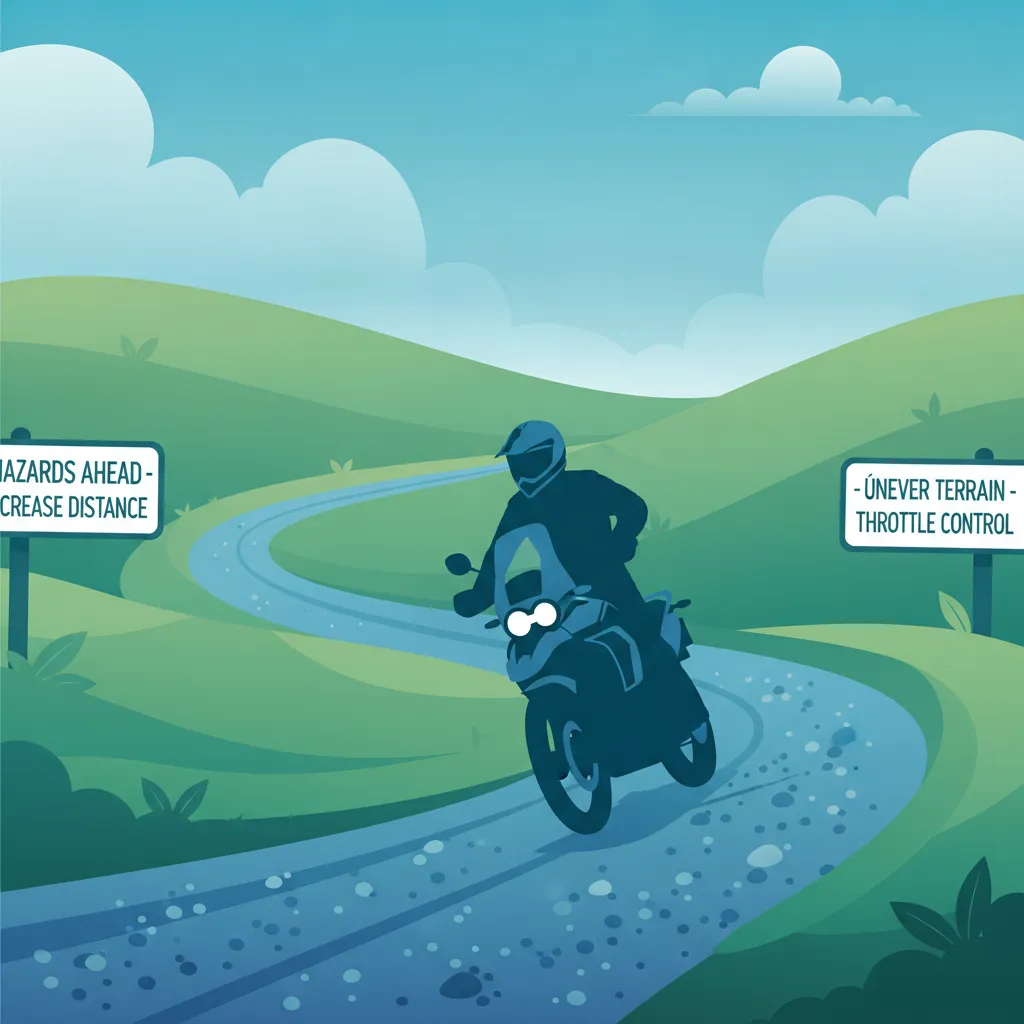
Lesson content overview
Operating a motorcycle on gravel, loose surfaces, and rural roads requires a fundamental shift in your riding style, mental focus, and physical control. In Ireland, transitioning from high-grip urban tarmac to regional (R-roads), local (L-roads), or unclassified rural lanes—often referred to locally as boreens—presents a unique set of challenges.
According to the Road Safety Authority (RSA), rural roads account for a disproportionate number of serious motorcycle collisions. Understanding how loose underfoot conditions affect motorcycle physics, adapting your control inputs, and learning how to read the rural landscape are critical steps for any rider pursuing a Category A, A1, or A2 licence.
To control a motorcycle on unstable terrain, you must first understand the physical forces at play. Grip is determined by the coefficient of friction () between your tyre’s rubber contact patch and the road surface.
The ratio of the force of friction between two bodies to the force pressing them together. On dry, clean asphalt, this value is high (typically 0.7 to 0.9), but it drops drastically on loose gravel, mud, or wet grass (often falling below 0.3).
On dry asphalt, tyres grip through chemical adhesion and mechanical interlock. However, when you ride onto loose gravel, sand, or mud:
Attempting to maintain highway speeds or applying sudden control inputs on loose surfaces will immediately overcome the limited friction available, resulting in a low-side or high-side fall. Smoothness is your primary safety mechanism.
Not all loose surfaces behave the same way. As a defensive rider, you must identify changes in the road surface well before you reach them.
Commonly encountered on newly resurfaced Irish roads or rural driveways. When road crews lay down "surface dressing" (loose chippings over bitumen), the road behaves like gravel for several weeks until traffic packs it down.
Frequently encountered on coastal routes such as the Wild Atlantic Way. Wind-blown sand can accumulate in drifts across the roadway, particularly after storms.
Common in agricultural areas during harvesting seasons (spring and autumn). Tractors pulling out of damp fields deposit slick, clay-heavy mud onto the road, which mixes with rainwater to form a highly lubricated layer.
Braking on loose surfaces requires a complete recalibration of your hand and foot inputs. Because the front tyre can easily lock up and wash out (slide sideways), your braking bias must change.
Straighten the Motorcycle: Ensure the motorcycle is completely upright and traveling in a straight line before attempting to decelerate.
Close the Throttle Smoothly: Use engine braking to initiate deceleration. Sudden throttle closure can upset chassis balance, so ease off the grip gradually.
Apply the Rear Brake First: Lightly apply the rear brake. The rear brake is highly effective on loose surfaces because a rear-wheel slide is far easier to control and recover from than a front-wheel slide.
Modulate the Front Brake Progressively: Gently squeeze the front brake lever. Treat the lever like an eggshell—never grab or squeeze it abruptly. Squeeze progressively to transfer weight to the front tyre, expanding its contact patch, before applying more pressure.
Keep Your Eyes Up: Look forward to your intended stopping point. Do not look down at the loose surface directly in front of your mudguard.
Many modern Category A, A1, and A2 motorcycles are equipped with ABS. On tarmac, ABS prevents tyre lock-up and maintains steering control. However, on deep gravel or loose sand, standard road-biased ABS can actually increase stopping distances.
This occurs because the system constantly releases brake pressure when it detects slipping, preventing the tyre from digging through the loose top layer to find firmer ground underneath. You must account for this by doubling or tripling your normal stopping distances on unsealed surfaces.
When cornering on gravel or rural roads, physical lean angles must be minimised. The more you lean the motorcycle, the more lateral force you exert on the tyre contact patch, making a slide highly likely.
[Normal Asphalt Cornering]        [Loose Surface Cornering]
     (High Lean Angle)                (Low Lean Angle)
            \                                |
             \  <-- Lateral Force            |   <-- Keep bike upright
              \                              |
               \                             |   <-- Use body weight offset
________________________             ________________________
To safely negotiate a bend on a loose surface:
Extra weight alters how a motorcycle handles, particularly on unpredictable rural roads. Whether carrying luggage or a pillion passenger, the physics of your machine change dramatically.
Irish rural roads require active scanning and advanced anticipation. Unlike urban streets with uniform lanes, country lanes are dynamic, shared ecosystems.
Many regional roads are bordered by high stone walls or dense hedgerows, completely blocking your view around corners.
Tractors, combines, and livestock trailers are common on rural routes. These vehicles are often wider than a standard lane and travel at much slower speeds (typically 20–40 km/h).
In rural areas of Ireland, it is common to encounter sheep, cattle, or wild deer crossing the roadway, particularly on open hillsides or near unfenced commonage.
The dangers of rural roads and loose surfaces are multiplied exponentially by poor weather.
| Weather Condition | Impact on Loose Surfaces | Correct Riding Adaptation |
|---|---|---|
| Heavy Rain | Turns dust and loose dirt into slippery mud. Creates deep water hazards in potholes (puddle depth is impossible to judge). | Double your following distance. Avoid puddles entirely if safe to do so, as they can conceal deep potholes that can damage rims or cause a crash. |
| Dusk, Dawn & Night | Dramatically reduces your ability to spot gravel patches, loose sand, or animal hazards ahead. | Reduce your speed to ensure you can stop safely within the reach of your headlight’s dipped beam. |
| Dry, Windy Spells | Blows loose sand and agricultural dust across the road, creating unpredictable dry-grip variations on bends. | Scan the road surface continuously for changes in colour or texture that indicate drifted debris. |
Riding on gravel, loose surfaces, and rural Irish roads requires a fundamental shift from urban riding techniques, with grip coefficients potentially dropping to one-third of normal asphalt levels due to the ball-bearing effect of loose stones and reduced tyre contact. The braking strategy must prioritize rear-wheel input first, with only gentle, progressive front brake squeeze after weight transfer, while cornering demands keeping the chassis upright and using body lean rather than motorcycle lean to maintain lateral stability. RSA guidance emphasizes that rural roads account for a disproportionate number of serious motorcycle collisions, requiring active scanning for blind bends, agricultural vehicles with obscured mirrors, and livestock, with speed always adjusted to allow stopping within the visible clear road ahead. Weather conditions exponentially multiply these dangers, transforming loose gravel into slippery mud and making continuous surface scanning essential.
A short set of high-value points that capture the most important learning from this lesson.
Grip drops drastically on loose surfaces; friction coefficients can fall below 0.3 compared to 0.7-0.9 on dry asphalt, requiring complete recalibration of control inputs
Different loose surface types (gravel, sand, mud) each behave uniquely and demand specific identification and adaptation strategies before you reach them
Rear brake must be applied before front brake on unstable terrain; a rear-wheel slide is recoverable, whereas a front-wheel lock-up typically causes a crash
When cornering on low-grip surfaces, keep the motorcycle upright and shift body weight inside the turn instead of increasing lean angle
Rural road hazards in Ireland require scanning far ahead for blind bends, farm vehicles, and livestock, with speed adjusted to allow a full stopping distance within your line of sight
Explore all units and lessons included in this driving theory course.
On loose surfaces, the tyre contact patch is significantly reduced and the ball-bearing effect of loose stones eliminates lateral stability
Use smooth, progressive inputs for every control action; sudden inputs will immediately overcome the limited available friction
Keep your eyes up and looking toward your intended stopping point or exit from the corner, never at the surface directly in front of your wheel
On unsealed surfaces, ABS may increase stopping distances because it prevents the tyre from digging through to firmer ground
Slow-moving agricultural vehicles travel at 20-40 km/h, often have obscured rear-view mirrors, and may turn suddenly into unmarked field entrances
Treating the posted 80 km/h speed limit as a target on rural roads with gravel patches or mud, where safe speeds may be only 30-40 km/h
Inadequate following distance on loose surfaces; stones thrown up by vehicles ahead can damage helmets, visors, and headlamps
Applying front brake aggressively without first transferring weight to the front tyre, causing front-wheel washout and a low-side fall
Attempting to overtake slow-moving farm vehicles without long-range visibility; they may turn right into unmarked field entrances
Over-inflating tyres for unsealed surfaces reduces the contact patch, making the motorcycle feel skittish and unstable
Lesson content overview
A short set of high-value points that capture the most important learning from this lesson.
Grip drops drastically on loose surfaces; friction coefficients can fall below 0.3 compared to 0.7-0.9 on dry asphalt, requiring complete recalibration of control inputs
Different loose surface types (gravel, sand, mud) each behave uniquely and demand specific identification and adaptation strategies before you reach them
Rear brake must be applied before front brake on unstable terrain; a rear-wheel slide is recoverable, whereas a front-wheel lock-up typically causes a crash
When cornering on low-grip surfaces, keep the motorcycle upright and shift body weight inside the turn instead of increasing lean angle
Rural road hazards in Ireland require scanning far ahead for blind bends, farm vehicles, and livestock, with speed adjusted to allow a full stopping distance within your line of sight
Explore all units and lessons included in this driving theory course.
On loose surfaces, the tyre contact patch is significantly reduced and the ball-bearing effect of loose stones eliminates lateral stability
Use smooth, progressive inputs for every control action; sudden inputs will immediately overcome the limited available friction
Keep your eyes up and looking toward your intended stopping point or exit from the corner, never at the surface directly in front of your wheel
On unsealed surfaces, ABS may increase stopping distances because it prevents the tyre from digging through to firmer ground
Slow-moving agricultural vehicles travel at 20-40 km/h, often have obscured rear-view mirrors, and may turn suddenly into unmarked field entrances
Treating the posted 80 km/h speed limit as a target on rural roads with gravel patches or mud, where safe speeds may be only 30-40 km/h
Inadequate following distance on loose surfaces; stones thrown up by vehicles ahead can damage helmets, visors, and headlamps
Applying front brake aggressively without first transferring weight to the front tyre, causing front-wheel washout and a low-side fall
Attempting to overtake slow-moving farm vehicles without long-range visibility; they may turn right into unmarked field entrances
Over-inflating tyres for unsealed surfaces reduces the contact patch, making the motorcycle feel skittish and unstable
Explore search topics learners often look for when studying Riding on Gravel, Loose Surfaces and Rural Roads. These topics reflect common questions about road rules, driving situations, safety guidance, and lesson level theory preparation for learners in Ireland.
Browse additional driving theory lessons that cover connected traffic rules, road signs, and common driving situations related to this topic. Improve your understanding of how different rules interact across everyday traffic scenarios.
Learn the principles of defensive riding and hazard anticipation within the Irish road network. This theory guide covers identifying common risk behaviors, planning safe travel routes, and maintaining constant awareness of other road users to help riders understand how to minimize risks and manage complex traffic environments effectively.

This lesson teaches how to cultivate a proactive defensive riding mindset, focusing on situational awareness and constant hazard scanning. It describes the system of motorcycle control, encouraging riders to anticipate potential mistakes from other drivers, pedestrians, and cyclists. Motorcyclists will learn to position themselves defensively, leaving clear escape routes in all driving environments.

This lesson analyzes the crucial role of rider attitude, mental focus, and psychological factors in preventing motorcycle collisions on Irish roads. It addresses how overconfidence, fatigue, and peer pressure can negatively impact a rider's decision-making process and elevate risk levels. Motorcyclists will explore strategies to maintain a defensive mindset, exercise patience, and practice active situational awareness under all traffic conditions.

Safeguarding vulnerable road users requires more than simple obedience to traffic signs; it demands a defensive driving mindset. This lesson summarizes safe practices, including scanning far ahead in urban areas, keeping massive safety margins in wet weather, and executing thorough blind spot checks before reversing. By anticipating the unpredictable movements of others, you can prevent accidents and support a safe road culture.

This lesson focuses on the critical techniques required to ride safely during severe rain or heavy fog in Ireland. It teaches riders how to handle aquaplaning risks, use headlights correctly, and significantly increase their following distances. Adapting speed to visibility ensures that riders can brake safely when road conditions deteriorate.

This lesson outlines how motorcyclists should respond when permanent road signs are dirty, damaged, or hidden by overgrown trees and hedges. It introduces the temporary signage, warning cones, and detour markers commonly deployed at active roadwork zones in Ireland. Riders will learn to read the road ahead defensively, reducing speed when visual information is incomplete or compromised.
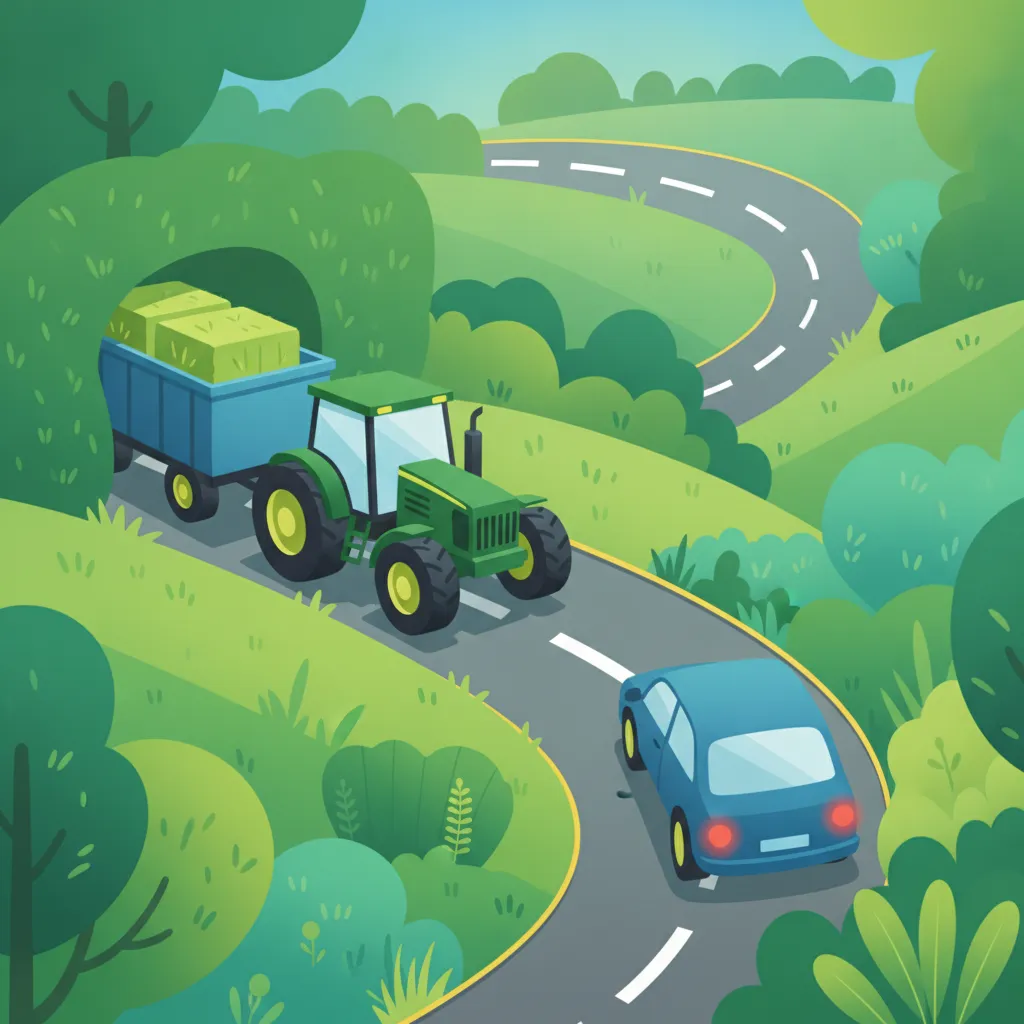
Irish rural roads are often narrow, winding, and bordered by high hedges, presenting unique hazards compared to urban streets. This lesson focuses on scanning for hidden hazards such as slow-moving farm machinery, mud on the road surface, and loose livestock. You will learn how to adjust your speed before entering blind bends, sound your horn at blind crests, and safely share the road with local agricultural traffic.

This lesson covers the strategic aspects of journey management, emphasizing the safety benefits of proactive route planning and weather checks. It teaches riders how to select safer roads, avoid high-congestion zones during rush hour, and schedule regular rest intervals. Motorcyclists will learn to pack essential tools, emergency contacts, and spare safety gear to remain prepared for any roadside situation.

Proactive hazard perception involves constantly scanning the road ahead to identify potential dangers before they turn into actual emergencies. This lesson covers active scanning techniques, helping you look far ahead, check mirrors regularly, and identify subtle risk clues such as exhaust smoke from parked cars or children playing near kerbs. Anticipating these developments gives you the time to adjust speed and position safely.

This lesson teaches riders how to actively identify and eliminate blind spots through proper mirror adjustment and physical shoulder checks. It explains the concept of a safety cushion, which represents the defensive space maintained around the moped at all times. Managing these zones ensures adequate reaction time and mitigates the impact of sudden braking.

This lesson explains how to choose the safest riding position within a traffic lane, considering the standard left-side driving rule in Ireland. It details the concept of dominant positioning to prevent other vehicles from crowding your space, while remaining visible to oncoming traffic. Riders will learn to adjust their track constantly to avoid road surface hazards, oil deposits, and wind currents.
Understand the physics behind motorcycle braking distances and surface grip for the Irish theory curriculum. This lesson explains how to manage deceleration on various road textures, the impact of weight distribution on stability, and the mechanical relationship between tyres and road surfaces for improved control and safer riding.
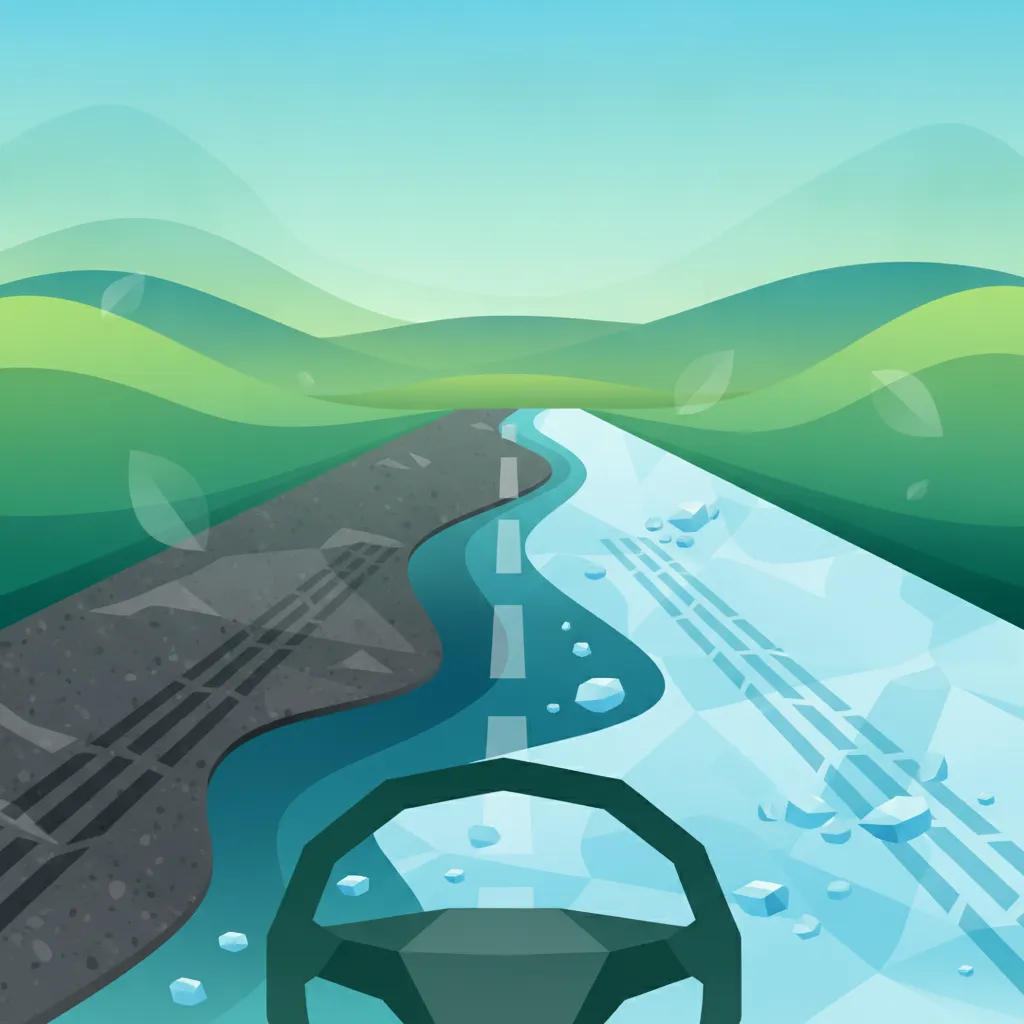
This lesson analyzes how tyre contact patches generate grip and how different road surfaces affect stability. It explains the dangers of diesel spills, loose gravel, fallen leaves, and cold tyres, which drastically reduce traction limits. Motorcyclists will learn to identify these surface hazards early and modify their throttle, braking, and lean inputs to prevent loss of control.
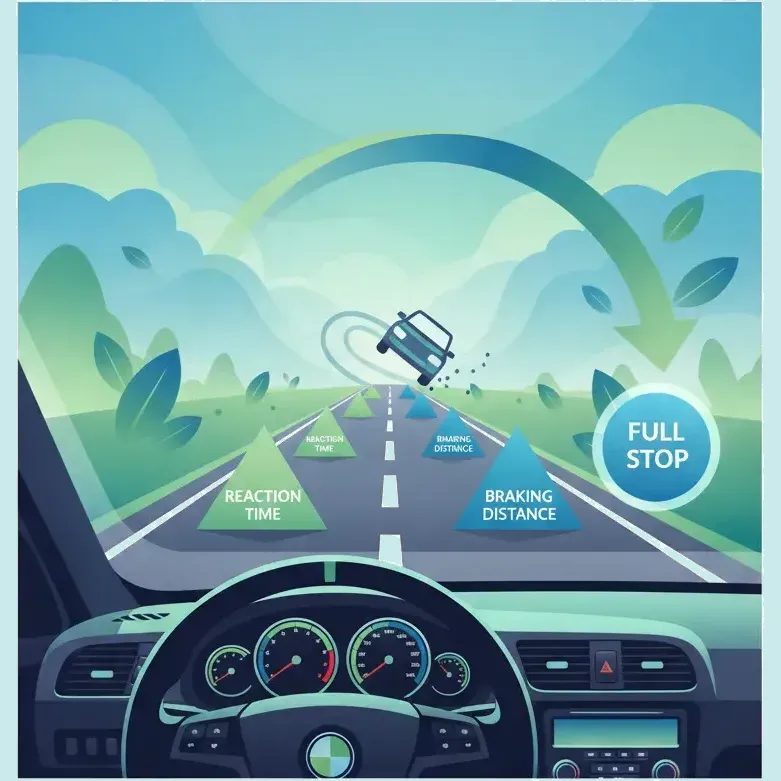
This lesson describes the physics of stopping a motorcycle, analyzing the distinct roles of the front and rear brakes during deceleration. It details how speed, road surface conditions, and vehicle weight distribution affect overall stopping distance and reaction times. Riders will learn how Anti-lock Braking Systems function and how to maximize braking force without locking the wheels.

This lesson explains how to modify riding techniques when navigating wet tarmac, focusing on the heightened risk of hydroplaning and reduced tire grip. It details the necessity of increasing following distances, avoiding painted road markings, and executing smoother control inputs. Riders will understand how surface water accumulates in ruts, presenting severe hazards during heavy rainstorms.

This lesson explains the physics of cornering, focusing on lean angles, speed selection, and body positioning on a moped. It teaches riders how to assess road curves, adjust their speed prior to entering a turn, and handle slippery cambers. Mastering these cornering principles is essential for avoiding lose-of-control accidents on winding rural Irish roads.
This lesson instructs riders on the correct application of the front and rear brakes to achieve smooth, controlled stopping. It explains how factors such as speed, reaction time, and tyre traction combine to determine total stopping distance. Learners will also study methods to prevent dangerous wheel lock-ups and skidding, especially in wet conditions.

This lesson covers the causes of front and rear-wheel skids and teaches the correct physical responses to regain control and stability. It describes how to recover from lockups caused by excessive braking or sudden downshifts on low-traction surfaces. Motorcyclists will learn how to react calmly during sudden deceleration events, maintaining straight-line stability under extreme pressure.
This lesson details the critical role of tyres in maintaining grip and vehicle stability on diverse road surfaces. It provides guidance on measuring tread depth, checking inflation levels, and identifying signs of tyre wear and damage. Additionally, it presents techniques for maintaining balance and executing tight, low-speed turns safely.

This lesson details the mechanics of counter-steering, which is the primary physical input used to initiate turns at speeds above walking pace. It explains how pushing on the handlebar in the direction of the turn initiates a controlled lean, allowing rapid direction changes. Riders will also study low-speed balance techniques, clutch slip control, and the stabilizing effect of the rear brake.

This lesson explores common surface hazards encountered on municipal and rural Irish roads, including loose gravel and wet leaves. It explains how these surface conditions rapidly reduce tyre traction and affect overall handling and braking control. Riders will learn visual scanning techniques to identify these hazards early and execute safe evasion maneuvers.

This lesson highlights the importance of smooth throttle adjustments for maintaining traction and stability on a moped. It teaches riders how to anticipate potential road hazards early, reducing the need for sudden emergency braking. Developing strong observation habits allows riders to adjust their speed smoothly and respond safely to traffic changes.
Find clear answers to common questions learners have about Riding on Gravel, Loose Surfaces and Rural Roads. Learn how the lesson is structured, which driving theory objectives it supports, and how it fits into the overall learning path of units and curriculum progression in Ireland. These explanations help you understand key concepts, lesson flow, and exam focused study goals.
Avoid sudden changes in speed or direction while on the gravel. Keep the motorcycle upright as much as possible, use a gentle throttle to maintain steady speed, and look through the turn to where you want to go, avoiding target fixation on the hazard.
Slow down before entering the bend and position yourself to maximize your view through the corner. Always ride at a speed that allows you to stop within the distance you can see to be clear, as rural roads often hide stationary vehicles, tractors, or livestock.
While there is no specific law just for tractors, you must follow general overtaking rules. Only overtake when you have a clear, unrestricted view of the road ahead, ensuring you have enough space to complete the maneuver safely without forcing oncoming traffic to brake.
Rural roads often have soft verges, deep potholes, or loose debris near the edge. Riding too close to the verge reduces your safety margin and increases the risk of the motorcycle losing traction or encountering hidden obstacles that could cause a crash.
Use the practice question search tool to pinpoint specific topics, road signs, or rules you need to master for your official Driver Theory Test. Refine your study strategy and ensure comprehensive preparation for all aspects of the Irish driving exam. Start your focused revision now and build confidence for your learner permit test.