
This lesson provides a comprehensive guide to understanding Irish road signs specifically for Category A, A1, and A2 motorcycle theory test candidates. By learning to recognize the meaning of various sign shapes, colors, and symbols, you will improve your ability to anticipate road conditions and make safe, informed decisions while riding on public roads.

Lesson content overview
Navigating the roads of Ireland safely on a motorcycle requires more than just mechanical control of your bike; it demands an immediate, instinctive understanding of the visual language of the road. For riders preparing for their Category A, A1, or A2 theory exams, mastering road signs is a core requirement of the Road Safety Authority (RSA) curriculum.
Because motorcyclists lack the protective shell of a car, reading signs in advance is your primary method of proactive hazard perception. This guide details every major category of Irish road sign, explains how to decode their shapes and colours instantly, and outlines how to translate this information into immediate, safe riding actions.
Irish road signs are categorised systematically by their shape, border colour, and background colour. This standardisation allows you to identify the general meaning of a sign from a distance, even before the specific icon or text becomes legible. This early recognition is critical when riding at speed, giving you the necessary time to adjust your road positioning or reduce speed.
Regulatory signs dictate what you must or must not do. They carry strict legal weight, and failing to obey them is a traffic offence that can result in fines, penalty points, or prosecution by An Garda Síochána.
Warning signs alert you to potential hazards or changes in the road layout ahead. Unlike regulatory signs, they do not carry direct legal penalties for non-compliance, but ignoring them significantly increases your risk of a collision or loss of control.
Information signs provide navigational guidance, route numbers, and details on local services. While they carry no direct legal instructions, they are essential for route planning and preventing sudden, dangerous lane changes.
As a motorcyclist, you must obey all regulatory signs. Failure to do so not only risks a Fixed Charge Notice (fine) and penalty points but can also put you in a highly vulnerable position, such as head-on traffic or unexpected crossing paths.
When approaching a Stop sign, you must bring your motorcycle to a complete halt behind the solid white stop line on the road. Merely rolling through at slow speed (a "rolling stop") is illegal and highly dangerous. Ensure you put at least one foot down to stabilise the motorcycle and confirm a complete stop, using this brief pause to perform a thorough observation of both directions.
The "No Entry" sign is commonly found at the exits of one-way streets, dual carriageways, or restricted access zones. Entering these zones places you directly in the path of oncoming traffic, a scenario that is highly lethal for a vulnerable motorcyclist.
Mandatory blue signs require active compliance. When you see a "Keep Left" sign (often placed on traffic islands, pedestrian refuges, or road splits), you must position your motorcycle to pass safely to the left. Attempting to pass on the right is a serious traffic violation and increases the risk of head-on collisions with oncoming vehicles hidden behind the traffic island.
Speed limits in Ireland are indicated by circular signs with a red border, white background, and black numbers displaying the speed limit in kilometres per hour (km/h).
As a Category A, A1, or A2 rider, you must strictly adhere to these limits. Remember that a speed limit is a maximum legal limit under ideal conditions, not a target speed.
Adverse Weather and Speed: If it is raining, foggy, or if the road surface is cold and damp, your motorcycle's grip is halved. In these conditions, riding at the posted speed limit may be legally permissible but physically unsafe. Always adjust your speed downward to match the physical traction limits of your tires.
Warning signs are your early-warning system. For motorcyclists, they are critical because motorcycles are highly sensitive to changes in road grip, camber, and geometry.
When you see a bend warning sign, it tells you that the road geometry is about to change. For a car, a sharp bend might simply cause body roll; for a motorcyclist, it requires a calculated entry speed, a specific lean angle, and precise lane positioning.
Analyze the Sign early: Check the direction of the arrow. A curve to the right requires different positioning than a curve to the left to maintain visibility and avoid oncoming traffic.
Adjust Speed in a Straight Line: Perform all of your braking and gear changes before you begin leaning the motorcycle. Trying to brake hard or shift gears mid-bend can upset the bike's chassis stability and cause a low-side slide.
Establish Road Positioning: For a right-hand bend, position yourself towards the left side of your lane (Position 1) to open up your view around the corner. For a left-hand bend, position yourself towards the center of the road (Position 3, near the center dividing line) while remaining cautious of oncoming vehicles cutting the corner.
Look through the Turn: Direct your eyes where you want the motorcycle to go—through the apex of the curve to the exit point.
Certain yellow diamond signs warn of physical hazards on the road surface that can compromise your two-wheel stability.
When encountering a "Slippery Road" sign, motorcyclists must immediately reduce speed and minimize lean angles. This sign is often placed where oil spills are common, where the road surface is worn smooth (polished aggregate), or where agricultural runoff frequently coats the asphalt.
While most signs apply universally to all road users, some signs feature specific configurations designed to manage different vehicle classes, including motorcycles.
In complex urban environments, lane street signs indicate which lane you must use to reach specific destinations. For motorcyclists, reading these signs early is vital. Because of a motorcycle's slim profile, changing lanes abruptly in heavy traffic is highly dangerous, as you can easily vanish into the blind spots of surrounding truck and car drivers.
When a lane street sign indicates a split in the road ahead, make your lane decision early. Use the OSM-PSL routine (Observation, Signal, Manoeuvre - Position, Speed, Look) to smoothly transition into the correct lane well before the physical dividing lines turn solid.
In some specific driving scenarios, advisory speed limits or vehicle-specific limits may be displayed alongside standard signs.
Every sign you read on the road must trigger a proactive physical response. The following table illustrates how to link visual signs with defensive motorcycle positioning and speed adjustments:
| Sign Category & Type | Visual Indicator | Immediate Rider Action | Defensive Positioning Strategy |
|---|---|---|---|
| Regulatory: No Overtaking | Two cars side-by-side inside a red circle | Cease any overtaking maneuvers; return to the center of your lane. | Maintain a safe, dominant lane position (Position 2) to discourage vehicles behind you from attempting to squeeze past. |
| Warning: Road Narrows | Black lines converging on a yellow diamond | Reduce speed; prepare for oncoming vehicles to cross the center line. | Move towards the outer edge of the lane (away from the narrowing side) while keeping a safe buffer zone from the curb. |
| Warning: Pedestrian Crossing | Person walking on a striped crossing inside a yellow diamond | Scan both sides of the road; cover your front and rear brake levers. | Maintain a central lane position; increase your following distance from the vehicle ahead so you can brake smoothly if they stop suddenly. |
| Regulatory: Yield / Give Way | Inverted triangle with a red border | Slow down and prepare to stop if vehicles are approaching on the major road. | Position yourself to maximize your view of the intersecting road without nose-bumping past the yield line. |
A frequent mistake made by learner riders is assuming that warning signs can be ignored because they do not carry direct penalty points. In the event of an accident, failing to heed a warning sign (such as a "Slippery Road" or "Hidden Junction" sign) can be used as key evidence of driving without reasonable consideration or care, leading to prosecution for careless or dangerous driving.
With the rise of handlebar-mounted GPS units and smartphone mounts, many riders focus on digital maps rather than looking up at physical road signs.
In rural areas of Ireland, signs can frequently become obscured by overgrown hedges, road dirt, or damaged by severe weather.
Deciphering Obscured Signs: If you encounter a sign where the central symbol is unreadable, rely on its outline. A red circle always means a restriction or prohibition; a yellow diamond always warns of a physical hazard. If you see a blank yellow diamond, assume there is a serious hazard ahead and proactively reduce your speed.
During heavy rain, fog, or night riding, the visibility of signs decreases significantly. Modern Irish road signs use retroreflective sheeting that reflects your motorcycle's headlight beam back towards you. To make the best use of this:
To excel in your Irish Category A, A1, or A2 motorcycle theory test and remain safe on the road, integrate these foundational rules into your daily riding habits:
This lesson teaches motorcyclists to instantly interpret Irish road signs by recognizing that shapes and colors convey distinct meanings: regulatory signs in circles impose legal obligations, warning signs in amber diamonds alert riders to hazards ahead, and rectangular information signs aid navigation. The content emphasizes that motorcyclists must translate sign information into proactive physical responses — adjusting speed and lane position well before reaching any hazard — because a motorcycle's stability depends on correct entry speed and lean angle. Key motorcycle-specific considerations include heightened sensitivity to surface conditions marked by warning signs, the importance of early sign recognition due to longer braking distances, and the critical habit of braking in a straight line before leaning into any curve. The lesson also highlights that warning signs carry legal significance in crash investigations even without direct penalty points, and that physical signs always override GPS navigation devices.
A short set of high-value points that capture the most important learning from this lesson.
Irish road signs use standardized shapes: circles indicate legal requirements, diamonds warn of hazards, rectangles provide navigation information
Regulatory signs (red circles for prohibitions, blue circles for mandatory actions) carry legal weight and must always be obeyed
Warning signs in Ireland are diamond-shaped with amber/yellow backgrounds, alerting motorcyclists to surface conditions, curves, and road layout changes
Motorcyclists must read signs significantly earlier than car drivers due to longer braking distances and reduced stability mid-corner
Sign interpretation must be integrated with proactive lane positioning and speed adjustments before reaching the hazard
Explore all units and lessons included in this driving theory course.
Circle equals law (regulatory), diamond equals hazard (warning), rectangle equals info (navigation) — memorize the three-code system
Advisory speed plaques below bend signs are highly authoritative for motorcyclists; exceeding them risks exceeding tire traction limits
When a sign is obscured, rely on its outline shape — a red circle always means prohibition, a yellow diamond always warns of hazard
Speed limits are maximum legal limits, not targets; wet or cold conditions halve grip and require lower speeds
Physical road signs always take precedence over GPS or sat-nav instructions
Treating warning signs as optional because they do not carry direct penalty points, leading to serious collisions on slippery or curved roads
Over-relying on handlebar-mounted GPS units instead of reading physical road signs, risking entry into one-way streets or missing temporary speed limits
Attempting to brake or change gear mid-corner after entering a bend, which destabilizes the chassis and can cause a low-side slide
Misinterpreting the direction of a bend warning sign, resulting in incorrect lane positioning that reduces visibility and increases collision risk
Failing to clean headlight lenses regularly, reducing retroreflective sign visibility by over 50% in low-light or adverse weather conditions
Lesson content overview
A short set of high-value points that capture the most important learning from this lesson.
Irish road signs use standardized shapes: circles indicate legal requirements, diamonds warn of hazards, rectangles provide navigation information
Regulatory signs (red circles for prohibitions, blue circles for mandatory actions) carry legal weight and must always be obeyed
Warning signs in Ireland are diamond-shaped with amber/yellow backgrounds, alerting motorcyclists to surface conditions, curves, and road layout changes
Motorcyclists must read signs significantly earlier than car drivers due to longer braking distances and reduced stability mid-corner
Sign interpretation must be integrated with proactive lane positioning and speed adjustments before reaching the hazard
Explore all units and lessons included in this driving theory course.
Circle equals law (regulatory), diamond equals hazard (warning), rectangle equals info (navigation) — memorize the three-code system
Advisory speed plaques below bend signs are highly authoritative for motorcyclists; exceeding them risks exceeding tire traction limits
When a sign is obscured, rely on its outline shape — a red circle always means prohibition, a yellow diamond always warns of hazard
Speed limits are maximum legal limits, not targets; wet or cold conditions halve grip and require lower speeds
Physical road signs always take precedence over GPS or sat-nav instructions
Treating warning signs as optional because they do not carry direct penalty points, leading to serious collisions on slippery or curved roads
Over-relying on handlebar-mounted GPS units instead of reading physical road signs, risking entry into one-way streets or missing temporary speed limits
Attempting to brake or change gear mid-corner after entering a bend, which destabilizes the chassis and can cause a low-side slide
Misinterpreting the direction of a bend warning sign, resulting in incorrect lane positioning that reduces visibility and increases collision risk
Failing to clean headlight lenses regularly, reducing retroreflective sign visibility by over 50% in low-light or adverse weather conditions
Explore search topics learners often look for when studying Interpreting Road Signs for Motorcyclists. These topics reflect common questions about road rules, driving situations, safety guidance, and lesson level theory preparation for learners in Ireland.
Browse additional driving theory lessons that cover connected traffic rules, road signs, and common driving situations related to this topic. Improve your understanding of how different rules interact across everyday traffic scenarios.
Learn how regulatory road signs and markings dictate right of way at Irish junctions. This guide explains how to interpret stop and yield signs to safely manage priority situations and avoid common traffic violations while navigating intersections as a motorcyclist or driver.
This lesson teaches the fundamental principles of priority and right-of-way at controlled and uncontrolled intersections across Ireland. It explains the legal obligations at yield signs, stop lines, and when meeting oncoming traffic turning across your lane. Motorcyclists will learn to carefully verify other drivers' intentions rather than assuming they will yield the correct right-of-way.

Right-of-way rules establish a clear order of precedence when the paths of two or more vehicles cross. This lesson explains how traffic on a major road has priority over traffic emerging from a minor road, and the general rule of yielding to oncoming vehicles when turning right. You will develop a solid understanding of how to approach intersections defensively, assessing speed and distance to make safe decisions.
This lesson covers the absolute rules of priority that regulate junctions, roundabouts, and pedestrian crossings in Ireland. It teaches riders when they must yield, who has right-of-way, and how to read Stop and Yield signs correctly. Understanding these priority hierarchies prevents collisions and maintains orderly, predictable movement at busy junctions.

Uncontrolled junctions represent a high-risk scenario because they lack physical signs, lines, or lights to dictate priority. This lesson covers the crucial 'priority to the right' principle, where you must yield to any traffic approaching from your right-hand side. You will learn the importance of reducing your speed, preparing to stop, and verifying the intentions of other drivers at these equal-status crossings.

Stop and yield signs require drivers to surrender right-of-way to crossing traffic, but they command different physical actions. This lesson explains that a stop sign mandates a complete, absolute halt behind the line, whereas a yield sign requires you to slow down and stop only if other traffic is approaching. You will learn how to manage restricted visibility at junctions and how to creep forward safely when clear.

When traffic control is actively performed by a Garda, a school warden, or authorized marshals, their hand signals override all standard traffic lights and road signs. This lesson illustrates the common hand gestures used by officers to stop, release, or slow down traffic. You will learn your strict legal obligation to obey these manual commands, ensuring public safety during emergencies, events, or school crossings.
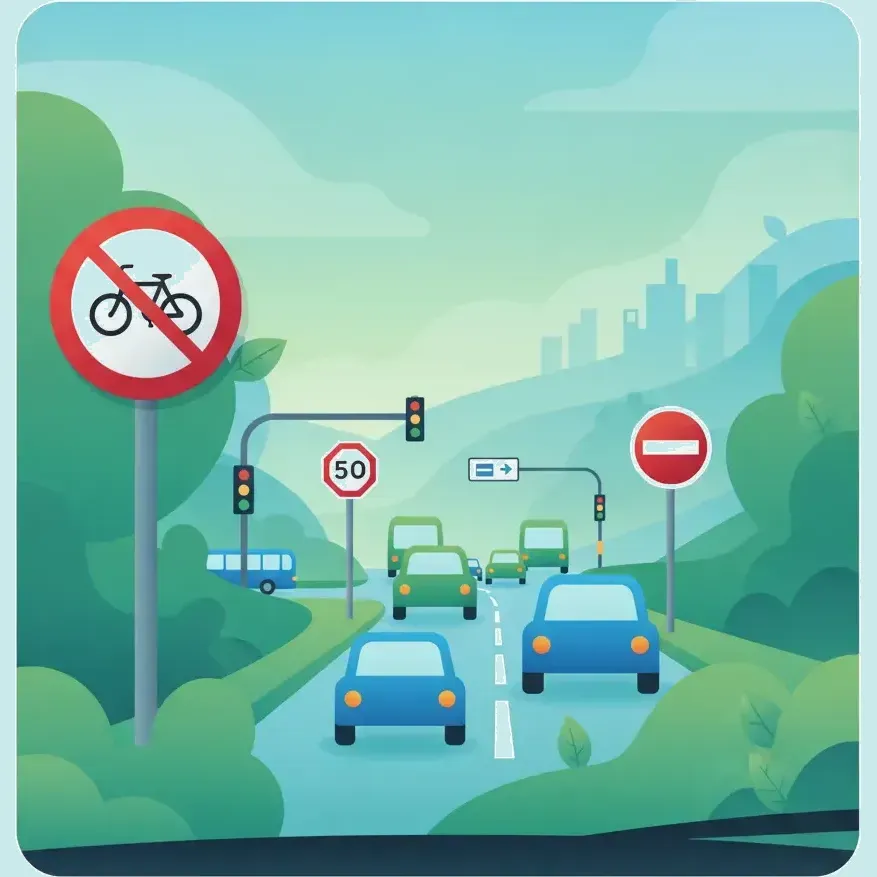
Regulatory signs give clear instructions and legal prohibitions that drivers must obey to prevent accidents and maintain traffic order. This lesson breaks down circular signs with red borders denoting prohibitions, blue circular signs showing mandatory directions, and key safety priorities like stop and yield signs. Failing to obey these specific indicators is a serious traffic offence that can lead to penalty points and immediate fines.

This lesson explains the critical meanings of solid, broken, and continuous lines painted on Irish road surfaces. It defines the legal rules surrounding bus lanes, bicycle lanes, and yellow box junctions in urban settings. Riders will learn correct lane discipline to ensure their safety and maintain proper separation from surrounding traffic.

The painted lines on the road surface act as continuous instructions to help drivers steer, position, and pass safely. This lesson explains the strict legal prohibitions of crossing solid white lines compared to broken lines, which indicate it is safe to cross if clear. You will also discover the purpose of coloured reflective road studs, known as cat's eyes, which improve safety during night driving and poor visibility.
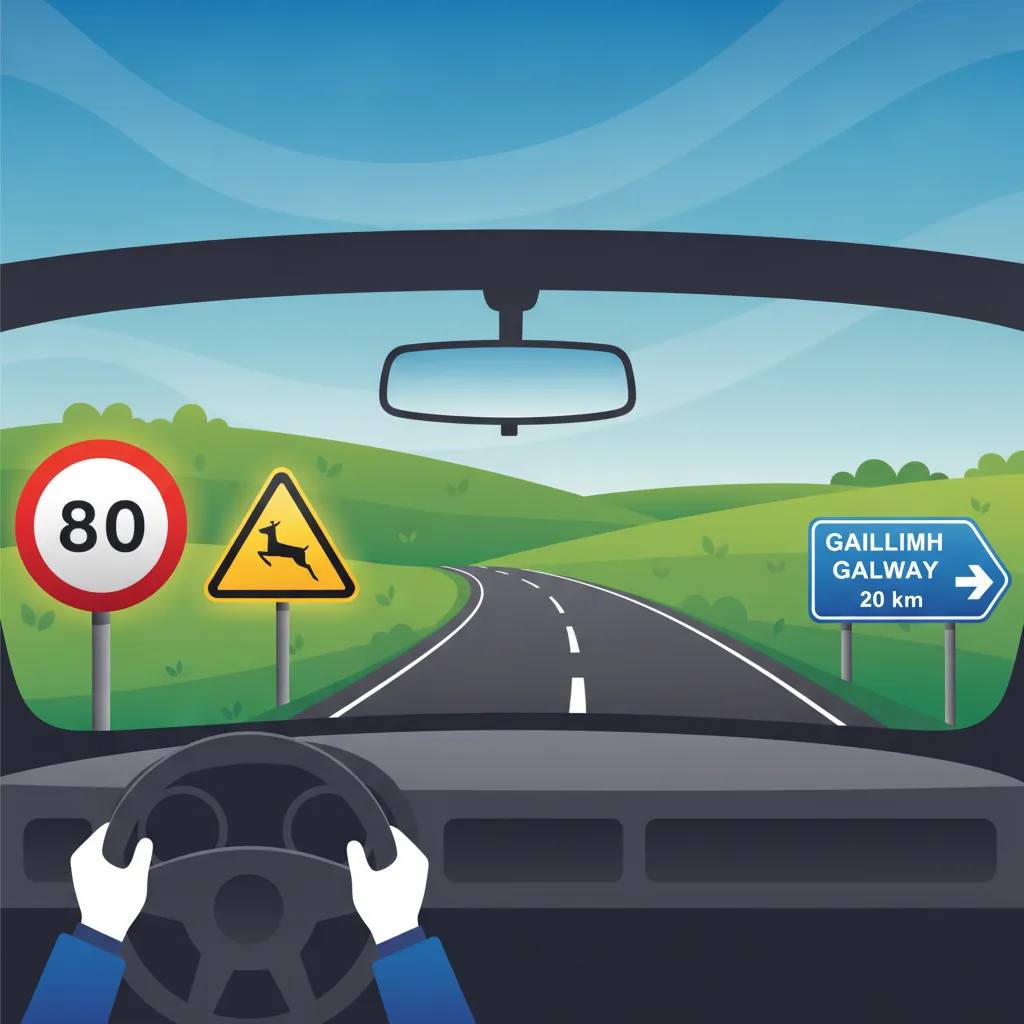
This lesson covers the primary road signs deployed across Ireland, focusing on their shapes, colors, and specific meanings. It details mandatory signs, prohibitive signs, warning alerts for upcoming hazards, and information signs useful for route planning. Category AM riders must recognize these indicators to stay compliant with local traffic laws.
Explore the complete system of Irish road markings and how they work in conjunction with regulatory and warning signs. This lesson provides an overview of road surface messages and how they define lane usage, speed limits, and safety requirements on national and regional roads.
This lesson covers the primary road signs deployed across Ireland, focusing on their shapes, colors, and specific meanings. It details mandatory signs, prohibitive signs, warning alerts for upcoming hazards, and information signs useful for route planning. Category AM riders must recognize these indicators to stay compliant with local traffic laws.
The painted lines on the road surface act as continuous instructions to help drivers steer, position, and pass safely. This lesson explains the strict legal prohibitions of crossing solid white lines compared to broken lines, which indicate it is safe to cross if clear. You will also discover the purpose of coloured reflective road studs, known as cat's eyes, which improve safety during night driving and poor visibility.
This lesson explains the critical meanings of solid, broken, and continuous lines painted on Irish road surfaces. It defines the legal rules surrounding bus lanes, bicycle lanes, and yellow box junctions in urban settings. Riders will learn correct lane discipline to ensure their safety and maintain proper separation from surrounding traffic.

This lesson explains the regulatory meanings of various road markings applied to Irish asphalt, including continuous double white lines and yellow boxes. It details how these markings govern overtaking privileges, lane restrictions, and stopping zones at intersections. Riders will learn to recognize specific surface hazards like wet paint markings, which present severe traction risks for motorcycles.
Regulatory signs give clear instructions and legal prohibitions that drivers must obey to prevent accidents and maintain traffic order. This lesson breaks down circular signs with red borders denoting prohibitions, blue circular signs showing mandatory directions, and key safety priorities like stop and yield signs. Failing to obey these specific indicators is a serious traffic offence that can lead to penalty points and immediate fines.
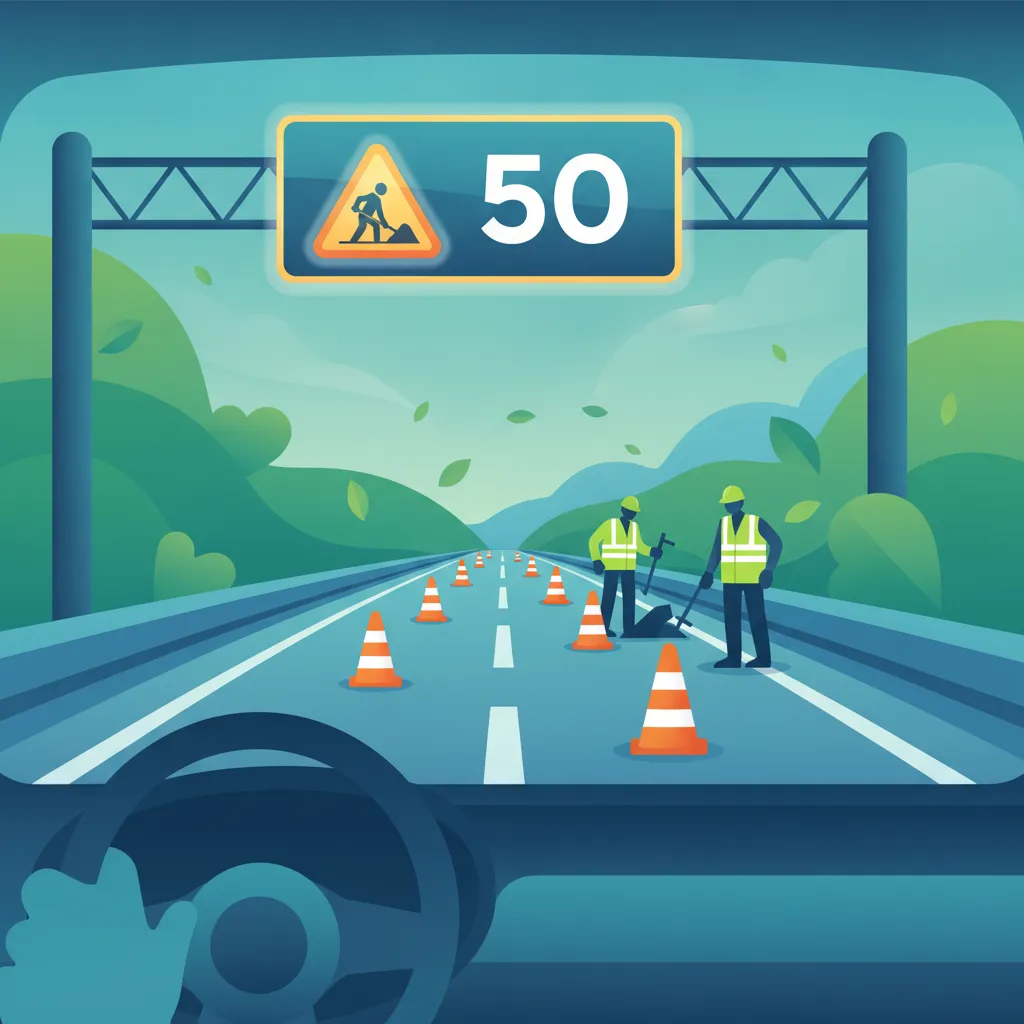
Variable Message Signs and roadwork indicators communicate temporary safety conditions, such as lane closures, heavy delays, or dynamic speed restrictions. This lesson teaches you how to interpret digital overhead gantries, temporary hazard cones, and specific detour layouts often encountered on Irish motorways and regional routes. Adhering to these real-time instructions protects both you and the vulnerable road crews working ahead.
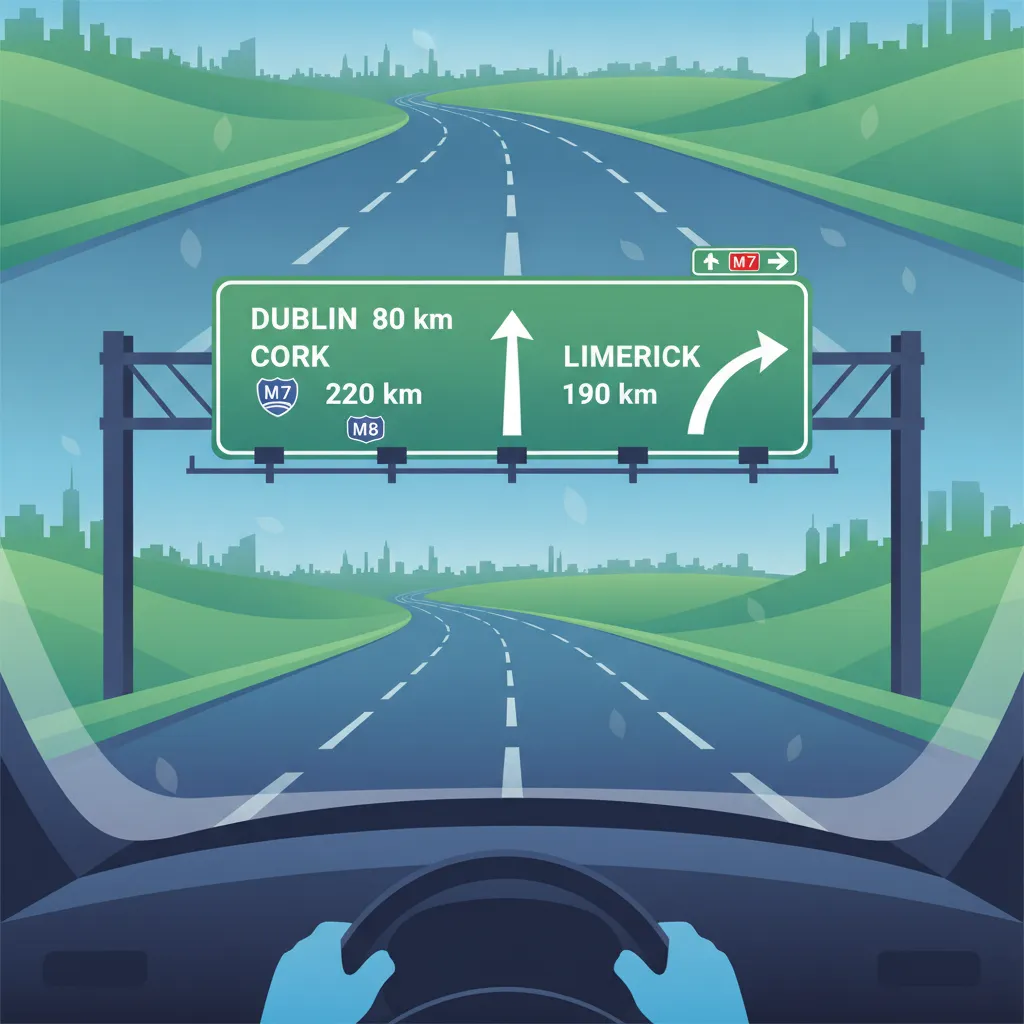
Information signs are designed to help drivers plan routes, select correct lanes, and find destinations or local amenities. This lesson explains the colour-coding system for routes in Ireland, including green for national roads, blue for motorways, and white for local roads. Developing route reading skills using directional signage reduces driver distraction, minimises sudden manoeuvres, and promotes a smoother traffic flow.

Operating large passenger vehicles requires instant, accurate interpretation of general and specialized Irish road signage to prevent regulatory violations. This lesson covers the precise meanings of clearway signs, bus corridor indicators, low bridge warnings, and weight restriction zones. Drivers will examine how school zone beacons and specific roundabout indicators apply to large vehicle dimensions.

Warning signs in Ireland are typically diamond-shaped with yellow backgrounds and black symbols, indicating potential dangers on the road ahead. This lesson details signs for upcoming sharp bends, narrow roads, steep hills, pedestrian activity, and animal hazards. Learning to spot these warning indicators early allows you to reduce speed safely and adjust your vehicle positioning before encountering the hazard itself.

This lesson outlines how motorcyclists should respond when permanent road signs are dirty, damaged, or hidden by overgrown trees and hedges. It introduces the temporary signage, warning cones, and detour markers commonly deployed at active roadwork zones in Ireland. Riders will learn to read the road ahead defensively, reducing speed when visual information is incomplete or compromised.
Find clear answers to common questions learners have about Interpreting Road Signs for Motorcyclists. Learn how the lesson is structured, which driving theory objectives it supports, and how it fits into the overall learning path of units and curriculum progression in Ireland. These explanations help you understand key concepts, lesson flow, and exam focused study goals.
In Ireland, regulatory signs that are mandatory are usually circular with a white background and red border. Warning signs are typically triangular in shape with a yellow background and black symbols, indicating an upcoming hazard.
While most signs apply to all road users, some signs feature motorcycle symbols to denote specific restrictions or entitlements, such as motorcycle-only parking areas or prohibitions on certain routes. Always check for supplementary plates.
Focus on the 'language' of signs: the shape and color often tell you the type of instruction. Practice by grouping them into categories and regularly using the flashcards or practice questions provided in this course.
The test uses official RSA imagery. While some may appear less frequently than common stop or yield signs, they all appear in the official Rules of the Road. If a sign is in the manual, it is fair game for the exam.
Use the practice question search tool to pinpoint specific topics, road signs, or rules you need to master for your official Driver Theory Test. Refine your study strategy and ensure comprehensive preparation for all aspects of the Irish driving exam. Start your focused revision now and build confidence for your learner permit test.