
This lesson explores the vital physiological and legal aspects of managing fatigue while operating heavy goods vehicles. You will learn the mandatory tachograph recording requirements and the strict driving and rest time regulations essential for professional safety and compliance on Irish roads.

Lesson content overview
Operating a heavy goods vehicle (HGV) in Ireland requires a high degree of professional skill, alertness, and physical endurance. Because of the sheer size and weight of Category C vehicles, any error in judgment can have catastrophic consequences. Driver fatigue is one of the most significant, yet preventable, safety hazards on Irish roads today.
To combat this risk, the European Union and the Irish Road Safety Authority (RSA) enforce strict regulations governing driving times, breaks, and rest periods. This lesson covers the physiological impacts of sleep deprivation, the legal frameworks established by EU and Irish legislation, tachograph recording requirements, and practical strategies to maintain peak alertness behind the wheel.
Driver fatigue is a gradual decline in mental and physical performance caused by prolonged wakefulness, lack of quality sleep, or high cognitive workload. Unlike sudden mechanical failures, fatigue creeps up progressively, impairing a driver’s cognitive faculties long before they actually fall asleep.
A physiological state of reduced mental or physical performance capability resulting from sleep loss, circadian phase, or high workload, which can impair a driver's alertness and ability to safely operate a vehicle.
Professional HGV drivers must constantly self-assess for the early warning signs of fatigue. Pushing through these signs is a leading cause of heavy vehicle collisions.
Studies have shown that being awake for 17 to 19 hours straight impairs driving performance to a level equivalent to a Blood Alcohol Concentration (BAC) of 0.05%. Being awake for 24 hours straight is comparable to a BAC of 0.10%, which is well over the legal limit for commercial drivers in Ireland.
To protect road users and guarantee fair competition within the transport industry, the European Union established harmonized rules for driving times, breaks, and rest periods under Regulation (EC) No 561/2006 (and subsequent amendments, including the EU Mobility Package). These rules apply to most professional goods transport vehicles exceeding 3.5 tonnes.
Compliance with EU driving time regulations is not optional. Both drivers and transport operators face severe legal prosecution, heavy fines, and the potential loss of their operator licences for non-compliance.
The regulations set strict maximum thresholds for active driving to prevent cumulative fatigue.
After a continuous driving period of 4.5 hours, a driver must take an immediate, uninterrupted break of at least 45 minutes, unless they begin a daily or weekly rest period.
Rest periods are designed to allow professional drivers to fully recover physically and mentally away from the vehicle and operational duties.
A daily rest period is the 24-hour cycle window in which a driver must take a designated amount of rest.
Every week, drivers must take a substantial period of rest to recover from the cumulative fatigue of the working week.
To enforce EU driving limits, commercial goods vehicles over 3.5 tonnes must be fitted with an approved recording device known as a tachograph. The tachograph automatically records the vehicle's speed, distance travelled, and the driver's activities (driving, work, availability, and rest).
An electronic or mechanical device installed in commercial vehicles that automatically records the vehicle’s driving metrics alongside individual driver work, availability, and rest periods.
While some older, historic vehicles still utilize analogue paper charts, almost all modern Category C vehicles operating in Ireland use digital or smart tachographs.
As an HGV driver in Ireland, you are legally responsible for how you manage your tachograph records:
Insert Your Driver Card: Always insert your digital driver card into the correct slot (Slot 1 for the active driver) of the tachograph unit before starting work.
Perform Manual Entries: If you did work away from the vehicle (e.g., loading, training, or office work) before inserting your card, you must use the manual entry function to log this activity correctly as "other work" or "rest."
Select the Correct Mode: Manually switch the tachograph mode selector to reflect your current activity:
Carry Mandatory Records: You must carry your digital driver card and paper printout rolls at all times while driving. You must be able to produce records for the current day and the preceding 28 calendar days (increasing to 56 days under modern EU updates) for roadside inspection.
Road Safety Authority (RSA) transport inspectors and officers of An Garda Síochána conduct random roadside inspections throughout Ireland.
If you are stopped, inspectors can download your digital card data on the spot. Common violations and their consequences include:
Relying solely on legal regulations is not enough to ensure you remain alert. Drivers must take personal responsibility for their physiological health by practicing good sleep hygiene.
Sleep hygiene refers to the behavioral habits and environmental factors that promote deep, restorative sleep.
Night-shift HGV operations run counter to human biology. The human body is naturally programmed to experience dips in alertness between 2:00 AM and 6:00 AM, and again between 2:00 PM and 4:00 PM.
If you are scheduled for night driving, prepare by taking a proactive afternoon nap before your shift starts. Ensure you take more frequent, shorter stops during these natural circadian low points to walk around, stretch, and get fresh air.
If you experience severe, uncontrollable drowsiness while driving, find a safe, legal parking area or service station immediately. Drink a cup of coffee and take a short "power nap" of no more than 15 to 20 minutes. Do not sleep longer than 20 minutes, or you may enter deep sleep and wake up with "sleep inertia," leaving you feeling more groggy than before.
Staying fully compliant can be challenging under changing operational conditions. Understanding how to handle unexpected situations is key to avoiding legal penalties and maintaining safety.
To help you memorize the strict regulatory requirements for your Category C driving theory exam, review this simplified breakdown of key limits:
| Regulation Metric | Standard Requirement | Permitted Variations / Reductions |
|---|---|---|
| Daily Driving | Max 9 hours | Can extend to 10 hours up to twice a week |
| Weekly Driving | Max 56 hours | None |
| Bi-Weekly Driving | Max 90 hours over 2 consecutive weeks | None |
| Mandatory Break | 45 minutes after 4.5 hours of driving | Can split into 15 mins, then 30 mins (in that order) |
| Daily Rest | Min 11 consecutive hours within 24-hour cycle | Can reduce to 9 hours (max 3 times between weekly rests) |
| Weekly Rest | Min 45 consecutive hours | Can reduce to 24 hours (must compensate within 3 weeks) |
By memorizing these limits, mastering your tachograph operation, and prioritizing healthy sleep habits, you protect your professional HGV driving licence, fulfill your legal obligations, and ensure you return home safely at the end of every shift.
This lesson covers the critical intersection of physiological fatigue and legal compliance for Category C drivers in Ireland. It explains that fatigue impairs driving to levels equivalent to dangerous blood alcohol concentrations, making early recognition of warning signs essential. The EU driving time regulations under Regulation (EC) No 561/2006 set enforceable limits including 9 hours daily driving (10 hours twice weekly), 4.5 hours before a mandatory 45-minute break, and minimum 11-hour daily rest periods. Proper tachograph operation requires correct mode selection and maintaining records for inspection, while sleep hygiene practices help drivers manage the biological circadian lows that naturally occur during night driving.
A short set of high-value points that capture the most important learning from this lesson.
Driver fatigue is a gradual physiological impairment that can match drunk-driving levels: 17 hours awake equals 0.05% BAC equivalent
EU Regulation (EC) No 561/2006 mandates strict limits: maximum 9 hours daily driving (extendable to 10 hours twice weekly), 56 hours weekly, and 90 hours bi-weekly
A mandatory 45-minute break is required after every 4.5 hours of continuous driving, and this break can only be split into 15 minutes followed by 30 minutes in that exact order
Daily rest must be at least 11 consecutive hours (reducible to 9 hours maximum three times between weekly rests), and weekly rest must be at least 45 hours (reducible to 24 with compensation required within three weeks)
Microsleeps lasting just four seconds at 80 km/h can cause a vehicle to travel nearly 90 metres completely uncontrolled
Explore all units and lessons included in this driving theory course.
The 4.5-hour driving rule and 45-minute break: the split must always be 15 minutes then 30 minutes, never reversed
Always switch tachograph to correct mode: driving, other work (crossed hammers), availability (boxed square), or rest (bed symbol)
Digital tachograph records must be available for the current day plus the preceding 28 calendar days (56 days under updated regulations)
Night drivers face natural alertness dips between 2:00 AM–6:00 AM and 2:00 PM–4:00 PM due to circadian biology
If taking reduced weekly rest of 24 hours, compensatory rest must be taken en bloc before the end of the third week following the reduction
Leaving the tachograph on 'rest' while loading or securing cargo instead of switching to 'other work' mode
Attempting to split the mandatory break as 30 minutes first, then 15 minutes, which is not legally compliant
Failing to perform manual tachograph entries when working away from the vehicle before inserting the driver card
Assuming stimulants like caffeine or energy drinks eliminate fatigue rather than temporarily masking its symptoms
Believing that reduced daily rest (9 hours) requires compensation when in fact only reduced weekly rest requires it
Lesson content overview
A short set of high-value points that capture the most important learning from this lesson.
Driver fatigue is a gradual physiological impairment that can match drunk-driving levels: 17 hours awake equals 0.05% BAC equivalent
EU Regulation (EC) No 561/2006 mandates strict limits: maximum 9 hours daily driving (extendable to 10 hours twice weekly), 56 hours weekly, and 90 hours bi-weekly
A mandatory 45-minute break is required after every 4.5 hours of continuous driving, and this break can only be split into 15 minutes followed by 30 minutes in that exact order
Daily rest must be at least 11 consecutive hours (reducible to 9 hours maximum three times between weekly rests), and weekly rest must be at least 45 hours (reducible to 24 with compensation required within three weeks)
Microsleeps lasting just four seconds at 80 km/h can cause a vehicle to travel nearly 90 metres completely uncontrolled
Explore all units and lessons included in this driving theory course.
The 4.5-hour driving rule and 45-minute break: the split must always be 15 minutes then 30 minutes, never reversed
Always switch tachograph to correct mode: driving, other work (crossed hammers), availability (boxed square), or rest (bed symbol)
Digital tachograph records must be available for the current day plus the preceding 28 calendar days (56 days under updated regulations)
Night drivers face natural alertness dips between 2:00 AM–6:00 AM and 2:00 PM–4:00 PM due to circadian biology
If taking reduced weekly rest of 24 hours, compensatory rest must be taken en bloc before the end of the third week following the reduction
Leaving the tachograph on 'rest' while loading or securing cargo instead of switching to 'other work' mode
Attempting to split the mandatory break as 30 minutes first, then 15 minutes, which is not legally compliant
Failing to perform manual tachograph entries when working away from the vehicle before inserting the driver card
Assuming stimulants like caffeine or energy drinks eliminate fatigue rather than temporarily masking its symptoms
Believing that reduced daily rest (9 hours) requires compensation when in fact only reduced weekly rest requires it
Explore search topics learners often look for when studying Managing Driver Fatigue and Time Regulations. These topics reflect common questions about road rules, driving situations, safety guidance, and lesson level theory preparation for learners in Ireland.
Browse additional driving theory lessons that cover connected traffic rules, road signs, and common driving situations related to this topic. Improve your understanding of how different rules interact across everyday traffic scenarios.
Learn the essential legal requirements and professional standards expected of category C drivers in Ireland. This overview covers the necessary documentation, reporting duties, and legal consequences of regulatory breaches to help you maintain a clean driving record and ensure full compliance with the Road Safety Authority regulations.

This lesson covers the absolute legal requirement for professional drivers to keep, update, and display essential transit and driver paperwork. It details the role of the Driver Certificate of Professional Competence, vehicle registration documents, transport logs, and insurance certs. Drivers will learn how to present clear records to Irish Road Safety Authority officers and Gardai during compliance inspections.

This lesson defines the professional duties and high duty of care that drivers must maintain while operating commercial heavy vehicles. It details the legal responsibilities regarding ongoing vehicle fitness, safe cargo securement, and statutory load limits under Irish legislation. Drivers will learn the consequences of neglecting these safety standards under the Irish Road Traffic Act.

This lesson details the specific classifications for goods vehicles including Category C, C1, CE, and C1E in Ireland. It explains the core eligibility requirements, necessary medical fitness evaluations, and the sequential steps for theory and practical testing. Professional drivers will also understand when the Driver Certificate of Professional Competence is legally mandatory.

This lesson reviews the legal definitions and safety guidelines for various categories of cargo, ranging from standard palletized goods to hazardous materials. It highlights the specific documentation, labelling, and safety equipment required by Irish and European laws for specialized transport. Drivers will learn their legal liabilities and the mandatory safety protocols corresponding to each load type.

This lesson outlines the vital actions required from a professional driver immediately following a collision on Irish roads. It details the correct protocols for contacting emergency services, assisting injured parties safely, and securing the accident scene to prevent secondary incidents. Additionally, the lesson explains the legal requirements for documenting the event, exchanging insurance details, and reporting to authorities.

This lesson delivers a detailed analysis of the legal and moral duty of care that passenger vehicle operators hold in Ireland. Drivers will learn to manage risk effectively, establishing a proactive safety culture that prioritizes vulnerable occupants and external road users. It covers practical methods for protecting passengers during transit, accelerating smoothly, and maneuvering safely in high-risk zones.
Explore the broader safety challenges facing commercial drivers, including managing cognitive load, understanding rural road risks, and adapting to adverse weather conditions. This lesson provides insights into staying alert behind the wheel and effectively identifying common hazards to improve decision-making and overall safety on Irish roads.

Driver fatigue and visual distractions are major contributors to commercial passenger vehicle accidents on national transport networks. This lesson explores the physiological indicators of drowsiness, the benefits of healthy sleep habits, and strategies for avoiding digital distractions. It emphasizes strict compliance with professional driver hours to maintain alertness and safe operations.
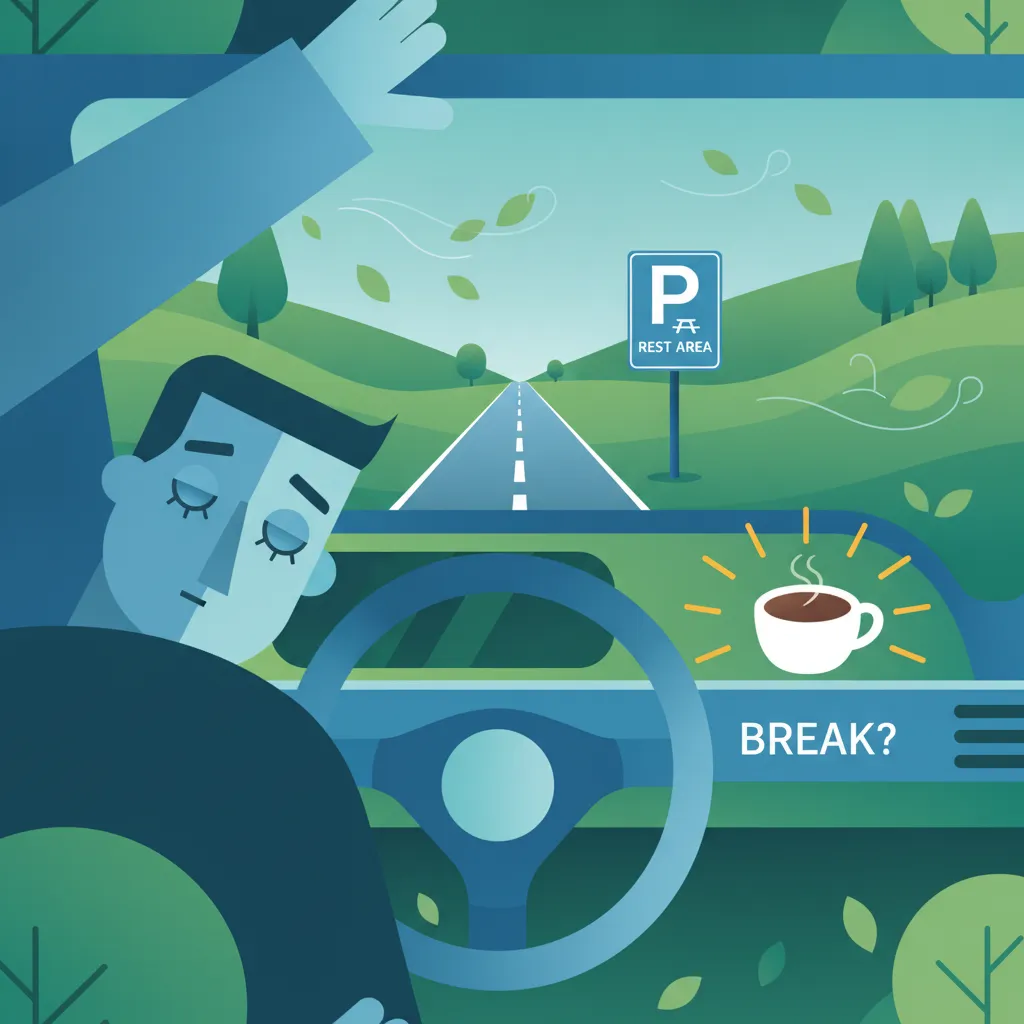
Driver fatigue is a silent killer on the roads, often causing drivers to drift out of lanes or experience catastrophic micro-sleeps. This lesson outlines the early warning signs of sleepiness, such as frequent yawning, heavy eyelids, and difficulty remembering the last few kilometres driven. You will learn effective prevention strategies, including planning regular rest stops, taking caffeine breaks, and never driving tired.

This lesson addresses the unique environmental and logistical challenges faced during delivery stops in commercial town and city centers. It covers the legal frameworks governing municipal loading zones, double-parking hazards, and temporary pedestrian-only street restrictions. Drivers will acquire practical skills for managing traffic build-up, utilizing visual spotters, and securing the vehicle while unloading cargo.

Irish rural routes are often narrow, lacking central markings, and bordered by tall hedges that restrict forward visibility on sharp bends. This lesson teaches drivers how to negotiate blind curves, anticipate slow-moving agricultural machinery, and respond to wandering farm animals. Drivers will learn to regulate vehicle speed proactively, maintaining a safe stopping margin in rural areas.
Find clear answers to common questions learners have about Managing Driver Fatigue and Time Regulations. Learn how the lesson is structured, which driving theory objectives it supports, and how it fits into the overall learning path of units and curriculum progression in Ireland. These explanations help you understand key concepts, lesson flow, and exam focused study goals.
A tachograph is used to accurately record the driver's driving time, speed, and distance covered, as well as mandatory rest periods. It ensures compliance with EU and Irish law regarding driver fatigue and safety.
Under standard regulations, a driver must take a break after 4.5 hours of driving. The break must last for at least 45 minutes, though it can be split into shorter segments under specific conditions.
While the core regulations for driving and rest times remain consistent for heavy goods vehicles, the management of rest periods must be strictly adhered to regardless of the distance, to ensure full compliance with the law.
Caffeine is a temporary stimulant and does not replace sleep. Drivers must learn to recognize true fatigue symptoms and understand that the only effective solution is to take a proper rest period or stop driving entirely.
Use the practice question search tool to pinpoint specific topics, road signs, or rules you need to master for your official Driver Theory Test. Refine your study strategy and ensure comprehensive preparation for all aspects of the Irish driving exam. Start your focused revision now and build confidence for your learner permit test.