This lesson explores the vital relationship between passenger weight distribution and the handling dynamics of Category D vehicles. You will learn how changing passenger loads affect your vehicle's center of gravity and why proper weight management is essential for passenger safety and regulatory compliance on Irish roads.

Lesson content overview
Operating a heavy passenger vehicle in Ireland—whether it is a 30-seater regional coach or a double-decker urban transit bus—requires more than just standard steering and braking skills. As a professional Category D or D1 licence holder, you must master the physics of vehicle weight and balance.
Unlike cargo vehicles where the load is static and secured, a passenger vehicle carries a dynamic, self-moving payload. Passengers board, alight, change seats, and carry varying amounts of luggage. These shifts alter your vehicle’s center of gravity, suspension loading, and tyre contact patches. This lesson explores how load variations dynamically reshape your vehicle's handling, steering responsiveness, and braking performance, and provides the practical strategies needed to keep your vehicle safe, stable, and compliant with Irish transport safety rules.
At the heart of vehicle dynamics is the Centre of Gravity (CoG).
The theoretical single point in a vehicle where its entire mass is concentrated and balanced. The location of this point determines how the vehicle responds to forces like acceleration, braking, and cornering.
The CoG of a passenger vehicle is not fixed; it is highly dynamic and shifts along three spatial axes:
When a passenger vehicle is empty, its CoG is relatively low, determined primarily by the heavy chassis, engine, and transmission components. However, as passengers fill the seats, the CoG rises. If passengers stand in designated standing areas or fill the upper deck of a double-decker bus, the vertical CoG climbs even higher, making the vehicle far more susceptible to lateral forces.
When a coach or bus enters a turn, centrifugal force pushes the vehicle outward. This causes Lateral Load Transfer, where weight shifts from the inside wheels to the outside wheels.
The Rollover Risk: In a high-sided passenger vehicle, lateral load transfer is amplified by a high Centre of Gravity. If a turn is taken too quickly, the vertical and lateral force vectors can fall outside the vehicle's track width, lifting the inside wheels off the ground and causing a rollover.
On Irish regional roads (R-roads) and national secondary routes, sharp bends, off-camber curves (where the road slopes downward toward the outside of the bend), and uneven surfaces are common.
Modern Category D vehicles rely heavily on advanced air suspension (pneumatic) systems to maintain a level ride height and absorb road shocks. However, suspension systems have physical limits.
The suspension system distributes the vehicle's weight to the wheels, which in turn transfer those forces to the road through the tyre contact patch (the area of tyre tread in actual contact with the road surface).
How your vehicle steers is directly tied to how its load is distributed. Incorrect load distribution leads to two highly dangerous handling characteristics:
When a vehicle enters a corner but continues in a straight line despite the wheels being turned, it is experiencing understeer.
In passenger vehicles, this commonly occurs when the rear luggage compartments are overloaded, or all passengers sit at the back of the bus. This rear-heavy distribution lightens the front of the vehicle. Without sufficient vertical load on the steering axle, the front tyres cannot generate the lateral force required to guide the heavy vehicle through the turn.
Oversteer occurs when the rear tyres lose adhesion before the front tyres, causing the rear of the vehicle to slide outward, potentially spinning the bus.
This is often caused by a sudden, heavy deceleration during a turn. As the brakes are applied, a massive longitudinal load transfer occurs, shifting weight from the rear to the front axle. The rear suspension unloads, the rear tyre contact patches shrink, and the tail of the vehicle swings out.
Distribute Luggage Evenly: Always load lower luggage compartments starting from the centre, spreading the weight evenly between the left and right sides, and keeping heavy bags as low as possible.
Manage Passenger Seating: On partially full routes, encourage passengers to spread out throughout the cabin rather than clustering in one section.
Drive Smoothly: Avoid abrupt steering inputs and harsh braking, which trigger sudden lateral and longitudinal weight shifts.
To protect road infrastructure and guarantee vehicle safety, the Road Safety Authority (RSA) and Irish transport legislation strictly enforce legal weight limits. Professional drivers must understand that complying with total vehicle weight limits is only half the battle; you must also comply with individual axle weight limits.
The maximum legal load permitted on a single axle or group of axles (tandem or tri-axle configurations) as specified by Irish and EU transport regulations.
An vehicle can be under its maximum permitted Gross Vehicle Weight (GVW) but still be highly illegal and dangerous because a single axle is overloaded.
To help you visualize these physical principles in action, let's explore two realistic driving scenarios.
As a professional passenger transport driver, you must remain vigilant regarding several common, yet often overlooked, dynamic loading hazards:
Safely managing load effects is a core responsibility of every professional passenger vehicle driver. By understanding how changes in passenger and luggage distribution shift the vehicle's centre of gravity, suspension loading, and steering responsiveness, you can proactively adjust your driving style.
Always slow down before turns to minimize lateral load transfer, keep your braking and steering actions smooth, and ensure your vehicle never exceeds Irish legal axle or gross vehicle weight limits. Your passengers depend on your understanding of these principles for a smooth, safe, and comfortable journey.
Explore all units and lessons included in this driving theory course.
Lesson content overview
Explore all units and lessons included in this driving theory course.
Explore search topics learners often look for when studying Managing Load Effects on Vehicle Dynamics. These topics reflect common questions about road rules, driving situations, safety guidance, and lesson level theory preparation for learners in Ireland.
Browse additional driving theory lessons that cover connected traffic rules, road signs, and common driving situations related to this topic. Improve your understanding of how different rules interact across everyday traffic scenarios.
Explore the specific challenges of operating heavy passenger vehicles in complex urban environments. Learn techniques for navigating tight city intersections, managing interaction with vulnerable road users, and maintaining stability during frequent stops and low-speed urban traffic manoeuvres.

Driving large vehicles through dense city traffic requires outstanding lane discipline, spatial awareness, and consistent patience. This lesson teaches drivers how to utilize public bus corridors, manage tight yellow box intersections, and handle narrow city streets. It focuses on predicting traffic pattern shifts to maintain service timetables while minimizing fuel waste and driver stress.

Driving a coach through narrow urban streets or historic Irish town centers demands precise spatial judgment and low speed control. This lesson covers turning radii, rear tail-swing physics, and managing overhangs when navigating around tight, permanent obstacles. Drivers will learn to assess clearance gaps accurately, reducing damage risks to the vehicle exterior and public infrastructure.

Speed management requires adjusting vehicle velocity to suit current weather, passenger load, and the specific limits of Irish roads. This lesson details speed restrictions for buses and minibuses on motorways, national routes, and built-up areas throughout Ireland. It highlights the driver obligation to prioritize passenger safety over schedule delays by maintaining appropriate speeds.
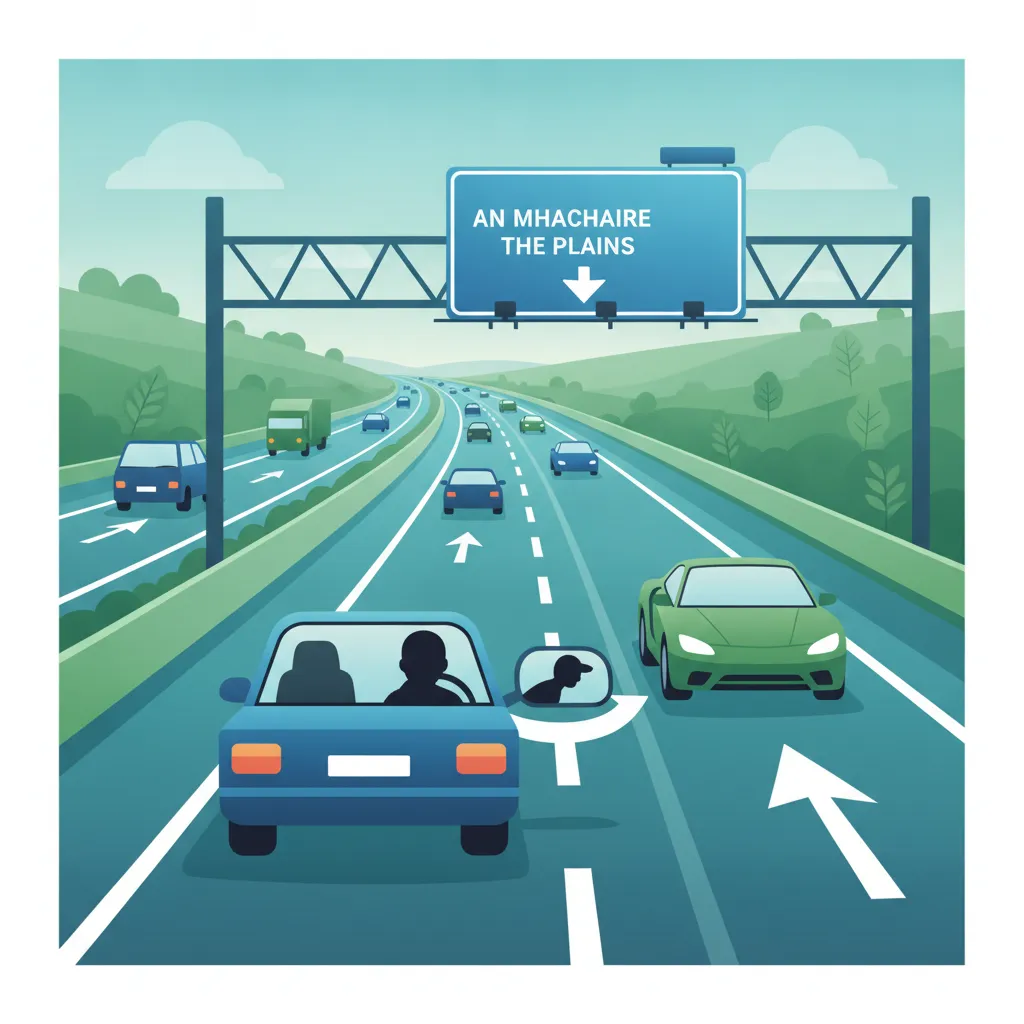
Merging a long, heavy passenger vehicle onto high-speed motorways requires matching the traffic speed within the limited length of slip lanes. This lesson covers signal timing, safe lane-merging gaps, and maintaining control during overtaking maneuvers on national routes. Drivers will learn to prioritize passenger comfort and vehicle stability, preventing sudden weight shifts during lane entries.

Bus terminals and central transport hubs are highly congested environments with dense pedestrian traffic and tight vehicle maneuver spaces. This lesson addresses terminal speed limits, reversing protocols, passenger queue management, and the coordination of scheduled departures. Drivers will learn how to navigate passenger platforms safely without causing service delays or compromising safety.

Large passenger vehicles must maintain consistent lane positioning to prevent side-swipe incidents and sustain smooth urban traffic patterns. This lesson covers standard lane selection rules, safe overtaking procedures, and how to use designated public transit corridors correctly. Drivers will learn the importance of checking mirrors continuously and planning lane changes well in advance.
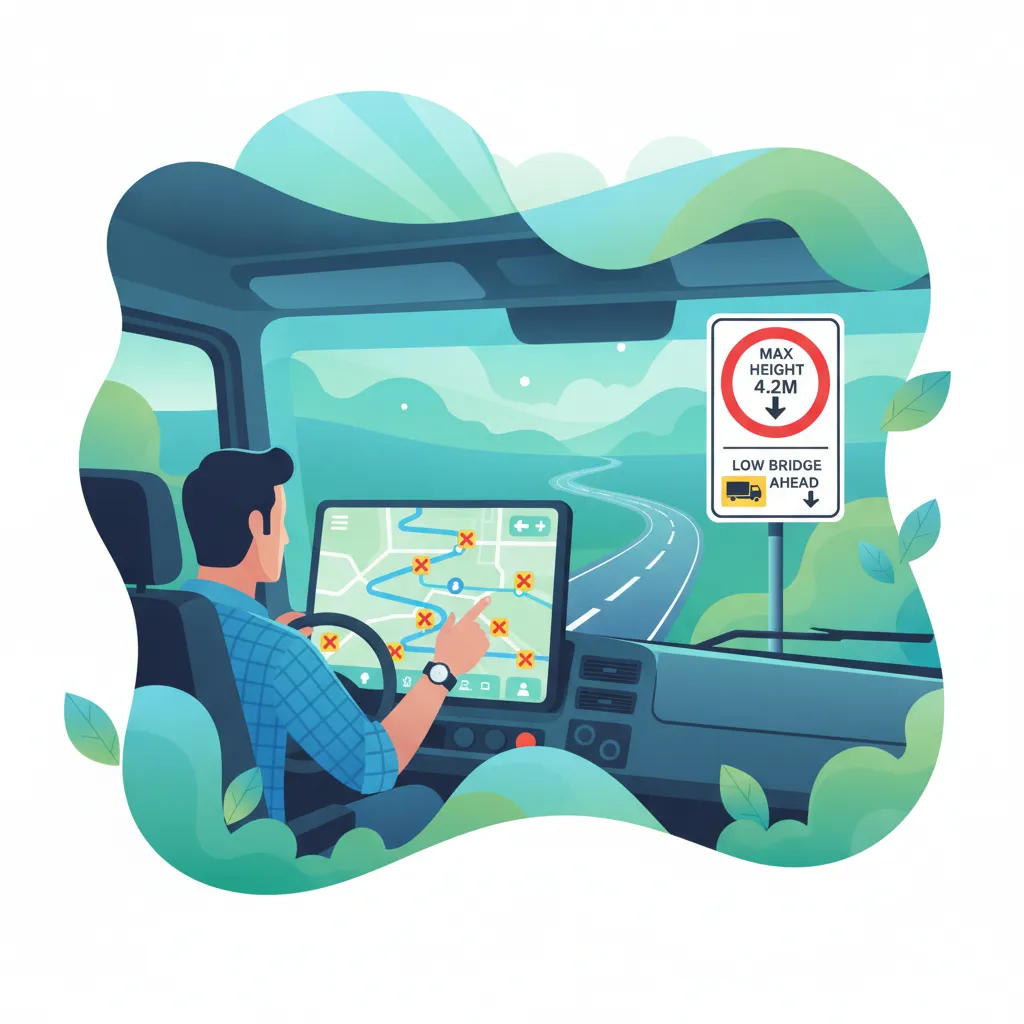
This lesson teaches professional drivers how to systematically map out travel routes that are compatible with heavy vehicle dimensions. It covers the limitations of consumer-grade GPS systems and emphasizes the use of specialized truck navigation systems that account for low bridges and load restrictions. Drivers will also learn to plan for congestion, access timing regulations, and proper entrance paths into commercial zones.

Shared public spaces rely heavily on road user cooperation, low speeds, and active visual communication rather than traditional traffic signals. This lesson teaches drivers how to navigate these open zones safely, yielding priority to pedestrians and integrated cyclists. Drivers will study how traffic calming designs alter vehicle trajectories, allowing safe, stress-free transit through modern city centers.

This lesson analyzes traffic flow characteristics in dense municipal areas and teaches safe riding methods for congested gridlock situations. It covers the maintenance of adequate safety cushions, scanning for opening car doors, and monitoring pedestrians stepping from between parked cars. Riders will learn to manage frequent stopping, constant clutch wear, and the stress of urban commuting.

This lesson addresses the unique environmental and logistical challenges faced during delivery stops in commercial town and city centers. It covers the legal frameworks governing municipal loading zones, double-parking hazards, and temporary pedestrian-only street restrictions. Drivers will acquire practical skills for managing traffic build-up, utilizing visual spotters, and securing the vehicle while unloading cargo.
Understand the official protocols for managing emergency situations on passenger vehicles. Learn how to execute safe passenger evacuations and coordinate with emergency services in accordance with Road Safety Authority guidelines for professional drivers.

When emergencies strike, a passenger driver must remain perfectly calm and execute structured emergency procedures to protect human life. This lesson outlines safety protocols for roadside breakdowns, engine fire isolation, and handling acute passenger medical emergencies. Drivers will learn how to secure the accident scene and report incidents to emergency services as required by Irish law.

Evacuating a coach or bus requires quick, decisive leadership, structured directions, and full use of onboard emergency exits. This lesson details the exact location and operation of emergency glass-breakers, roof hatches, and manual door release systems. Drivers will study crowd management techniques to prevent panic, ensuring all passengers gather at a safe distance from the vehicle.

Passenger boarding and exiting periods represent a highly critical operational window where slip and fall injuries frequently occur. This lesson outlines safe door opening procedures, the deployment of mechanical boarding steps, and proper handrail holding instructions. Drivers will learn to supervise passenger flow, ensuring passengers clear the immediate exit area before the bus begins moving.

Maintaining cabin discipline is critical for preventing driver distractions and ensuring passenger transit remains completely safe and comfortable. This lesson teaches conflict resolution, proactive de-escalation techniques, and the roles of specialized escorts on school or medical transport. Drivers will learn to assess security threats on board and apply the appropriate response protocols under Irish laws.

Securing passengers and luggage properly is essential to prevent injury during emergency braking, sudden steering inputs, or traffic collisions. This lesson provides instructions on passenger restraint systems, seatbelt laws in Ireland, and wheelchair ramp deployment processes. Drivers will study weight distribution guidelines for luggage compartments to protect the physical stability of the passenger vehicle.

Arriving at or being involved in a road traffic collision requires immediate, structured action to protect lives and prevent secondary crashes. This lesson covers how to safely secure an accident scene, activate hazard warning lights, place a warning triangle, and contact emergency services on 112. You will learn your legal duties to stop and share details, along with basic life-saving first aid principles for crash victims.

Standing passengers face heightened safety risks due to sudden changes in bus velocity, turning forces, or abrupt stops. This lesson covers maximum standing capacity regulations, correct passenger distribution, and the importance of active handrail utilization. Drivers will learn how to adjust their braking and acceleration patterns to prevent slips, trips, and falls among standing occupants.

Drivers bear the legal responsibility of ensuring that all passengers under seventeen years of age are properly secured in the vehicle. This lesson covers Ireland's strict seatbelt laws and the requirement to use an EU-approved child restraint system appropriate for the child's height and weight. You will learn how to locate ISOFIX anchorage points, fit child seats correctly, and deactivate passenger airbags when using rear-facing seats.

The regulatory framework in Ireland imposes strict standards of operation, dimension limits, and speed boundaries on heavy passenger fleets. This lesson reviews vehicle registration tax context, commercial operator licensing laws, and mandatory annual vehicle roadworthiness testing. By understanding these statutory regulations, drivers avoid severe legal infractions and maintain their professional driving credentials.
Find clear answers to common questions learners have about Managing Load Effects on Vehicle Dynamics. Learn how the lesson is structured, which driving theory objectives it supports, and how it fits into the overall learning path of units and curriculum progression in Ireland. These explanations help you understand key concepts, lesson flow, and exam focused study goals.
A fully loaded bus has significantly more mass than an empty one. According to Irish Rules of the Road, this increased mass requires more energy to slow down, meaning your total stopping distance increases, particularly in wet weather.
Uneven weight across the vehicle can shift the center of gravity, making the bus feel unstable when cornering. This can lead to increased body roll, affecting your steering responsiveness and potentially putting passengers at risk during sharp turns.
You should ensure you understand your vehicle's maximum axle weight limits as per the RSA guidelines. Regularly monitor the load distribution during your route to ensure the bus remains stable and balanced for all passengers.
Yes, the theory test frequently includes questions on vehicle dynamics and how load affects braking and handling. Understanding these physics is essential for professional bus driving and safety.
Use the practice question search tool to pinpoint specific topics, road signs, or rules you need to master for your official Driver Theory Test. Refine your study strategy and ensure comprehensive preparation for all aspects of the Irish driving exam. Start your focused revision now and build confidence for your learner permit test.