Prohibition signs, officially termed Verbots- oder Beschränkungszeichen in the Austrian Road Traffic Act (StVO), are a critical category of traffic signs. These signs clearly indicate actions that drivers are not permitted to perform, designed to prevent dangerous situations and ensure smooth traffic flow. Recognizing them immediately is fundamental to safe driving and successfully navigating Austria's diverse road network.
Theory topic content overview
Read the full theory topic guide for Prohibition Signs with structured, easy-to-scan content built for learners in Austria. This detailed section explains the exact rule, meaning, traffic context, comparison points, and exam logic behind this Austrian driving theory topic so you can study faster, understand the concept more clearly, and avoid common interpretation mistakes on the theory test.
Verbots- oder Beschränkungszeichen)?Prohibition signs, officially known as Verbots- oder Beschränkungszeichen in the Austrian Road Traffic Act (StVO), are a crucial category of traffic signs designed to forbid specific actions or restrict certain types of road users. They are easily recognizable by their distinctive visual characteristics, typically featuring a red circular border and a black symbol on a white background, often with a red diagonal bar to indicate prohibition.
The primary purpose of these Austrian prohibition signs is to:
These signs are legally binding and must be strictly obeyed by all drivers in Austria. Ignoring them not only poses a significant safety risk but also carries severe legal consequences, including fines and potential license penalties under Austrian law.
Mastering the interpretation of Verbots- oder Beschränkungszeichen is fundamental for safe and legal driving on Austrian roads, and it is a frequently tested area in the Austrian driving theory exam.
Überholverbot (no overtaking) signs are strategically placed on bends, crests, or narrow sections where visibility is limited, making overtaking extremely dangerous.Straßenverkehrsordnung) explicitly defines each prohibition sign and the corresponding penalties for non-compliance. Austrian traffic law is strict, and ignorance of a sign is not a valid excuse.Autobahnen, or in areas with specific environmental concerns.The StVO specifies numerous Verbots- oder Beschränkungszeichen. Here are some of the most common ones encountered on Austrian roads:
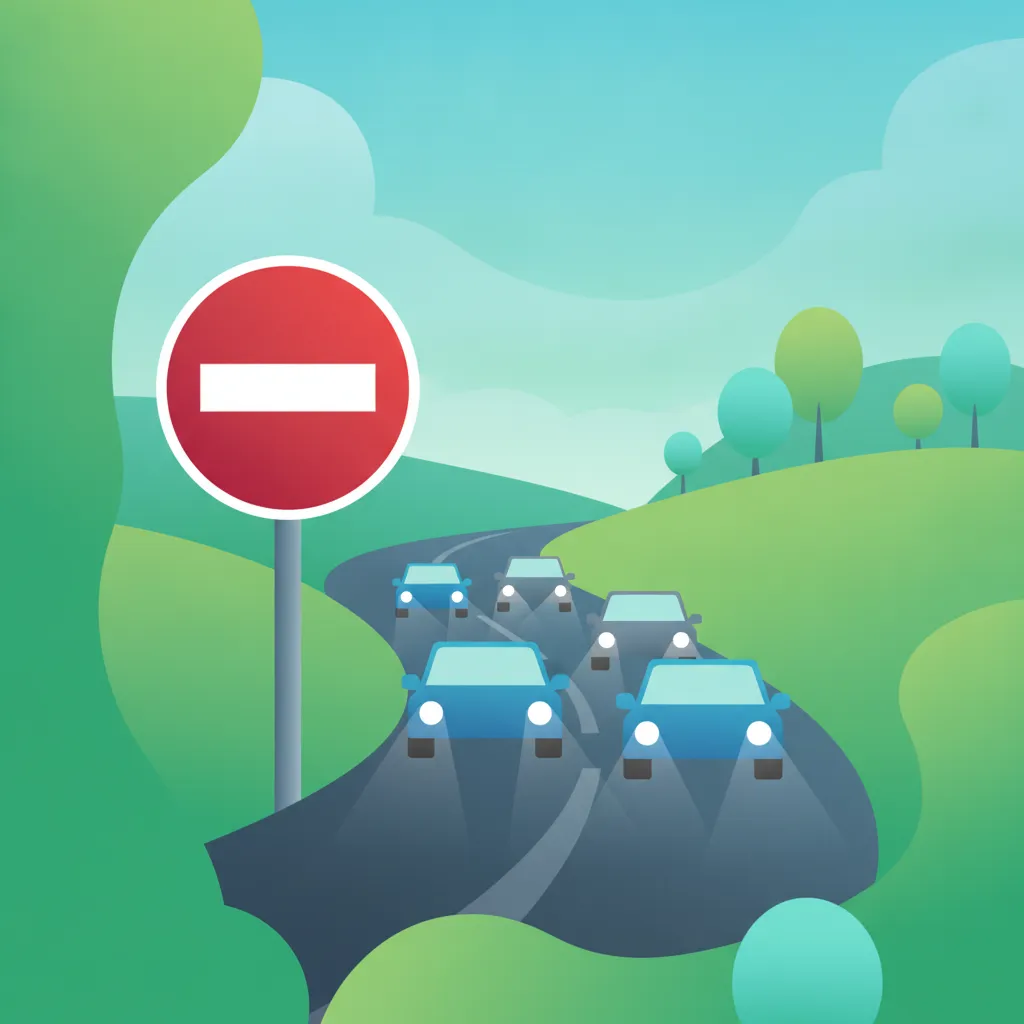
Fahrverbot (in beiden Richtungen) (No Entry for Vehicles in Both Directions): A red circle with a horizontal white bar. This sign means no vehicles are allowed to enter or proceed in either direction. However, it is important to note that pushing a bicycle is allowed.Einfahrt verboten (No Entry): A red circular sign with a white horizontal bar. This sign forbids entry into a road or area from the direction it is facing, often found at one-way street exits.Überholverbot (No Overtaking): A red circular sign with two cars (one red, one black). This sign forbids drivers of multi-track motor vehicles from overtaking other multi-track motor vehicles.
Ende des Überholverbotes (End of Overtaking Prohibition): A grey sign with a diagonal bar, indicating the end of the Überholverbot.Überholen für Lastkraftfahrzeuge verboten (No Overtaking for Lorries): Similar to the no overtaking sign, but specifically for lorries with a maximum permissible total weight exceeding 3.5 tonnes.Halten und Parken verboten (No Stopping or Parking): A red circular border with a blue background and a single red diagonal bar. This sign prohibits both stopping (except for immediate traffic necessities) and parking.Parken verboten (No Parking): A red circular border with a blue background and two red diagonal bars forming an 'X'. This sign prohibits parking, but allows stopping for up to 10 minutes to load/unload or let passengers in/out.50): A red circular border with a black number indicating the maximum permissible speed in km/h. Remember, this is a maximum, not a recommended speed, especially in adverse conditions.Abbiegen nach links/rechts verboten (No Left/Right Turn): A red circular border with a black arrow turning left or right, crossed by a red diagonal bar.Zusatztafeln)Austrian prohibition signs are often accompanied by Zusatztafeln (supplementary panels) beneath them. These panels provide crucial additional information, clarifying the sign's scope, duration, or specific application. For example:
Always read and understand these Zusatztafeln as they can significantly alter the meaning and enforceability of the primary prohibition sign.
In the Austrian traffic sign system, it's vital to differentiate prohibition signs from other categories, as their legal implications vary significantly.
Verbots- oder Beschränkungszeichen) vs. Mandatory Signs (Gebotszeichen):
Überholverbot (no overtaking).Vorgeschriebene Fahrtrichtung (mandatory direction).Gefahrenzeichen):
Gefährliches Gefälle - steep downgrade), prompting caution, but do not forbid specific actions themselves.Vorrangzeichen):
Stop, Vorrang geben). While they involve restrictions (like giving way), they are a distinct category focused solely on who has priority at junctions. Prohibition signs are broader in their scope of forbidden actions.Understanding these signs in context is key to practical driving.
Ortsgebiet): You're driving through a narrow street in a historic Austrian town and see an Einfahrt verboten sign ahead. This indicates a one-way street coming towards you. You must not enter and should find an alternative route. This prevents head-on collisions in confined spaces.Gebirgsstraßen): When ascending an alpine pass, you encounter a Überholverbot sign. This is often due to sharp bends, limited visibility, or narrow lanes characteristic of Austrian mountain roads. Attempting to overtake here would be extremely dangerous and strictly illegal.Kurzparkzonen often have time-restricted parking. However, even within these zones, a Halten und Parken verboten sign overrides other parking rules, meaning you cannot even stop briefly. Always check for supplementary panels indicating enforcement times.Freilandstraßen), you might see Überholen für Lastkraftfahrzeuge verboten (no overtaking for lorries). This is often to improve safety and traffic flow for smaller vehicles, particularly on uphill sections where heavy vehicles are slower.Austrian driving theory exam candidates and new drivers frequently make mistakes related to prohibition signs.
Halten verboten and Parken verboten: Many learners don't fully grasp the subtle but important difference. Halten verboten (single red bar) prohibits any stop unless traffic demands it, while Parken verboten (cross-through) allows short stops (up to 10 minutes) for loading/unloading or passenger pick-up/drop-off.Zusatztafeln): Failing to read Zusatztafeln can lead to misinterpreting the exact scope or duration of a prohibition. A sign might only apply during specific hours or to certain vehicle types.Ende des Überholverbotes). Until you pass such a sign or a major intersection, the prohibition typically remains in effect.For safe driving and success in your Austrian driving theory exam, approach Verbots- oder Beschränkungszeichen with a focus on immediate recognition, precise interpretation, and absolute obedience. These signs are not advisory; they are direct commands from the Austrian traffic authorities (StVO) designed to protect all road users. Always scan for these red-bordered signs, understand what specific action they forbid, and meticulously check for any Zusatztafeln that may modify their meaning. Your ability to correctly interpret and react to these signs is a cornerstone of responsible driving in Austria.
Start with a short, direct summary of Prohibition Signs before reading the full explanation below.
Prohibition signs are Austrian traffic signs that forbid specific actions, such as entering a road, overtaking, or parking. They typically feature a red circle or a red diagonal bar, clearly indicating a restriction. These legally binding signs enforce critical safety rules, regulate traffic, and must be strictly obeyed by all road users to avoid accidents and legal penalties.
Review the most important terms, rule signals, and traffic concepts linked to Prohibition Signs.
Explore related theory topic pages connected to Prohibition Signs and continue with the next useful rule explanation.
See the common search queries learners use when trying to understand Prohibition Signs in Austria.

Ready to delve deeper into specific theory topics? Continue exploring detailed explanations of Austrian road signs, traffic rules, and critical driving situations. Solidify your knowledge, clarify any doubts, and ensure you're fully prepared for every aspect of your official driving licence theory exam.
Austrian Driving Theory TopicsTheory topic content overview
Start with a short, direct summary of Prohibition Signs before reading the full explanation below.
Prohibition signs are Austrian traffic signs that forbid specific actions, such as entering a road, overtaking, or parking. They typically feature a red circle or a red diagonal bar, clearly indicating a restriction. These legally binding signs enforce critical safety rules, regulate traffic, and must be strictly obeyed by all road users to avoid accidents and legal penalties.
Review the most important terms, rule signals, and traffic concepts linked to Prohibition Signs.
Explore related theory topic pages connected to Prohibition Signs and continue with the next useful rule explanation.
See the common search queries learners use when trying to understand Prohibition Signs in Austria.
Ready to delve deeper into specific theory topics? Continue exploring detailed explanations of Austrian road signs, traffic rules, and critical driving situations. Solidify your knowledge, clarify any doubts, and ensure you're fully prepared for every aspect of your official driving licence theory exam.
Austrian Driving Theory TopicsUse this exam-focused revision tip to understand how Prohibition Signs is likely to appear in theory questions for learners in Austria. This section helps you identify the most testable part of the rule, avoid common traps, and remember the concept more effectively during Austrian driving theory exam preparation.
In the Austrian theory exam, pay close attention to the specific symbol and any supplementary panels on prohibition signs. Many questions test not just recognition, but also the exact scope and exceptions of the prohibition, especially for common signs like 'no overtaking' or 'no entry' for specific vehicle types.
Read direct answers to the most common learner questions about Prohibition Signs in Austria. This FAQ focuses on rule confusion, practical meaning, comparison with similar concepts, and the exact uncertainties that appear most often in Austrian driving theory revision and exam preparation.
Verbots- oder Beschränkungszeichen are Austrian prohibition or restriction signs that indicate actions drivers are not allowed to perform. They are a subset of 'Vorschriftszeichen' (regulatory signs) defined in § 52 of the StVO.
Most Austrian prohibition signs are circular with a red border, and often contain a black symbol on a white background, sometimes with a red diagonal line through it. This distinct appearance signals a 'no' or 'forbidden' action.
Common examples include 'Fahrverbot (in beiden Richtungen)' (no entry from both directions), 'Einfahrt verboten' (no entry), 'Überholverbot' (no overtaking), 'Halteverbot' (no stopping), and 'Parkverbot' (no parking).
This sign indicates that driving is prohibited in both directions on the road ahead. Only pushing a bicycle is allowed past this sign, as specified in the StVO.
Prohibition signs generally apply continuously from where they are placed, unless a supplementary panel specifies conditions (e.g., 'during certain hours' or 'for specific vehicles') or until an 'Ende des Verbotes' (end of prohibition) sign is encountered.
Prohibition signs forbid actions and are typically round with a red border. Warning signs, usually triangular with a red border, alert drivers to potential dangers ahead but do not forbid specific actions.
Ignoring a prohibition sign in Austria can lead to significant traffic penalties, fines, and even points on your license. More importantly, it can cause dangerous traffic situations and accidents, endangering yourself and other road users.
Refine your study plan by searching for specific Austrian driving theory practice sets. Pinpoint questions related to particular road rules, signs, or challenge levels, and begin practicing immediately to reinforce your knowledge and excel in your official exam with confidence. Get started with focused revision today.