
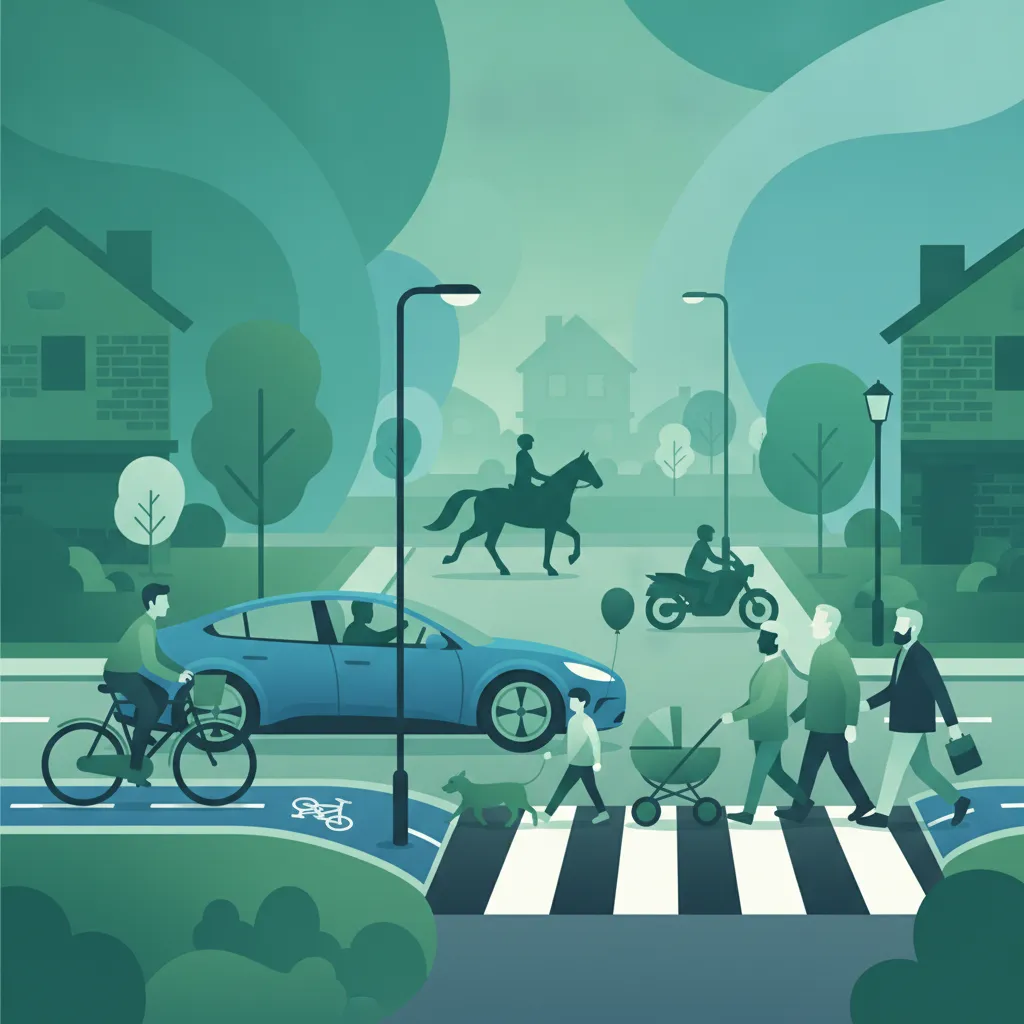
This unit focuses on your duty of care towards pedestrians, cyclists, motorcyclists, horse riders, and other vulnerable road users. Understanding their needs and potential actions is crucial for safe driving and passing your Great Britain Category B theory test. We'll cover techniques for safely interacting with them in various road scenarios.
Browse all lessons that make up Pedestrians, Crossings, Cyclists and Vulnerable Road Users. Each lesson focuses on specific topics, learning objectives, and core concepts, helping you build essential knowledge and follow a clear, structured progression toward your study goals in Great Britain.
This lesson provides a detailed guide to various pedestrian crossings and their specific rules. You will learn to identify each type by its markings and signals, from the black and white stripes of a zebra crossing to the sensor-controlled lights of a puffin crossing. The focus is on knowing when and how to stop to ensure pedestrian safety.
This lesson focuses on the safe interaction between cars and bicycles. It covers the importance of giving cyclists ample room when overtaking—at least 1.5 metres—and looking for them before turning or changing lanes. You will also learn about cyclist-specific infrastructure like cycle lanes and how to use the 'Dutch Reach' method to open your car door safely.
This lesson highlights the need for heightened awareness and reduced speed around schools, parks, and residential areas. Children can be unpredictable, so you must be prepared for them to step into the road without warning. The lesson covers specific signs for school zones and the legal requirement to stop for a school crossing patrol.
This lesson explains how to adapt your driving around different vehicles. You will learn to look out for motorcyclists, who are often hard to see, especially at junctions. It also covers the challenges of sharing the road with large vehicles, such as their extended blind spots, wider turning circles, and the wind turbulence they can create.
This lesson prepares you for the specific challenges of driving in the countryside. It explains the correct procedure for overtaking horse riders: slow down and pass wide, ensuring you do not spook the animal. You will also learn how to anticipate and safely manage encounters with slow-moving tractors and other farm machinery.
Explore high-intent keywords and long-tail search topics learners use when researching Pedestrians, Crossings, Cyclists and Vulnerable Road Users. These terms reflect how people search for reliable study materials, structured explanations, and unit-level theory preparation support in Great Britain.
Find clear answers to the most common questions learners ask about Pedestrians, Crossings, Cyclists and Vulnerable Road Users. Understand how the unit is organized, what learning goals it supports, and how it contributes to your study progression with structured explanations and practical guidance tailored for learners in Great Britain.
The most important rule is to be prepared to stop. Always approach pedestrian crossings, especially zebra crossings, with caution. Look for any pedestrians waiting to cross or already on the crossing, and be ready to stop to allow them to cross safely. Remember your duty of care extends to anticipating potential movements.
When overtaking a cyclist, you must give them plenty of space. Do not attempt to overtake if you cannot pass them safely, especially on narrow roads or bends. Aim to leave at least 1.5 metres (approximately 5 feet) of space. Check your mirrors and signal before moving out, and only return to your normal position when you are safely past them and have checked your mirrors again.
Motorcyclists can be harder to spot than other vehicles because they are smaller and can easily be hidden in your blind spots. Always check your mirrors thoroughly, including your blind spots, before changing direction or lane. Remember that motorcyclists may manoeuvre differently and can accelerate or decelerate quickly.
Yes, you must exercise extra caution around children, particularly near schools, parks, or residential areas. Children can be unpredictable and may dart into the road without warning. Be prepared to slow down and stop suddenly if necessary. Always scan ahead for potential child-related hazards.
When you see horses, slow down and be prepared to stop. Give them a wide berth when passing, ideally at least 2 metres (6.5 feet). Avoid sounding your horn or revving your engine, as this can startle the horse. Ensure you are not too close when passing, to avoid frightening the animal or its rider.
Vulnerable road users are those who are not protected by a vehicle structure, making them more susceptible to injury in a collision. This category includes pedestrians (adults, children, elderly), cyclists, motorcyclists, horse riders, and users of mobility scooters. Drivers have a heightened duty of care towards them.
All included lessons
Lessons in Pedestrians, Crossings, Cyclists and Vulnerable Road Users
See who benefits most from studying Pedestrians, Crossings, Cyclists and Vulnerable Road Users. This overview explains how the unit supports different learning needs, what level of knowledge is helpful before starting, and how it fits into the overall study path in Great Britain.
This unit is essential for all learner drivers in Great Britain preparing for their Category B theory test. It is particularly important for new drivers who may underestimate the risks faced by vulnerable road users, and for anyone needing to refresh their understanding of crucial safety protocols beyond basic traffic rules.

Ready to prepare effectively for your DVSA driving theory test? Explore our structured courses and guided study paths. They cover every topic of the Great Britain Highway Code and official exam requirements, ensuring systematic learning and success.
Explore Driving Theory CoursesExplore all units and lessons included in this driving theory course.
Ready to prepare effectively for your DVSA driving theory test? Explore our structured courses and guided study paths. They cover every topic of the Great Britain Highway Code and official exam requirements, ensuring systematic learning and success.
Explore Driving Theory Courses