
This unit covers essential skills for large passenger vehicle operation, focusing on safe lane usage, executing turns, managing blind spots, and performing reversing and complex manoeuvres. Mastering these abilities is crucial for both your Great Britain Passenger Vehicle theory test and ensuring passenger safety on UK roads.
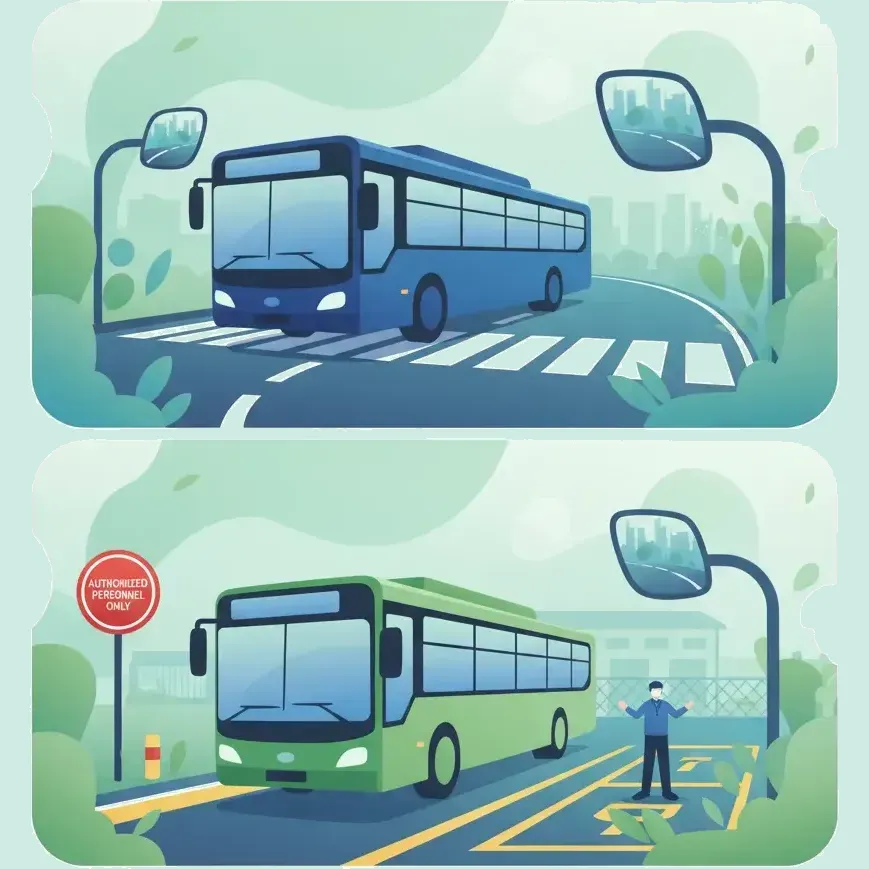
Browse all lessons that make up Lane Use, Turning, Blind Spots, Reversing and Manoeuvring. Each lesson focuses on specific topics, learning objectives, and core concepts, helping you build essential knowledge and follow a clear, structured progression toward your study goals in Great Britain.
This lesson covers the importance of maintaining correct lane discipline when driving a large passenger vehicle. It details how to position your vehicle safely within a lane on various road types, including multi-lane carriageways and motorways. You will learn the specific rules governing bus lanes, including how to interpret markings, adhere to operating times, and understand the exemptions and penalties associated with their use to ensure legal and efficient driving.
This lesson provides detailed instruction on turning techniques tailored for long vehicles. It explains the concepts of off-tracking (where rear wheels follow a tighter path than front wheels) and rear swing, and how to compensate for them. Learners will understand how to position the vehicle correctly when approaching and navigating left and right turns at junctions, roundabouts, and tight corners, using mirrors and signals effectively to ensure clearance and safety.
This lesson focuses on the critical skill of managing the large blind spots inherent to buses and coaches. It details the purpose of different mirror classes (e.g., wide-angle and kerb-view) and how to use them effectively. Learners will develop a systematic scanning and mirror-checking routine to maintain constant awareness of their surroundings, particularly looking for cyclists and pedestrians who may be hidden from direct view, thereby minimizing the risk of a collision.
Reversing a large passenger vehicle is a high-risk manoeuvre, and this lesson provides essential safety protocols. It covers the importance of using a trained banksman or reversing assistant and understanding standard hand signals. The lesson also discusses the use of technical aids like reversing cameras and audible warnings. Learners will master the procedure for conducting a full 360-degree safety check before beginning and maintaining slow, controlled movement throughout the manoeuvre.
This lesson builds on basic skills to address complex manoeuvres in challenging, confined environments such as bus stations, depots, and service areas. It covers techniques for positioning the vehicle for bay parking and navigating tight, complex routes. Key focus areas include developing precise spatial awareness, using reference points, maintaining extremely slow and controlled movements, and performing continuous observation to navigate safely without causing damage or injury.
Explore high-intent keywords and long-tail search topics learners use when researching Lane Use, Turning, Blind Spots, Reversing and Manoeuvring. These terms reflect how people search for reliable study materials, structured explanations, and unit-level theory preparation support in Great Britain.
Find clear answers to the most common questions learners ask about Lane Use, Turning, Blind Spots, Reversing and Manoeuvring. Understand how the unit is organized, what learning goals it supports, and how it contributes to your study progression with structured explanations and practical guidance tailored for learners in Great Britain.
Off-tracking refers to the phenomenon where the rear wheels of a long vehicle follow a different path than the front wheels when turning. This means the vehicle will cut corners. Understanding off-tracking is critical when turning at junctions to avoid hitting kerbs, other vehicles, or pedestrians, and is a common topic in the theory test for bus and coach drivers.
Managing blind spots involves using your mirrors constantly and correctly, checking them before any manoeuvre, and positioning your vehicle to minimise these areas. For large vehicles, you'll also need to understand the specific blind areas created by the vehicle's length and height. This unit teaches you how to use mirrors and situational awareness to maintain a clear view of your surroundings.
Bus lanes are typically reserved for buses, although some may also permit cycles or taxis. You must only use a bus lane when indicated, and observe any specific times of operation. Misusing a bus lane can result in fines. This unit clarifies the rules and signage associated with bus lane usage to ensure compliance.
A banksman is a person who guides a vehicle driver, especially when reversing or manoeuvring in tight spaces. They use hand signals to communicate with the driver, helping to prevent collisions. You may need a banksman for complex manoeuvres in confined areas, such as depots or narrow streets, where visibility is limited and a second pair of eyes is essential for safety.
While the fundamental principles of safe reversing are similar, large passenger vehicles have significantly larger blind spots and less manoeuvrability than cars. The turning circle and potential for off-tracking are also much greater. Therefore, reversing a bus requires more planning, greater use of mirrors, and a heightened awareness of surroundings and potential hazards.
All included lessons
Lessons in Lane Use, Turning, Blind Spots, Reversing and Manoeuvring
See who benefits most from studying Lane Use, Turning, Blind Spots, Reversing and Manoeuvring. This overview explains how the unit supports different learning needs, what level of knowledge is helpful before starting, and how it fits into the overall study path in Great Britain.
This unit is designed for individuals preparing for their Category D, D1, D1E, or DE driving licence theory tests in Great Britain. It is particularly beneficial for those who may be new to driving larger vehicles or who need to refresh their understanding of complex manoeuvres and spatial awareness required for bus and coach operation.

Ready to prepare effectively for your DVSA driving theory test? Explore our structured courses and guided study paths. They cover every topic of the Great Britain Highway Code and official exam requirements, ensuring systematic learning and success.
Explore Driving Theory CoursesExplore all units and lessons included in this driving theory course.
Ready to prepare effectively for your DVSA driving theory test? Explore our structured courses and guided study paths. They cover every topic of the Great Britain Highway Code and official exam requirements, ensuring systematic learning and success.
Explore Driving Theory Courses