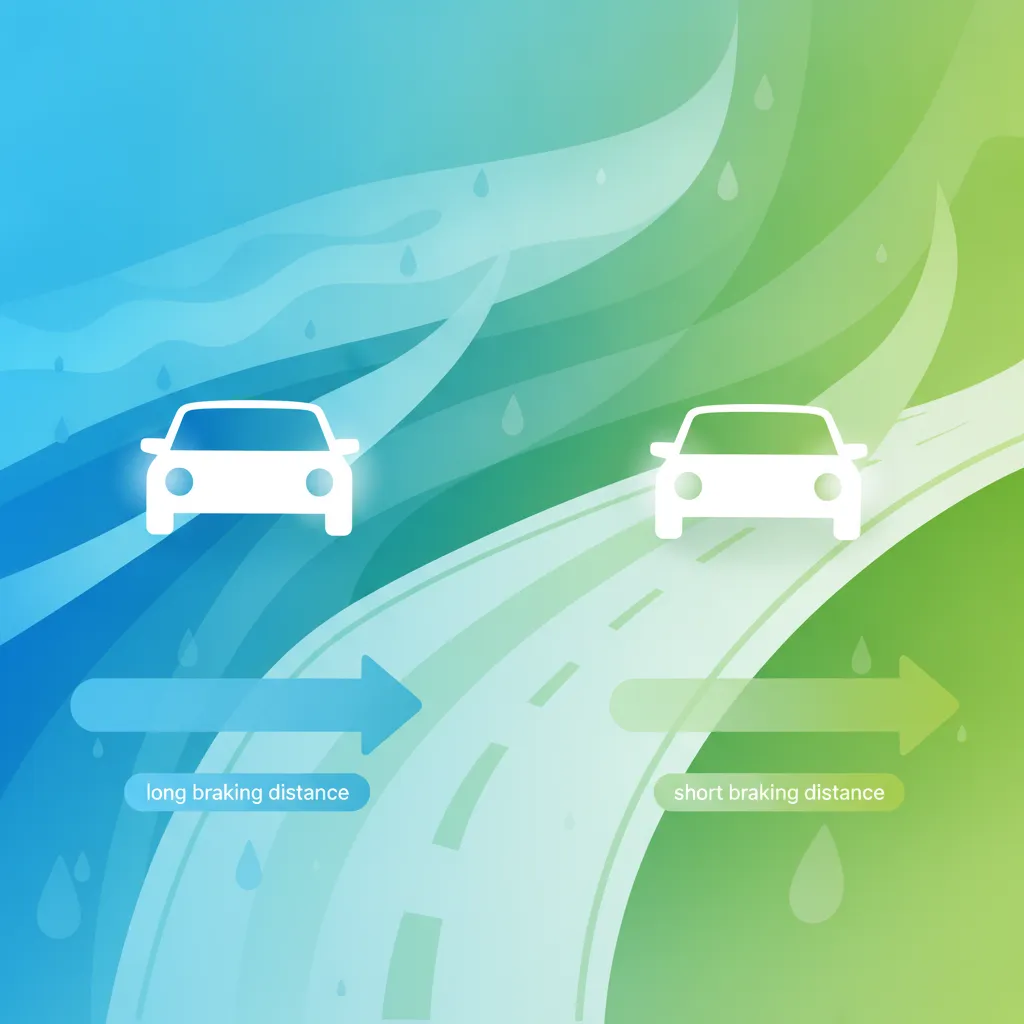
Braking distance refers to the distance your vehicle travels from the instant you press the brake pedal until it completely stops. This distance is a vital component of overall stopping distance and is heavily influenced by several factors that drivers in Great Britain must be aware of, especially when planning for hazards or adjusting to adverse weather.
Theory topic content overview
Read the full theory topic guide for Braking Distance with structured, easy-to-scan content built for learners in Great Britain. This detailed section explains the exact rule, meaning, traffic context, comparison points, and exam logic behind this British driving theory topic so you can study faster, understand the concept more clearly, and avoid common interpretation mistakes on the theory test.
Braking distance is the exact stretch your vehicle travels from the moment you apply the brakes until it comes to a complete stop. It is a critical component of safe driving and a foundational concept in the Great Britain driving theory test. Unlike overall stopping distance, braking distance only accounts for the phase when your vehicle is actively decelerating due to the braking force.
Think of it as the distance your car "uses up" to shed its speed entirely once your foot is firmly on the brake pedal.
Understanding braking distance is paramount for safety on Great Britain's roads and essential for passing your DVSA theory test. A precise grasp of this concept directly impacts:
The most significant factor influencing braking distance is speed. This relationship is not linear; it's exponential. As your speed increases, the kinetic energy your vehicle possesses rises with the square of its speed. This means:
This dramatic increase is why even a small rise in speed makes a huge difference to the distance required to stop safely. Higher speeds demand significantly more road ahead to bring the vehicle to a halt.
Beyond speed, several other crucial factors directly affect how quickly your vehicle can stop in Great Britain:
Road Conditions (Grip/Traction):
Tyre Condition and Pressure:
Vehicle Condition:
Vehicle Load:
This is a key area of confusion for many learners in Great Britain and a common question on the DVSA theory test.
Total Stopping Distance = Thinking Distance + Braking Distance
The Highway Code's typical stopping distances (e.g., 6 car lengths at 30 mph, 24 car lengths at 70 mph) always refer to the overall stopping distance, not just braking distance. Theory test questions will often test whether you understand this critical difference.
Consider these everyday Great Britain driving scenarios:
Learners in Great Britain often make the following mistakes regarding braking distance:
To be a safe driver in Great Britain and confidently pass your theory test, remember:
Start with a short, direct summary of Braking Distance before reading the full explanation below.
Braking distance is the length a vehicle covers while the brakes are actively engaged, bringing it to a halt. It starts when braking force is applied and ends when the vehicle is stationary. Key factors increasing this distance include higher speeds, poor road grip (like wet or icy roads), worn tyres, and heavier vehicle loads. It is a distinct part of the total stopping distance, which also includes reaction distance.
Review the most important terms, rule signals, and traffic concepts linked to Braking Distance.
Explore related theory topic pages connected to Braking Distance and continue with the next useful rule explanation.
See the common search queries learners use when trying to understand Braking Distance in Great Britain.

Continue your journey to a successful Great Britain driving theory test by delving deeper into specific topics. Enhance your understanding of complex rules, review detailed explanations, and solidify your knowledge of the Highway Code, preparing you thoroughly for all aspects of the official DVSA exam. Start mastering key concepts today.
Great Britain Driving Theory TopicsTheory topic content overview
Start with a short, direct summary of Braking Distance before reading the full explanation below.
Braking distance is the length a vehicle covers while the brakes are actively engaged, bringing it to a halt. It starts when braking force is applied and ends when the vehicle is stationary. Key factors increasing this distance include higher speeds, poor road grip (like wet or icy roads), worn tyres, and heavier vehicle loads. It is a distinct part of the total stopping distance, which also includes reaction distance.
Review the most important terms, rule signals, and traffic concepts linked to Braking Distance.
Explore related theory topic pages connected to Braking Distance and continue with the next useful rule explanation.
See the common search queries learners use when trying to understand Braking Distance in Great Britain.
Continue your journey to a successful Great Britain driving theory test by delving deeper into specific topics. Enhance your understanding of complex rules, review detailed explanations, and solidify your knowledge of the Highway Code, preparing you thoroughly for all aspects of the official DVSA exam. Start mastering key concepts today.
Great Britain Driving Theory TopicsUse this exam-focused revision tip to understand how Braking Distance is likely to appear in theory questions for learners in Great Britain. This section helps you identify the most testable part of the rule, avoid common traps, and remember the concept more effectively during British driving theory exam preparation.
A common theory test trap involves confusing braking distance with overall stopping distance, or underestimating how much factors like speed and wet roads increase the distance needed to stop. Remember: 'Braking' starts when your foot hits the pedal, but 'Stopping' includes your reaction time before that. Always double your following distance in wet conditions and be aware of much larger increases on ice as per the Highway Code.
Read direct answers to the most common learner questions about Braking Distance in Great Britain. This FAQ focuses on rule confusion, practical meaning, comparison with similar concepts, and the exact uncertainties that appear most often in British driving theory revision and exam preparation.
Braking distance is the distance your vehicle travels from the moment you apply the brakes until it comes to a complete stop. It specifically excludes the time it takes for a driver to react to a hazard.
Stopping distance is the total distance traveled from when a driver first identifies a hazard until the vehicle stops. It comprises two parts: reaction distance (the distance covered during the driver's reaction time) and braking distance (the distance covered while braking).
The primary factors increasing braking distance include higher vehicle speed, poor road surface conditions (such as wet, icy, or gravel roads), worn or incorrectly inflated tyres, heavy vehicle loads, and inefficient braking systems.
Braking distance increases exponentially with speed. For example, doubling your speed roughly quadruples your braking distance due to the increased kinetic energy that needs to be dissipated.
Wet or icy roads drastically reduce the friction (grip) between your tyres and the road surface. With less grip, the brakes cannot apply maximum stopping force efficiently, requiring a much greater distance to slow down and stop, as highlighted in The Highway Code Rule 227.
Yes, a heavier vehicle requires more force and therefore a longer distance to stop from the same speed, as there is more mass (and thus more kinetic energy) to overcome.
Regularly check your tyre tread depth, pressure, and overall condition, and ensure your braking system (pads, discs, fluid) is well-maintained and free from faults. These checks are part of responsible vehicle maintenance in the UK.
Dive into our comprehensive question bank to find exactly what you need for your Great Britain theory test. Use our advanced filters to pinpoint specific subjects or test your knowledge on challenging areas, ensuring you're fully prepared for success.