Stopping distance is the total ground covered from the moment you identify a hazard until your vehicle comes to a complete halt. It's not just about applying the brakes; it involves your reaction time and the vehicle's braking capability. Mastering this distinction and the factors influencing it is key to responsible driving in the UK.
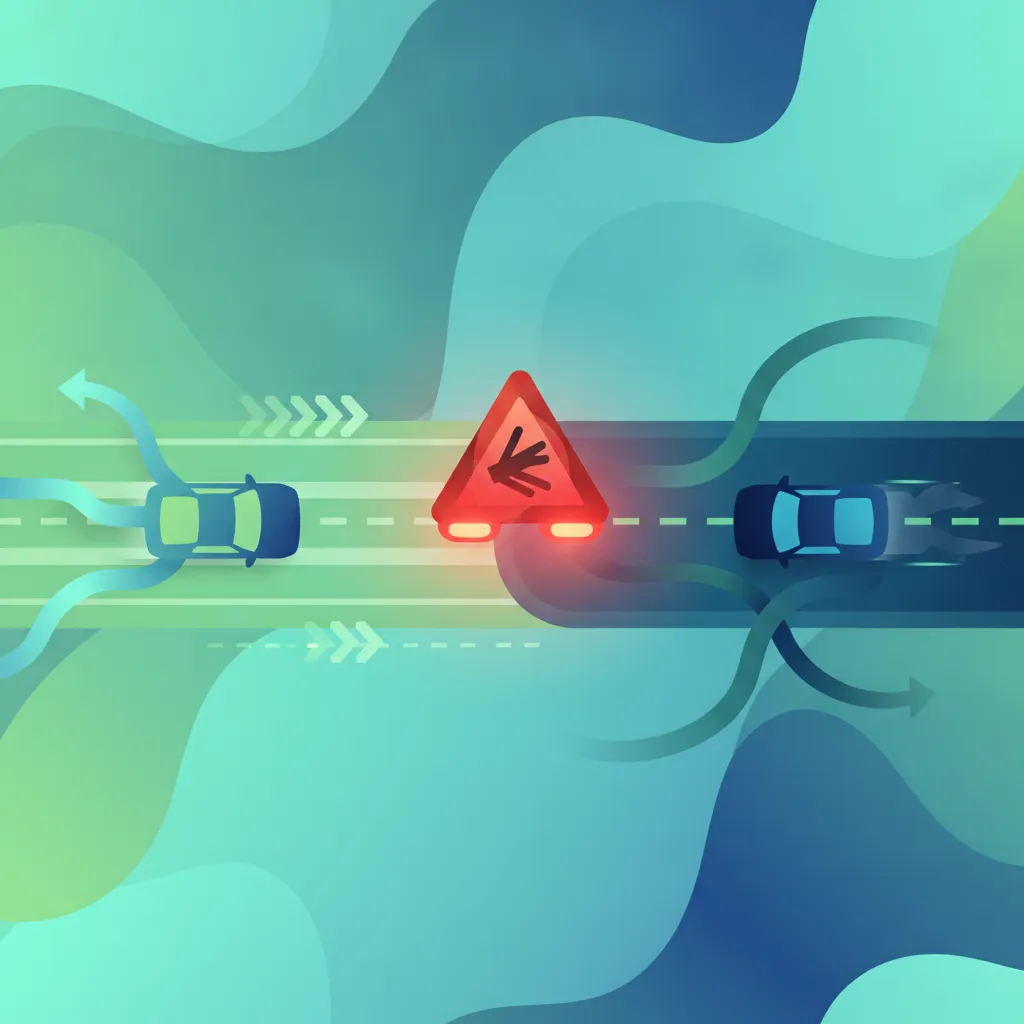
Theory topic content overview
Read the full theory topic guide for Stopping Distance Explained with structured, easy-to-scan content built for learners in Great Britain. This detailed section explains the exact rule, meaning, traffic context, comparison points, and exam logic behind this British driving theory topic so you can study faster, understand the concept more clearly, and avoid common interpretation mistakes on the theory test.
Stopping distance in Great Britain driving theory is the total distance your vehicle travels from the very moment you perceive a hazard until it comes to a complete, standstill stop. It's a critical concept for road safety and a cornerstone of the DVSA driving theory test.
This total distance is not a single measurement but is fundamentally broken down into two distinct parts:
Therefore, the formula is simple: Stopping Distance = Reaction Distance + Braking Distance.
Mastering the concept of stopping distance is crucial for several reasons specific to driving in the UK:
This is the 'human' element of stopping. It's the distance covered during the time it takes for a driver to:
An average, alert driver's reaction time is often considered to be around 1 second. This means that for every 1 second of reaction time, your vehicle covers a certain distance. Crucially, reaction distance increases proportionally with speed. If you double your speed, you double your reaction distance.
This is the 'mechanical' element of stopping. It's the distance your vehicle travels from the moment the brake pedal is pressed and the brakes engage until the vehicle reaches a complete stop.
Braking distance is influenced by a multitude of factors, but its relationship with speed is profound: braking distance increases approximately with the square of your speed. This means if you double your speed, your braking distance will increase by roughly four times (2 squared). This exponential increase is why small speed adjustments have a massive impact on overall stopping distance.
The most critical insight for Great Britain driving learners is the compounding effect of speed. Because reaction distance increases linearly with speed, and braking distance increases exponentially (with the square of speed), even a slight increase in speed leads to a disproportionately longer total stopping distance.
Consider a typical scenario in dry conditions:
This isn't just double the distance for double the speed; it's over three times the distance. This principle underpins much of the advice in the Highway Code regarding safe speed and following distances, particularly on high-speed roads and motorways across the UK.
Several factors can significantly affect both your reaction and braking distances, leading to a much longer overall stopping distance in Great Britain:
For the DVSA theory test and practical driving in Great Britain, it's vital to differentiate:
Learners in Great Britain often make these mistakes regarding stopping distance:
The most important takeaway for any driver in Great Britain is to cultivate a constant awareness of the space you need around your vehicle. Always apply these principles:
By integrating this understanding of stopping distance into your driving habits, you'll be a safer and more responsible driver on Great Britain's roads, ready for both your theory test and practical driving test challenges.
Start with a short, direct summary of Stopping Distance Explained before reading the full explanation below.
Stopping distance is the sum of reaction distance (distance traveled while perceiving and reacting to a hazard) and braking distance (distance traveled after applying brakes until stopping). It increases significantly with speed, and is further affected by road conditions, tyre quality, and driver alertness. Always leave enough space to stop safely, as advised by The Highway Code for Great Britain.
Review the most important terms, rule signals, and traffic concepts linked to Stopping Distance Explained.
Explore related theory topic pages connected to Stopping Distance Explained and continue with the next useful rule explanation.
See the common search queries learners use when trying to understand Stopping Distance Explained in Great Britain.

Continue your journey to a successful Great Britain driving theory test by delving deeper into specific topics. Enhance your understanding of complex rules, review detailed explanations, and solidify your knowledge of the Highway Code, preparing you thoroughly for all aspects of the official DVSA exam. Start mastering key concepts today.
Great Britain Driving Theory TopicsTheory topic content overview
Start with a short, direct summary of Stopping Distance Explained before reading the full explanation below.
Stopping distance is the sum of reaction distance (distance traveled while perceiving and reacting to a hazard) and braking distance (distance traveled after applying brakes until stopping). It increases significantly with speed, and is further affected by road conditions, tyre quality, and driver alertness. Always leave enough space to stop safely, as advised by The Highway Code for Great Britain.
Review the most important terms, rule signals, and traffic concepts linked to Stopping Distance Explained.
Explore related theory topic pages connected to Stopping Distance Explained and continue with the next useful rule explanation.
See the common search queries learners use when trying to understand Stopping Distance Explained in Great Britain.
Continue your journey to a successful Great Britain driving theory test by delving deeper into specific topics. Enhance your understanding of complex rules, review detailed explanations, and solidify your knowledge of the Highway Code, preparing you thoroughly for all aspects of the official DVSA exam. Start mastering key concepts today.
Great Britain Driving Theory TopicsUse this exam-focused revision tip to understand how Stopping Distance Explained is likely to appear in theory questions for learners in Great Britain. This section helps you identify the most testable part of the rule, avoid common traps, and remember the concept more effectively during British driving theory exam preparation.
Many learners confuse stopping distance with just braking distance. Remember, for the DVSA theory test, stopping distance always includes both the 'thinking' (reaction) distance and the 'braking' distance. Always factor in your own reaction time when calculating safe following gaps.
Read direct answers to the most common learner questions about Stopping Distance Explained in Great Britain. This FAQ focuses on rule confusion, practical meaning, comparison with similar concepts, and the exact uncertainties that appear most often in British driving theory revision and exam preparation.
Reaction distance is the distance your vehicle travels from when you first see a hazard until you start braking. Braking distance is the distance your vehicle travels from when you apply the brakes until it comes to a complete stop.
Stopping distance increases disproportionately with speed. While reaction distance increases linearly, braking distance increases approximately with the square of the speed. This means doubling your speed can more than quadruple your stopping distance, as emphasized by The Highway Code.
Key factors include higher speed, poor road conditions (wet, icy, gravel), worn tyres, vehicle load, and driver factors like fatigue, distraction, alcohol, or drugs, all of which extend reaction time or reduce braking efficiency.
While no exact formula needs to be memorised, the DVSA theory test focuses on understanding the relationship between speed and stopping distance, and how various factors influence it. The Highway Code provides typical stopping distances for reference, but the core concept is the main focus.
Maintaining a safe following distance, such as the 2-second rule in dry conditions, is vital because it provides the necessary space for your total stopping distance if the vehicle ahead suddenly stops. This minimises the risk of rear-end collisions, especially in varying conditions.
Wet roads can double your stopping distance, and icy roads can increase it by up to ten times compared to dry conditions. This is due to significantly reduced tyre grip, making it essential to slow down and increase your following distance.
Dive into our comprehensive question bank to find exactly what you need for your Great Britain theory test. Use our advanced filters to pinpoint specific subjects or test your knowledge on challenging areas, ensuring you're fully prepared for success.