
This unit delves into the critical aspects of operating vehicle combinations, focusing on trailers and semitrailers. You'll learn the proper techniques for coupling and uncoupling, understand the unique dynamics of articulated vehicles, and prepare for specific exam questions related to combination behaviour. Mastering these skills is vital for safe heavy goods vehicle operation in Austria.
Browse all lessons that make up Trailers, Semitrailers, Coupling and Combination Behaviour. Each lesson focuses on specific topics, learning objectives, and core concepts, helping you build essential knowledge and follow a clear, structured progression toward your study goals in Austria.
This lesson introduces the different classifications of trailers used in Austria, including drawbar trailers (Anhänger) and semi-trailers (Sattelanhänger/Auflieger). It explains their key structural differences, typical uses, and the types of coupling systems they employ. Understanding these types is the first step in learning to operate combination vehicles.
This lesson provides a step-by-step guide to the process of safely coupling a trailer to a tractor unit (Kuppeln). It covers aligning the vehicles, securing the mechanical lock (e.g., fifth wheel), and correctly connecting the air and electrical lines. A thorough safety check after coupling is mandatory to prevent trailer separation.
This lesson explains the physics of an articulated vehicle and the factors that can lead to a jackknife, where the trailer swings out and folds against the tractor. It discusses common causes, such as improper braking on slippery surfaces or excessive speed in a turn. Learners will understand the crucial preventative measures to avoid this dangerous loss of control.
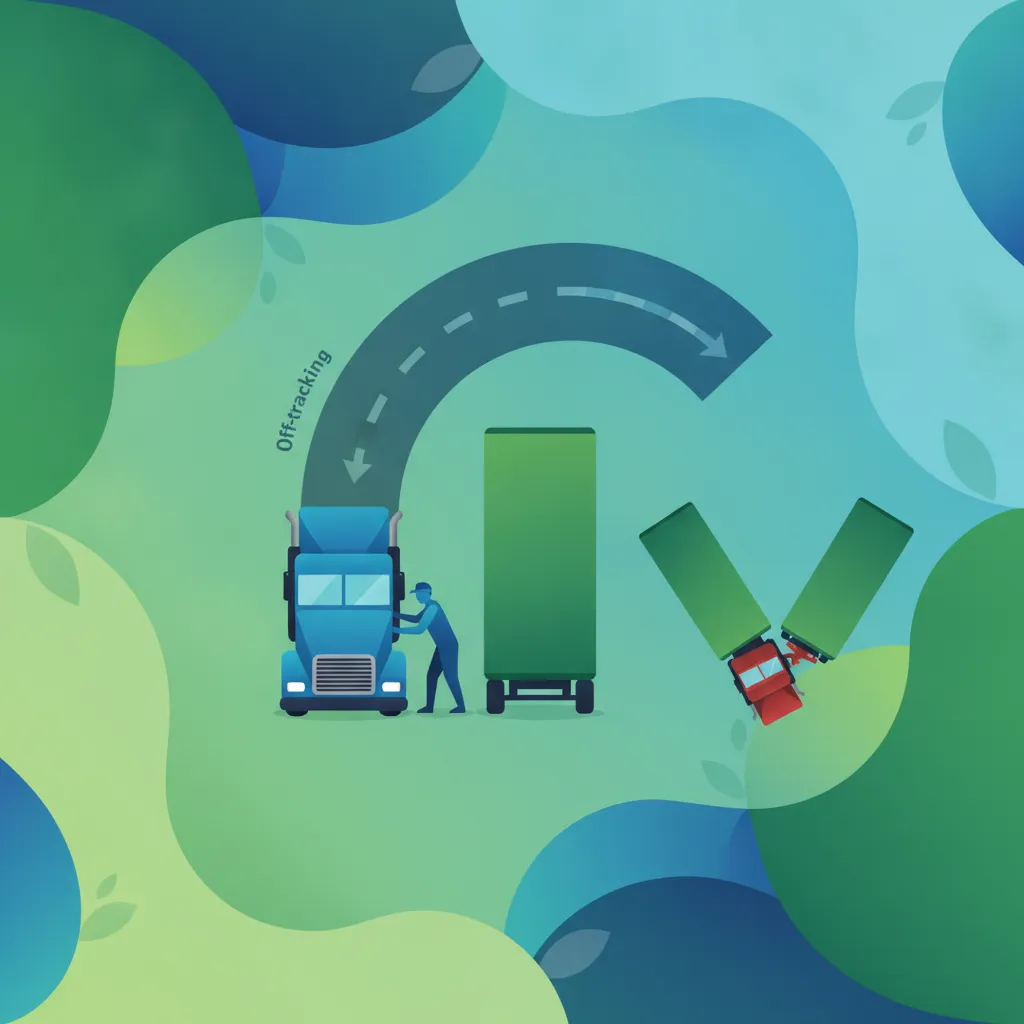
This lesson focuses on the phenomenon of off-tracking, where the rear wheels of a trailer follow a path inside that of the tractor's wheels during a turn. It explains how to anticipate this effect and allow extra space when cornering to avoid running over curbs, signs, or other roadside objects. Managing off-tracking is a key skill for navigating intersections and roundabouts.
This lesson addresses the complex task of reversing a combination vehicle. It explains the principles of reverse articulation and how steering inputs have an opposite effect on the trailer's direction. The lesson provides strategies for using mirrors and, if available, a spotter to safely and accurately back the trailer into a desired position.
This lesson consolidates the legal restrictions on the maximum dimensions and weight for different vehicle combinations in Austria. It covers how to read signs indicating these limits and the importance of compliance for route planning. Adhering to these regulations is essential for legal operation and avoiding fines.
Explore high-intent keywords and long-tail search topics learners use when researching Trailers, Semitrailers, Coupling and Combination Behaviour. These terms reflect how people search for reliable study materials, structured explanations, and unit-level theory preparation support in Austria.
Find clear answers to the most common questions learners ask about Trailers, Semitrailers, Coupling and Combination Behaviour. Understand how the unit is organized, what learning goals it supports, and how it contributes to your study progression with structured explanations and practical guidance tailored for learners in Austria.
In Austrian driving theory, an Anhänger (trailer) is typically a separate vehicle towed by a rigid truck, connected via a drawbar. A Sattelanhänger (semitrailer) is a trailer without front axles that rests partially on a coupling device (Sattelkupplung) on the towing vehicle, known as a tractor unit (Sattelschlepper). Understanding these distinctions is crucial for exam preparation and safe operation.
Off-tracking, often referred to as 'trailer cut-in' or 'rear swing', occurs when the trailer wheels do not follow the exact path of the towing vehicle's wheels, especially during turns. This means the trailer's rear will swing outwards. You must anticipate this by taking wider turns to avoid hitting curbs, other vehicles, or pedestrians, a common point of focus in the Austrian theory test.
Jackknifing occurs when the towing unit and the trailer form an acute angle, resembling a folding pocket knife. This can happen during sudden braking or acceleration, especially on slippery surfaces. It leads to a complete loss of steering control. The theory exam tests your understanding of how to prevent this by maintaining appropriate speed, distance, and smooth control inputs.
Before driving, crucial safety checks include ensuring the coupling mechanism is correctly engaged and locked, the safety chain or cable is attached, the electrical connections are secure, and the trailer's parking brake is released. You must also verify that the trailer's lights are functioning. These steps are vital for safe operation and frequently appear in exam scenarios.
Reversing with a trailer is significantly more challenging because the trailer's rear tends to move in the opposite direction of your steering input relative to the towing vehicle. You need to use minimal steering movements and be highly aware of the trailer's path. Practicing controlled corrections and understanding the articulation point are key, as tested in the theory exam.
Incorrect coupling can lead to the trailer detaching, causing severe accidents and significant legal penalties, including fines and licence suspension. Similarly, improper load securing or exceeding weight limits on trailers can result in penalties. Austrian law is strict on the safe operation of all vehicle combinations, and theory questions often cover these responsibilities.
All included lessons
Lessons in Trailers, Semitrailers, Coupling and Combination Behaviour
See who benefits most from studying Trailers, Semitrailers, Coupling and Combination Behaviour. This overview explains how the unit supports different learning needs, what level of knowledge is helpful before starting, and how it fits into the overall study path in Austria.
This unit is essential for all drivers pursuing Austrian heavy goods vehicle licences (C, C1, C1E, CE) who need to operate combinations involving trailers or semitrailers. It is particularly crucial for those preparing for the theory exam, as questions on coupling, reversing, and combination behaviour are common.

Ready to systematically master Austrian driving theory? Explore our diverse range of structured courses and find the perfect learning path for your license category. Start building your knowledge foundation and preparing confidently for your official driving theory exam in Austria.
Browse Theory CurriculumExplore all units and lessons included in this driving theory course.
Ready to systematically master Austrian driving theory? Explore our diverse range of structured courses and find the perfect learning path for your license category. Start building your knowledge foundation and preparing confidently for your official driving theory exam in Austria.
Browse Theory Curriculum