
This lesson provides a comprehensive overview of the legal dimensions and mass limits for heavy vehicle combinations in Austria. You will learn how to interpret specific road signs and apply these restrictions to your route planning to ensure legal compliance and vehicle safety. This knowledge is crucial for your C and CE licence theory exam and your professional driving career.

Lesson content overview
Operating heavy goods vehicles (HGVs) and their combinations in Austria demands a thorough understanding of legal restrictions concerning length, width, height, and weight. These regulations are not arbitrary; they are critical for maintaining road infrastructure, ensuring traffic flow, and most importantly, guaranteeing road safety for all users. As a professional driver, strict adherence to these limits is paramount for legal operation and avoiding severe penalties.
This lesson consolidates the essential legal parameters for vehicle combinations within the Austrian driving license categories C, C1, C1E, and CE. It will equip you with the knowledge to interpret relevant road signs, understand the implications of non-compliance, and plan your routes effectively to meet all regulatory demands.
Compliance with dimensional and weight restrictions for heavy goods vehicles is a cornerstone of responsible and legal transport operations in Austria. Ignoring these regulations can lead to a cascade of negative consequences, affecting safety, infrastructure, and your professional standing.
Exceeding established limits severely compromises vehicle handling characteristics, significantly increasing braking distances and making the combination less stable, especially during emergency manoeuvres or in adverse weather. This directly escalates the risk of accidents. Furthermore, over-dimensioned or overweight vehicles cause excessive wear and tear on roads, bridges, and tunnels, leading to costly infrastructure damage. Beyond safety and infrastructure, non-compliance results in hefty fines, potential vehicle impoundment, points on your driving license, and even a driving ban, posing a serious threat to your career as a professional driver.
The regulations governing the dimensions and weight of vehicle combinations are built upon several core principles designed to ensure safety, protect infrastructure, and facilitate efficient traffic management. Grasping these foundational concepts is crucial for making informed decisions on the road.
This principle establishes strict legal limits on the overall length, width, and height of vehicle combinations. Its primary purpose is to prevent collisions with fixed roadside objects, ensure adequate clearance in tunnels and under bridges, and enable safe passage through narrow passages or around tight corners. Drivers must diligently verify their vehicle's dimensions against all posted limits, as exceeding them necessitates route adjustments or, in specific cases, a special permit.
This principle dictates the maximum permissible total gross vehicle weight (GVW) and the individual loads allowed on each axle or axle group within a combination. These limits are crucial for preserving the structural integrity of roads and bridges, which are engineered to withstand specific load capacities. Adhering to these weight restrictions also ensures that the vehicle maintains predictable handling characteristics and optimal braking performance. Overweight combinations must either be rerouted, unload cargo, or obtain special permits for transport.
The combined length principle focuses specifically on the overall length of a tractor unit coupled with its trailer(s). Special limits are set based on the vehicle class (e.g., CE, C1E). The intent is to ensure sufficient turning radius and safe manoeuvring capabilities, particularly on challenging urban streets or winding alpine roads. Drivers are required to accurately measure their entire combination length and compare it against any posted restrictions, as exceeding these limits can lead to unsafe operation and legal infractions.
Ultimately, all professional drivers are bound by the legal compliance principle, which mandates strict adherence to all posted road signs indicating dimensional and weight restrictions. This principle underpins the uniform application of traffic laws across the entire road network, enabling authorities to manage infrastructure usage effectively. Drivers must be prepared to stop, assess their vehicle's compliance, and adjust their route if necessary. Violations can lead to significant fines, further penalties, and even temporary traffic bans.
Austria has specific legal maximums for the dimensions and weight of heavy goods vehicle combinations. These apply generally, but specific road signs can impose stricter local limits. It's vital to know both the general rules and how to interpret signs.
The overall length is measured from the foremost point of the tractor unit to the rearmost point of the trailer(s), including all coupling devices and any projections. This measurement is critical for determining a combination's ability to negotiate turns and fit within designated spaces.
For most standard tractor-semitrailer combinations (typically for the CE category), the maximum permissible overall length in Austria is 18.75 metres. This length is a common standard across many European countries and dictates the design of many articulated vehicles. Longer vehicle combinations, such as those with a drawbar trailer (Lastzug), have different standard limits.
Always measure your combination's full length, including the space between the tractor and trailer, not just the individual lengths of the units.
Certain types of articulated combinations, such as those used for specific logistics tasks (e.g., transporting multiple swap bodies), may be allowed to operate at lengths up to 25.25 metres. However, such extended lengths are only permitted under a special permit issued by the authorities. These permits often come with strict conditions regarding approved routes, times of travel, and sometimes require escort vehicles.
The overall width is defined as the greatest horizontal distance between the outermost points of the vehicle combination. This includes all fixed parts and accessories.
The standard maximum overall width for most heavy vehicle combinations in Austria is 2.55 metres. This measurement must include side mirrors and any other permanently affixed equipment that protrudes beyond the main body of the vehicle. Drivers often overlook mirror extensions, which can inadvertently cause a violation of width restrictions, leading to collisions with roadside objects or other vehicles.
Do not forget to account for your side mirrors when calculating the overall width. These can add several centimetres to each side, potentially exceeding the 2.55 m limit.
The overall height is the vertical distance from the ground to the highest point of the vehicle combination, including any load or roof-mounted equipment.
The standard maximum overall height for most heavy vehicle combinations in Austria is 4.00 metres. This limit is crucial for ensuring safe passage under bridges, overpasses, and through tunnels. It is important to note that while 4.00 metres is the general maximum, some tunnels or specific routes, particularly in alpine regions, may have lower clearances, sometimes as low as 3.80 metres. Always pay close attention to height restriction signs.
Gross Vehicle Weight (GVW) is the total permissible weight of the entire vehicle combination, including its own weight, the cargo (payload), fuel, driver, passengers, and any accessories.
The GVW limits vary significantly based on the vehicle category and the number of axles.
It is a common misunderstanding to confuse GVW with maximum payload. Payload refers only to the weight of the cargo you can carry. GVW, on the other hand, includes the vehicle's own empty weight (tare weight) plus the payload and everything else on board. Always ensure your total GVW does not exceed the legal limit for your vehicle combination and the road section.
Beyond the overall GVW, strict limits are placed on the maximum permissible load that can be borne by individual axles or axle groups. This is vital for protecting the road surface, bridge structures, and ensuring the vehicle's stability and braking performance.
Typically, the maximum permissible load for a single axle on a heavy goods vehicle in Austria is 10 tonnes. For tandem axles (two axles positioned close together), the combined load limit is generally 18 tonnes, though this can vary slightly based on the exact spacing between the axles. Tridem (three) axle groups have their own specific limits.
Correct load distribution across all axles is critical. Unevenly distributed loads can cause excessive stress on certain axles, leading to premature tire wear, tire blowouts, and potentially dangerous alterations to braking characteristics. During emergency braking, an overloaded axle can lose traction or experience brake fade more quickly, compromising control. Always ensure your cargo is secured and distributed evenly to comply with these limits.
Road signs are your primary source of information regarding local dimensional and weight restrictions. Recognizing and correctly interpreting these signs is a fundamental skill for every professional driver in Austria.
Length restriction signs indicate the maximum overall length allowed for vehicle combinations on a specific road segment.
This circular sign, typically red-bordered with a black number and a symbol of a truck, dictates the maximum length in metres. For example, a sign showing "18.75 m" means your vehicle combination must not exceed 18.75 metres. Supplementary plates might provide additional context, such as "only for articulated vehicles" or specific time restrictions. Failure to comply can result in fines and the necessity to find an alternative route, potentially causing significant delays.
Width restriction signs are common on narrow roads, bridges, and tunnels, indicating the maximum permissible width.
Similar to length signs, these are circular, red-bordered, and show a black number with a truck symbol indicating the maximum width in metres. Remember that this measurement includes your side mirrors. Ignoring such a sign can lead to direct collisions with structures, causing damage to your vehicle and potential infrastructure.
Height restriction signs warn drivers of limited vertical clearance, particularly important before tunnels, underpasses, and low bridges.
This circular, red-bordered sign shows a black number in metres, often with an overhead arch symbol. It denotes the maximum height allowed. Always confirm your vehicle's exact height, especially when transporting unusual loads or using double-deck trailers, before approaching such restricted areas. Colliding with an overhead structure can cause severe damage and traffic disruption.
Gross Vehicle Weight (GVW) limit signs prohibit vehicles or combinations exceeding a certain total weight from entering a specific road or bridge.
This red-bordered circular sign shows a black number in tonnes (t). For instance, a sign displaying "44 t" means the total weight of your combination, including its load, must not exceed 44 tonnes. Bridges are particularly susceptible to damage from overweight vehicles, and these signs are placed strategically to protect them. Always verify your laden weight before crossing such a bridge.
Axle load limit signs restrict the maximum weight that can be carried by any single axle or axle group.
This circular, red-bordered sign features a black number in tonnes (t) and a single axle symbol. It specifies the maximum load permitted on any one axle. Even if your overall GVW is within limits, an unevenly distributed load could cause one or more axles to exceed their individual limits. This can lead to fines and, more critically, compromises vehicle stability and braking effectiveness.
While standard limits cover the vast majority of transport operations, there are situations where specific loads naturally exceed these dimensions or weights. In such cases, a special permit is required.
Special permits are necessary for transporting oversized loads that genuinely cannot be broken down into smaller, compliant units. This often includes large industrial machinery, wind turbine components, or exceptionally long structural elements.
The process for obtaining a special permit (Sondertransportgenehmigung) involves submitting a detailed application to the relevant Austrian road traffic authorities. This application typically includes precise measurements of the vehicle combination and load, a detailed route plan, and sometimes a structural analysis of bridges or other infrastructure along the proposed route.
Permits are issued under strict conditions, which may include:
Successfully navigating Austria's roads with a heavy goods vehicle combination requires more than just knowing the rules; it demands careful planning and continuous vigilance.
Effective route planning is the first line of defence against non-compliance. Before embarking on any journey, professional drivers must:
Proper Ladungssicherung (load securing) is inextricably linked to maintaining legal weight distribution and overall vehicle stability.
Many violations stem from oversight or miscalculation. Be aware of common pitfalls:
When in doubt, always err on the side of caution. If a sign's meaning is unclear, or you're unsure of your vehicle's exact dimensions, it's safer to find an alternative route than risk a violation.
External conditions and the state of your vehicle can significantly influence the risks associated with dimensional and weight restrictions.
Mastering the intricacies of combination length, weight, and legal restrictions is a fundamental requirement for every heavy goods vehicle driver in Austria. This knowledge empowers you to make responsible decisions, plan safe and legal routes, and operate your vehicle combination with confidence.
Remember these key takeaways:
By consistently applying these principles, you contribute to road safety, protect vital infrastructure, and uphold your professional responsibilities, ensuring smooth and uninterrupted operation across Austria's diverse road network.
This lesson covers Austria's legal framework for heavy vehicle combination dimensions and weights, including standard maximum limits of 18.75m length, 2.55m width, 4.00m height, and 44 tonnes GVW for CE combinations. Key skills include interpreting road signs that indicate local restrictions, understanding the critical distinction between GVW and payload, and recognizing that mirrors must be included in width measurements. The lesson also addresses axle load limits (10t single, 18t tandem), the requirement for special permits when standard limits are exceeded, and the importance of proper load distribution for both legal compliance and vehicle stability. Professional drivers must apply this knowledge during route planning to avoid fines, infrastructure damage, and safety hazards.
A short set of high-value points that capture the most important learning from this lesson.
Standard combination limits in Austria are 18.75m length, 2.55m width (including mirrors), 4.00m height, and 44t GVW for CE category
Overall width measurement must always include side mirrors and any permanently affixed protrusions, not just the vehicle body
GVW includes the vehicle's tare weight plus all cargo, fuel, driver, passengers, and accessories—never confuse it with payload alone
Axle load limits are 10 tonnes for single axles and 18 tonnes for tandem axles, and these must be respected even if total GVW is compliant
Special permits (Sondertransportgenehmigung) are required for oversized loads and must be visibly displayed during transport
Explore all units and lessons included in this driving theory course.
Local road signs can impose stricter limits than standard rules—always check posted restrictions before entering a road section
Some alpine tunnels and bridges have reduced clearances as low as 3.80m, so never assume all routes conform to the 4.00m standard
Payload is only the cargo weight; GVW is the total of everything on board including the empty vehicle itself
Evenly distributed cargo is essential—uneven loading can overload individual axles despite total weight being within limits
Permit conditions may include specific routes, time restrictions, escort vehicles, and visible display requirements
Forgetting that side mirrors add several centimetres to each side, potentially causing accidental width violations
Confusing GVW with maximum payload and incorrectly calculating how much cargo can be loaded
Assuming all tunnels and bridges have standard 4.00m clearance without checking actual posted heights
Loading cargo unevenly, which overloads specific axles even when the total combination weight is legally compliant
Failing to visibly display special permits during oversized transport, making the load non-compliant despite having valid authorization
Lesson content overview
A short set of high-value points that capture the most important learning from this lesson.
Standard combination limits in Austria are 18.75m length, 2.55m width (including mirrors), 4.00m height, and 44t GVW for CE category
Overall width measurement must always include side mirrors and any permanently affixed protrusions, not just the vehicle body
GVW includes the vehicle's tare weight plus all cargo, fuel, driver, passengers, and accessories—never confuse it with payload alone
Axle load limits are 10 tonnes for single axles and 18 tonnes for tandem axles, and these must be respected even if total GVW is compliant
Special permits (Sondertransportgenehmigung) are required for oversized loads and must be visibly displayed during transport
Explore all units and lessons included in this driving theory course.
Local road signs can impose stricter limits than standard rules—always check posted restrictions before entering a road section
Some alpine tunnels and bridges have reduced clearances as low as 3.80m, so never assume all routes conform to the 4.00m standard
Payload is only the cargo weight; GVW is the total of everything on board including the empty vehicle itself
Evenly distributed cargo is essential—uneven loading can overload individual axles despite total weight being within limits
Permit conditions may include specific routes, time restrictions, escort vehicles, and visible display requirements
Forgetting that side mirrors add several centimetres to each side, potentially causing accidental width violations
Confusing GVW with maximum payload and incorrectly calculating how much cargo can be loaded
Assuming all tunnels and bridges have standard 4.00m clearance without checking actual posted heights
Loading cargo unevenly, which overloads specific axles even when the total combination weight is legally compliant
Failing to visibly display special permits during oversized transport, making the load non-compliant despite having valid authorization
Explore search topics learners often look for when studying Combination Length, Weight, and Legal Restrictions. These topics reflect common questions about road rules, driving situations, safety guidance, and lesson level theory preparation for learners in Austria.
Browse additional driving theory lessons that cover connected traffic rules, road signs, and common driving situations related to this topic. Improve your understanding of how different rules interact across everyday traffic scenarios.
Understand the fundamental legal restrictions on overall length, width, height, and weight for HGV combinations in Austria. Essential knowledge for safe and compliant route planning and operation.

This lesson details the legal ramifications of operating an overloaded heavy vehicle in Austria, which include significant fines and penalty points. It also emphasizes the severe safety risks, such as compromised braking performance and increased mechanical stress on the vehicle. Understanding these consequences reinforces the importance of strict adherence to weight limits.

This lesson focuses on the legal restrictions concerning a heavy vehicle's dimensions, including maximum height, width, and length. It teaches drivers how to interpret road signs and supplemental plates that indicate these limits. This knowledge is crucial for route planning, especially when navigating under bridges, through tunnels, and on restricted roads.

This lesson provides an overview of the legal framework governing heavy vehicle drivers in Austria. It details the potential penalties for violations, including fines, penalty points, and the risk of licence suspension. A clear understanding of these consequences reinforces the importance of compliant and responsible driving.
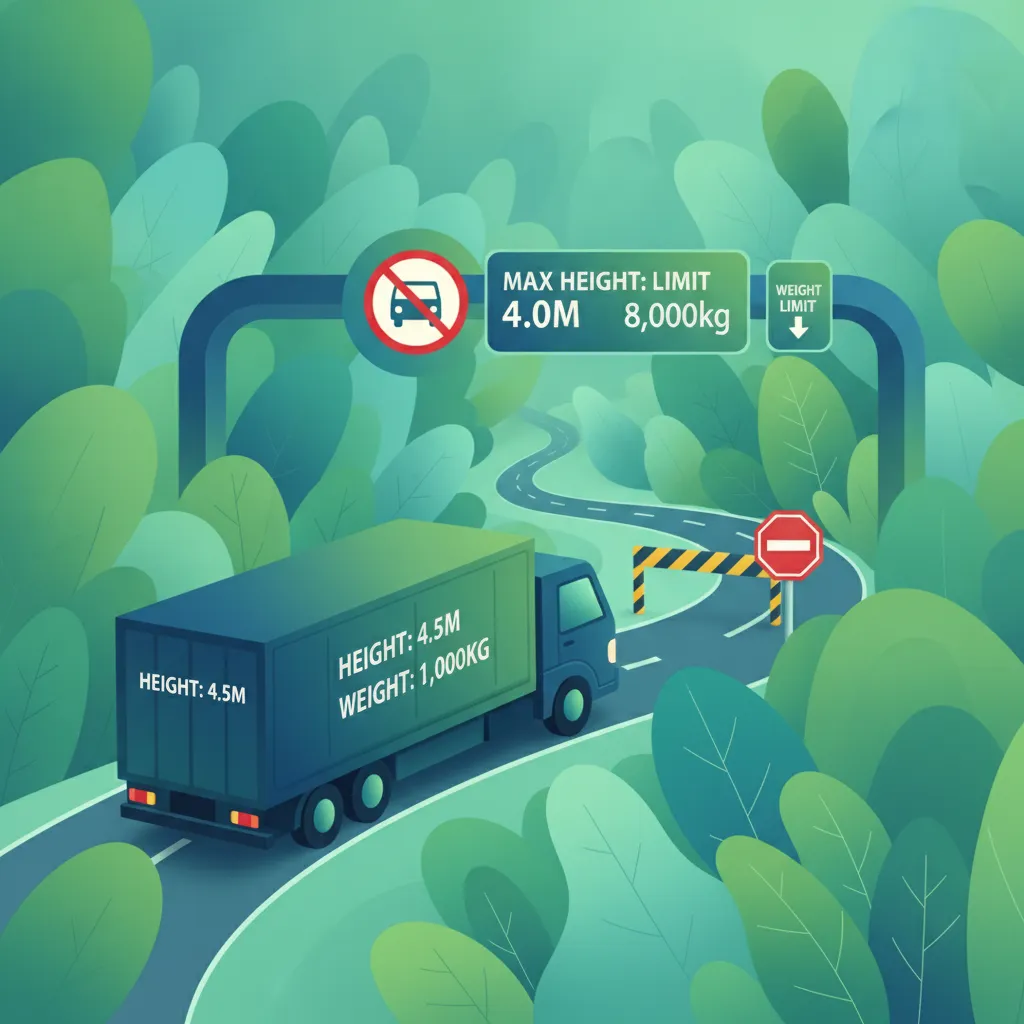
This lesson covers the practical aspects of planning a route for a heavy goods vehicle. It explains how to use maps and specialized GPS systems to identify and avoid roads with height, weight, or other restrictions. Proactive route planning is essential for ensuring an efficient, legal, and safe journey.

This lesson details the general traffic rules applicable to heavy goods vehicles on Austrian roads, highlighting differences from passenger car regulations. It covers key topics such as right-of-way at intersections, specific rules for overtaking, maintaining proper lane discipline, and adhering to designated speed limits. Understanding these rules is critical for safe integration into mixed traffic.

This lesson details the regulations for heavy goods vehicles on Austria's high-speed road network. It covers the specific speed limits, rules on lane usage (e.g., when overtaking is permitted), and procedures for entering and exiting the motorway. Adherence to these rules is crucial for safety in a fast-paced environment.
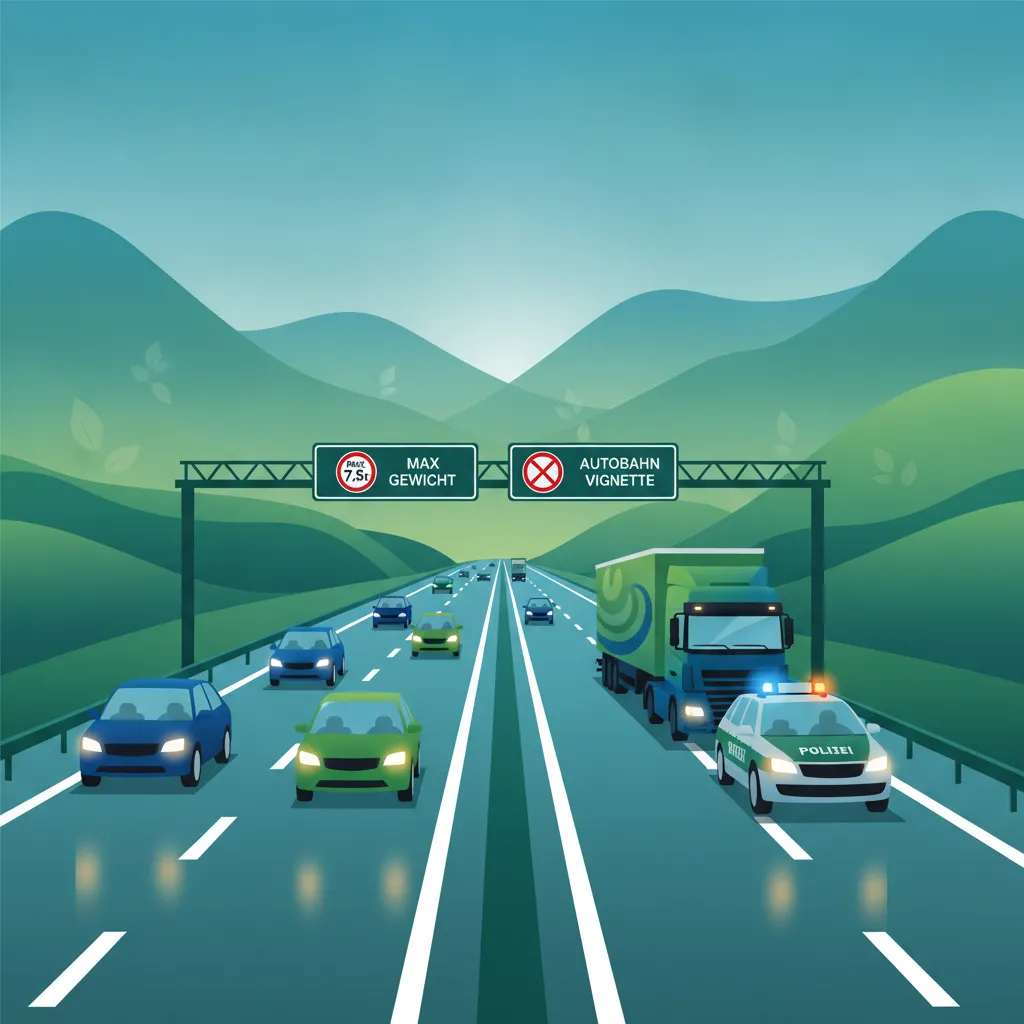
This lesson explains the system of penalties and enforcement for heavy vehicle operations in Austria. It covers the fines and penalty points associated with common traffic violations, such as overloading or insecure loads. Learners will understand the role of authorities in conducting roadside checks and inspections to ensure regulatory compliance.

This lesson covers the specific weight restrictions that apply to sensitive infrastructure like Alpine passes and bridges throughout Austria. It explains how to identify these limits through road signage and incorporate them into route planning. Adhering to these restrictions is vital for preventing structural damage and ensuring safety in challenging terrain.
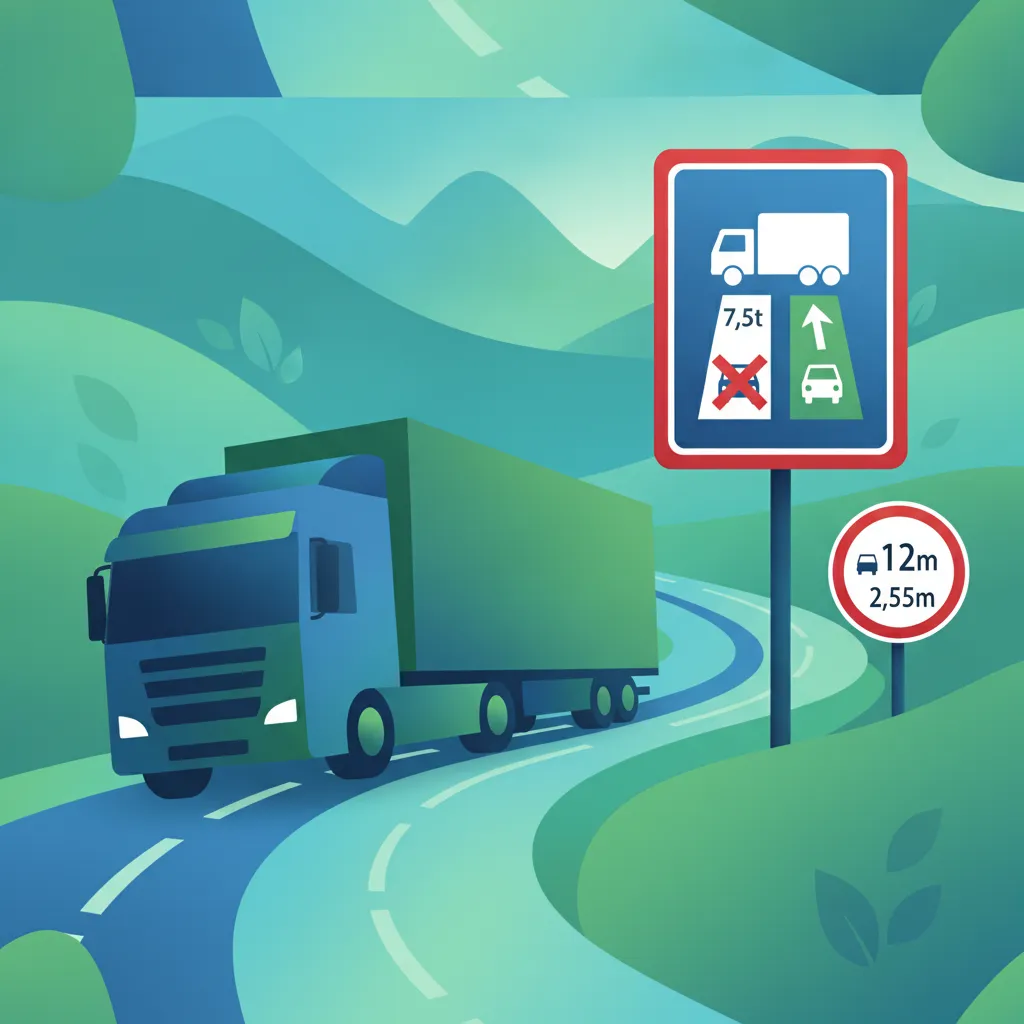
This lesson focuses on the specific Austrian road signs and supplemental plates that apply to heavy goods vehicles. It explains how to interpret signage indicating weight limits, height and width restrictions, lane usage rules, and other critical regulatory information. Correctly understanding these signs is essential for legal compliance and safe navigation on Austria's roads.
Learn to identify and understand specific Austrian road signs that indicate maximum permissible length, width, height, and axle loads for heavy goods vehicles. Crucial for avoiding violations.
This lesson focuses on the specific Austrian road signs and supplemental plates that apply to heavy goods vehicles. It explains how to interpret signage indicating weight limits, height and width restrictions, lane usage rules, and other critical regulatory information. Correctly understanding these signs is essential for legal compliance and safe navigation on Austria's roads.
This lesson focuses on the legal restrictions concerning a heavy vehicle's dimensions, including maximum height, width, and length. It teaches drivers how to interpret road signs and supplemental plates that indicate these limits. This knowledge is crucial for route planning, especially when navigating under bridges, through tunnels, and on restricted roads.
This lesson covers the specific weight restrictions that apply to sensitive infrastructure like Alpine passes and bridges throughout Austria. It explains how to identify these limits through road signage and incorporate them into route planning. Adhering to these restrictions is vital for preventing structural damage and ensuring safety in challenging terrain.

This lesson focuses on the critical importance of observing posted weight and height limits for bridges and other structures. It explains how to read the relevant signage and stresses the driver's responsibility to know their vehicle's exact height and weight. Ignoring these limits can lead to catastrophic structural failure and severe legal consequences.
This lesson details the regulations for heavy goods vehicles on Austria's high-speed road network. It covers the specific speed limits, rules on lane usage (e.g., when overtaking is permitted), and procedures for entering and exiting the motorway. Adherence to these rules is crucial for safety in a fast-paced environment.
This lesson covers the practical aspects of planning a route for a heavy goods vehicle. It explains how to use maps and specialized GPS systems to identify and avoid roads with height, weight, or other restrictions. Proactive route planning is essential for ensuring an efficient, legal, and safe journey.
Find clear answers to common questions learners have about Combination Length, Weight, and Legal Restrictions. Learn how the lesson is structured, which driving theory objectives it supports, and how it fits into the overall learning path of units and curriculum progression in Austria. These explanations help you understand key concepts, lesson flow, and exam focused study goals.
You must look for the official circular prohibition signs with a red border that feature a weight limit (in tonnes). These signs apply to the actual mass of your vehicle or combination at that moment, not the maximum permissible weight unless specified.
No, length restrictions vary depending on the type of combination (rigid with trailer vs. articulated vehicle). You must know the specific legal limits for your vehicle class as defined by Austrian traffic law.
The actual mass is what your vehicle weighs at the time of driving, including load, while the permissible total mass (zGG) is the maximum weight the vehicle is legally allowed to reach. Weight restrictions on signs usually refer to the actual mass.
Failing to account for height or length can lead to collisions with bridges or tunnels and expensive fines. Proper route planning ensures your vehicle remains within the legal and physical capacity of the roads you are travelling.
Refine your study plan by searching for specific Austrian driving theory practice sets. Pinpoint questions related to particular road rules, signs, or challenge levels, and begin practicing immediately to reinforce your knowledge and excel in your official exam with confidence. Get started with focused revision today.