
Safe following distance, or Sicherheitsabstand, is the minimum space you must keep between your vehicle and the one in front to react to hazards and stop safely. This distance is directly related to your stopping distance and depends heavily on your speed and current road conditions. Mastering this concept is fundamental for safe driving on Austrian roads, from urban streets to the Autobahn.
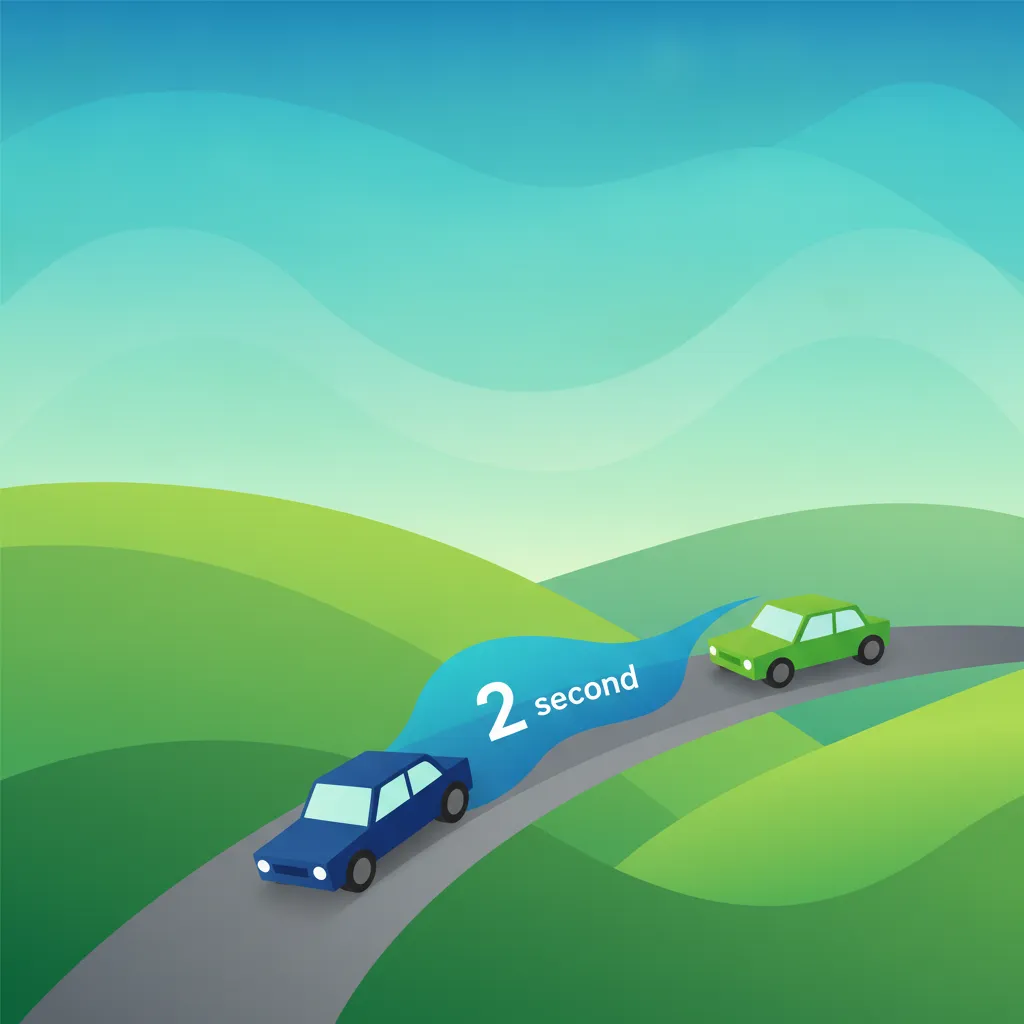
Theory topic content overview
Read the full theory topic guide for Safe Following Distance with structured, easy-to-scan content built for learners in Austria. This detailed section explains the exact rule, meaning, traffic context, comparison points, and exam logic behind this Austrian driving theory topic so you can study faster, understand the concept more clearly, and avoid common interpretation mistakes on the theory test.
Following distance, known in Austria as Sicherheitsabstand, is the crucial space you maintain between your vehicle and the vehicle directly in front of you. Its purpose is fundamental: to provide enough time and space for you to react to unexpected events and bring your vehicle to a complete stop safely, without colliding with the vehicle ahead.
In essence, your Sicherheitsabstand is your personal safety buffer. It directly relates to your total stopping distance, which comprises both your reaction distance and your braking distance. Without adequate Sicherheitsabstand, you drastically increase your risk of a rear-end collision, a common and often preventable type of accident on Austrian roads, from busy urban streets to the high-speed Autobahn.
Maintaining a proper Sicherheitsabstand is not merely a suggestion; it's a cornerstone of defensive driving and a frequent focus in the Austrian driving theory exam. Here's why it's so vital:
The most widely accepted and practical method for judging Sicherheitsabstand in Austria, especially in good conditions, is the "2-Sekunden-Abstand" (two-second distance) rule. This rule accounts for an average driver's reaction time and provides an initial safety margin.
To apply the "2-Sekunden-Abstand":
This method works well because the time interval automatically adjusts the physical distance based on your speed. The faster you drive, the further your vehicle travels in two seconds, thus providing a larger physical gap.
While the "2-Sekunden-Abstand" is a good baseline, a truly safe Sicherheitsabstand must always be equal to or greater than your total stopping distance.
Stopping Distance = Reaction Distance + Braking Distance
Your Sicherheitsabstand must allow for both these phases. Failing to account for braking distance, or mistakenly thinking "1-Sekunden-Abstand" is always sufficient, is a common error and a significant risk.
Several critical factors demand that you increase your Sicherheitsabstand beyond the minimum "2-Sekunden-Abstand":
Understanding Sicherheitsabstand also involves clarifying what it is not, and what it is often confused with:
Let's look at how Sicherheitsabstand applies in common Austrian driving situations:
Learners and even experienced drivers often make these mistakes:
Think of Sicherheitsabstand not as a static rule, but as a dynamic, constantly adjusted safety buffer. On Austrian roads, from mountain passes to urban thoroughfares and high-speed motorways, this buffer is your primary tool for preventing collisions and responding safely to the unpredictable nature of traffic. Always aim for more space than the minimum, especially when conditions are less than ideal. Your life, and the lives of others, depend on it.
Following distance (Sicherheitsabstand) is the safety buffer between your vehicle and the one ahead, designed to give you time to react and stop safely. The 2-Sekunden-Abstand rule provides a practical minimum baseline by counting 'Twenty-one, twenty-two' to a fixed object, but this must always be extended based on speed, road conditions, and other factors. Since doubling speed quadruples braking distance, your required following gap increases dramatically at higher velocities. Real-world Austrian driving demands particular attention to this on the Autobahn at 130 km/h, where a 2-second gap means roughly 72 metres, and in adverse weather where distances must at least double. Tailgating, fixed-distance thinking, and failing to adjust for conditions are the most common and dangerous mistakes to avoid.
A short set of high-value points that capture the most important ideas from this theory explanation.
Sicherheitsabstand must always cover both reaction distance and braking distance combined, not just reaction time.
The 2-Sekunden-Abstand (two-second rule) is a minimum baseline for good conditions only, not a fixed rule for all situations.
Doubling your speed approximately doubles reaction distance but quadruples braking distance, requiring exponentially more space.
Wet roads at least double your braking distance, while snow or ice can extend it 5-10 times, demanding much larger following gaps.
Safe following distance is a dynamic buffer you continuously adjust based on speed, weather, visibility, vehicle condition, and traffic.
At 130 km/h on the Autobahn, a 2-second gap equals approximately 72 metres; wet conditions require at least 144 metres.
Count 'Twenty-one, twenty-two' to measure the 2-second interval using a fixed roadside object.
Always increase following distance when behind large vehicles (LKW), in reduced visibility, or when road surfaces are wet, icy, or gravel.
Stopping distance equals reaction distance plus braking distance; your Sicherheitsabstand must accommodate both.
The 2-second rule automatically scales with speed because faster travel means a greater physical gap in the same time.
Assuming the 2-second rule is always sufficient regardless of speed or weather conditions.
Believing Sicherheitsabstand only needs to cover reaction time and ignoring braking distance, especially at higher speeds.
Using a fixed physical distance (like 'half your speed in metres') instead of a time-based method that adjusts to conditions.
Failing to increase following distance behind heavy vehicles (LKW) and buses due to their longer braking distances and blind spots.
Driving too close in poor visibility, thinking the vehicle ahead is close enough to see and react to instantly.
Start with a short, direct summary of Safe Following Distance before reading the full explanation below.
Following distance is the crucial space you maintain behind another vehicle to ensure you have enough time and space to react and stop safely. In Austria, a common guideline, especially in good conditions, is to maintain a 'two-second distance' (2-Sekunden-Abstand), which accounts for your reaction time and a portion of your braking distance. This distance must always be adjusted based on speed, weather, and traffic density to prevent rear-end collisions.
Review the most important terms, rule signals, and traffic concepts linked to Safe Following Distance.
Explore related theory topic pages connected to Safe Following Distance and continue with the next useful rule explanation.
See the common search queries learners use when trying to understand Safe Following Distance in Austria.

Ready to delve deeper into specific theory topics? Continue exploring detailed explanations of Austrian road signs, traffic rules, and critical driving situations. Solidify your knowledge, clarify any doubts, and ensure you're fully prepared for every aspect of your official driving licence theory exam.
Austrian Driving Theory TopicsTheory topic content overview
A short set of high-value points that capture the most important ideas from this theory explanation.
Sicherheitsabstand must always cover both reaction distance and braking distance combined, not just reaction time.
The 2-Sekunden-Abstand (two-second rule) is a minimum baseline for good conditions only, not a fixed rule for all situations.
Doubling your speed approximately doubles reaction distance but quadruples braking distance, requiring exponentially more space.
Wet roads at least double your braking distance, while snow or ice can extend it 5-10 times, demanding much larger following gaps.
Safe following distance is a dynamic buffer you continuously adjust based on speed, weather, visibility, vehicle condition, and traffic.
At 130 km/h on the Autobahn, a 2-second gap equals approximately 72 metres; wet conditions require at least 144 metres.
Count 'Twenty-one, twenty-two' to measure the 2-second interval using a fixed roadside object.
Always increase following distance when behind large vehicles (LKW), in reduced visibility, or when road surfaces are wet, icy, or gravel.
Stopping distance equals reaction distance plus braking distance; your Sicherheitsabstand must accommodate both.
The 2-second rule automatically scales with speed because faster travel means a greater physical gap in the same time.
Assuming the 2-second rule is always sufficient regardless of speed or weather conditions.
Believing Sicherheitsabstand only needs to cover reaction time and ignoring braking distance, especially at higher speeds.
Using a fixed physical distance (like 'half your speed in metres') instead of a time-based method that adjusts to conditions.
Failing to increase following distance behind heavy vehicles (LKW) and buses due to their longer braking distances and blind spots.
Driving too close in poor visibility, thinking the vehicle ahead is close enough to see and react to instantly.
Start with a short, direct summary of Safe Following Distance before reading the full explanation below.
Following distance is the crucial space you maintain behind another vehicle to ensure you have enough time and space to react and stop safely. In Austria, a common guideline, especially in good conditions, is to maintain a 'two-second distance' (2-Sekunden-Abstand), which accounts for your reaction time and a portion of your braking distance. This distance must always be adjusted based on speed, weather, and traffic density to prevent rear-end collisions.
Review the most important terms, rule signals, and traffic concepts linked to Safe Following Distance.
Explore related theory topic pages connected to Safe Following Distance and continue with the next useful rule explanation.
See the common search queries learners use when trying to understand Safe Following Distance in Austria.
Ready to delve deeper into specific theory topics? Continue exploring detailed explanations of Austrian road signs, traffic rules, and critical driving situations. Solidify your knowledge, clarify any doubts, and ensure you're fully prepared for every aspect of your official driving licence theory exam.
Austrian Driving Theory TopicsUse this exam-focused revision tip to understand how Safe Following Distance is likely to appear in theory questions for learners in Austria. This section helps you identify the most testable part of the rule, avoid common traps, and remember the concept more effectively during Austrian driving theory exam preparation.
In Austrian theory exams, pay close attention to questions involving changing conditions (e.g., wet roads, higher speeds) and how they impact required following distance. Remember that doubling your speed does not just double your stopping distance; it drastically increases it, requiring a much larger safety gap.
Read direct answers to the most common learner questions about Safe Following Distance in Austria. This FAQ focuses on rule confusion, practical meaning, comparison with similar concepts, and the exact uncertainties that appear most often in Austrian driving theory revision and exam preparation.
Sicherheitsabstand (safe following distance) is the minimum distance you should maintain behind the vehicle in front of you to allow for safe reaction and stopping in any situation.
The 'two-second rule' (2-Sekunden-Abstand) is a simple method to estimate a safe following distance in good conditions. You choose a fixed point, and when the vehicle ahead passes it, you should count two seconds before your vehicle reaches the same point. This approximately covers your reaction distance and a margin for braking.
As your speed increases, both your reaction distance and braking distance increase significantly. Therefore, the safe following distance must increase proportionally with your speed to allow enough time to stop.
Yes, absolutely. In adverse conditions like rain, snow, ice, or fog, braking distances are longer and visibility is reduced. You must increase your following distance to three seconds or more to maintain safety.
Tailgating drastically reduces your reaction time and stopping space, making it nearly impossible to avoid a collision if the vehicle in front brakes suddenly. It is a major cause of rear-end accidents.
While the 2-second rule is a general guideline for good conditions, Austrian law requires drivers to maintain a distance that allows them to stop safely, taking into account speed, road conditions, and vehicle type. Failing to do so can result in penalties.
Use the two-second rule by picking a fixed landmark (e.g., a sign or tree) and counting the seconds after the car in front passes it until your car reaches it. Practicing this helps you internalize safe spacing.
Refine your study plan by searching for specific Austrian driving theory practice sets. Pinpoint questions related to particular road rules, signs, or challenge levels, and begin practicing immediately to reinforce your knowledge and excel in your official exam with confidence. Get started with focused revision today.