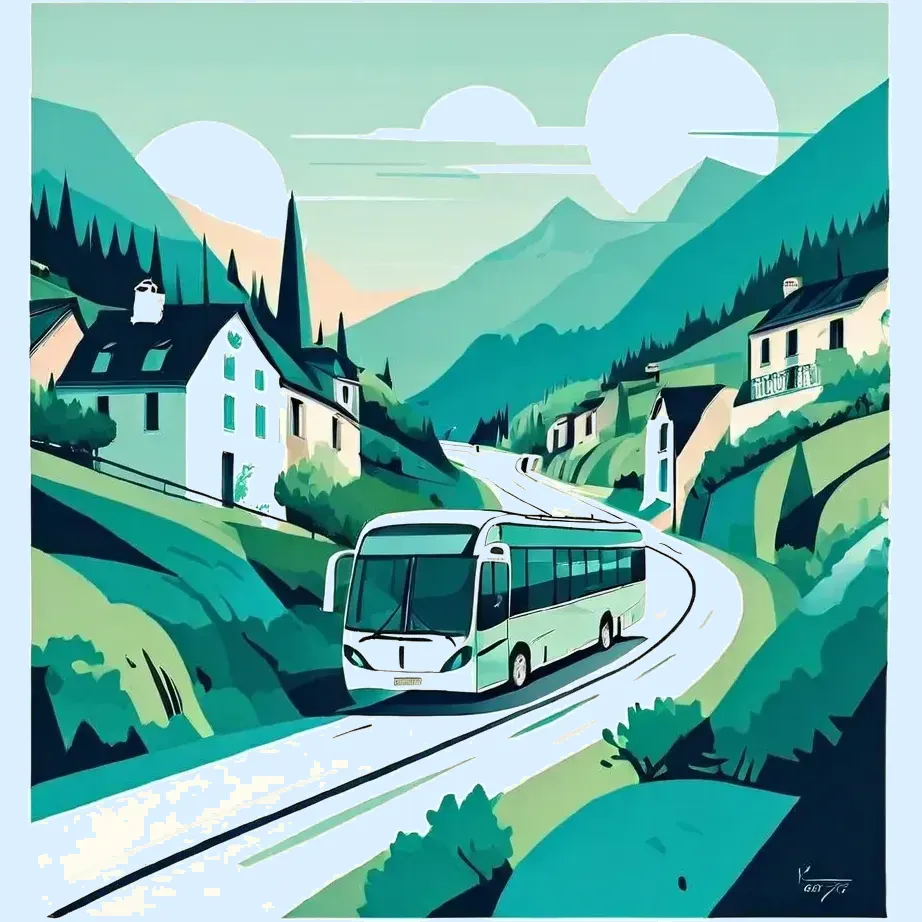
Driving in France presents unique challenges when encountering large vehicles such as tourist coaches, especially in busy towns and steep mountain areas. This article will equip you with the knowledge needed to anticipate their movements, understand their operational limitations, and maintain safe distances, a critical aspect for your Code de la route preparation.
Article content overview
Driving in France, whether through bustling urban centres or winding mountain passes, requires constant awareness of other road users and their capabilities. Among the most significant challenges are large vehicles, particularly tourist coaches and articulated lorries. Understanding the unique limitations and behaviours of these behemoths is not just a matter of courtesy; it is a critical component of safe driving and a key area of focus within the French driving theory exam, the Code de la route. Familiarity with these hazards will help you anticipate their movements, avoid dangerous situations, and ultimately contribute to a safer journey for everyone on French roads.
Large vehicles like tourist coaches, often referred to as autocars, and heavy goods vehicles (poids lourds) present distinct challenges due to their size, weight, and engineering. Their sheer mass impacts their acceleration and deceleration capabilities, meaning they require significantly more space and time to manoeuvre compared to standard passenger cars. This fundamental difference dictates how other road users must interact with them, especially in environments where space is already limited.
A primary concern when driving near large vehicles is the significant reduction in visibility for both the coach driver and other road users. Tourist coaches, in particular, have large blind spots, often referred to as "zones de danger" in French driving terminology, that extend considerable distances to the front, rear, and sides. Drivers of smaller vehicles, cyclists, and motorcyclists can easily find themselves completely obscured from the coach driver's view. This means that a coach driver may initiate a manoeuvre, such as a lane change or turn, without being aware of a smaller vehicle in their blind spot, leading to potentially severe collisions.
Conversely, the elevated position of a coach driver can also create visibility issues for them when observing smaller vehicles directly ahead. They may have difficulty seeing a car that has stopped suddenly or is much lower than the coach. It is therefore imperative for drivers of smaller vehicles to maintain a safe following distance, ensuring they are always visible to the coach driver and are not within these dangerous zones.
The significant turning radius of large vehicles is another critical factor to consider, particularly in urban environments and on narrow mountain roads. A tourist coach requires a much wider arc to complete a turn than a typical car. This means that when a coach is turning, especially at intersections or into side streets, the driver must often cross into opposing traffic lanes or even onto pavements to negotiate the corner. Drivers approaching a turning coach must be patient and understand that the vehicle will take a considerable amount of time and space to complete its manoeuvre.
In mountainous regions of France, where roads are often narrow and winding, this turning challenge is amplified. Drivers must be prepared for coaches to take up a significant portion of the road width when turning, and it is essential to give them ample room and never attempt to overtake during a turn. Misjudging the space required can lead to the coach mounting a kerb, striking roadside obstacles, or even colliding with oncoming traffic.
The immense weight of tourist coaches and other large vehicles dictates much longer braking distances. Under emergency braking conditions, a fully loaded coach can take significantly longer to stop than a passenger car, even at moderate speeds. This is due to the sheer inertia they possess. Drivers following a large vehicle must always be mindful of this, maintaining a generous following distance. Sudden braking by a car in front of a coach can leave the coach driver with insufficient time and distance to react, leading to a rear-end collision.
The momentum of these vehicles also means that once they are moving, they are difficult to stop quickly. This is especially true on inclines and declines. In mountainous areas, coaches can build up considerable speed when descending, and their braking systems can be stressed. Conversely, when ascending steep gradients, their acceleration is slow, and they can cause significant traffic delays. Anticipating these factors is crucial for safe driving.
The hazards associated with large vehicles are amplified in specific French geographical and traffic contexts. Urban environments and mountain roads each present unique challenges that demand particular attention.
French towns and cities are often characterised by narrow streets, complex intersections, and high traffic density. Navigating these areas alongside tourist coaches requires a heightened sense of caution. Coaches may struggle to manoeuvre through tight junctions, and their drivers might use tactics such as signalling a turn significantly in advance and then executing it slowly, requiring other road users to wait patiently. It is vital to remember that passengers on these coaches, including children and elderly individuals, are also vulnerable road users.
Roundabouts, prevalent in France, can also be challenging. Large coaches need more space to enter and exit roundabouts, and their drivers may take a wider path. Drivers entering a roundabout must ensure they do not cut off a large vehicle that is already committed to its manoeuvre. The Code de la route emphasizes patience and yielding in such situations to prevent accidents.
Mountain roads in France, such as those in the Alps or Pyrenees, are notoriously challenging for all drivers, but especially for those operating or encountering large vehicles. The combination of steep gradients, sharp bends, and limited visibility makes these routes particularly hazardous. Coaches often use specific routes designated for their size, but even then, unexpected encounters can occur.
When descending steep mountain roads, coaches rely heavily on their braking systems. Drivers of smaller vehicles should never try to overtake a coach on a descent unless it is absolutely safe and legally permitted. Coaches may slow down significantly on inclines, and it is essential to allow them to maintain their pace without pressure, as they cannot accelerate quickly. If a coach is ascending a steep hill, and you are behind it, be prepared for a very slow journey. If you are approaching a coach from the opposite direction on a narrow mountain road, it is often the responsibility of the smaller vehicle to pull over and allow the larger vehicle to pass.
Understanding these hazards translates directly into safe driving practices and is a common theme in the French driving theory examination. The Code de la route places significant emphasis on hazard perception and the ability to anticipate the actions of other road users based on their vehicle type and the environment.
The ETG (Épreuve Théorique Générale) exam frequently includes questions that assess your understanding of interactions with large vehicles. These questions are designed to evaluate whether you can apply the principles of safe driving in complex situations. Expect scenarios that require you to decide the correct course of action when a coach is turning, merging, or braking, particularly in urban or mountainous settings. The correct answer will always prioritize safety, often by suggesting waiting, yielding, or maintaining a greater distance.
The presence of large vehicles like tourist coaches in French towns and mountains necessitates a proactive and informed approach to driving. By understanding their limitations in terms of visibility, turning, and braking, you can significantly enhance your safety and the safety of others. This knowledge is not only fundamental to passing your permis de conduire theory test but is also an indispensable skill for any responsible driver navigating the diverse landscapes of France. Always remember that anticipation and patience are your greatest allies when sharing the road with these substantial vehicles.
This article covers the critical hazards posed by tourist coaches and heavy goods vehicles on French roads, focusing on visibility limitations, wide turning requirements, and extended braking distances. It addresses specific challenges in urban environments where coaches navigate narrow streets and roundabouts, and in mountainous regions where steep gradients amplify these difficulties. Understanding these limitations helps learners anticipate dangerous situations and respond safely during the Code de la route exam. The key to passing related ETG questions lies in demonstrating patience, maintaining safe distances, and prioritizing visibility at all times when sharing the road with large vehicles.
A short set of high-value points that capture the most important ideas from this article.
Large vehicles have extensive blind spots (zones de danger) where smaller vehicles can be completely invisible to the driver
Tourist coaches require significantly longer braking distances due to their mass and momentum
Large vehicles need a much wider turning arc and their rear overhang extends into lanes they are turning from
Coach drivers may struggle to see smaller vehicles stopped directly ahead due to the elevated driving position
Mountain roads amplify all hazards due to steep gradients, sharp bends, and limited passing opportunities
Always maintain a greater following distance behind large vehicles than you would for a standard car
Never assume a coach driver can see you—assume you are invisible if you are in their blind spot
Be prepared for coaches to take up multiple lanes when turning, especially at urban intersections
On mountain descents, coaches may build up speed and their brakes can become stressed
On narrow mountain roads, smaller vehicles typically have the responsibility to pull over for large vehicles
Assuming that if you can see a coach driver's face, they can see you back
Underestimating braking distance by only leaving the standard 2-second gap used for cars
Attempting to overtake a large vehicle on a narrow mountain road or during a turn
Positioning your vehicle where the rear overhang of a turning coach could strike it
Pressuring or rushing a large vehicle by tailgating or appearing impatient at intersections
Article content overview
A short set of high-value points that capture the most important ideas from this article.
Large vehicles have extensive blind spots (zones de danger) where smaller vehicles can be completely invisible to the driver
Tourist coaches require significantly longer braking distances due to their mass and momentum
Large vehicles need a much wider turning arc and their rear overhang extends into lanes they are turning from
Coach drivers may struggle to see smaller vehicles stopped directly ahead due to the elevated driving position
Mountain roads amplify all hazards due to steep gradients, sharp bends, and limited passing opportunities
Always maintain a greater following distance behind large vehicles than you would for a standard car
Never assume a coach driver can see you—assume you are invisible if you are in their blind spot
Be prepared for coaches to take up multiple lanes when turning, especially at urban intersections
On mountain descents, coaches may build up speed and their brakes can become stressed
On narrow mountain roads, smaller vehicles typically have the responsibility to pull over for large vehicles
Assuming that if you can see a coach driver's face, they can see you back
Underestimating braking distance by only leaving the standard 2-second gap used for cars
Attempting to overtake a large vehicle on a narrow mountain road or during a turn
Positioning your vehicle where the rear overhang of a turning coach could strike it
Pressuring or rushing a large vehicle by tailgating or appearing impatient at intersections
Explore related topics, search based questions, and concepts that learners often look up when studying Large Vehicle Hazards in France. These themes reflect real search intent and help you understand how this topic connects to wider driving theory knowledge in France.
Find clear and practical answers to common questions learners often have about Large Vehicle Hazards in France. This section helps explain difficult points, remove confusion, and reinforce the key driving theory concepts that matter for learners in France.
In French towns, large vehicles have reduced visibility for both the driver and other road users, a wider turning radius requiring more space, and longer braking distances, increasing the risk of collisions in tight urban environments.
Mountainous terrain in France exacerbates hazards for large vehicles due to steep gradients affecting braking and acceleration, sharp bends requiring significant maneuvering space, and potential for reduced visibility caused by weather or road curvature.
A coach's wide turning radius means it needs to swing out significantly, often crossing into other lanes or the oncoming lane, which requires other drivers to anticipate this movement and maintain a safe distance to avoid being caught in the turn.
Knowing that large vehicles have much longer braking distances than cars is essential for the French theory exam as it teaches you to maintain a safe following distance, avoid sudden braking, and anticipate potential hazards well in advance.
While the Code de la route may not detail every specific hazard, it emphasizes general principles of safe driving, anticipating other road users' actions, maintaining appropriate speeds, and understanding vehicle limitations, all of which apply to large vehicles.
Continue your preparation for the French permis de conduire exam. Dive deeper into specific Code de la route sections, practice scenarios, or review official procedures. Use our comprehensive article collection to master every aspect of driving theory.