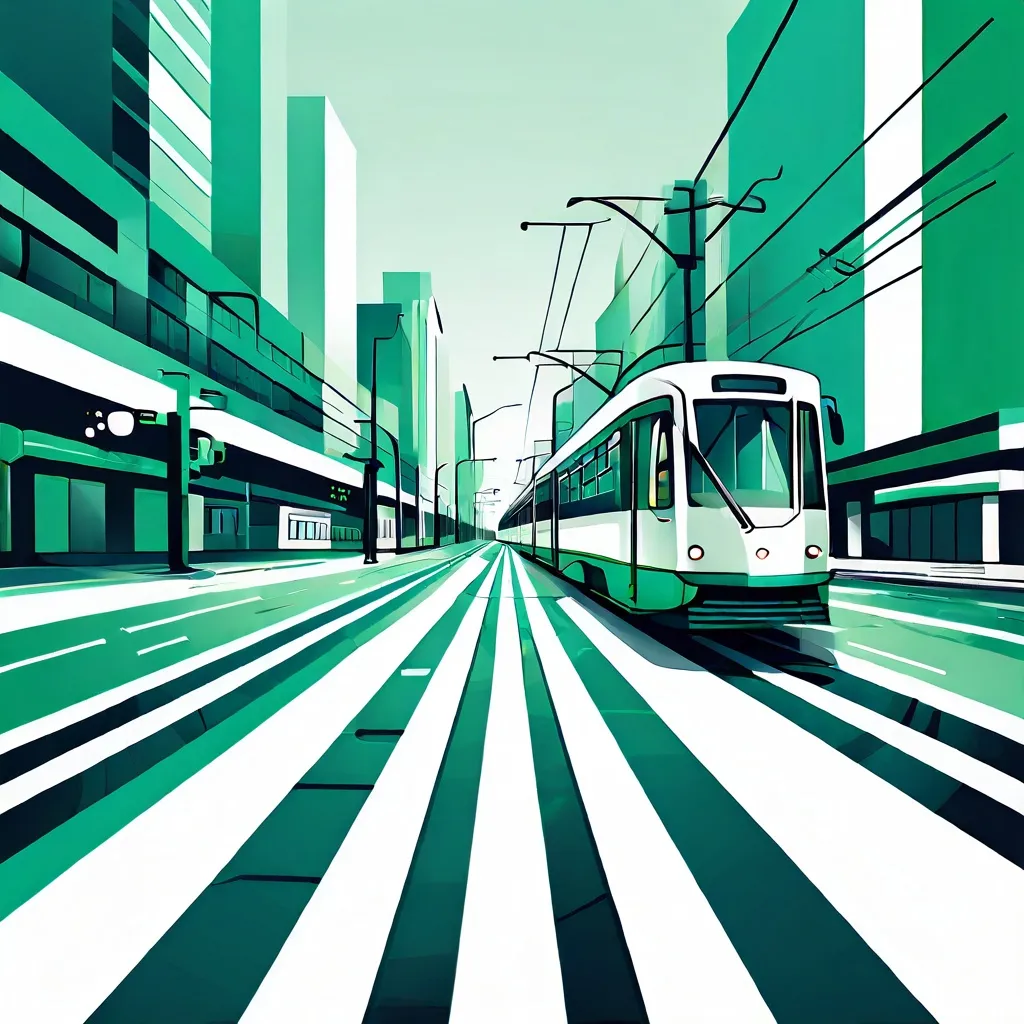
Driving in French cities requires special attention to tramway crossings, a common source of danger. This article explains the specific rules, potential hazards, and essential behaviours needed to safely navigate these urban environments. Mastering this knowledge is vital for your French driving licence theory preparation and for safe daily driving.
Article content overview
Driving in French cities presents unique challenges, and one of the most significant is sharing the road with trams. These dedicated public transport vehicles operate on fixed tracks and have specific rules governing their movement and priority. Understanding tramway crossings and the potential hazards associated with them is not just a matter of courtesy but a critical component of passing the French driving theory exam and ensuring safety in urban environments. This article delves into the intricacies of cohabitation with trams in France, covering essential rules, common dangers, and how to perceive and react to tram-related situations effectively.
Trams, or tramways, are an integral part of public transportation in many French cities, often integrated directly into the road network. Unlike other vehicles, trams run on rails embedded in the road surface, which can create specific driving challenges. Their operational paths are fixed, meaning drivers must anticipate their presence and movements along these designated routes. This integration requires a heightened sense of awareness, as trams can appear unexpectedly from different angles, especially at junctions and crossings. The concept of cohabitation urbaine (urban cohabitation) is central here, emphasizing the need for all road users to coexist safely and respectfully.
The infrastructure for trams can vary. Sometimes, tram tracks are segregated from regular traffic lanes, clearly demarcating their space. More often, however, tram tracks are shared with other vehicles, sometimes even appearing in the middle of busy roads or crossing lanes of traffic. This shared space necessitates a deep understanding of priority rules and hazard perception. Drivers must be constantly aware of whether they are about to cross tram tracks, enter a zone where trams have priority, or potentially impede a tram's progress.
The presence of tram tracks introduces several distinct hazards for drivers. One of the most common dangers arises from the tracks themselves. Metal rails embedded in asphalt can be slippery, especially when wet or icy, and can pose a risk to the stability of two-wheeled vehicles like motorcycles and bicycles, as well as affecting the grip of car tires if driven over at an angle. Drivers must be particularly cautious when crossing tracks, aiming to do so at a right angle whenever possible to avoid skidding or losing control.
Another significant hazard is the tram's inability to swerve. Unlike a car that can manoeuvre to avoid an obstacle or a pedestrian, a tram is confined to its tracks. This means that once a tram is on a collision course, it cannot easily deviate. Therefore, it is the responsibility of other road users to ensure they do not obstruct the tram's path. Drivers must always be aware of the tram's trajectory and maintain a safe distance, especially when it is approaching or at a crossing.
Trams also have a considerable turning radius and can take longer to stop than a car due to their weight and momentum. This means that a driver misjudging a tram's speed or intending to cross its path might find themselves trapped on the tracks or in its direct line of travel. Blind spots around trams are also a concern; drivers should never assume that the tram operator can see them, particularly if they are close to the tram or in its peripheral vision.
Understanding priority is paramount when driving in France, and this applies significantly to interactions with trams. In most French urban settings, trams are afforded a high degree of priority, often comparable to emergency vehicles, due to their role in public transport and their fixed route. Generally, when a tram is approaching a junction or crossing, and its path is not clearly separated, other road users must yield to it. This principle is often signalled by specific road markings and signs, but also by context and general traffic flow.
The Code de la route dictates that vehicles must not hinder the progress of trams. This means that if you are positioned on tram tracks and a tram is approaching, you must move off the tracks as soon as possible. If you are turning across tram tracks, you must ensure that you can complete the manoeuvre without obstructing the tram. This often means waiting for the tram to pass, even if you have a green light, especially if the intersection is congested.
In some situations, specific signs might indicate that trams have absolute priority. For example, a sign might require all other traffic to yield to trams when entering a specific zone or approaching a particular intersection. It is crucial for drivers to recognise these signs and understand their implications for priority. The general rule, however, is to err on the side of caution and assume the tram has priority unless explicitly indicated otherwise.
One common scenario involves roundabouts. If tram tracks run through a roundabout, or if a tram is entering or exiting a roundabout, drivers must be exceptionally vigilant. While general roundabout priority rules apply, the tram's fixed path and potential momentum mean that it often takes precedence. Drivers must yield to trams on the roundabout or when they are merging into or exiting the roundabout flow.
The French driving theory exam, the Examen Théorique Général (ETG), frequently tests candidates' understanding of tram interactions. Questions are designed to assess hazard perception and the correct application of priority rules in complex urban situations. Learners can expect scenarios that involve:
A critical aspect of hazard perception related to trams is anticipating their movements. Trams often follow predictable routes, but their speed can vary, and they can appear from behind buildings or other traffic. Drivers should always scan the road ahead, particularly for the presence of tram tracks, and be prepared for a tram to emerge.
The principle of cohabitation urbaine extends beyond strict adherence to the Code de la route. It involves a proactive and considerate approach to sharing the urban space. This means being aware of vulnerable road users who might be less visible or more affected by tram tracks, such as cyclists and pedestrians. Cyclists, in particular, can be vulnerable when riding on or near tram tracks, and drivers must be mindful of their presence and potential difficulties in maintaining balance.
When driving alongside a tram, maintain a safe lateral distance. Do not attempt to overtake a tram if it is moving, especially if it is stopped at a designated stop. When a tram stops to pick up or drop off passengers, other vehicles must also stop behind it, unless there is a clear, safe, and legal way to pass indicated by road markings or signs (which is rare). This is similar to the rules for passing stopped buses.
Drivers should also be aware of environmental zones, such as Zones à Faibles Émissions (ZFE), which are becoming increasingly common in French cities. While these zones primarily regulate vehicle emissions, their presence often means increased traffic and more complex urban driving scenarios, where interactions with trams are frequent.
Successfully navigating tramway crossings in France requires a combination of knowledge, vigilance, and a proactive approach to safety. By understanding the unique hazards posed by trams, mastering the priority rules, and embracing the spirit of urban cohabitation, drivers can significantly reduce the risk of accidents and contribute to a smoother, safer traffic flow. For those preparing for the French driving theory exam, dedicated study of these scenarios and rules is essential. Always remember that the tram’s fixed path means other road users must adapt and yield to ensure everyone reaches their destination safely.
Tramway crossings in France present unique hazards because trams run on fixed tracks and cannot deviate to avoid obstacles, making it essential for drivers to always yield and avoid obstructing their path. The tracks themselves create driving challenges, particularly when wet or when crossed at an angle, and tram braking distances are longer than cars due to their weight and momentum. Priority rules under the Code de la route generally favour trams in urban environments, requiring drivers to move off tracks immediately and wait for trams to pass even when they have a green light. The cohabitation urbaine principle extends beyond rules to encompass considerate driving, maintaining lateral distance from trams, and being especially aware of cyclists and pedestrians near tracks. Mastery of these concepts is vital for passing the ETG and for safe daily driving in French cities with tram networks.
A short set of high-value points that capture the most important ideas from this article.
Tram tracks embedded in roads can be slippery when wet or icy, and crossing them at an angle risks skidding or losing control of two-wheeled vehicles
Trams cannot swerve or stop quickly due to their fixed rails and momentum, making it solely other road users' responsibility to avoid collision
In French urban environments, trams generally have priority and drivers must yield unless signs explicitly indicate otherwise
The cohabitation urbaine principle requires all road users to coexist safely, with particular attention to vulnerable users like cyclists near tram tracks
Drivers should always assume a tram has priority at crossings when uncertain, as this approach is safest and aligns with ETG expectations
Cross tram tracks at a right angle whenever possible to maintain vehicle grip and stability
If positioned on tram tracks when a tram approaches, move off immediately regardless of traffic light status
Never attempt to overtake a moving tram or pass a stopped tram unless road markings explicitly permit it
Tram tracks in roundabouts mean the tram often takes precedence over standard roundabout priority rules
Recognise that specific signs may indicate absolute tram priority zones where all other traffic must yield
Assuming you can proceed at a green light without checking for approaching trams at the same junction
Crossing tram tracks at a shallow angle, which can cause motorcycles, bicycles, or even cars to lose traction
Misjudging a tram's speed or thinking it will stop in time, ignoring its longer braking distance
Failing to yield to a tram when turning across its path, even with a valid green light
Assuming the tram driver can see you, particularly in blind spots near the front or sides of the tram
Article content overview
A short set of high-value points that capture the most important ideas from this article.
Tram tracks embedded in roads can be slippery when wet or icy, and crossing them at an angle risks skidding or losing control of two-wheeled vehicles
Trams cannot swerve or stop quickly due to their fixed rails and momentum, making it solely other road users' responsibility to avoid collision
In French urban environments, trams generally have priority and drivers must yield unless signs explicitly indicate otherwise
The cohabitation urbaine principle requires all road users to coexist safely, with particular attention to vulnerable users like cyclists near tram tracks
Drivers should always assume a tram has priority at crossings when uncertain, as this approach is safest and aligns with ETG expectations
Cross tram tracks at a right angle whenever possible to maintain vehicle grip and stability
If positioned on tram tracks when a tram approaches, move off immediately regardless of traffic light status
Never attempt to overtake a moving tram or pass a stopped tram unless road markings explicitly permit it
Tram tracks in roundabouts mean the tram often takes precedence over standard roundabout priority rules
Recognise that specific signs may indicate absolute tram priority zones where all other traffic must yield
Assuming you can proceed at a green light without checking for approaching trams at the same junction
Crossing tram tracks at a shallow angle, which can cause motorcycles, bicycles, or even cars to lose traction
Misjudging a tram's speed or thinking it will stop in time, ignoring its longer braking distance
Failing to yield to a tram when turning across its path, even with a valid green light
Assuming the tram driver can see you, particularly in blind spots near the front or sides of the tram
Explore related topics, search based questions, and concepts that learners often look up when studying French Tramway Crossing Hazards. These themes reflect real search intent and help you understand how this topic connects to wider driving theory knowledge in France.
Find clear and practical answers to common questions learners often have about French Tramway Crossing Hazards. This section helps explain difficult points, remove confusion, and reinforce the key driving theory concepts that matter for learners in France.
The main challenge is anticipating the tram's movement and understanding that trams have priority in many situations, alongside the need to share space with other road users in busy urban areas.
Trams generally have priority over road vehicles, especially at crossings and junctions. Drivers must always be prepared to yield to trams and understand specific priority signage or road markings.
Hazards include the tram's speed, its fixed route, potential for sudden braking, cyclists and pedestrians near the tracks, and confusion about priority at junctions or shared spaces.
'Cohabitation urbaine' means sharing urban space harmoniously. When driving near trams, it means being aware of their presence, respecting their right-of-way, and adapting your driving to coexist safely with them and other road users.
While there may not be a universal 'tram crossing' sign, drivers should look for signs indicating shared space, priority rules, and warning signs related to tracks or junctions where trams operate.
Continue your preparation for the French permis de conduire exam. Dive deeper into specific Code de la route sections, practice scenarios, or review official procedures. Use our comprehensive article collection to master every aspect of driving theory.