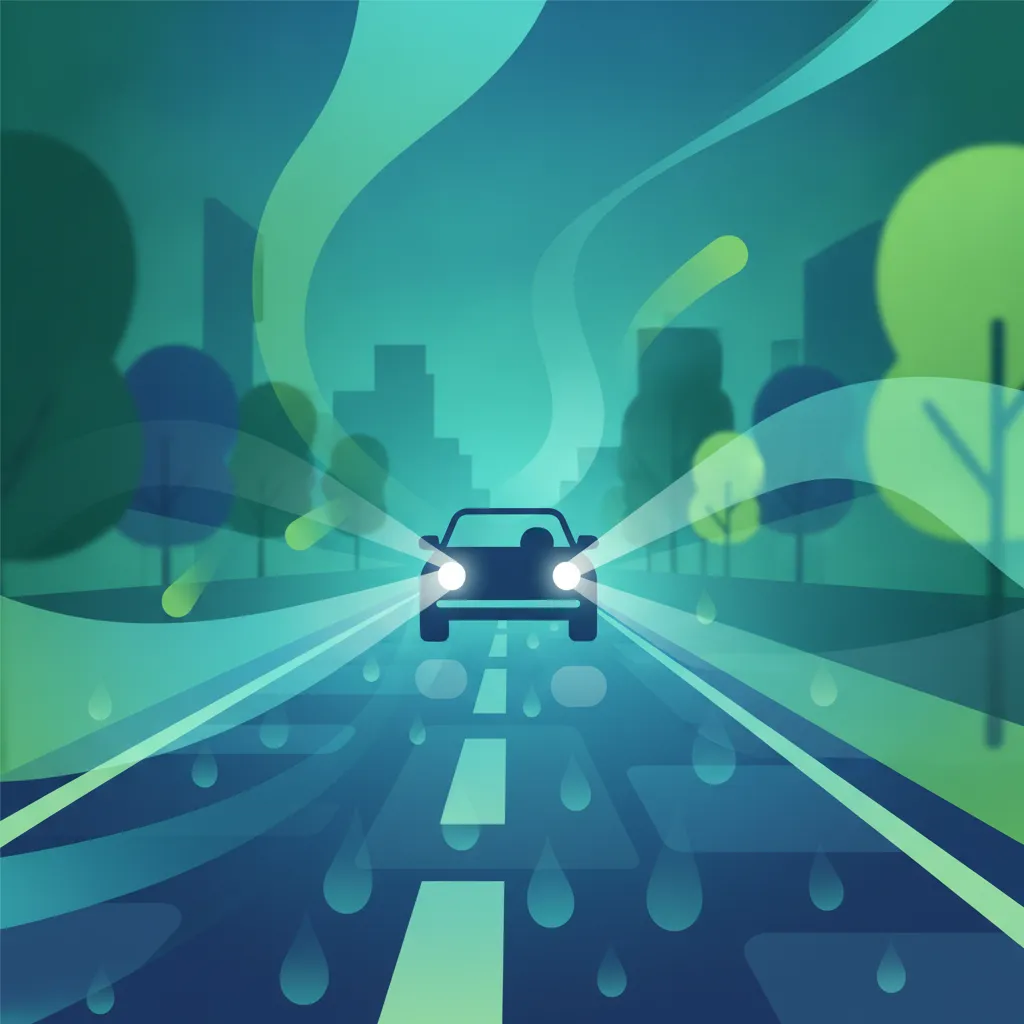
In France, knowing when and how to use your vehicle's lights is fundamental for road safety, ensuring you can see clearly and are visible to others. The Code de la route specifies distinct rules for different lighting types and driving conditions, from clear nights to heavy fog or rain. This guide details the proper application of 'feux de croisement' (low beams), 'feux de route' (high beams), 'feux de position' (side lights), and 'feux de brouillard' (fog lights) to prevent accidents and comply with French law.
Theory topic content overview
Read the full theory topic guide for Headlights & Visibility with structured, easy-to-scan content built for learners in France. This detailed section explains the exact rule, meaning, traffic context, comparison points, and exam logic behind this French driving theory topic so you can study faster, understand the concept more clearly, and avoid common interpretation mistakes on the theory test.
Vehicle lights are essential safety features designed to achieve two primary goals:
In France, the proper use of your vehicle's lighting system is strictly governed by the Code de la route and is a fundamental part of safe driving. Understanding each type of light – from feux de position (side lights) to feux de brouillard (fog lights) – is crucial for both your safety and successful completion of the French driving theory exam (ETG).
Misusing or failing to use vehicle lights correctly is a major contributor to road accidents and a common source of penalties under French law. For new drivers, it's not just about passing the permis de conduire test; it's about adopting safe habits from day one.
routes départementales.Code de la route specifies precise conditions for the use of each lighting type. Non-compliance can result in fines (amende forfaitaire) starting from 68 € and, in severe cases, even the immobilisation (impounding) of your vehicle, especially if essential lights are absent or defective.feux de croisement and feux de route, and the specific rules for feux de brouillard, are frequent in the ETG. Candidates must know exactly when and where each light is appropriate.Modern vehicles come equipped with various lights, each serving a specific purpose. Knowing their function and when to activate them is key for driving in France.
These lights illuminate the front and rear of your vehicle, making it visible to others without significantly lighting the road ahead.
feux de croisement.feux de brouillard when visibility is low during the day.The most commonly used headlights, providing moderate illumination without dazzling oncoming traffic.
crépuscule) to dawn (aube).tunnels), even if they are well-lit.These powerful headlights provide maximum illumination, allowing you to see far ahead.
routes de campagne or autoroutes.agglomérations), on roads that are not lit.feux de croisement when:
Specialized lights designed to cut through fog, heavy rain, or snow. They consist of front and rear components with distinct usage rules in France.
Feux de Brouillard Avant (Front Fog Lights):
brouillard).forte pluie).chutes de neige).feux de croisement.Feux de Brouillard Arrière (Rear Fog Lights):
brouillard épais) or heavy snow (chutes de neige importantes).Code de la route and a common exam question.The Code de la route is very specific about light usage based on conditions:
crépuscule (dusk) to aube (dawn), and whenever visibility is less than 50 meters, even during the day.feux de croisement) are mandatory upon entering a tunnel, regardless of ambient light levels.feux de croisement. Only activate front fog lights (feux de brouillard avant) if the rain is very heavy. Never use rear fog lights in rain.feux de croisement and front fog lights (feux de brouillard avant). Activate rear fog lights (feux de brouillard arrière) only if the fog is dense and visibility is severely reduced.feux de croisement and front fog lights. Use rear fog lights only in heavy snowfall.French driving theory places strong emphasis on precise light usage:
feux de croisement are required. Feux de route are for illuminating otherwise dark, empty roads.feux de croisement to ensure you are visible from the rear.Ampoules de rechange (Spare Bulbs): While no longer a strict legal requirement for all vehicles since 2018 (especially for modern cars with LED lights), the recommendation to carry a spare bulb kit for older vehicles or vehicles with easily replaceable bulbs persists. This is a common historical point in French theory tests, emphasizing readiness to maintain functional lighting. The Service-Public still advises it.route départementale outside Poitiers at night: You have feux de route on. As you see an oncoming car's lights in the distance, you must immediately switch to feux de croisement to avoid dazzling them.tunnel on the autoroute A7 near Lyon during the day: Even if the tunnel is well-lit, you must activate your feux de croisement. This is a mandatory safety measure under the Code de la route.Nantes: You should have your feux de croisement on. You may also activate your feux de brouillard avant (front fog lights) for better forward visibility. Crucially, you must not use your feux de brouillard arrière.Massif Central: Here, you'd use your feux de croisement and feux de brouillard avant. If the fog is truly dense and visibility is extremely poor, you would also activate your feux de brouillard arrière to ensure you are seen from behind. Remember to switch them off as soon as the fog lifts or a car approaches closely from behind.feux de route to feux de croisement in time. This is a significant safety hazard and a frequent error.feux de brouillard arrière in conditions that aren't dense fog or heavy snow (especially in rain). This is a very common mistake and a key focus of French theory tests.immobilisation of the vehicle.Mastering vehicle lighting is about proactive decision-making. Always assess the current visibility conditions – how far can you see, and how easily can others see you? The French Code de la route prioritizes clarity and safety above all else. When in doubt, it's generally safer to use feux de croisement to ensure you are seen, and remember the specific rules for feux de brouillard as they are a frequent point of confusion and testing. Regular checks of your lights for cleanliness and function are also essential for safe driving in France.
This topic covers the essential French vehicle lighting rules under the Code de la route, teaching the 'See and Be Seen' principle fundamental to road safety. The four main light types serve distinct purposes: side lights for parking visibility, low beams as the default headlight for reduced visibility, high beams for dark unlit roads only, and fog lights with strict usage conditions. The most critical distinction for the ETG exam is that front fog lights can be used in fog, heavy rain, or snow, while rear fog lights are strictly limited to dense fog or heavy snow only. Drivers are legally responsible for proper light usage regardless of automatic systems, with penalties including fines and vehicle immobilisation for non-compliance.
A short set of high-value points that capture the most important ideas from this theory explanation.
Vehicle lights serve two essential purposes: to help you see the road ahead and to make your vehicle visible to other road users
Feux de croisement (low beams) are the default headlights and must be used whenever visibility is reduced, including in tunnels, during rain, fog, snow, or from dusk to dawn
Feux de route (high beams) are only permitted on unlit roads outside built-up areas when there are no other vehicles ahead or oncoming
Feux de brouillard avant (front fog lights) can be used in dense fog, heavy rain, or heavy snow to improve forward visibility
Feux de brouillard arrière (rear fog lights) are strictly reserved for dense fog or heavy snowfall only, never for rain or light fog
Low beams are mandatory in tunnels even during daytime and well-lit conditions
Switch from high beams to low beams when approaching oncoming traffic or following another vehicle
Rear fog lights must be switched off as soon as visibility improves or a vehicle is following closely behind
Daytime running lights (DRL) typically do not activate rear lights, so you must switch to low beams when visibility is reduced
Automatic light systems do not replace driver responsibility for ensuring correct lighting is active
Failing to switch from high beams to low beams when meeting oncoming traffic, causing dangerous dazzling
Using rear fog lights in rain or light fog, which dazzles following drivers and is prohibited under the Code de la route
Relying solely on automatic lights in tunnels, forgetting that low beams are mandatory upon entry
Assuming daytime running lights are sufficient in poor visibility, not realizing rear lights may not be active
Driving with dirty or faulty lights, which can result in vehicle immobilisation and fines starting from 68 €
Start with a short, direct summary of Headlights & Visibility before reading the full explanation below.
Drivers in France must use their vehicle's headlights and other lighting systems whenever visibility is reduced, such as at night, in tunnels, or during adverse weather like rain, fog, or snow. The specific type of light—low beam ('feux de croisement'), high beam ('feux de route'), or fog lights ('feux de brouillard')—depends on the conditions to ensure adequate illumination without dazzling other road users. Correct light usage is a legal requirement under the Code de la route and essential for preventing collisions.
Review the most important terms, rule signals, and traffic concepts linked to Headlights & Visibility.
Explore related theory topic pages connected to Headlights & Visibility and continue with the next useful rule explanation.
See the common search queries learners use when trying to understand Headlights & Visibility in France.

Continue your journey by exploring specific French driving theory topics, from road signs and priority rules to vehicle safety and administrative procedures. Deepen your understanding of the Code de la route and prepare effectively for your permis de conduire ETG exam to ensure success and safe driving practices.
French Driving Theory Topics & RulesTheory topic content overview
A short set of high-value points that capture the most important ideas from this theory explanation.
Vehicle lights serve two essential purposes: to help you see the road ahead and to make your vehicle visible to other road users
Feux de croisement (low beams) are the default headlights and must be used whenever visibility is reduced, including in tunnels, during rain, fog, snow, or from dusk to dawn
Feux de route (high beams) are only permitted on unlit roads outside built-up areas when there are no other vehicles ahead or oncoming
Feux de brouillard avant (front fog lights) can be used in dense fog, heavy rain, or heavy snow to improve forward visibility
Feux de brouillard arrière (rear fog lights) are strictly reserved for dense fog or heavy snowfall only, never for rain or light fog
Low beams are mandatory in tunnels even during daytime and well-lit conditions
Switch from high beams to low beams when approaching oncoming traffic or following another vehicle
Rear fog lights must be switched off as soon as visibility improves or a vehicle is following closely behind
Daytime running lights (DRL) typically do not activate rear lights, so you must switch to low beams when visibility is reduced
Automatic light systems do not replace driver responsibility for ensuring correct lighting is active
Failing to switch from high beams to low beams when meeting oncoming traffic, causing dangerous dazzling
Using rear fog lights in rain or light fog, which dazzles following drivers and is prohibited under the Code de la route
Relying solely on automatic lights in tunnels, forgetting that low beams are mandatory upon entry
Assuming daytime running lights are sufficient in poor visibility, not realizing rear lights may not be active
Driving with dirty or faulty lights, which can result in vehicle immobilisation and fines starting from 68 €
Start with a short, direct summary of Headlights & Visibility before reading the full explanation below.
Drivers in France must use their vehicle's headlights and other lighting systems whenever visibility is reduced, such as at night, in tunnels, or during adverse weather like rain, fog, or snow. The specific type of light—low beam ('feux de croisement'), high beam ('feux de route'), or fog lights ('feux de brouillard')—depends on the conditions to ensure adequate illumination without dazzling other road users. Correct light usage is a legal requirement under the Code de la route and essential for preventing collisions.
Review the most important terms, rule signals, and traffic concepts linked to Headlights & Visibility.
Explore related theory topic pages connected to Headlights & Visibility and continue with the next useful rule explanation.
See the common search queries learners use when trying to understand Headlights & Visibility in France.
Continue your journey by exploring specific French driving theory topics, from road signs and priority rules to vehicle safety and administrative procedures. Deepen your understanding of the Code de la route and prepare effectively for your permis de conduire ETG exam to ensure success and safe driving practices.
French Driving Theory Topics & RulesUse this exam-focused revision tip to understand how Headlights & Visibility is likely to appear in theory questions for learners in France. This section helps you identify the most testable part of the rule, avoid common traps, and remember the concept more effectively during French driving theory exam preparation.
Pay close attention to the conditions under which each type of light ('feux de croisement', 'feux de route', 'feux de brouillard') is legally required or prohibited in France. Exam questions often focus on distinguishing these scenarios, especially the use of fog lights in rain versus fog, and when to switch between high and low beams to avoid dazzling other drivers. Remember that proper lighting ensures both your vision and your visibility to others.
Read direct answers to the most common learner questions about Headlights & Visibility in France. This FAQ focuses on rule confusion, practical meaning, comparison with similar concepts, and the exact uncertainties that appear most often in French driving theory revision and exam preparation.
The main types are 'feux de croisement' (low beam headlights) for general driving, 'feux de route' (high beam headlights) for maximum illumination, and 'feux de position' (side lights or parking lights) for being visible when parked or driving in good light conditions.
You must use 'feux de croisement' at night on all roads, during the day when visibility is poor (rain, fog, snow), in tunnels, and whenever you approach or follow another vehicle to avoid dazzling.
You can use 'feux de route' at night on unlit roads when there is no oncoming traffic and you are not following another vehicle, to see as far as possible. You must switch to low beams when another vehicle approaches or you are within a certain distance behind another vehicle.
'Feux de brouillard' are fog lights. Front fog lights can be used in heavy rain, fog, or snow. Rear fog lights should only be used in very thick fog or heavy snow to make your vehicle visible from behind, and must be turned off as soon as conditions improve to avoid dazzling others.
While it is no longer strictly mandatory to carry a full spare bulb kit, the Code de la route requires all vehicle lights to be in good working order. It is highly recommended to have spare bulbs ('ampoules de rechange') for essential lights, especially if your vehicle uses easily replaceable halogen bulbs, to avoid potential fines or vehicle immobilization if a bulb fails.
Not using mandatory lights, having defective lights, or misusing lights (e.g., dazzling others with high beams) can result in a fine, typically 68 Euros. In more severe cases, or for multiple light failures at night or in poor visibility, your vehicle could be immobilized, with fines up to 450 Euros.
Ready to focus your study? Use the practice search to find exactly the French driving theory questions you need for the Code de la route and permis de conduire ETG. Refine your knowledge on specific topics or challenging rules to boost your confidence and exam readiness.