
Distance plates are crucial additions to many traffic signs, providing essential information about how far away a hazard, service, or restriction is. By reading these plates in conjunction with the main sign, you can better anticipate upcoming situations and adjust your speed and awareness accordingly. Understanding these indicators is key to both driving safely and succeeding in your theory exam, helping you avoid unnecessary braking or delayed reactions.
An explanation of how France Distance Plates road signs apply in real traffic situations in France. Learn where these signs are typically placed, what drivers are expected to do when they appear, and how correct reactions help you stay safe, avoid fines, and succeed in your French driving theory exam.
Distance plates are often found in conjunction with warning signs, regulatory signs, or information signs. For example, you might see a 'M1: Distance' plate below a sign warning of a sharp curve, indicating that the curve is a certain distance ahead. Similarly, a plate indicating 'M1a: Distance to the next gas station' might appear to inform you how far you need to travel to find fuel. These signs are common on highways, rural roads, and approach roads to cities, helping drivers to plan ahead. They are particularly useful for managing speed and attention, allowing drivers to slow down gradually if a hazard is approaching or to prepare for a facility without stopping too early or driving past it.
An overview of the key learning outcomes when studying the France Distance Plates road sign category. Understand the main concepts, sign meanings, and traffic situations covered here so you can recognise patterns, answer theory questions more confidently, and build a solid foundation for safe driving in France.
Understand how French distance plates, often paired with warning or regulatory signs, specify the exact range of an upcoming hazard or restriction. Studying these distance plates together with their associated traffic signs is crucial for accurate hazard perception and exam preparation, helping you time your responses correctly and navigate French roads safely.

The M1 Distance plate tells you how far away the next sign's instruction or hazard is.
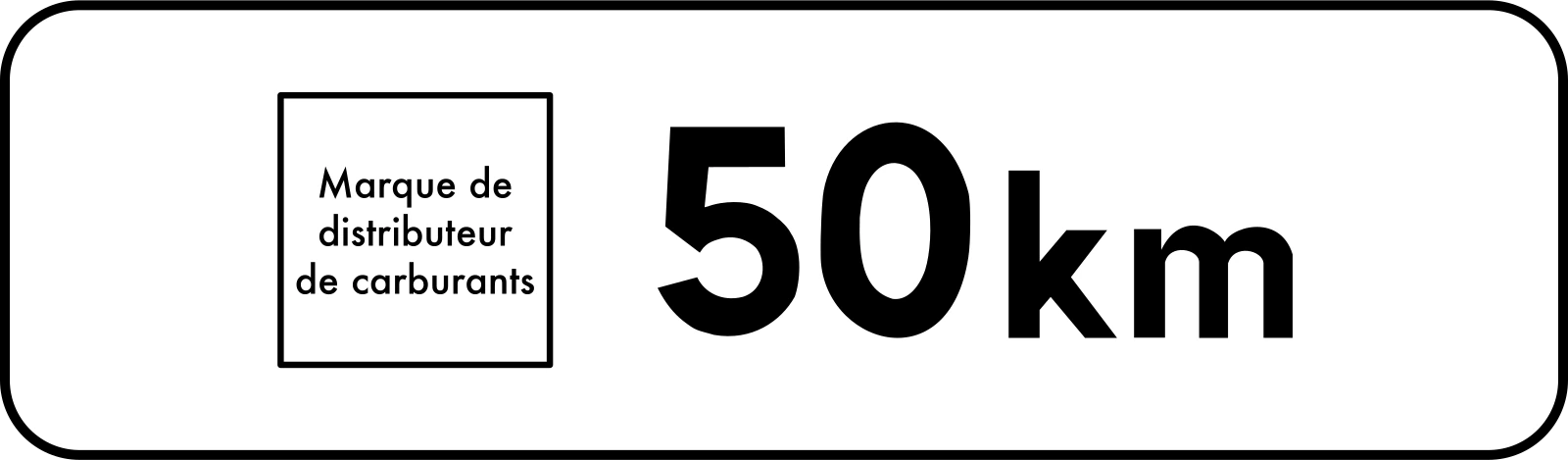
The M1a sign tells you the distance to the next gas station.
Clear answers to common questions about the France Distance Plates road sign category. Use this FAQ to review tricky rules, understand how these signs appear in exam scenarios, and remove confusion that often leads to mistakes in the French driving theory exam in France.
The main purpose of a distance plate is to tell you how far away the situation indicated by the main sign is. This helps you to time your reactions correctly, avoiding braking too suddenly or being surprised by a hazard or restriction.
You should always read the distance plate together with the main sign it accompanies. The distance indicated on the plate applies to the situation shown on the main sign. For example, if a 'sharp curve' warning sign has a distance plate of 200 meters below it, it means the sharp curve is 200 meters ahead.
No, distance plates are typically used with warning signs to indicate how far in advance a hazard is, or with information signs to show the distance to a facility like a service area or exit. They are less commonly used with mandatory or prohibitory signs, though exceptions can exist.
Yes, absolutely. The theory exam tests your understanding of all official road signs, including supplementary plates like distance plates. You need to know how they affect the meaning of the main sign and how to react appropriately in real traffic.
A sign without a distance plate usually applies immediately or at the location of the sign itself. A sign with a distance plate indicates that the condition, hazard, or facility is located at the specified distance ahead, giving you advance notice.
Ready to deepen your understanding of French road signs? Dive into our comprehensive overview of official sign categories and groups. This structured approach will help you learn Code de la route classifications more effectively, preparing you thoroughly for your Permis de Conduire theory exam.
Explore Sign Categories