
This lesson teaches you how to manage your moped speed smoothly and anticipate potential dangers early. By mastering throttle control and observation, you will build the defensive riding skills needed for the Irish theory test and real-world safety.

Lesson content overview
Operating a moped or a light quadricycle under an Irish Category AM licence requires a deep understanding of vehicle dynamics and road observation. Because mopeds are lightweight, have small tyres, and are restricted to a maximum design speed of 45 km/h, they are highly sensitive to sudden inputs.
Any abrupt twist of the throttle or sudden grab of the brakes can instantly disrupt your tyre grip, leading to a fall. This lesson details how to manage your speed smoothly through proactive hazard anticipation and precise throttle control, ensuring you remain stable and safe on Irish roads.
Every control input you make—whether accelerating, braking, or steering—is transferred to the road through two tiny contact patches where your tyres meet the tarmac. On a Category AM moped, each contact patch is roughly the size of a credit card.
[ Acceleration ]  -->  Weight shifts Rear  -->  Front contact patch shrinks
[ Deceleration ]  -->  Weight shifts Front -->  Rear contact patch shrinks
When you accelerate, weight transfers to the rear of the vehicle, compressing the rear suspension and increasing the rear tyre's grip while unloading the front tyre. When you decelerate or brake, the opposite occurs: weight transfers forward, compressing the front forks and reducing grip at the rear wheel.
If these weight transfers happen too rapidly due to abrupt throttle changes, the tyres cannot cope with the sudden shift in force. This results in a traction breakdown: the rear tyre may spin out during sudden acceleration, or lock up during sudden deceleration. Smooth, progressive inputs allow the suspension to settle and the tyres to maintain constant, predictable contact with the road.
On a moped, the throttle is not an "on-off" switch; it is a precision instrument. Most modern Category AM mopeds use a Continuously Variable Transmission (CVT), which automatically adjusts the gear ratio. When you twist the throttle, there is a brief moment before the automatic clutch engages and power is sent to the rear wheel. Understanding this mechanical behaviour is key to smooth riding.
To accelerate safely, you must practice a technique known as "rolling on" the throttle. This means gradually twisting the handlebar grip towards you in a controlled, progressive motion.
The technique of gradually and smoothly increasing throttle input to allow the engine, transmission, and tyres to adapt to the change in speed without losing traction.
This gradual application is vital when:
Many novice riders make the mistake of "pinning" the throttle—twisting it fully open instantly—when they see a gap in traffic. On a dry road, this causes a sudden jerk that can destabilise your steering. On a wet, greasy, or gravel-strewn Irish road, it will almost certainly cause the rear tyre to spin, leading to a low-side fall.
Slowing down safely involves more than just pulling the brake levers. Effective speed management relies heavily on engine braking and early throttle reduction.
The process of slowing down a vehicle by releasing the throttle, allowing the internal resistance of the engine and transmission to decelerate the drive wheel.
On an automatic CVT moped, when you roll off (close) the throttle, the engine speed drops, and the transmission provides a mild braking effect on the rear wheel. While this effect is less pronounced than on a manual motorcycle, it is highly effective for controlled deceleration.
Scan ahead: Identify the need to slow down early (e.g., an approaching junction or a red light).
Roll off the throttle: Gradually return the throttle grip to its closed position. Allow engine braking to begin shedding speed.
Apply progressive braking: If further deceleration is needed, gently apply both brakes, squeezing the levers progressively rather than grabbing them.
Stabilise the vehicle: Keep the moped upright and inline as you come to a gentle stop.
By rolling off the throttle early, you reduce the physical effort required by your brakes, minimise weight transfer, and keep your moped stable.
The Irish Rules of the Road emphasise that defensive riding is about expecting the unexpected. Because mopeds are smaller and slower than other motorised vehicles, you are more vulnerable. You must use active hazard anticipation to protect yourself.
Do not ride with "tunnel vision," looking only at the rear bumper of the vehicle directly in front of you. Instead, scan the road 12 to 15 seconds ahead. In an urban 50 km/h zone, this represents about 150 to 200 metres ahead.
By looking far ahead, you can spot potential conflicts early:
In Ireland, junctions and roundabouts are high-risk zones for Category AM riders. Drivers often fail to spot mopeds due to their narrow profile (a phenomenon known as "looked-but-failed-to-see" errors).
When approaching a junction, look for clues that suggest another driver might pull out or turn across your path. Watch the driver’s head alignment or the movement of their front wheels. If you anticipate that a driver has not seen you, do not wait for them to make a move—adjust your speed and position immediately.
The Yellow Light Dilemma: When a traffic light changes from green to amber, do not accelerate to "beat the light." As an AM rider, your vehicle lacks the acceleration power to clear a wide junction quickly. Always anticipate the change and prepare to decelerate smoothly.
The primary objective of hazard anticipation is to allow for early speed adjustment. If you spot a hazard early, you can adjust your speed using only throttle control and light braking, completely eliminating the need for sudden, emergency braking.
Your total stopping distance consists of two main parts:
[ Hazard Spotted ] ---> [ 1 Sec Reaction / Thinking ] ---> [ Brakes Applied ] ---> [ Full Stop ]
|<--------- Reaction Distance --------->|<------- Braking Distance ------->|
|<----------------------------- Total Stopping Distance ----------------------------->|
If you ride defensively and adjust your speed before a hazard becomes an immediate threat, you effectively eliminate the panic reaction phase.
For example, if you see a cyclist weaving slightly ahead, rolling off the throttle immediately creates a safety cushion. If the cyclist swerves, you are already travelling at a speed that allows for a controlled, gentle stop, rather than a frantic grab of the brakes that could lock your wheels.
Ireland's weather and road infrastructure demand constant adaptation of your acceleration and deceleration habits. What is safe on a dry summer afternoon can be highly dangerous on a wet winter evening.
Rain drastically reduces tyre grip. Furthermore, during the first 15 minutes of rainfall after a dry spell, water mixes with oil, rubber dust, and grease on the road surface, creating a highly slippery layer often referred to as "summer ice."
On rural Irish roads (Local "L" roads), you will frequently encounter loose gravel, mud from agricultural vehicles, and damp, decaying leaves in autumn.
To pass your Irish Driving Theory Test and remain a safe road user, you must understand the common mistakes and illegal riding habits associated with speed control.
Why do riders fail to anticipate hazards? The answer often lies in human factors, such as fatigue, distraction, or peer pressure.
Because Category AM mopeds are physically small, other road users frequently misjudge your speed, often assuming you are travelling slower than you actually are, or failing to notice you altogether. As a defensive rider, you must compensate for their lack of awareness.
Maintaining a buffer space around your moped—especially in front of you—gives you the time needed to apply smooth throttle changes. Smooth riding is not just about vehicle control; it is a mental discipline that ensures you are always in charge of your moped’s stability.
This lesson explains why smooth throttle control is critical for moped stability, using the physics of weight transfer and tyre contact patches to show how abrupt inputs cause traction loss. It teaches the 12-second scanning rule for proactive hazard identification and provides step-by-step guidance for smooth acceleration and deceleration techniques including engine braking. Specific warnings cover wet road conditions where grip is halved, the danger of accelerating on amber lights, and the need to anticipate "looked-but-failed-to-see" errors from other drivers. Common violations such as sudden throttle inputs, brake over-reliance, and late braking are clearly identified to help learners avoid dangerous riding habits on Irish roads.
A short set of high-value points that capture the most important learning from this lesson.
Smooth throttle application prevents sudden weight transfer that can cause tyre grip loss and instability
The 12-second scanning rule means looking 150-200 metres ahead in a 50 km/h zone to spot hazards early
Engine braking through throttle release allows controlled deceleration while keeping the moped stable
On wet roads, halve your throttle input and begin decelerating twice as early as in dry conditions
"Looked-but-failed-to-see" errors mean you must assume other drivers may not notice your moped at junctions
Explore all units and lessons included in this driving theory course.
Accelerating shifts weight rearward, reducing front tyre contact; decelerating shifts weight forward, reducing rear tyre grip
Always roll on the throttle gradually when moving off, exiting corners, or merging with traffic
When traffic lights turn amber, prepare to stop rather than accelerating to beat the light
Avoid making speed changes while positioned over painted road markings in wet conditions
Maintain buffer space around your moped to allow time for smooth, progressive control inputs
Sudden throttle "pinning" in traffic gaps, which destabilises steering on dry roads and causes rear wheel spin on wet surfaces
Riding with fingers dragging brake levers constantly instead of using engine braking to manage speed
Accelerating through yellow traffic lights, which is particularly dangerous on mopeds lacking quick acceleration to clear junctions
Heavy late braking at pedestrian crossings that frightens pedestrians and risks rear-end collisions from following vehicles
Making abrupt speed changes on loose gravel, mud, or wet leaves instead of maintaining steady, constant throttle through these hazards
Lesson content overview
A short set of high-value points that capture the most important learning from this lesson.
Smooth throttle application prevents sudden weight transfer that can cause tyre grip loss and instability
The 12-second scanning rule means looking 150-200 metres ahead in a 50 km/h zone to spot hazards early
Engine braking through throttle release allows controlled deceleration while keeping the moped stable
On wet roads, halve your throttle input and begin decelerating twice as early as in dry conditions
"Looked-but-failed-to-see" errors mean you must assume other drivers may not notice your moped at junctions
Explore all units and lessons included in this driving theory course.
Accelerating shifts weight rearward, reducing front tyre contact; decelerating shifts weight forward, reducing rear tyre grip
Always roll on the throttle gradually when moving off, exiting corners, or merging with traffic
When traffic lights turn amber, prepare to stop rather than accelerating to beat the light
Avoid making speed changes while positioned over painted road markings in wet conditions
Maintain buffer space around your moped to allow time for smooth, progressive control inputs
Sudden throttle "pinning" in traffic gaps, which destabilises steering on dry roads and causes rear wheel spin on wet surfaces
Riding with fingers dragging brake levers constantly instead of using engine braking to manage speed
Accelerating through yellow traffic lights, which is particularly dangerous on mopeds lacking quick acceleration to clear junctions
Heavy late braking at pedestrian crossings that frightens pedestrians and risks rear-end collisions from following vehicles
Making abrupt speed changes on loose gravel, mud, or wet leaves instead of maintaining steady, constant throttle through these hazards
Explore search topics learners often look for when studying Acceleration, Deceleration and Hazard Anticipation. These topics reflect common questions about road rules, driving situations, safety guidance, and lesson level theory preparation for learners in Ireland.
Browse additional driving theory lessons that cover connected traffic rules, road signs, and common driving situations related to this topic. Improve your understanding of how different rules interact across everyday traffic scenarios.
Learn the essential rules for safe approaches, departures, and road positioning at Irish junctions and roundabouts. This guide explains how to manage blind spots and interact safely with larger vehicles while maintaining stability on a category AM moped in diverse traffic conditions.

This lesson details the sequential steps required to approach and exit junctions safely under the Irish driving rules. It teaches riders how to select the correct lane, utilize mirrors, apply early signals, and reduce speed appropriately. Effective observation strategies are highlighted to help riders identify crossing pedestrians or approaching side traffic.

This lesson covers correct procedures for navigating roundabouts, which present significant risks for Category AM riders. It details lane selection rules, timely indicator signals for exiting, and the importance of checking blind spots before shifting lanes. Riders will learn to safely share the roundabout with large vehicles and vulnerable road users.

This lesson focuses on the safe approach and execution of turns at T-junctions, staggered intersections, and blind crossroads. It explains the critical mirror-signal-manoeuvre routine and how to select the best position for maximum visibility to cross-traffic. Motorcyclists will learn to identify potential hazards like vehicles pulling out suddenly or turning across their direct path.

Executing safe turns requires early preparation, correct road positioning, and clear communication with other road users. This lesson focuses on the mandatory Mirror-Signal-Manoeuvre (MSM) routine used across Ireland for turning at cross junctions and navigating roundabouts. You will learn how to choose the correct lane early, adjust your speed, and complete your turn smoothly without cutting corners or blocking trailing vehicles.
Understand how to adapt your riding style for hazardous Irish road conditions including wet surfaces, loose gravel, and poor visibility. This theory guide provides insights into maintaining traction and preventing instability when facing adverse weather or common road surface obstacles while operating a category AM vehicle.

This lesson explores common surface hazards encountered on municipal and rural Irish roads, including loose gravel and wet leaves. It explains how these surface conditions rapidly reduce tyre traction and affect overall handling and braking control. Riders will learn visual scanning techniques to identify these hazards early and execute safe evasion maneuvers.

This lesson focuses on the critical techniques required to ride safely during severe rain or heavy fog in Ireland. It teaches riders how to handle aquaplaning risks, use headlights correctly, and significantly increase their following distances. Adapting speed to visibility ensures that riders can brake safely when road conditions deteriorate.

This lesson explains how to modify riding techniques when navigating wet tarmac, focusing on the heightened risk of hydroplaning and reduced tire grip. It details the necessity of increasing following distances, avoiding painted road markings, and executing smoother control inputs. Riders will understand how surface water accumulates in ruts, presenting severe hazards during heavy rainstorms.

This lesson teaches riders how to actively identify and eliminate blind spots through proper mirror adjustment and physical shoulder checks. It explains the concept of a safety cushion, which represents the defensive space maintained around the moped at all times. Managing these zones ensures adequate reaction time and mitigates the impact of sudden braking.

This lesson details the critical role of tyres in maintaining grip and vehicle stability on diverse road surfaces. It provides guidance on measuring tread depth, checking inflation levels, and identifying signs of tyre wear and damage. Additionally, it presents techniques for maintaining balance and executing tight, low-speed turns safely.

This lesson explains the physics of cornering, focusing on lean angles, speed selection, and body positioning on a moped. It teaches riders how to assess road curves, adjust their speed prior to entering a turn, and handle slippery cambers. Mastering these cornering principles is essential for avoiding lose-of-control accidents on winding rural Irish roads.
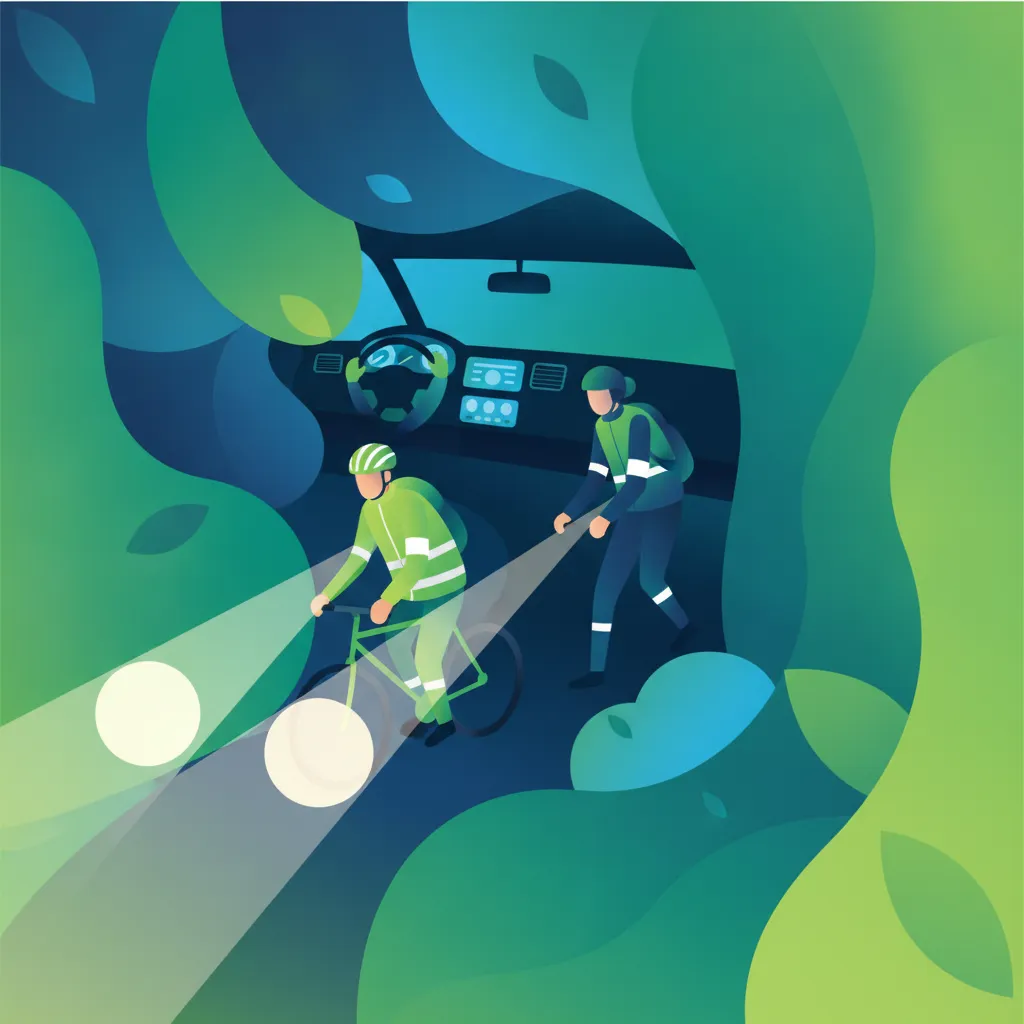
This lesson emphasizes the critical importance of being highly visible to other road users under various lighting conditions. It reviews the legal requirements for front and rear lights on Category AM vehicles and the active use of reflective materials. Proper maintenance of lighting systems is discussed to ensure continuous operation during adverse weather.

This lesson explores the safety benefits of abrasion-resistant jackets, gloves, trousers, and boots designed for moped riders. It explains how integrated body armour shields critical impact zones, such as shoulders, elbows, and knees, from severe injury. Additionally, it provides guidance on selecting clothing appropriate for the damp and cold Irish weather.

This lesson details the use of daytime running lights to raise a rider's profile during daylight hours on Irish roads. It discusses the installation guidelines, legal restrictions, and safety benefits of auxiliary lighting systems on mopeds. Special care must be taken to prevent dazzling oncoming traffic while ensuring the vehicle remains highly recognizable.
This lesson covers correct procedures for navigating roundabouts, which present significant risks for Category AM riders. It details lane selection rules, timely indicator signals for exiting, and the importance of checking blind spots before shifting lanes. Riders will learn to safely share the roundabout with large vehicles and vulnerable road users.
Find clear answers to common questions learners have about Acceleration, Deceleration and Hazard Anticipation. Learn how the lesson is structured, which driving theory objectives it supports, and how it fits into the overall learning path of units and curriculum progression in Ireland. These explanations help you understand key concepts, lesson flow, and exam focused study goals.
Smooth acceleration helps maintain tyre grip and vehicle balance, especially on lower-powered Category AM vehicles. Abrupt changes can cause loss of control or instability, which is a key assessment point during your practical and theory training.
By scanning the road and identifying potential risks early, you can ease off the throttle or gently brake well in advance. This gives you more time and space to react, removing the need for sudden, dangerous emergency stops.
Yes, the theory test evaluates your ability to recognize road hazards and choose the correct safety response. Understanding the mechanics of speed and distance is essential to answering these scenario-based questions correctly.
Look for junctions, driveways, pedestrians, cyclists, and changing traffic light phases. Always scan ahead for road surface issues, such as wet leaves or gravel, which require extra caution and slower speeds.
Use the practice question search tool to pinpoint specific topics, road signs, or rules you need to master for your official Driver Theory Test. Refine your study strategy and ensure comprehensive preparation for all aspects of the Irish driving exam. Start your focused revision now and build confidence for your learner permit test.