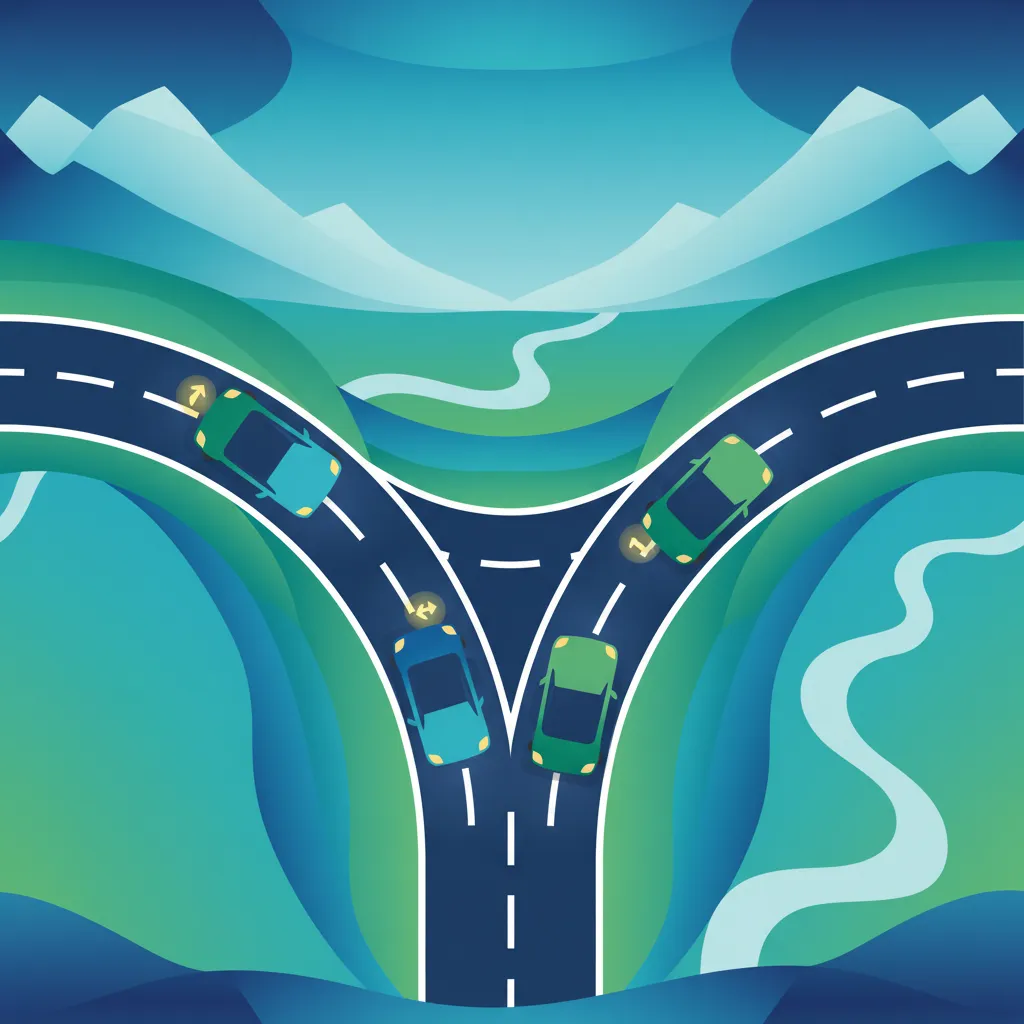
Merging traffic requires drivers to combine separate traffic streams into a single lane smoothly and safely. This page explains the fundamental principles, including observation, speed matching, and cooperation, which are vital for navigating junctions, highway entrances, and lane reductions in Iceland. Understanding these techniques helps prevent accidents and maintain efficient traffic flow.
Theory topic content overview
Read the full theory topic guide for Safe Merging Techniques with structured, easy-to-scan content built for learners in Iceland. This detailed section explains the exact rule, meaning, traffic context, comparison points, and exam logic behind this Icelandic driving theory topic so you can study faster, understand the concept more clearly, and avoid common interpretation mistakes on the theory test.
Merging traffic is a common driving situation where two separate traffic streams combine into a single lane. This often occurs at motorway entrances, when multiple lanes reduce to one, or at specific junctions. The goal of merging is to integrate vehicles smoothly and safely, preventing congestion and collisions. In Iceland, mastering merging techniques is particularly important for maintaining efficient traffic flow and safe driving, especially given varied road conditions and traffic patterns.
Merging effectively is critical for several reasons:
Safe merging requires both the driver entering the main traffic stream and the drivers already in the main stream to act cooperatively.
216 Merging traffic sign.Several factors affect how a driver should approach a merge:
216 Merging traffic Sign: This Icelandic priority sign indicates where two traffic streams merge into one, signaling drivers to prepare for the "cogwheel principle" or "mesh drive" (zipper merge).It's crucial to distinguish between merging and situations where you must yield:
216 Merging traffic sign is present, the principle is often a cooperative "zipper merge" or "cogwheel principle" (mesh drive). This means vehicles from each lane should take turns entering the single stream, fostering smooth flow. While main lane traffic generally has priority, the expectation in Iceland is for drivers to actively facilitate the merge, not simply assert priority.202 obligation to wait sign): When you see a "Yield" sign (Icelandic: 202 obligation to wait or a stop sign 204 Stop sign), you must give way to all traffic on the main road, even if it means coming to a complete stop. You only proceed when it is completely safe and clear to do so, without causing any main road traffic to change speed or direction. This is a strict priority rule, distinct from the cooperative spirit of merging.The key difference lies in the level of interaction and responsibility: yielding is about absolute priority; merging (especially zipper merging) is about shared responsibility for smooth integration.
Learners and even experienced drivers often make mistakes when merging, increasing accident risk and traffic disruption:
In Iceland, the concept of a cooperative merge is emphasized, often referred to as the "cogwheel principle" (tannhjólareglan) or "mesh drive." This directly correlates to what is globally known as the "zipper merge."
The introduction of the new Sign 216 Merging traffic (Samruni akreina) explicitly signals these situations. When you encounter this sign, it is a clear indication that drivers from both merging streams are expected to take turns, one from each lane, entering the single combined lane. This shared responsibility is crucial for maintaining flow and safety on Icelandic roads, aligning with the guidelines set by the Icelandic Transport Authority (Samgöngustofa). Understanding and applying the cogwheel principle will be highly beneficial for your driving test and everyday driving.
Merging traffic is a dance of anticipation and cooperation. For Icelandic drivers, remember to:
By mastering these skills, you ensure safer, smoother journeys for yourself and all other road users in Iceland.
Start with a short, direct summary of Safe Merging Techniques before reading the full explanation below.
Merging traffic involves skillfully joining a single lane from two separate streams. Drivers must observe traffic in the target lane, adjust their speed to match, and signal their intentions clearly. Cooperation is key: drivers in the merging lane should look for gaps, while drivers in the main lane should facilitate entry by maintaining space. In Iceland, this often involves the 'zipper merge' principle to keep traffic flowing smoothly.
Review the most important terms, rule signals, and traffic concepts linked to Safe Merging Techniques.
Explore related theory topic pages connected to Safe Merging Techniques and continue with the next useful rule explanation.
See the common search queries learners use when trying to understand Safe Merging Techniques in Iceland.

Ready to master Icelandic driving theory? Explore our comprehensive sections. Review road rules, traffic signs, and critical concepts. Build essential knowledge for confident and safe driving in Iceland. Start studying today.
Explore Icelandic Driving TheoryTheory topic content overview
Start with a short, direct summary of Safe Merging Techniques before reading the full explanation below.
Merging traffic involves skillfully joining a single lane from two separate streams. Drivers must observe traffic in the target lane, adjust their speed to match, and signal their intentions clearly. Cooperation is key: drivers in the merging lane should look for gaps, while drivers in the main lane should facilitate entry by maintaining space. In Iceland, this often involves the 'zipper merge' principle to keep traffic flowing smoothly.
Review the most important terms, rule signals, and traffic concepts linked to Safe Merging Techniques.
Explore related theory topic pages connected to Safe Merging Techniques and continue with the next useful rule explanation.
See the common search queries learners use when trying to understand Safe Merging Techniques in Iceland.
Ready to master Icelandic driving theory? Explore our comprehensive sections. Review road rules, traffic signs, and critical concepts. Build essential knowledge for confident and safe driving in Iceland. Start studying today.
Explore Icelandic Driving TheoryUse this exam-focused revision tip to understand how Safe Merging Techniques is likely to appear in theory questions for learners in Iceland. This section helps you identify the most testable part of the rule, avoid common traps, and remember the concept more effectively during Icelandic driving theory exam preparation.
In the Icelandic driving theory exam, pay close attention to scenarios involving merging traffic. Questions often test your understanding of observation, speed matching, and the cooperative 'zipper merge' principle. Remember that while main lane traffic generally has priority, safe and smooth merging relies heavily on all drivers cooperating and anticipating movements.
Read direct answers to the most common learner questions about Safe Merging Techniques in Iceland. This FAQ focuses on rule confusion, practical meaning, comparison with similar concepts, and the exact uncertainties that appear most often in Icelandic driving theory revision and exam preparation.
Zipper merging is a method where drivers from two lanes take turns, one by one, to merge into a single lane, much like the teeth of a zipper. This is the recommended approach in Iceland when two traffic streams merge into one to maintain smooth traffic flow.
Generally, drivers already in the lane that continues without merging have priority. However, drivers entering the main traffic stream must adjust their speed and find a safe gap. Cooperation is expected from both merging and through traffic.
You should adjust your speed to match the flow of traffic in the lane you are entering. Accelerate if needed to find a safe gap and merge smoothly without causing other drivers to brake.
Iceland uses a specific warning sign (typically a triangular sign with two converging lines) to indicate that two traffic streams merge into one, often referred to as "Merging Traffic" (Samrunatrafík).
Careful observation allows you to assess the speed and spacing of vehicles in the target lane. This helps you identify safe gaps and predict other drivers' movements, which is critical for a smooth and safe merge.
If there isn't a safe gap, you should slow down, signal, and wait for an appropriate opportunity. Never force your way into traffic, as this significantly increases the risk of a collision.
Always use your turn signal well in advance to indicate your intention to merge. This alerts other drivers to your plans and allows them to adjust their speed or position if necessary.
Utilize our advanced practice set search to pinpoint the exact Icelandic driving theory topics you need to review. Filter by subject, difficulty, or question type to create a highly effective study plan and ensure you are fully prepared for your official driving licence test in Iceland.