
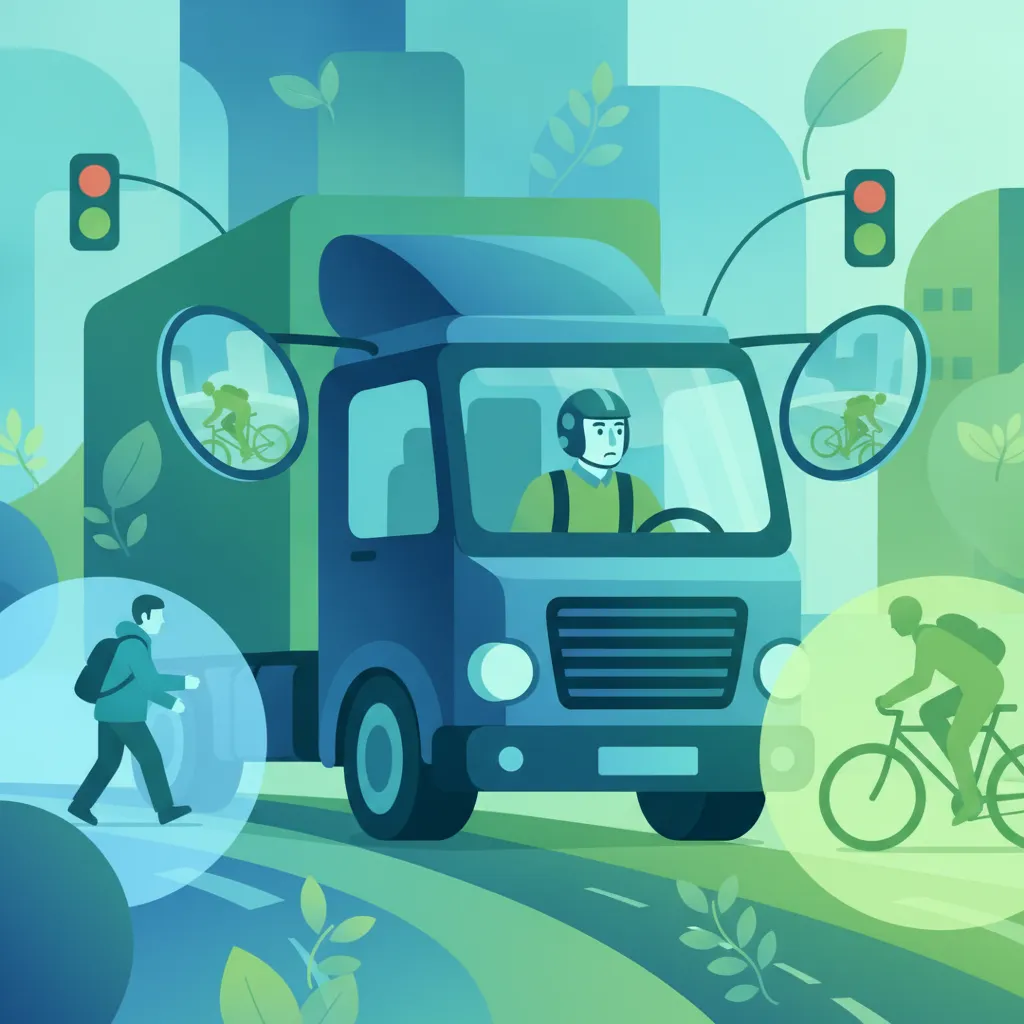
Operating a large goods vehicle in urban areas presents unique challenges. This unit prepares you to identify and manage your vehicle's blind spots, crucial for interacting safely with pedestrians, cyclists, and motorcyclists. You'll learn essential strategies to anticipate their movements and ensure safety during urban deliveries and manoeuvres, directly supporting your Category C licence theory exam preparation.
Browse all lessons that make up Blind Spots, Vulnerable Road Users and Urban Delivery Risks. Each lesson focuses on specific topics, learning objectives, and core concepts, helping you build essential knowledge and follow a clear, structured progression toward your study goals in Great Britain.
This lesson provides a detailed map of the significant blind spots located to the front, sides, and rear of a typical heavy goods vehicle. It explains the purpose of the different classes of mirrors and how to adjust them correctly for maximum visibility. Learners will be taught effective scanning techniques—'mirror-signal-manoeuvre'—to actively check these zones before changing position, ensuring they are aware of any hidden hazards or other road users.
This lesson is dedicated to the safe interaction between large vehicles and the most vulnerable road users: pedestrians and cyclists. It highlights high-risk scenarios, such as left turns at junctions, where cyclists can be hidden in nearside blind spots. The content stresses the importance of anticipation, using signals clearly, and providing generous space at crossings, in cycle lanes, and within pedestrianized zones to prevent tragic accidents.
This lesson focuses on the unique risks faced by motorcyclists and scooter riders when sharing the road with HGVs. It explains how their small size and rapid acceleration can make them difficult to see, especially when they are filtering through traffic. Drivers will learn the importance of making extra mirror checks—'look twice'—before any maneuver and giving motorcyclists extra space, as they can be more affected by wind buffeting and road surface imperfections.
This lesson addresses the established best practices for making deliveries in busy urban environments. It covers how to use designated loading bays safely, the protocols for kerbside deliveries, and the importance of adhering to local time restrictions. Managing the interaction with the public, using hazard warning lights correctly, and ensuring the safety of pedestrians and other road users during the delivery process are key components of professional conduct.
This lesson synthesizes safety concepts into a proactive strategy for collision avoidance. It teaches the principles of defensive driving, which involves anticipating potential hazards created by other road users or road conditions and planning an escape route. Maintaining high levels of situational awareness, managing distractions, and leaving a significant safety margin around the vehicle are presented as fundamental techniques for minimizing risk on every journey.
Explore high-intent keywords and long-tail search topics learners use when researching Blind Spots, Vulnerable Road Users and Urban Delivery Risks. These terms reflect how people search for reliable study materials, structured explanations, and unit-level theory preparation support in Great Britain.
Find clear answers to the most common questions learners ask about Blind Spots, Vulnerable Road Users and Urban Delivery Risks. Understand how the unit is organized, what learning goals it supports, and how it contributes to your study progression with structured explanations and practical guidance tailored for learners in Great Britain.
Large goods vehicles (LGVs), or HGVs, have significant blind spots. These include areas directly to the front, sides, and rear of the vehicle that cannot be seen directly or in the mirrors. Specific blind spots are usually found immediately in front of the cab, along the sides of the trailer or body, and a large area directly behind the vehicle. Correct mirror adjustment and active scanning are critical to mitigate these.
Vulnerable road users (VRUs) like pedestrians, cyclists, and motorcyclists are less protected than vehicle occupants. Their movements can be unpredictable, and they may not be easily seen by large vehicles due to blind spots or vehicle size. Professional HGV drivers have a duty of care to anticipate their presence and actions, especially in urban environments, to prevent serious accidents.
Cyclists and motorcyclists are smaller, quieter, and can manoeuvre more quickly than larger vehicles. They may ride in blind spots, filter through traffic, or make sudden turns. An HGV driver must be constantly aware of their potential presence, particularly when turning, changing lanes, or pulling away, as they can be easily missed and are at high risk of serious injury if involved in a collision.
Properly adjusted mirrors are essential for seeing as much as possible around your vehicle. This includes wing mirrors, close-proximity mirrors, and sometimes additional wide-angle mirrors. Regular checking and scanning of these mirrors, combined with looking directly into areas not covered by mirrors, is the best way to detect hidden road users or hazards.
Urban delivery zones often involve complex traffic, narrow streets, loading bays, and increased pedestrian and cyclist activity. Protocols include anticipating these conditions, using hazard lights when necessary, being aware of other vehicles and pedestrians, maintaining low speeds, and communicating intentions clearly. It's about operating with extra caution and awareness in areas where the risks are heightened.
Theory test questions often present scenarios involving large vehicles in urban settings, focusing on your awareness of blind spots and vulnerable road users. Study situations where turning, reversing, or passing cyclists might be hazardous. Practice identifying the correct actions a professional driver should take, focusing on observation, anticipation, and safe interaction, as covered in this unit.
All included lessons
Lessons in Blind Spots, Vulnerable Road Users and Urban Delivery Risks
See who benefits most from studying Blind Spots, Vulnerable Road Users and Urban Delivery Risks. This overview explains how the unit supports different learning needs, what level of knowledge is helpful before starting, and how it fits into the overall study path in Great Britain.
This unit is essential for all drivers preparing for their Category C Goods Vehicle theory test in Great Britain. It is particularly crucial for those new to operating large vehicles in urban settings or drivers who wish to strengthen their understanding of interactions with pedestrians, cyclists, and motorcyclists.

Ready to prepare effectively for your DVSA driving theory test? Explore our structured courses and guided study paths. They cover every topic of the Great Britain Highway Code and official exam requirements, ensuring systematic learning and success.
Explore Driving Theory CoursesExplore all units and lessons included in this driving theory course.
Ready to prepare effectively for your DVSA driving theory test? Explore our structured courses and guided study paths. They cover every topic of the Great Britain Highway Code and official exam requirements, ensuring systematic learning and success.
Explore Driving Theory Courses