
This lesson provides a comprehensive guide to understanding and managing the significant blind spots inherent to large goods vehicles. You will learn how to correctly set and use different classes of mirrors and apply the mirror-signal-manoeuvre routine to ensure you are aware of all road users. Mastering these visibility techniques is essential for your Category C theory exam and for safe, professional driving on roads across Great Britain.

Lesson content overview
Driving a Heavy Goods Vehicle (HGV) or Large Goods Vehicle (LGV) demands exceptional situational awareness, particularly concerning blind spots. Due to their considerable size, HGVs inherently have significant areas around the vehicle that are not directly visible to the driver, even with properly adjusted mirrors. This lesson, part of the Professional Goods Vehicle Theory for Great Britain - Category C Licence curriculum, is designed to provide a detailed understanding of these hidden zones, the critical role of various mirror types, and essential techniques to mitigate the associated risks, ensuring maximum safety for all road users.
Understanding and effectively managing blind spots is not merely a recommendation; it is a fundamental aspect of professional driving and a core requirement for meeting DVSA safety standards. Collisions related to blind spots are a leading cause of accidents involving HGVs, often resulting in severe consequences for vulnerable road users such as pedestrians, cyclists, and motorcyclists. By mastering systematic mirror adjustment, the Mirror-Signal-Manoeuvre (MSM) sequence, and active scanning techniques, drivers can significantly reduce the risk of accidents and ensure safer journeys on Great Britain's roads.
Blind spots are specific areas around a Heavy Goods Vehicle where the driver’s field of view is obstructed. These zones are created by the vehicle's large dimensions, cab structure, and the limitations of mirror placement and direct sightlines. Recognizing these specific zones is the first step in effective blind spot management.
The area directly ahead of the HGV cab, often concealed by the engine bonnet, dashboard, and roof structure, constitutes the front blind spot. This zone can extend several metres in front of the vehicle, making it impossible to see objects or individuals directly in front of the truck from the driver's seat.
This blind spot is particularly dangerous at junctions, pedestrian crossings, and when pulling away from a standstill. A cyclist, child, or even a small vehicle could be entirely hidden in this area without the driver's knowledge.
Side blind spots are the extensive areas alongside the HGV that are not fully covered by mirrors. These are typically divided into two categories:
These side blind spots are critical during lane changes, overtaking manoeuvres, and when turning, as they can conceal other road users for extended periods.
The rear blind spot refers to the zone directly behind the vehicle that is not covered by any of the side mirrors. For HGVs, this can be a substantial area, often 1-3 metres in length directly behind the vehicle or trailer, especially if no rear-view camera system is installed. This blind spot is most relevant during reversing manoeuvres, when exiting junctions onto busy roads, or when dealing with tailgating vehicles.
Assuming mirrors alone eliminate all blind spots is a common and dangerous misunderstanding. Many drivers also overlook the front blind spot, which can lead to severe injuries, particularly to vulnerable road users.
Heavy Goods Vehicles are equipped with a combination of mirrors designed to provide the widest possible field of view and minimise blind spots. Each mirror class serves a specific purpose in extending the driver's visibility envelope.
Mounted on the cab roof, the interior mirror reflects the view through the rear window. While useful for monitoring the immediate rear of the cab and sometimes the load, its effectiveness is often limited by the length of the HGV and any attached trailers or cargo. For longer vehicles, it might only provide a partial view of the load or the very beginning of the trailer.
These are the primary side mirrors, mounted on the outer pillars of the cab. They provide a crucial view of the lane immediately beside the vehicle and a portion of the lane beyond. HGVs are typically fitted with large, robust side-outside mirrors on both the near-side and off-side to cover the adjacent traffic lanes.
Also known as wide-angle or close-proximity mirrors, these are often located inside the vehicle on the driver’s side or sometimes mounted adjacent to the main side-outside mirrors. Their purpose is to supplement the view provided by the side-outside mirrors, specifically to capture the area just behind the vehicle's off-side, helping to bridge the gap between the main side mirror view and the rear of the vehicle.
Many HGVs are fitted with additional convex mirrors. These mirrors have a wide-angle curvature, allowing them to cover a much broader area than flat mirrors. While they are highly effective at reducing blind spots, convex mirrors distort distances, making objects appear further away than they actually are. They should always be used as supplementary aids, not as replacements for main mirrors or direct observation.
The cumulative area observable to the driver, comprising the field-of-view from all mirrors, direct sightlines from the cockpit, and additional coverage achieved through dynamic head and eye scanning movements.
Correct mirror adjustment is fundamental to professional driving safety. A systematic procedure ensures that mirrors are set to maximise the visibility envelope and minimise blind spots before every journey.
Sit in Your Normal Driving Position: Adjust your seat, steering wheel, and controls for optimal comfort and reach, as your seating position directly impacts mirror alignment.
Adjust the Interior Mirror: Position the interior mirror to see as much of the rear window or the immediate rear of the cab as possible. For longer cabs or those with limited rear visibility, aim for the widest possible view of the load or the very start of the trailer.
Set Side-Outside Mirrors (SOM): Adjust each side-outside mirror so that you can just see a small portion of your own vehicle's side, while the majority of the mirror shows the adjacent lane and the area beyond. The goal is to see traffic behind and to the side, covering the main areas where other vehicles might travel.
Align Side-Inside Mirrors (SIM) / Convex Mirrors: These auxiliary mirrors should be adjusted to cover the areas immediately adjacent to the vehicle that the main side-outside mirrors might miss. For example, the near-side SIM should be angled to reveal the area very close to the left side of your vehicle, often capturing pedestrians or cyclists at junctions. The off-side SIM should cover the longer blind spot along the right side.
Fine-Tune and Overlap: Once the initial adjustments are made, lean slightly forward, then back. Ensure there is minimal overlap between mirror views; each mirror should pick up where the adjacent one leaves off. When a vehicle passes out of your interior mirror, it should almost immediately appear in your side-outside mirror.
Always re-adjust your mirrors after a change in seating position, after any maintenance work, or crucially, after loading or unloading cargo, as the vehicle's dynamics and obstruction points may change significantly.
The Mirror-Signal-Manoeuvre (MSM) sequence is a formalised, three-step process that must be followed before any change in direction or position, such as changing lanes, overtaking, or turning. This systematic approach ensures that potential hazards are identified and appropriate communication is made to other road users.
A common and dangerous mistake is performing the signal before the mirror check. Signalling prematurely can lead other road users to assume you have already checked your blind spots and are committed to the manoeuvre, potentially leading to confusion or accidents if a hazard is later discovered.
While mirrors are invaluable, they have inherent limitations. The Scanning Technique, also known as a head or neck check, involves physically moving your head and eyes to directly view blind spots that mirrors cannot fully cover. This technique is an essential supplement to mirror checks and is crucial for detecting vulnerable road users and other hidden hazards.
Mirror Check First: Always begin with a comprehensive mirror check as part of the MSM sequence. This gives you an initial overview of the traffic situation.
Quick Head Turn: Immediately after your mirror check, execute a brief, deliberate head turn. For a near-side manoeuvre (e.g., turning left or changing to the left lane), look directly over your left shoulder into the near-side blind spot. For an off-side manoeuvre, look over your right shoulder.
Do Not Linger: The head check should be a quick, purposeful glance. Do not hold your head turned for too long, as this can momentarily take your focus away from the road ahead, which is particularly dangerous at higher speeds.
Repeat as Needed: In dense traffic or complex situations, repeated mirror checks and head turns may be necessary to confirm the path remains clear, as conditions can change rapidly.
This active scanning is particularly vital for detecting smaller, lower-stature road users like cyclists or motorcyclists who might be perfectly hidden in your HGV's blind spots.
The Visibility Envelope (VE) is the combined area a driver can observe through all available means: mirrors, direct sightlines from the cab, and dynamic scanning techniques. For HGV drivers, understanding and managing this envelope is crucial, as it is dynamic and can change significantly based on various factors.
The VE is not static. It is influenced by:
The cargo carried by an HGV can dramatically alter the vehicle's blind spots and, consequently, its visibility envelope.
After any change in load, whether loading or unloading, always perform a full re-check and adjustment of all mirrors. Never assume they remain effective with a variable load.
Vulnerable Road Users (VRUs) are pedestrians, cyclists, motorcyclists, and mobility-impaired individuals. They are at a significantly higher risk in collisions with HGVs due to their lack of physical protection. Their smaller size and often lower height mean they are far more likely to be hidden within an HGV's blind spots.
Several regulations and guidelines mandate specific mirror configurations and driving practices for HGVs in the UK to ensure maximum visibility and safety. Adherence to these is not only a matter of best practice but a legal obligation.
Ignoring or improperly managing HGV blind spots can lead to severe consequences, ranging from minor accidents to fatal collisions and legal prosecution. Understanding common violations helps drivers avoid these pitfalls.
| Violation | Why It’s Wrong | Correct Behaviour | Consequence |
|---|---|---|---|
| Skipping the blind-spot scan before a lane change | Reliance solely on mirrors is insufficient; they can miss cyclists, motorcyclists, or smaller vehicles. | Perform a quick, deliberate head-turn glance over the shoulder after mirror checks and before moving. | Collision with a vehicle in the blind spot; potential severe injuries or fatalities; legal prosecution; high insurance premiums. |
| Improper mirror alignment (angled too far inward) | Creates unnecessarily large blind spot zones, especially on the off-side, reducing the Visibility Envelope. | Adjust mirrors outward to provide a clear view of the adjacent lane and a small portion of the lane beyond. | Reduced visibility leading to side-impact accidents; failure to meet legal requirements for field of view. |
| Signalling before a mirror check | Other road users may assume the lane change is already underway, creating confusion and potential conflict. | Follow the Mirror-Signal-Manoeuvre (MSM): Mirror check, then Signal, then Manoeuvre. | Unpredictable reactions from other road users; potential sudden lane intrusion leading to collisions. |
| Neglecting the front blind spot inspection | Vehicles, pedestrians, or small obstacles can be directly ahead of the cab but hidden by the vehicle's structure. | Perform a brief forward glance over the bonnet after signalling, especially before turning at intersections. | Front-impact collision with hidden obstacles or vulnerable road users; severe injuries or fatalities. |
| Over-reliance on convex mirrors | Distance perception is distorted, potentially leading to misjudgement of speed and gap sizes. | Use convex mirrors only to supplement, not replace, direct scanning and primary mirror views. | Collisions due to misjudged distances or speeds of other vehicles. |
| Ignoring load influence on mirrors | Changes in cargo size, weight, or position can significantly alter blind spot geometry and mirror effectiveness. | Re-adjust all mirrors after every load change; perform a test scan before departing from a loading area. | Unexpected blind spots causing collisions, particularly when reversing or manoeuvring in tight spaces. |
| Not checking mirrors in heavy rain/fog | Water droplets or condensation can obscure mirror views, effectively enlarging blind spots. | Clean mirrors regularly; use anti-fog/heating functions; increase scanning frequency and extend observation time. | Hidden hazards go unnoticed, leading to accidents; reduced reaction time in adverse conditions. |
| Failing to give emergency vehicles extra space/time | Emergency vehicles move faster and may approach from unexpected angles, entering blind spots rapidly. | Recognise flashing lights/sirens; scan quickly; allow extra stopping distance and clear the path safely. | Accidents with emergency vehicles; severe penalties and potential harm to emergency responders. |
The effectiveness of blind spot management techniques is influenced by various external and internal factors. Professional drivers must adapt their approach based on prevailing conditions.
Mastering blind spot management is a cornerstone of safe and professional HGV driving. It involves a combination of technical knowledge, systematic procedures, and constant situational awareness.
By diligently applying these principles, HGV drivers can significantly reduce the risk of collisions, protect all road users, and uphold the high safety standards required for professional driving in Great Britain.
This lesson teaches HGV drivers to identify and manage the four major blind spot zones (front, near-side, off-side, and rear) through proper mirror adjustment and systematic procedures. Key techniques include the Mirror-Signal-Manoeuvre sequence, active head scanning to supplement mirror checks, and understanding how cargo affects visibility envelopes. The content emphasizes the heightened risk to vulnerable road users—particularly cyclists and pedestrians—who can remain invisible in these blind spots. Compliance with Highway Code Rule 202 and DVSA mirror guidance represents a legal obligation, not merely best practice, for all Category C drivers on Great Britain roads.
A short set of high-value points that capture the most important learning from this lesson.
HGVs have four distinct blind spot zones: front (FBS), near-side (NS-SBS), off-side (OS-SBS), and rear (RBS), each requiring specific awareness strategies.
The Mirror-Signal-Manoeuvre (MSM) sequence must always be followed in order: check mirrors first, then signal, then confirm with scanning before executing any manoeuvre.
Active head scanning is essential because mirrors alone cannot eliminate all blind spots, particularly for detecting cyclists and pedestrians.
Cargo and load changes significantly alter blind spot geometry, requiring mirror re-adjustment after every loading or unloading operation.
Vulnerable road users—pedestrians, cyclists, and motorcyclists—are at highest risk because their smaller size makes them completely hidden in HGV blind spots.
Explore all units and lessons included in this driving theory course.
The Highway Code Rule 202 mandates mirror and blind spot checks before any lane change or direction change.
Convex mirrors distort distances, making objects appear further away than they actually are; never rely on them alone.
When coupling a trailer, the vehicle's rear blind spot extends dramatically, requiring increased reliance on side-inside mirrors.
In the UK (right-hand drive), the near-side blind spot is on the left side and is critical during left turns where cyclists can be crushed against the kerb.
In adverse weather (rain, fog, snow), mirror effectiveness is reduced and scanning frequency must increase accordingly.
Signalling before checking mirrors leads other road users to assume you are committed to the manoeuvre, creating confusion.
Adjusting side mirrors too far inward creates unnecessarily large off-side blind spots by sacrificing view of the adjacent lane.
Skipping the head check and relying solely on mirrors fails to detect smaller road users like cyclists who may be invisible in mirrors.
Failing to re-adjust mirrors after loading or unloading allows blind spots to go unrecognized due to changed vehicle geometry.
Over-relying on convex mirrors causes misjudged distances because their curved surface distorts the perception of how far away objects are.
Lesson content overview
A short set of high-value points that capture the most important learning from this lesson.
HGVs have four distinct blind spot zones: front (FBS), near-side (NS-SBS), off-side (OS-SBS), and rear (RBS), each requiring specific awareness strategies.
The Mirror-Signal-Manoeuvre (MSM) sequence must always be followed in order: check mirrors first, then signal, then confirm with scanning before executing any manoeuvre.
Active head scanning is essential because mirrors alone cannot eliminate all blind spots, particularly for detecting cyclists and pedestrians.
Cargo and load changes significantly alter blind spot geometry, requiring mirror re-adjustment after every loading or unloading operation.
Vulnerable road users—pedestrians, cyclists, and motorcyclists—are at highest risk because their smaller size makes them completely hidden in HGV blind spots.
Explore all units and lessons included in this driving theory course.
The Highway Code Rule 202 mandates mirror and blind spot checks before any lane change or direction change.
Convex mirrors distort distances, making objects appear further away than they actually are; never rely on them alone.
When coupling a trailer, the vehicle's rear blind spot extends dramatically, requiring increased reliance on side-inside mirrors.
In the UK (right-hand drive), the near-side blind spot is on the left side and is critical during left turns where cyclists can be crushed against the kerb.
In adverse weather (rain, fog, snow), mirror effectiveness is reduced and scanning frequency must increase accordingly.
Signalling before checking mirrors leads other road users to assume you are committed to the manoeuvre, creating confusion.
Adjusting side mirrors too far inward creates unnecessarily large off-side blind spots by sacrificing view of the adjacent lane.
Skipping the head check and relying solely on mirrors fails to detect smaller road users like cyclists who may be invisible in mirrors.
Failing to re-adjust mirrors after loading or unloading allows blind spots to go unrecognized due to changed vehicle geometry.
Over-relying on convex mirrors causes misjudged distances because their curved surface distorts the perception of how far away objects are.
Explore search topics learners often look for when studying Identifying and Managing Blind Spots. These topics reflect common questions about road rules, driving situations, safety guidance, and lesson level theory preparation for learners in Great Britain.
Browse additional driving theory lessons that cover connected traffic rules, road signs, and common driving situations related to this topic. Improve your understanding of how different rules interact across everyday traffic scenarios.
Learn how HGV blind spots pose risks to pedestrians, cyclists, and motorcyclists. This lesson details specific blind zones and strategies for safe interaction with vulnerable road users according to DVSA standards.

This lesson highlights the significant danger posed by the large blind spots of HGVs and buses. You will learn to identify these hazardous areas around a vehicle where the driver cannot see you. The lesson provides practical strategies for staying out of these zones, especially at junctions and when overtaking, to prevent serious accidents.

This lesson explains how to adapt your driving around different vehicles. You will learn to look out for motorcyclists, who are often hard to see, especially at junctions. It also covers the challenges of sharing the road with large vehicles, such as their extended blind spots, wider turning circles, and the wind turbulence they can create.

This lesson focuses on the critical skill of managing the large blind spots inherent to buses and coaches. It details the purpose of different mirror classes (e.g., wide-angle and kerb-view) and how to use them effectively. Learners will develop a systematic scanning and mirror-checking routine to maintain constant awareness of their surroundings, particularly looking for cyclists and pedestrians who may be hidden from direct view, thereby minimizing the risk of a collision.

This lesson focuses on the critical skill of positioning your AM vehicle safely in relation to larger vehicles and roadside hazards like parked cars. You will learn to identify and stay out of the extensive blind spots of lorries and buses, especially at junctions. The content also provides strategies for maintaining a safe 'space cushion' around your vehicle and navigating narrow gaps or filtering in traffic without compromising your safety.
This lesson teaches drivers how to identify various types of vulnerable road users and anticipate their potential actions to prevent conflicts. It covers the specific risks associated with pedestrians, cyclists, motorcyclists, children, and elderly or disabled individuals. Emphasis is placed on heightened awareness and defensive driving techniques required to share the road safely. Understanding their perspectives and typical behaviours is key to protecting them and maintaining safety for everyone.

This lesson is dedicated to the safe interaction between large vehicles and the most vulnerable road users: pedestrians and cyclists. It highlights high-risk scenarios, such as left turns at junctions, where cyclists can be hidden in nearside blind spots. The content stresses the importance of anticipation, using signals clearly, and providing generous space at crossings, in cycle lanes, and within pedestrianized zones to prevent tragic accidents.

This lesson addresses the unique challenges of driving a large vehicle on rural roads. It provides techniques for positioning the vehicle through sharp bends and on narrow lanes, and for safely navigating unmarked or uncontrolled junctions. Learners will be taught to anticipate hidden hazards common in the countryside, such as slow-moving farm vehicles, animals on the road, and concealed entrances. The correct use of passing places and strategies for meeting oncoming traffic are also covered.

This lesson teaches riders how to be constantly aware of blind spots to prevent collisions. You will learn the importance of the 'lifesaver' shoulder check before changing position, turning, or moving off. The content emphasizes active visual scanning of the road ahead and around you, along with developing the judgment needed to accurately assess traffic speed and create safe gaps for maneuvering in various traffic situations.

This lesson explains how to optimise your field of vision to be aware of your surroundings. It covers how to correctly adjust your interior and exterior mirrors to minimise blind spots. Crucially, it emphasizes that mirrors alone are not enough, and a direct 'head check' or 'shoulder check' is essential before manoeuvres like changing lanes or moving off.

This lesson prepares you for the specific challenges of driving in the countryside. It explains the correct procedure for overtaking horse riders: slow down and pass wide, ensuring you do not spook the animal. You will also learn how to anticipate and safely manage encounters with slow-moving tractors and other farm machinery.
Master correct HGV mirror adjustment and the Mirror-Signal-Manoeuvre (MSM) sequence for comprehensive visibility. This theory lesson focuses on systematic scanning techniques to mitigate blind spots.
This lesson explains how to optimise your field of vision to be aware of your surroundings. It covers how to correctly adjust your interior and exterior mirrors to minimise blind spots. Crucially, it emphasizes that mirrors alone are not enough, and a direct 'head check' or 'shoulder check' is essential before manoeuvres like changing lanes or moving off.
This lesson focuses on the critical skill of managing the large blind spots inherent to buses and coaches. It details the purpose of different mirror classes (e.g., wide-angle and kerb-view) and how to use them effectively. Learners will develop a systematic scanning and mirror-checking routine to maintain constant awareness of their surroundings, particularly looking for cyclists and pedestrians who may be hidden from direct view, thereby minimizing the risk of a collision.
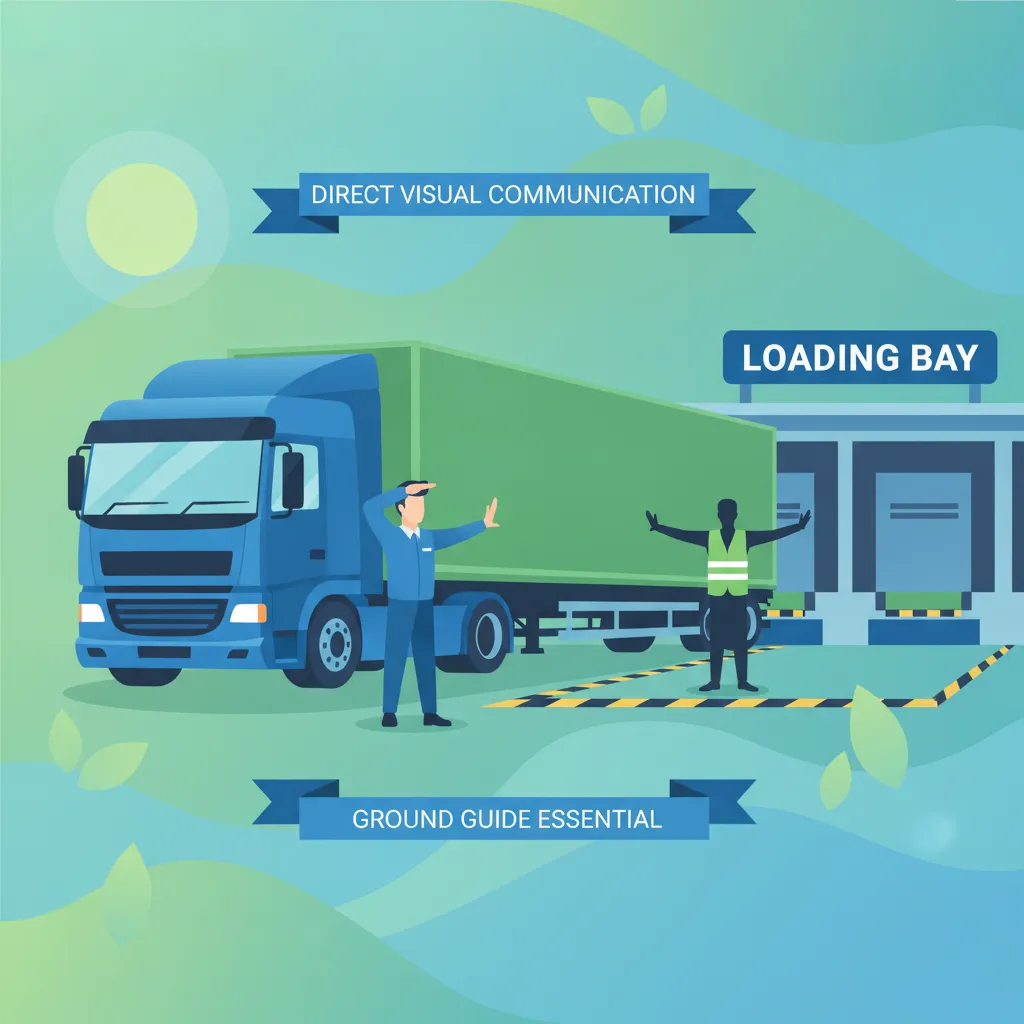
Reversing is one ofthe highest-risk maneuvers for an HGV driver. This lesson provides a structured guide to reversing safely, covering the 'get out and look' principle, effective use of all mirrors, and the use of reversing cameras and alarms. It stresses the importance of using a trained banksman (signaller) whenever possible, using agreed signals, and maintaining a slow, controlled speed throughout the maneuver to prevent accidents.
This lesson highlights the significant danger posed by the large blind spots of HGVs and buses. You will learn to identify these hazardous areas around a vehicle where the driver cannot see you. The lesson provides practical strategies for staying out of these zones, especially at junctions and when overtaking, to prevent serious accidents.

This lesson examines the physical space a goods vehicle occupies on the road and its impact on maneuvering at junctions, roundabouts, and in tight spaces. Learners will understand the concepts of tail swing and off-tracking, and how to calculate the necessary clearance for safe turns. The content emphasizes maintaining safe distances from other road users and infrastructure, which is a key component of professional spatial awareness and accident prevention.

This lesson addresses the increased risks associated with driving after dark. It explains when to switch between dipped and main beam headlights to maximise your own vision without dazzling other drivers. Techniques for reducing glare and spotting hazards like cyclists or pedestrians with poor visibility are also covered.

This lesson reinforces the vital safety rule of maintaining an adequate following distance from the vehicle ahead. It explains why the standard 'two-second rule' must be extended for heavy vehicles, especially in poor weather or when heavily laden, to account for longer stopping distances. You will learn practical methods for judging a safe gap in various traffic situations, creating a crucial safety buffer to react to unforeseen hazards.

This lesson focuses on the specific rules and best practices for driving HGVs on motorways in Great Britain. It covers mandatory speed limits for goods vehicles, lane discipline including restrictions on using the outside lane, and procedures for safely joining and leaving the motorway. The lesson also includes up-to-date information on driving on smart motorways, including understanding the signs and using emergency refuge areas correctly.

This lesson teaches strategic road positioning techniques to maximize your visibility and safety in traffic. You will learn how to choose the correct lane position to avoid the blind spots of larger vehicles and how to communicate your intentions through predictable riding. Key skills covered include effective use of shoulder checks, making eye contact with drivers, and maintaining a safe following distance, all of which are crucial for defensive riding on British roads.

A key aspect of motorcycle safety is being seen by others. This lesson teaches techniques to increase your conspicuity on the road. Topics include the strategic use of high-visibility and reflective clothing, correct use of headlights and daytime running lights, and adopting lane positions that place you in the direct line of sight of other drivers.
Find clear answers to common questions learners have about Identifying and Managing Blind Spots. Learn how the lesson is structured, which driving theory objectives it supports, and how it fits into the overall learning path of units and curriculum progression in Great Britain. These explanations help you understand key concepts, lesson flow, and exam focused study goals.
HGVs have significantly larger dimensions and higher seating positions, creating much larger areas around the vehicle where other road users, such as cyclists or pedestrians, remain completely invisible to the driver. Proper mirror management and active scanning are the only ways to mitigate these risks.
It is a fundamental safety procedure where you check your mirrors (observation), signal your intention, and then execute the manoeuvre only when it is safe. For HGV drivers, the observation phase must be more thorough to account for the larger vehicle profile.
You should check your mirrors frequently, especially before any change in direction, speed, or lane position. As a professional driver, consistent scanning is key to building a mental map of your surroundings.
No, vehicles are equipped with different classes of mirrors, including main mirrors, wide-angle mirrors, and close-proximity mirrors. Each is designed to provide visibility into a specific zone around the vehicle, and they must be adjusted correctly to function as intended.
Dive into our comprehensive question bank to find exactly what you need for your Great Britain theory test. Use our advanced filters to pinpoint specific subjects or test your knowledge on challenging areas, ensuring you're fully prepared for success.