Warning signs are a vital part of the Highway Code, designed to prepare you for changing road conditions or hazards ahead in Great Britain. Unlike regulatory or informational signs, they don't give direct orders but signal the need for increased caution. Understanding their meaning is key to safe driving and passing your theory test.
Theory topic content overview
Read the full theory topic guide for Understanding Warning Signs with structured, easy-to-scan content built for learners in Great Britain. This detailed section explains the exact rule, meaning, traffic context, comparison points, and exam logic behind this British driving theory topic so you can study faster, understand the concept more clearly, and avoid common interpretation mistakes on the theory test.
Warning signs are an indispensable part of the Great Britain road network and the Highway Code. Their fundamental purpose is to alert drivers to potential hazards, unusual conditions, or changes in the road ahead that require increased caution. Unlike regulatory signs which issue commands (like 'Stop' or 'Give Way') or prohibitive signs (like 'No Entry'), warning signs act as an advisory notice, giving you advance time to adjust your driving safely.
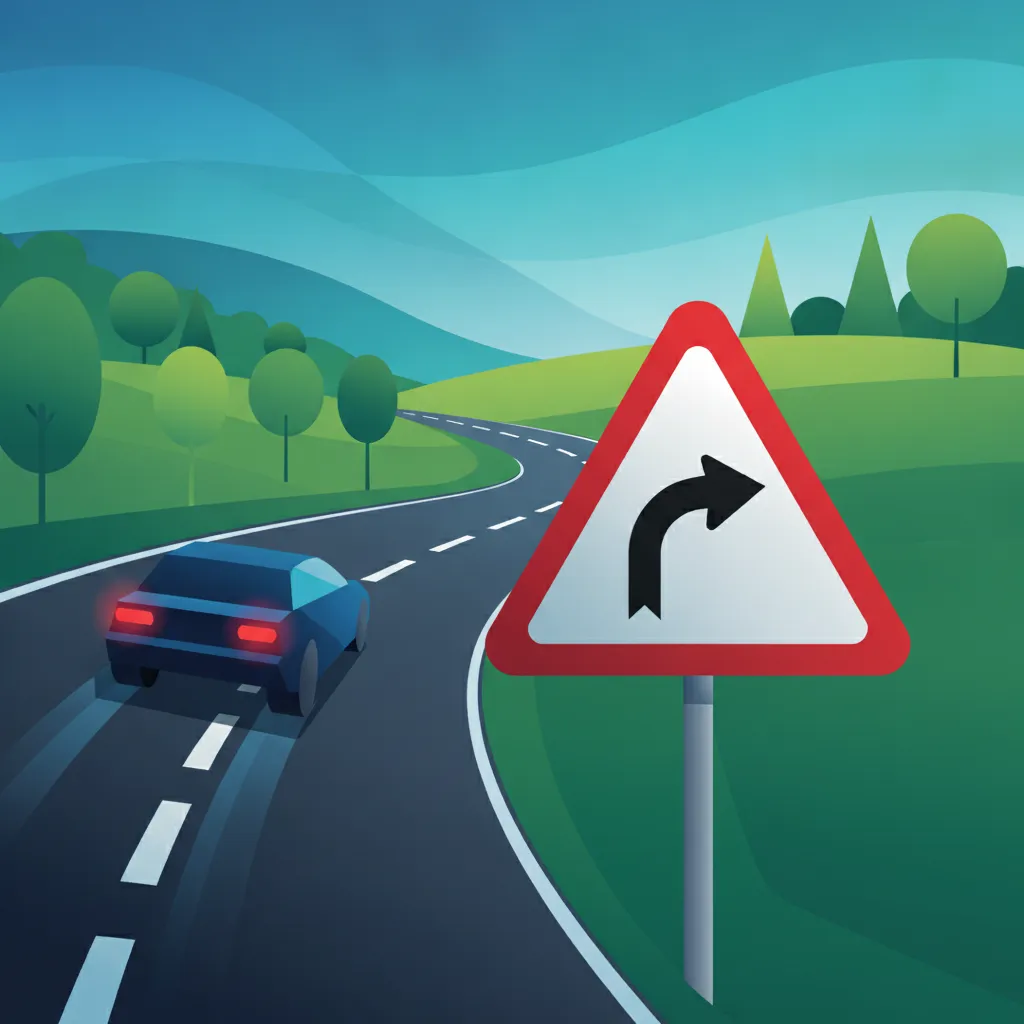
In Great Britain, most permanent warning signs are triangular in shape with a distinctive red border, a white background, and a black symbol or pictogram depicting the specific hazard. This universally recognised design allows drivers to quickly identify them as warnings, even before clearly reading the symbol, enabling earlier reaction.
Mastering warning signs is critical for both passing your DVSA driving theory test and for safe, proactive driving on England, Scotland, and Wales' roads.
The core principle when encountering any warning sign is anticipation and safe adaptation. It's not enough to simply see the sign; you must process its meaning and modify your driving accordingly.
Warning signs are typically placed a specific distance before the hazard to allow sufficient reaction time. This distance varies depending on the speed limit of the road. On faster roads, signs will be placed further in advance.
Warning signs in Great Britain cover a vast range of potential hazards. Here are some common categories:
Sharp bend to right/leftDouble bend first to right/leftRoad narrowsUneven roadHumps or roundabouts aheadHidden dip (requiring you to hold back if overtaking, as per the Highway Code)Pedestrians in road aheadChildren crossingSchool crossing patrol ahead (often accompanied by flashing amber lights when in use)Cyclists in roadWild animals or CattleSlippery roadRisk of iceSteep hill downwards/upwards (gradients may be shown as a ratio, e.g., 20% = 1:5)Falling or fallen rocksSide windsQuayside or river bankLevel crossing with barrier/gate or without barrier/gateTraffic signals ahead (including Miniature warning lights at level crossings)Tunnel aheadLow-flying aircraft or Sudden aircraft noiseUnderstanding the differences between warning signs and other categories is crucial for your theory test and practical driving in Great Britain:
For temporary hazards like roadworks, accidents, or diversions, Great Britain uses warning signs with a yellow background and black symbols. These carry the same advisory weight as permanent warning signs but indicate a non-permanent situation. Always treat temporary signs with extra caution, as the conditions they warn of can change rapidly.
On Great Britain's motorways, overhead gantry signals or roadside signals often display warnings. As per Highway Code Rule 257, amber flashing lights on these signals warn of a hazard ahead. Your response should be to reduce your speed and be prepared for the hazard, as traffic may be stopping further ahead.
Beyond signs, road markings also provide warnings. A hazard warning line (white broken line with longer markings and shorter gaps) indicates an unspecified hazard ahead. This often precedes double white lines, meaning you should not overtake if the solid line is on your side.
Warning signs are not just decorative roadside furniture; they are your eyes further down the road, a critical safety feature of Great Britain's road system. By consistently observing, interpreting, and reacting appropriately to these triangular hazard signs, you'll develop the essential hazard perception skills required by the DVSA and become a safer, more confident driver. Always anticipate, always prepare, and always adapt your driving to the conditions ahead.
Start with a short, direct summary of Understanding Warning Signs before reading the full explanation below.
Warning signs in Great Britain are predominantly triangular with a red border and black symbols, indicating potential hazards or unusual conditions ahead. Their primary purpose is to give drivers sufficient time to react safely by reducing speed, increasing vigilance, or preparing for specific actions. These signs are essential for anticipating risks like sharp bends, level crossings, or pedestrian activity, ensuring you don't encounter a surprise.
Review the most important terms, rule signals, and traffic concepts linked to Understanding Warning Signs.
Explore related theory topic pages connected to Understanding Warning Signs and continue with the next useful rule explanation.
See the common search queries learners use when trying to understand Understanding Warning Signs in Great Britain.

Continue your journey to a successful Great Britain driving theory test by delving deeper into specific topics. Enhance your understanding of complex rules, review detailed explanations, and solidify your knowledge of the Highway Code, preparing you thoroughly for all aspects of the official DVSA exam. Start mastering key concepts today.
Great Britain Driving Theory TopicsTheory topic content overview
Start with a short, direct summary of Understanding Warning Signs before reading the full explanation below.
Warning signs in Great Britain are predominantly triangular with a red border and black symbols, indicating potential hazards or unusual conditions ahead. Their primary purpose is to give drivers sufficient time to react safely by reducing speed, increasing vigilance, or preparing for specific actions. These signs are essential for anticipating risks like sharp bends, level crossings, or pedestrian activity, ensuring you don't encounter a surprise.
Review the most important terms, rule signals, and traffic concepts linked to Understanding Warning Signs.
Explore related theory topic pages connected to Understanding Warning Signs and continue with the next useful rule explanation.
See the common search queries learners use when trying to understand Understanding Warning Signs in Great Britain.
Continue your journey to a successful Great Britain driving theory test by delving deeper into specific topics. Enhance your understanding of complex rules, review detailed explanations, and solidify your knowledge of the Highway Code, preparing you thoroughly for all aspects of the official DVSA exam. Start mastering key concepts today.
Great Britain Driving Theory TopicsUse this exam-focused revision tip to understand how Understanding Warning Signs is likely to appear in theory questions for learners in Great Britain. This section helps you identify the most testable part of the rule, avoid common traps, and remember the concept more effectively during British driving theory exam preparation.
On your theory test, pay close attention to the symbol *inside* the warning sign. These questions often test your ability to correctly identify the specific hazard (e.g., a steep hill versus a sharp bend) and the safe action required, not just the general shape. Remember, triangular means 'danger ahead, be prepared'.
Read direct answers to the most common learner questions about Understanding Warning Signs in Great Britain. This FAQ focuses on rule confusion, practical meaning, comparison with similar concepts, and the exact uncertainties that appear most often in British driving theory revision and exam preparation.
The main purpose of a warning sign is to alert drivers to potential hazards or unusual road conditions ahead, giving them time to react safely and prepare for changes.
Most warning signs in Great Britain are triangular with a red border, a white background, and a black symbol depicting the specific hazard.
When you see a warning sign, you should anticipate the indicated hazard, reduce your speed, increase your observation, and be prepared to take appropriate action such as braking or changing your road position.
While most permanent warning signs are triangular, some specific warnings, like those for temporary hazards (e.g., roadworks) or motorway signals, may have different shapes or use amber flashing lights.
Warning signs inform you of potential dangers, requiring caution. Regulatory signs give definite commands or prohibitions (e.g., 'STOP', 'NO ENTRY') that you must legally obey.
Yes, the Highway Code extensively covers all types of road signs, including warning signs, explaining their meanings and how drivers should respond to them to maintain safety.
They are positioned to provide drivers with adequate time to perceive the sign, understand the hazard, and safely adjust their driving behaviour, such as reducing speed, before reaching the danger zone.
Dive into our comprehensive question bank to find exactly what you need for your Great Britain theory test. Use our advanced filters to pinpoint specific subjects or test your knowledge on challenging areas, ensuring you're fully prepared for success.