
Mastering road markings is a vital part of your theory test preparation and your future as a safe driver. This guide walks you through the distinction between standard waiting restrictions and specific loading prohibitions, helping you identify where and when you are permitted to stop. By learning to read kerb markings and loading bay signage accurately, you will be better equipped to handle real-world traffic scenarios.
Article content overview
Understanding the difference between parking and loading is a fundamental requirement for every learner driver in Great Britain. The Highway Code provides clear, strict rules regarding where you can stop, wait, or park, and confusing these regulations can lead to penalty charge notices or even safety hazards. In the DVSA theory test, you will likely encounter questions that test your ability to interpret road signs, time plates, and specific markings on the kerb.
Many learners struggle to distinguish between yellow lines on the road and yellow markings on the kerb. While both are used to manage traffic flow, they communicate different types of restrictions. Yellow lines on the carriageway indicate waiting restrictions, whereas yellow marks on the kerb specifically warn you about loading prohibitions.
Refers to a vehicle being stationary, regardless of whether the driver is in the car or the engine is running.
The act of actively placing goods into or removing them from a vehicle. This does not include browsing in shops or waiting for passengers who are not yet present.
You are permitted to stop on yellow lines to allow passengers to board or alight, or to load or unload heavy items, provided there are no additional loading restrictions in force. However, if there are yellow marks on the kerb, you must check the nearby black and white time plates to see if loading is prohibited during those specific hours.
Yellow marks on the kerb are easy to identify once you know what to look for. They appear as short, vertical lines painted directly onto the kerb edge. When you see these, it serves as a sign that loading or unloading is restricted at certain times.
Always look for the accompanying black and white time plate. If the plate does not specify days of the week, the restriction applies every day, including Sundays and Bank Holidays. Failure to check these signs is a common cause for test errors, as many students assume that restrictions only apply during typical business hours.
| Marking Type | Restriction | Note |
|---|---|---|
| Single Yellow Line | Waiting prohibited | Check time plate for hours |
| Double Yellow Lines | No waiting at any time | No time plate needed |
| Kerb Marks (Single) | Loading/unloading restricted | Check time plate for hours |
| Kerb Marks (Double) | No loading at any time | Always prohibited |
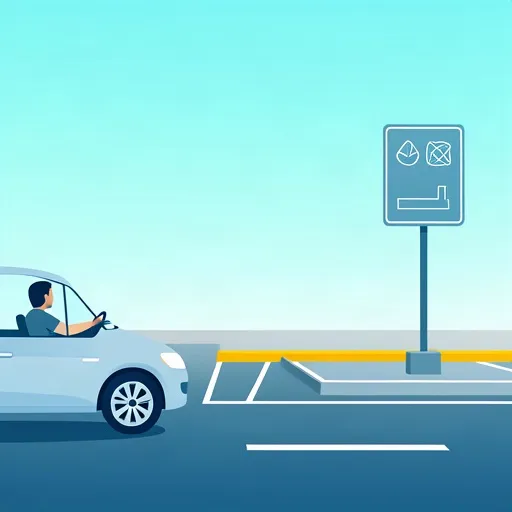
In many towns and cities across England, Scotland, and Wales, you will find white bay markings designated for "Loading Only." These bays are intended to facilitate the delivery of goods and are typically marked with a sign featuring a blue background and a white trolley symbol.
It is crucial to understand that these bays are not general parking spaces. If you are not actively loading or unloading, you cannot stop here, even for a few minutes. Some bays are restricted to goods vehicles only; if your vehicle is a private car, you must be certain that the sign does not explicitly forbid you from using the space before you stop.
Do not mistake "setting down passengers" for loading. While the Highway Code allows you to stop on most yellow lines to pick up or drop off passengers, this exemption does not apply in areas where there is a clear "No Stopping" order, such as school entrance markings or red routes.
The DVSA theory test often presents scenarios where a driver stops to perform a quick task, such as buying a newspaper or checking a map. It is essential to remember that these are not considered "loading." If you are stationary, you are "waiting," and if you do so in a restricted area, you are committing a parking contravention.
When answering exam questions, always identify the presence of a time plate first. If a sign shows specific times, the restriction is lifted outside of those hours. If no days are listed, the rule is in effect 24/7. Paying attention to these small details will ensure you do not fall for distractors in your theory test.
Article content overview
Explore related topics, search based questions, and concepts that learners often look up when studying Understanding Loading Restrictions. These themes reflect real search intent and help you understand how this topic connects to wider driving theory knowledge in Great Britain.
Find clear and practical answers to common questions learners often have about Understanding Loading Restrictions. This section helps explain difficult points, remove confusion, and reinforce the key driving theory concepts that matter for learners in Great Britain.
Yellow lines on the road surface generally indicate waiting restrictions (parking), whereas yellow marks on the kerb specifically indicate loading or unloading restrictions.
Yes, you are usually permitted to stop to allow passengers to board or alight, even where loading restrictions are in force, provided you do not wait or park.
Check the nearby black and white sign featuring a blue trolley symbol. This sign will specify if the bay is restricted to goods vehicles only and will indicate the times of operation.
If no days or times are indicated on the plates, the restrictions are in force every day of the year, including Sundays and Bank Holidays.
Explore our extensive library of Great Britain driving theory articles to clarify any topic, review specific road rules, or gain deeper insights into vehicle safety and the Highway Code. Use the search to find exactly what you need for comprehensive DVSA theory test preparation.