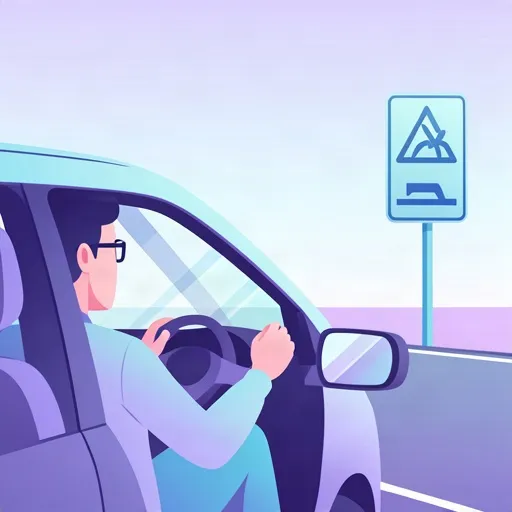
Observation is a fundamental pillar of the Irish Driver Theory Test, requiring more than just a quick glance at your mirrors. This guide breaks down why checking your blind spots is a legal and safety requirement for all road users, especially when maneuvering near more vulnerable road users like motorcyclists. Mastering these observational techniques will help you identify potential hazards early and meet the safety standards expected by the RSA.
Article content overview
Observation is the cornerstone of safe driving on Irish roads. For those preparing for the Driver Theory Test, understanding that observation requires more than just a quick glance at your internal and external mirrors is a critical step. The Road Safety Authority (RSA) emphasizes that mirrors provide an incomplete picture of your surroundings; failing to supplement these with physical shoulder checks is a leading cause of both exam failure and real-world road accidents.
While your rear-view and side-view mirrors are essential tools for monitoring traffic behind you, they are physically limited by the design of your vehicle. Every vehicle possesses "blind spots"—areas to the sides and rear that remain invisible to the driver regardless of how well the mirrors are adjusted. Relying solely on mirrors when changing lanes, merging, or moving off from a parked position is a dangerous oversight that often leads to collisions with cyclists, motorcyclists, or smaller vehicles.
In the context of your Irish theory test, you must demonstrate a deep understanding of defensive driving. The RSA guidelines suggest that you should not rely on your mirrors when moving off, changing lanes, turning right, or overtaking. Instead, you are expected to physically look over your shoulders to ensure your intended path is clear of any road users who may have entered your blind spot.
Common Exam Trap: Many learners fail questions regarding lane changes because they assume mirrors provide a 360-degree view. Always select the option that includes physical shoulder checks or "blind spot" observation in addition to mirror usage.
Motorcyclists and cyclists are particularly vulnerable to being missed during mirror-only checks due to their narrow profile. Because other drivers may instinctively look for larger objects, they often subconsciously filter out the smaller silhouettes of motorcycles. As an aspiring driver in Ireland, it is your responsibility to anticipate this danger.
When preparing to change position, you must watch your surroundings by scanning into the far, middle, and near distance. When you identify a motorcyclist or cyclist, maintain a significant gap and avoid aggressive maneuvers that might force them to take evasive action. Remember that you must avoid riding or driving between traffic lanes, and you should always keep well clear of other vehicles when passing them.
Ireland’s climate presents unique challenges for observation. Rain, mist, and road spray can significantly reduce the effectiveness of your mirrors, often obscuring your view of vehicles behind you. When visibility is compromised, your reliance on direct observation becomes even more vital.
Additionally, gravel, sand, and pools of water on the road surface can destabilize motorcycles, making them move unpredictably. If you are following a motorcyclist in poor weather, increase your following distance well beyond the standard "two-second rule." Expect the unexpected; if a motorcycle is forced to swerve to avoid a hazard like a drain or a patch of oil, your increased distance and constant observation will be the only things that prevent an accident.
To ensure you are fully prepared for the road, follow this structured approach to observation for any maneuver.
Mastering these concepts is not just about passing the test; it is about building a foundation for a lifetime of safe driving. The Irish Driver Theory Test will frequently present scenarios requiring you to prioritize safety over speed or convenience. By consistently applying the principle of "look, signal, maneuver," you demonstrate the observational rigor that the RSA demands.
Safe driving observation in Ireland requires more than mirror checks; drivers must physically look over their shoulders to cover blind spots before any maneuver. The RSA mandates this combined approach for lane changes, turning, moving off, and overtaking. Motorcyclists and cyclists are especially vulnerable to mirror-only checks, so drivers must actively scan for smaller vehicles and maintain appropriate gaps. In Ireland's wet climate, mirrors become less reliable, making direct observation even more critical. The standard observation protocol—scan distances, check mirrors, perform shoulder check, signal, then maneuver—must become automatic for both test success and lifelong safe driving.
A short set of high-value points that capture the most important ideas from this article.
Mirrors only provide an incomplete picture; physical shoulder checks are mandatory for safe maneuvers including lane changes, turning right, moving off, and overtaking
Every vehicle has blind spots—areas that remain invisible regardless of mirror adjustment—requiring direct head observation to cover
Motorcyclists and cyclists are particularly vulnerable because drivers may subconsciously filter out smaller vehicle silhouettes from mirror views
In wet weather conditions, mirrors become less effective due to rain, mist, and road spray, increasing reliance on direct observation
A structured observation protocol should be applied: scan distances, check mirrors, perform shoulder check, signal, then execute the maneuver
Use the Mirror-Signal-Manoeuvre sequence plus shoulder check as the complete safety routine for any change in direction or lane
Increase following distance beyond the two-second rule when following motorcyclists in poor weather due to their unpredictable movement on unstable surfaces
Scan far, middle, and near distances to build a complete mental map before committing to any maneuver
Never drive or ride between traffic lanes in Ireland—always maintain lane discipline and clear separation from other vehicles
In poor visibility, direct observation becomes even more critical as mirror effectiveness is significantly reduced
Assuming mirrors provide 360-degree visibility and skipping physical shoulder checks when changing lanes or merging
Subconsciously filtering out motorcycles and cyclists when scanning mirrors due to their narrow profile compared to larger vehicles
Performing mirror checks too late in the maneuver sequence instead of early enough to assess traffic speed and position
Not increasing following distance when following motorcyclists in wet conditions, leading to insufficient reaction time for unexpected swerving
Confusing the order of observation—some learners signal before checking mirrors or perform checks after signaling rather than before
Article content overview
A short set of high-value points that capture the most important ideas from this article.
Mirrors only provide an incomplete picture; physical shoulder checks are mandatory for safe maneuvers including lane changes, turning right, moving off, and overtaking
Every vehicle has blind spots—areas that remain invisible regardless of mirror adjustment—requiring direct head observation to cover
Motorcyclists and cyclists are particularly vulnerable because drivers may subconsciously filter out smaller vehicle silhouettes from mirror views
In wet weather conditions, mirrors become less effective due to rain, mist, and road spray, increasing reliance on direct observation
A structured observation protocol should be applied: scan distances, check mirrors, perform shoulder check, signal, then execute the maneuver
Use the Mirror-Signal-Manoeuvre sequence plus shoulder check as the complete safety routine for any change in direction or lane
Increase following distance beyond the two-second rule when following motorcyclists in poor weather due to their unpredictable movement on unstable surfaces
Scan far, middle, and near distances to build a complete mental map before committing to any maneuver
Never drive or ride between traffic lanes in Ireland—always maintain lane discipline and clear separation from other vehicles
In poor visibility, direct observation becomes even more critical as mirror effectiveness is significantly reduced
Assuming mirrors provide 360-degree visibility and skipping physical shoulder checks when changing lanes or merging
Subconsciously filtering out motorcycles and cyclists when scanning mirrors due to their narrow profile compared to larger vehicles
Performing mirror checks too late in the maneuver sequence instead of early enough to assess traffic speed and position
Not increasing following distance when following motorcyclists in wet conditions, leading to insufficient reaction time for unexpected swerving
Confusing the order of observation—some learners signal before checking mirrors or perform checks after signaling rather than before
Explore related topics, search based questions, and concepts that learners often look up when studying Mirror and Blind Spot Checks. These themes reflect real search intent and help you understand how this topic connects to wider driving theory knowledge in Ireland.
Find clear and practical answers to common questions learners often have about Mirror and Blind Spot Checks. This section helps explain difficult points, remove confusion, and reinforce the key driving theory concepts that matter for learners in Ireland.
Mirrors have inherent blind spots that cannot show vehicles or hazards positioned beside or slightly behind you. The RSA mandates physical head checks to ensure the road is clear before you change position.
You must check your blind spots whenever you intend to move off, change lanes, overtake, or turn, especially when turning right.
Motorcyclists are smaller and harder to see. Always scan your surroundings, including far and near distances, and physically check your blind spots to compensate for their narrow profile.
Yes, observation is a core component of the theory and practical test. Failure to demonstrate proper observation is considered a serious fault.
After searching, continue your DTT preparation by exploring related articles, practicing questions, or reviewing specific road sign categories. Deepen your understanding of Irish road rules and ensure you're fully prepared for your Driver Theory Test.