Understanding how to interact with public transport is a critical skill for both the Driver Theory Test and your future practical driving. This guide covers the essential observation and caution required when approaching bus stops and school buses to ensure you act lawfully and safely in every traffic scenario.
Article content overview
Navigating the roads alongside public transport is a fundamental skill for every driver in Ireland. Whether you are preparing for your Driver Theory Test or gaining experience for your practical lessons, understanding how to interact safely with buses and bus stops is essential for passing your exam and staying safe on the road. According to the Road Safety Authority (RSA) Rules of the Road, road users must demonstrate a high level of observation and patience when dealing with large vehicles. This article breaks down the essential procedures for handling bus stops, school buses, and urban traffic flow.
A common misconception among learner permit holders is that buses always possess an absolute right-of-way. In reality, while we should be cooperative with public transport to keep urban traffic moving efficiently, the legal responsibility for safety lies with the driver who is executing a manoeuvre. When you encounter a bus pulling away from a stop, you are required to exercise caution. You must observe all relevant road users, slow down in anticipation of the bus moving into your lane, and only proceed when it is both lawful and safe to do so.
Do not assume a bus driver will always wait for you. In the Driver Theory Test, always choose the answer that emphasizes observation and caution over speed or assumed priority. Rote memorization of bus stop locations is no substitute for live hazard perception.
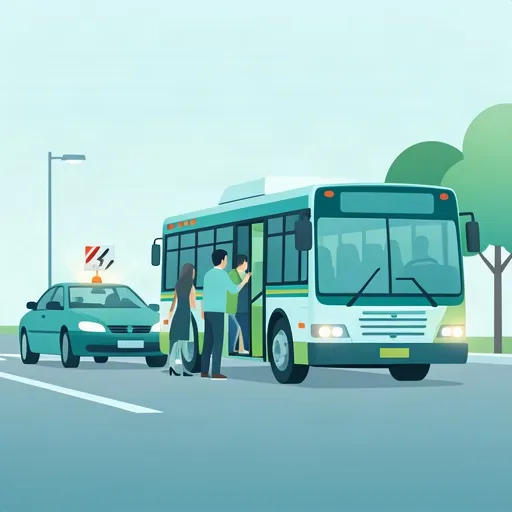
School buses are a unique category of hazard in Irish traffic theory. Because these vehicles are frequently stopping to allow young children to board or alight, they represent a significant risk. The RSA Rules of the Road are clear: you must be extra vigilant when approaching or overtaking a vehicle clearly marked as a school bus.
Urban driving requires constant scanning of the environment. Bus stops, specifically, are high-risk zones where pedestrians—often distracted or rushing—may step out into the path of traffic. When approaching a bus stop, your hazard perception must be active. This involves scanning for movement around the bus, identifying the presence of school wardens, and maintaining a safe following distance.
Familiarizing yourself with the correct terminology is vital for success in the Irish theory exam. Below are some core terms related to road safety and bus interaction that you will likely encounter.
Many learners fail to distinguish between "being polite" and "driving safely" in theory questions. If a question asks how to handle a bus pulling away, the correct answer will never be "continue at the same speed" or "rely on the bus driver." Always look for the options that mention early observation, reducing your speed, and assessing the safety of the manoeuvre before committing to it. Remember, in Ireland, safety standards are non-negotiable, and your exam responses must reflect the official Rules of the Road.
This article clarifies that while cooperation with public transport keeps urban traffic flowing, buses do not have absolute right-of-way and drivers must exercise constant observation and caution. For school buses specifically, drivers must slow down early, watch for children crossing from behind the vehicle, and avoid overtaking when visibility is poor or children are present. Urban bus stops are identified as high-risk zones requiring active hazard perception to identify distracted pedestrians who may step into traffic. The content emphasizes that theory exam answers should always prioritize safety and observation over speed or assumed priority, and that common exam traps involve confusing courtesy with correct procedure.
A short set of high-value points that capture the most important ideas from this article.
Buses do not have absolute right-of-way; drivers must always exercise caution when buses are pulling out or changing lanes
School buses require extra vigilance because children frequently board and alight unpredictably
Approach bus stops with active hazard perception, scanning for pedestrians who may step into traffic
Observation and caution take priority over speed or assumed priority in all bus-related scenarios
Safety standards as defined by RSA Rules of the Road are non-negotiable in both the exam and real driving
Slow down well before reaching a school bus and be prepared to stop completely
Do not overtake a school bus if children are nearby or if visibility is impaired
Look for children crossing or emerging from behind any stationary bus
Use your horn if children appear unaware of your approach to a school bus
Bus stops are high-risk zones where distracted pedestrians may step into traffic unexpectedly
Assuming buses always have priority and will wait for you to proceed
Continuing at the same speed when a bus indicates to pull away from a stop
Relying on bus drivers to anticipate your actions rather than observing them
Failing to actively scan for pedestrians when approaching bus stops in urban areas
Confusing being polite with being safe; hesitation can create hazards as much as speed
Article content overview
A short set of high-value points that capture the most important ideas from this article.
Buses do not have absolute right-of-way; drivers must always exercise caution when buses are pulling out or changing lanes
School buses require extra vigilance because children frequently board and alight unpredictably
Approach bus stops with active hazard perception, scanning for pedestrians who may step into traffic
Observation and caution take priority over speed or assumed priority in all bus-related scenarios
Safety standards as defined by RSA Rules of the Road are non-negotiable in both the exam and real driving
Slow down well before reaching a school bus and be prepared to stop completely
Do not overtake a school bus if children are nearby or if visibility is impaired
Look for children crossing or emerging from behind any stationary bus
Use your horn if children appear unaware of your approach to a school bus
Bus stops are high-risk zones where distracted pedestrians may step into traffic unexpectedly
Assuming buses always have priority and will wait for you to proceed
Continuing at the same speed when a bus indicates to pull away from a stop
Relying on bus drivers to anticipate your actions rather than observing them
Failing to actively scan for pedestrians when approaching bus stops in urban areas
Confusing being polite with being safe; hesitation can create hazards as much as speed
Explore related topics, search based questions, and concepts that learners often look up when studying Safe Driving Near Buses. These themes reflect real search intent and help you understand how this topic connects to wider driving theory knowledge in Ireland.
Find clear and practical answers to common questions learners often have about Safe Driving Near Buses. This section helps explain difficult points, remove confusion, and reinforce the key driving theory concepts that matter for learners in Ireland.
No, buses do not have an automatic right-of-way. You must use caution, observe the bus driver’s signals, and ensure it is safe and lawful to pass or allow them to pull out.
You must exercise extra care, especially when children are boarding or leaving. Slow down, be prepared to stop, and if necessary, use your horn to alert children to your presence.
Yes, the safest approach in theory test scenarios is to slow down early, observe all road users, and proceed only when it is safe to do so.
After searching, continue your DTT preparation by exploring related articles, practicing questions, or reviewing specific road sign categories. Deepen your understanding of Irish road rules and ensure you're fully prepared for your Driver Theory Test.