
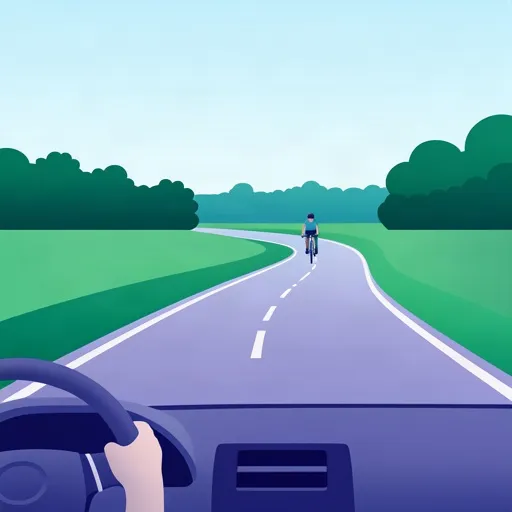
Navigating narrow, winding rural roads requires a heightened level of anticipation and caution, especially when vulnerable road users like cyclists are present. This article explains the RSA guidelines for managing road conditions effectively, ensuring you can stop safely should a hidden hazard emerge around a bend. You will learn why slowing down early is a fundamental defensive driving skill that directly impacts your success in the hazard perception portion of the Irish theory test.
Article content overview
This article teaches essential skills for navigating rural bends in Ireland, emphasising that posted speed limits are maximum limits, not targets, and that drivers must always be able to stop within their visible range. It explains the RSA requirement to give cyclists at least 1.5 metres of space when overtaking on roads above 50 km/h, and stresses that cyclists should always be expected on narrow rural roads. The content provides a six-step defensive driving procedure for approaching bends and reinforces that successful hazard perception relies on anticipation rather than reaction. These principles directly support preparation for the Irish Driver Theory Test.
A short set of high-value points that capture the most important ideas from this article.
Posted speed limits on rural roads are not targets; you must be able to stop within the distance you can see ahead
Always assume a cyclist or vulnerable road user could be just around a bend on narrow rural roads
You must give cyclists at least 1.5 metres of space when overtaking on roads with speed limits above 50 km/h
Anticipation and early speed reduction are the core principles of defensive driving on rural bends
Hazard perception in the theory test tests your ability to recognise when hidden hazards require speed reduction
If visibility is restricted by hedges or walls, reduce speed significantly before entering any bend
Do not overtake on a bend if visibility is poor or the road is too narrow for safe passing
Use the defensive driving procedure: scan, assess, reduce speed, observe, select gear, then accelerate when clear
The Rules of the Road require you to yield to vulnerable road users sharing narrow rural roads
Your stopping distance must always be within your visible clear road ahead
Assuming the posted speed limit is always the appropriate speed for current conditions
Failing to slow down early enough before a bend with restricted visibility
Attempting to overtake a cyclist on a narrow bend where visibility is limited
Not scanning for warning signs that indicate bends or narrow roads ahead
Accelerating out of a bend before confirming the road ahead is clear of hazards
Article content overview
A short set of high-value points that capture the most important ideas from this article.
Posted speed limits on rural roads are not targets; you must be able to stop within the distance you can see ahead
Always assume a cyclist or vulnerable road user could be just around a bend on narrow rural roads
You must give cyclists at least 1.5 metres of space when overtaking on roads with speed limits above 50 km/h
Anticipation and early speed reduction are the core principles of defensive driving on rural bends
Hazard perception in the theory test tests your ability to recognise when hidden hazards require speed reduction
If visibility is restricted by hedges or walls, reduce speed significantly before entering any bend
Do not overtake on a bend if visibility is poor or the road is too narrow for safe passing
Use the defensive driving procedure: scan, assess, reduce speed, observe, select gear, then accelerate when clear
The Rules of the Road require you to yield to vulnerable road users sharing narrow rural roads
Your stopping distance must always be within your visible clear road ahead
Assuming the posted speed limit is always the appropriate speed for current conditions
Failing to slow down early enough before a bend with restricted visibility
Attempting to overtake a cyclist on a narrow bend where visibility is limited
Not scanning for warning signs that indicate bends or narrow roads ahead
Accelerating out of a bend before confirming the road ahead is clear of hazards
Explore related topics, search based questions, and concepts that learners often look up when studying Rural Driving and Cyclist Safety. These themes reflect real search intent and help you understand how this topic connects to wider driving theory knowledge in Ireland.
Find clear and practical answers to common questions learners often have about Rural Driving and Cyclist Safety. This section helps explain difficult points, remove confusion, and reinforce the key driving theory concepts that matter for learners in Ireland.
Slowing down early ensures you have enough time to observe the road ahead and come to a safe stop if you encounter a hazard, such as a cyclist, a slow-moving vehicle, or livestock, that was previously hidden by the bend.
No, the speed limit is the maximum legal speed under ideal conditions. You must always adjust your speed to be appropriate for the current road conditions, visibility, and the presence of other road users.
The test often uses scenarios to check if you understand the need for early observation and anticipation. You are expected to demonstrate defensive decision-making, such as reducing speed before entering a blind bend, rather than simply memorizing facts.
After searching, continue your DTT preparation by exploring related articles, practicing questions, or reviewing specific road sign categories. Deepen your understanding of Irish road rules and ensure you're fully prepared for your Driver Theory Test.