Understanding how to safely navigate near HGVs is a critical component of defensive driving and your preparation for the official theory test. You will learn how to identify truck blind spots, the importance of mirror checks, and why maintaining a safe distance is vital for accident prevention. This guide ensures you possess the practical knowledge required to interact confidently with large vehicles under varied Irish traffic conditions.
Article content overview
Navigating Irish roads alongside Heavy Goods Vehicles (HGVs) requires a high level of defensive driving awareness. Because of their sheer size, weight, and the physical limitations of their drivers’ vision, trucks operate under different constraints than passenger cars. Understanding these limitations is not only vital for your personal safety but is also a core requirement for passing the Irish Driver Theory Test, as the Road Safety Authority (RSA) expects all learner permit holders to demonstrate a proactive approach to hazard perception.
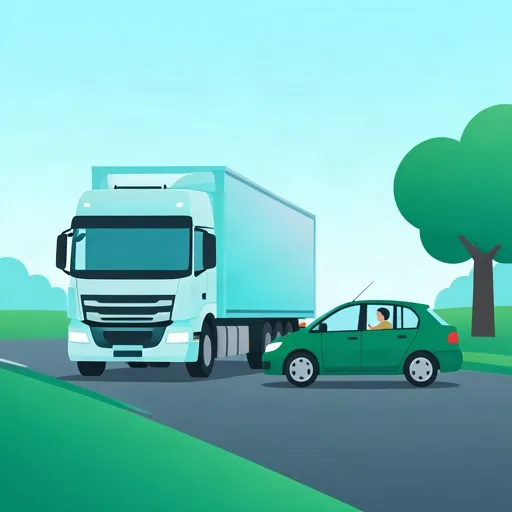
The most significant danger when driving near an HGV is the presence of extensive blind spots. Unlike a standard car, a truck driver often has limited visibility directly in front of the vehicle, along the sides, and immediately behind the trailer. In the context of the theory test, you must remember the golden rule: if you cannot see the truck driver in their mirrors, they almost certainly cannot see you.
Modern HGVs are legally required to be fitted with wide-angle and close-proximity mirrors—sometimes referred to as 'Cyclops' mirrors—to mitigate these risks. However, even with these aids, these zones remain inherently dangerous. Attempting to overtake an HGV without fully understanding these limits often leads to learners lingering in a position where they remain invisible during a lane change or turn.
Overtaking an HGV on a motorway or national road is a manoeuvre that should only be undertaken when you are certain it is safe and legal to do so. Before you commit to passing, you must assess the road conditions, the speed of the vehicle, and your own acceleration capabilities. Never move into a position where you might be forced to brake suddenly in front of an HGV, as their stopping distances are significantly longer than those of a lighter vehicle.
The RSA emphasizes that you do not have a greater right of way than any other road user. When dealing with buses or HGVs, you should be prepared to yield, particularly when a large vehicle is signalling to pull back into the flow of traffic after a stop. Expecting the unexpected is the hallmark of a defensive driver; this includes anticipating that a truck might need to swing wide to negotiate a tight left-hand turn, which can create a temporary hazard for those on the inside.
Many learners struggle with questions that focus on the interaction between passenger cars and large vehicles. A common mistake is treating hazard perception as a matter of rote memorisation rather than a dynamic decision-making process. The theory exam often presents scenarios where the "fastest" answer is not the "safest" one. Always look for options that prioritize observing other road users, slowing down early, and ensuring your manoeuvre is lawful.
Understanding how to safely interact with HGVs is essential for both road safety and the Irish Driver Theory Test. The core principle is that HGVs have extensive blind spots where a car can be invisible to the driver, so if you cannot see the truck driver in their mirrors, they cannot see you. Safe overtaking requires checking mirrors, signalling clearly, completing the manoeuvre swiftly within speed limits, and only returning to the left lane when the truck's full front is visible in your mirror. The RSA emphasizes defensive driving and hazard anticipation over memorisation, and learners must understand that large vehicles require extra room to turn, creating a swept path that can catch nearby vehicles unaware.
A short set of high-value points that capture the most important ideas from this article.
If you cannot see the truck driver in their mirrors, they almost certainly cannot see you
Never linger in an HGV's blind spot; complete overtakes swiftly but within legal speed limits
HGVs require significantly longer stopping distances than passenger vehicles
Large vehicles swing wide on left turns because their rear wheels follow a different path than the front wheels
Defensive driving means anticipating the unexpected actions of other road users
HGVs have extensive blind spots: directly in front, along both sides, and immediately behind the trailer
Modern HGVs are fitted with wide-angle 'Cyclops' mirrors but some danger zones remain
Only move back into the left lane after overtaking when you can see the truck's full front in your rear-view mirror
The RSA expects learner permit holders to demonstrate proactive hazard perception with large vehicles
You do not have a greater right of way than any other road user when sharing the road with HGVs
Assuming an HGV driver can see you when you are positioned beside or behind the truck
Attempting to squeeze between a turning HGV and the kerb due to the swept path danger
Treating hazard perception questions as rote memorisation rather than dynamic decision-making
Moving back into the left lane too early after overtaking, before seeing the truck's full front
Braking suddenly in front of an HGV, not accounting for their longer stopping distances
Article content overview
A short set of high-value points that capture the most important ideas from this article.
If you cannot see the truck driver in their mirrors, they almost certainly cannot see you
Never linger in an HGV's blind spot; complete overtakes swiftly but within legal speed limits
HGVs require significantly longer stopping distances than passenger vehicles
Large vehicles swing wide on left turns because their rear wheels follow a different path than the front wheels
Defensive driving means anticipating the unexpected actions of other road users
HGVs have extensive blind spots: directly in front, along both sides, and immediately behind the trailer
Modern HGVs are fitted with wide-angle 'Cyclops' mirrors but some danger zones remain
Only move back into the left lane after overtaking when you can see the truck's full front in your rear-view mirror
The RSA expects learner permit holders to demonstrate proactive hazard perception with large vehicles
You do not have a greater right of way than any other road user when sharing the road with HGVs
Assuming an HGV driver can see you when you are positioned beside or behind the truck
Attempting to squeeze between a turning HGV and the kerb due to the swept path danger
Treating hazard perception questions as rote memorisation rather than dynamic decision-making
Moving back into the left lane too early after overtaking, before seeing the truck's full front
Braking suddenly in front of an HGV, not accounting for their longer stopping distances
Explore related topics, search based questions, and concepts that learners often look up when studying Safe Overtaking and HGV Awareness. These themes reflect real search intent and help you understand how this topic connects to wider driving theory knowledge in Ireland.
Find clear and practical answers to common questions learners often have about Safe Overtaking and HGV Awareness. This section helps explain difficult points, remove confusion, and reinforce the key driving theory concepts that matter for learners in Ireland.
The rule is simple: if you cannot see the driver in their vehicle mirrors, they cannot see you. Always assume you are in a blind spot if you are positioned directly behind or alongside a large vehicle.
HGVs require more space to manoeuvre, turn, and stop. Defensive driving—expecting the unexpected and giving them extra room—is necessary to avoid accidents caused by their limited visibility and larger turning circles.
Always check your mirrors for vehicles behind you, check your blind spots to ensure no one is already overtaking you, and signal your intent clearly in good time before starting the manoeuvre.
Yes, under Road Safety Authority standards, HGVs must be equipped with close-proximity and wide-angle mirrors, often referred to as Cyclops mirrors, to minimize blind spots around the front and sides of the vehicle.
After searching, continue your DTT preparation by exploring related articles, practicing questions, or reviewing specific road sign categories. Deepen your understanding of Irish road rules and ensure you're fully prepared for your Driver Theory Test.