
This lesson guides you through the legal consequences of traffic offences in Ireland and how the penalty point system applies to your motorcycle licence. It is an essential part of understanding your responsibilities as a new rider under the Road Safety Authority framework. You will learn how points are accumulated, the implications for learner permit holders, and how to avoid enforcement actions.

Lesson content overview
Operating a motorcycle on public roads in Ireland carries significant responsibility. To promote road safety and deter dangerous riding behaviours, the Irish government utilizes a progressive sanction framework known as the Penalty Point System. This system, enforced actively by An Garda Síochána (the Irish national police force), tracks driving offences and applies cumulative demerit points directly to a rider's record.
For motorcyclists, understanding how this system operates is not just a matter of passing the Category A, A1, or A2 motorcycle theory test; it is an essential part of maintaining a valid driving licence and ensuring personal survival on the road. Motorcyclists are inherently vulnerable road users, and compliance with the Road Traffic Acts directly correlates with a reduced risk of serious accidents.
Introduced under the Road Traffic Act 1995 and subsequently updated through various Road Traffic Acts, the penalty point system is designed to identify, deter, and penalize repeat traffic offenders.
Penalty points are administrative sanctions recorded on your driving record by An Garda Síochána when you commit specific traffic offences. They accumulate over time and can lead to an automatic licence suspension if thresholds are breached.
When an offence is detected and verified, penalty points are officially recorded against your driver record. Key aspects of their validity include:
The Irish licensing framework recognizes that inexperienced road users pose a statistically higher risk of collisions. Consequently, the threshold at which an automatic licence suspension is triggered depends on the type of driving licence or permit you hold.
To protect inexperienced motorcyclists and other road users, the Road Safety Authority (RSA) enforces a lower tolerance threshold for learner permit holders and novice riders.
The Learner Permit and Novice Threshold is 7 Points. If you accumulate 7 penalty points within a rolling 3-year period while riding on a learner permit—or during your first two years holding a full motorcycle licence (Novice phase)—your licence is automatically suspended.
Once you have successfully completed your two-year novice period, you transition to the standard threshold.
Certain driving offences carry mandatory penalty point allocations. While these rules apply to all motor vehicles, some are of particular consequence to Category A, A1, and A2 motorcyclists.
Exceeding the posted speed limit is one of the most common traffic infractions in Ireland.
Riding a motorcycle without valid third-party insurance is a serious criminal offence under Irish law.
Wearing a secure, approved safety helmet is a legal requirement for both motorcycle riders and pillion passengers in Ireland.
A common point of confusion among riders is how points are calculated if they are stopped for multiple offences simultaneously.
The "Single Occasion" Rule: Under Irish road traffic law, if you commit multiple penalty point offences on the same occasion and they are processed together, you will only receive the penalty points for the highest-pointing offence. However, you must still pay the separate monetary fines for each individual offence committed.
The monitoring and detection of road traffic violations are executed through a combination of technology and physical policing.
Ireland utilizes a network of speed detection devices to monitor vehicle speeds:
Members of the Garda National Economic Crime Bureau and local traffic units patrol roads using both marked and unmarked vehicles, including highly maneuverable Garda motorcycles.
When a traffic violation is recorded, either via camera or direct Garda intercept, a structured legal process begins.
Detection and Logging: The offence is detected by an officer or camera. The details are registered on the National Vehicle and Driver File (NVDF).
First Payment Window (28 Days): A Fixed Charge Notice (FCN) is posted to the registered owner of the vehicle. You have 28 days from the date of the notice to pay the specified fine (e.g., €160 for speeding) and accept the associated penalty points.
Second Payment Window (Days 29 to 56): If you do not pay within the first 28 days, the fine increases by 50%. You have an additional 28 days to pay this elevated amount.
Court Summons: If payment is still not received after 56 days, a court summons is issued. If convicted in court, the penalty points applied are significantly higher (e.g., escalating from 3 to 5 points for speeding), and the court may impose a much larger fine and record a criminal conviction.
A highly dangerous misconception among some learners is that paying the monetary fine "settles" the matter and prevents penalty points from being applied.
This is entirely false. Paying the fine is simply an admission of the offence to avoid going to court. The associated penalty points will always be applied to your licence record once the payment is processed.
If you reach the point threshold (7 points for learners/novices, 12 points for full licence holders), your right to ride is legally withdrawn.
To help consolidate your understanding for the theory exam, keep these core regulations in mind:
| Regulation / Situation | Standard Rider Rule | Learner / Novice Rider Rule |
|---|---|---|
| Automatic Suspension Threshold | 12 penalty points within 3 years | 7 penalty points within 3 years |
| Suspension Duration | Mandatory 6-month disqualification | Mandatory 6-month disqualification |
| Point Validity | 3 years from date of offence/payment | 3 years from date of offence/payment |
| Riding Without an Approved Helmet | 2 points (FCN), 4 points (Court) | 2 points (FCN), 4 points (Court) |
| Failing to Display L or N-Plates | N/A | 2 points (FCN), 4 points (Court) |
By developing a thorough respect for the rules of the road and understanding how the penalty point system works, you protect not only your driving licence but also your life. Consistent, defensive riding habits are the best defense against points, fines, and collisions.
The Irish penalty point system operates under the Road Traffic Act 1995 and tracks traffic offences recorded by An Garda Síochána on your driving record. Learner permit holders and novice riders (those within their first two years of holding a full licence with N-plates) face automatic 6-month suspension at 7 accumulated points within 3 years, while fully licensed riders reach the same suspension at 12 points. Common offences include speeding (3 points via Fixed Charge Notice, 5 points if convicted), uninsured riding (5 points and court appearance), and helmet violations (2-4 points). The Fixed Charge Notice process provides a 28-day payment window at the standard fine, rising by 50% in the following 28 days, with court summons and higher penalties if payment is still not received after 56 days.
A short set of high-value points that capture the most important learning from this lesson.
Learner permit and novice riders face automatic licence suspension at 7 penalty points within 3 years, while fully licensed riders reach suspension at 12 points
Penalty points remain active on your licence for 3 years from the date of the offence or the date of payment of the Fixed Charge Notice
Speed limits are absolute maximums, not targets; you must ride below the posted limit in adverse weather conditions regardless of circumstances
Paying a Fixed Charge Notice fine does not prevent penalty points from being applied to your licence record
If multiple offences occur on the same occasion and are processed together, you only receive points for the highest-pointing offence, but you must still pay separate fines for each violation
Explore all units and lessons included in this driving theory course.
The 6-month automatic suspension applies once either the 7-point (learner/novice) or 12-point (full licence) threshold is reached within a rolling 3-year period
Fixed Charge Notice fines increase by 50% after the first 28-day payment window, and non-payment leads to court conviction with significantly higher point values
Learner permit holders must display L-plates on both front and rear of the motorcycle; novice riders (first 2 years after passing) must display N-plates and maintain the 7-point threshold
Riding without valid third-party insurance is a criminal offence resulting in mandatory court appearance, 5 penalty points, and potential direct disqualification
During any period of suspension or disqualification, that time does not count toward the 3-year point validity period
Assuming that paying the Fixed Charge Notice fine 'settles' the matter and prevents penalty points from being recorded on the licence
Believing that penalty point duration pauses during periods of suspension, when in fact suspension periods are excluded from the 3-year calculation
Thinking that maintaining speed at the posted limit is acceptable in adverse weather, when conditions may require riding significantly below the limit
Confusing novice rider status with full licence status and forgetting that the lower 7-point threshold applies for the first two years after passing the practical test
Overlooking the requirement to return the physical licence to the NDLS after receiving an automatic suspension notice
Lesson content overview
A short set of high-value points that capture the most important learning from this lesson.
Learner permit and novice riders face automatic licence suspension at 7 penalty points within 3 years, while fully licensed riders reach suspension at 12 points
Penalty points remain active on your licence for 3 years from the date of the offence or the date of payment of the Fixed Charge Notice
Speed limits are absolute maximums, not targets; you must ride below the posted limit in adverse weather conditions regardless of circumstances
Paying a Fixed Charge Notice fine does not prevent penalty points from being applied to your licence record
If multiple offences occur on the same occasion and are processed together, you only receive points for the highest-pointing offence, but you must still pay separate fines for each violation
Explore all units and lessons included in this driving theory course.
The 6-month automatic suspension applies once either the 7-point (learner/novice) or 12-point (full licence) threshold is reached within a rolling 3-year period
Fixed Charge Notice fines increase by 50% after the first 28-day payment window, and non-payment leads to court conviction with significantly higher point values
Learner permit holders must display L-plates on both front and rear of the motorcycle; novice riders (first 2 years after passing) must display N-plates and maintain the 7-point threshold
Riding without valid third-party insurance is a criminal offence resulting in mandatory court appearance, 5 penalty points, and potential direct disqualification
During any period of suspension or disqualification, that time does not count toward the 3-year point validity period
Assuming that paying the Fixed Charge Notice fine 'settles' the matter and prevents penalty points from being recorded on the licence
Believing that penalty point duration pauses during periods of suspension, when in fact suspension periods are excluded from the 3-year calculation
Thinking that maintaining speed at the posted limit is acceptable in adverse weather, when conditions may require riding significantly below the limit
Confusing novice rider status with full licence status and forgetting that the lower 7-point threshold applies for the first two years after passing the practical test
Overlooking the requirement to return the physical licence to the NDLS after receiving an automatic suspension notice
Explore search topics learners often look for when studying Understanding Penalty Points and Enforcement. These topics reflect common questions about road rules, driving situations, safety guidance, and lesson level theory preparation for learners in Ireland.
Browse additional driving theory lessons that cover connected traffic rules, road signs, and common driving situations related to this topic. Improve your understanding of how different rules interact across everyday traffic scenarios.
Learn how to adopt a defensive riding mindset to anticipate common traffic hazards and avoid dangerous situations. This overview explores how proactive hazard awareness and planning safe routes can prevent accidents and help you maintain a clean driving record while navigating Irish traffic.

This lesson teaches how to cultivate a proactive defensive riding mindset, focusing on situational awareness and constant hazard scanning. It describes the system of motorcycle control, encouraging riders to anticipate potential mistakes from other drivers, pedestrians, and cyclists. Motorcyclists will learn to position themselves defensively, leaving clear escape routes in all driving environments.
This lesson covers the strategic aspects of journey management, emphasizing the safety benefits of proactive route planning and weather checks. It teaches riders how to select safer roads, avoid high-congestion zones during rush hour, and schedule regular rest intervals. Motorcyclists will learn to pack essential tools, emergency contacts, and spare safety gear to remain prepared for any roadside situation.

This lesson outlines how motorcyclists should respond when permanent road signs are dirty, damaged, or hidden by overgrown trees and hedges. It introduces the temporary signage, warning cones, and detour markers commonly deployed at active roadwork zones in Ireland. Riders will learn to read the road ahead defensively, reducing speed when visual information is incomplete or compromised.

This lesson highlights the importance of smooth throttle adjustments for maintaining traction and stability on a moped. It teaches riders how to anticipate potential road hazards early, reducing the need for sudden emergency braking. Developing strong observation habits allows riders to adjust their speed smoothly and respond safely to traffic changes.

This lesson analyzes the crucial role of rider attitude, mental focus, and psychological factors in preventing motorcycle collisions on Irish roads. It addresses how overconfidence, fatigue, and peer pressure can negatively impact a rider's decision-making process and elevate risk levels. Motorcyclists will explore strategies to maintain a defensive mindset, exercise patience, and practice active situational awareness under all traffic conditions.

This lesson teaches riders how to create and preserve a protective safety envelope around their motorcycle under various traffic densities. It explains the two-second rule for dry conditions and how to expand this buffer zone in adverse weather or heavy traffic. Motorcyclists will learn to manage tailgaters by gradually increasing their following distance from the vehicle ahead to prevent sudden braking.
This lesson focuses on riding techniques suited for gravel, loose surfaces, and rural roads. Learners will understand how to maintain stability, adjust braking and cornering approaches, and anticipate hazards such as potholes and farm vehicles, following RSA guidance for safe riding in the Irish countryside.

This lesson focuses on practical strategies for maximizing a motorcyclist's visibility to other road users in day and night scenarios. It details the effective placement of retro-reflective materials, high-visibility jackets, and the constant use of dipped headlights. Riders will examine how road positioning within their lane dramatically reduces the likelihood of being obscured by other vehicles.

This lesson details the location of blind spots on passenger cars, commercial trucks, and buses, explaining how to avoid staying in these danger zones. It teaches the vital importance of the lifesaver glance or physical shoulder check before executing any lateral lane change or turn. Motorcyclists will learn how to monitor other drivers' mirrors to verify if their motorcycle is visible.

This lesson identifies prevalent risky behaviours among motorcyclists, including speeding, tailgating, and reckless riding under the influence of alcohol or drugs. Learners will understand the associated penalties, legal implications, and the impact of fatigue and peer pressure on decision-making, following RSA and Irish legal frameworks.
Understand the legal obligations for Category A, A1, and A2 motorcyclists regarding road traffic laws in Ireland. This lesson details the consequences of common violations such as speeding, uninsured riding, and failing to display required plates to ensure full compliance with the Road Safety Authority regulations.

This lesson explains the foundational legal obligations of motorcyclists under Irish road traffic legislation and the official Rules of the Road. It covers mandatory compliance with speed limits, correct signalling protocols, and strict adherence to lane discipline and right-of-way laws. Riders will gain a comprehensive understanding of the legal consequences and safety risks associated with traffic violations.

This lesson details the legal consequences of non-compliance with Irish road traffic laws, focusing on fixed charge notices, fines, and court prosecutions. It explains how persistent traffic violations can lead to mandatory licence disqualification, vehicle seizure, and soaring insurance premiums. Motorcyclists will learn about the serious long-term impact that a criminal driving record has on employment.

This lesson details the statutory rules governing learner permit holders, including compulsory safety gear and vehicle roadworthiness standards. Riders must understand the requirement for high-visibility clothing, functioning warning devices, and compliance with the official Rules of the Road. Safe riding habits are established by strictly adhering to these RSA standards.

This lesson details the legal requirements for motorcycle insurance under Irish law, emphasizing the absolute necessity of holding valid third-party cover. It outlines the rider's responsibility to maintain their motorcycle in a completely roadworthy condition, focusing on critical safety components like tyres, brakes, and lights. Learners will examine how mechanical failures and non-compliance with maintenance standards compromise legal eligibility and safety.
This lesson identifies prevalent risky behaviours among motorcyclists, including speeding, tailgating, and reckless riding under the influence of alcohol or drugs. Learners will understand the associated penalties, legal implications, and the impact of fatigue and peer pressure on decision-making, following RSA and Irish legal frameworks.

This lesson covers the rules governing zebra, pelican, and toucan pedestrian crossings, focusing on driver obligations and rider safety. It details how to interact safely with cyclists, personal mobility devices, and pedestrians in busy urban sectors. Motorcyclists will learn to scan pavement edges, yield right-of-way, and maintain safe overtaking distances when passing slower road users.
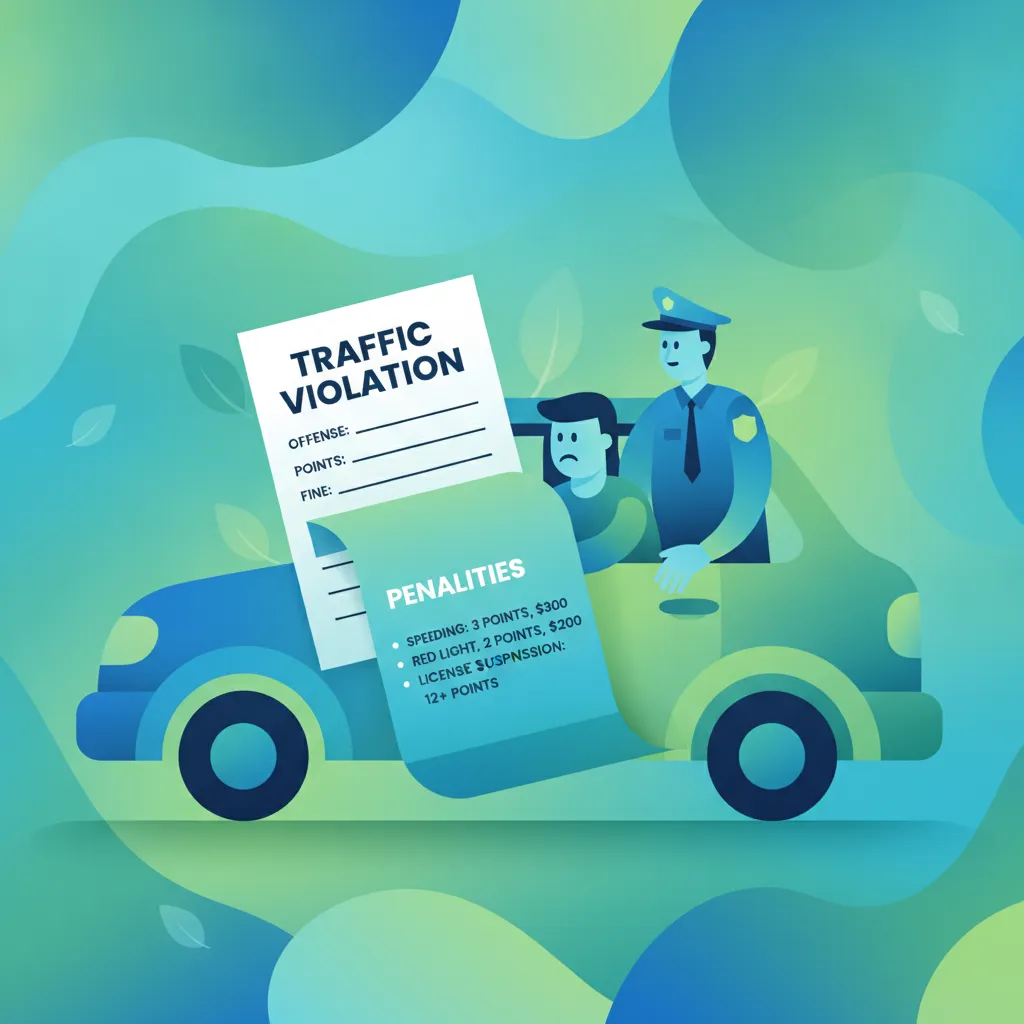
This lesson details the legal consequences of failing to adhere to the Irish Rules of the Road as a Category AM rider. It explains the structure of financial fines, penalty points, and situations that trigger immediate license suspension or disqualification. Understanding these severe penalties emphasizes the importance of consistent compliance and safe road use.

Learner drivers in Ireland must adhere to strict operational rules, including the compulsory display of red L-plates and driving under qualified supervision. This lesson outlines your specific duties as a learner, the legal definitions of an accompanying experienced driver, and the elevated safety margins you must maintain on the road. Failing to comply with these learner regulations carries serious legal penalties and delays your progression to a full driving licence.
Find clear answers to common questions learners have about Understanding Penalty Points and Enforcement. Learn how the lesson is structured, which driving theory objectives it supports, and how it fits into the overall learning path of units and curriculum progression in Ireland. These explanations help you understand key concepts, lesson flow, and exam focused study goals.
No, learner permit holders face stricter enforcement. Certain offences that carry lower points for full licence holders may lead to immediate disqualification or additional restrictions for learners under the specific Irish regulations monitored by the RSA.
Generally, penalty points remain on your driving record for a period of three years from the date of the alleged offence. It is vital for all motorcyclists to keep their record clear to avoid higher insurance premiums and potential licence suspension.
Yes, penalty points are issued for a variety of offences, including mobile phone use while riding, failing to obey traffic signals, and dangerous overtaking. Any breach of the Rules of the Road enforced by An Garda Síochána can trigger a penalty.
If a driver or rider reaches the threshold of 12 penalty points within a three-year period, they face an automatic six-month disqualification from driving. For learner permit holders, the threshold for disqualification is lower, making it critical to avoid all offences.
Use the practice question search tool to pinpoint specific topics, road signs, or rules you need to master for your official Driver Theory Test. Refine your study strategy and ensure comprehensive preparation for all aspects of the Irish driving exam. Start your focused revision now and build confidence for your learner permit test.