
This lesson is a critical part of the Category C course, focusing on the high-stakes interactions between heavy goods vehicles and vulnerable road users like cyclists and pedestrians. You will learn to navigate dense urban environments by managing your vehicle's significant blind spots and adjusting your driving habits to ensure safety. Mastering these concepts is essential for both your theory exam success and your professional responsibilities on Irish roads.

Lesson content overview
Operating a large goods vehicle (LGV) under a Category C licence in Ireland carries a profound professional and moral responsibility. Because of their immense mass, physical dimensions, and extensive blind spots, heavy commercial vehicles pose a disproportionate risk to those who share the road without the protection of a metal passenger cabin.
In the context of the Irish Goods Vehicle Driver Theory Test Course (Category C), mastering the dynamics of interactions with Vulnerable Road Users (VRUs) is not merely a requirement for passing your Driver CPC (Certificate of Professional Competence) exams; it is a critical daily operational skill. This lesson covers defensive driving strategies, statutory compliance under Irish road traffic laws, and the physical principles required to safely manage interactions with pedestrians, cyclists, and motorcyclists in both busy urban centres and narrow rural corridors.
A Vulnerable Road User (VRU) is defined as any road user who lacks a protective protective shell and is therefore highly susceptible to injury or death in the event of a collision. In practice, this category primarily comprises pedestrians, cyclists, motorcyclists, and persons with reduced mobility.
Any non-motorised or lightweight road user—such as a pedestrian, cyclist, motorcyclist, or equestrian—who has no protective structural shield and is highly exposed to severe trauma in collisions with larger vehicles.
When driving a rigid truck or a heavy tipper, you must constantly account for the extreme disparity in mass. A fully loaded Category C vehicle can weigh up to 32,000 kg (32 tonnes), whereas a cyclist and their bicycle typically weigh under 100 kg. Simple physics dictates that even a low-speed impact from an HGV can transfer catastrophic kinetic energy to a VRU. Therefore, professional drivers must shift their mindset from "asserting right-of-way" to actively "preserving life through defensive margin management."
Pedestrians are the most common VRUs you will encounter, particularly during urban delivery routes in cities like Dublin, Cork, Limerick, and Galway. Managing these interactions safely requires an understanding of different crossing types, pedestrian psychology, and the physical limitations of your vehicle.
In Ireland, drivers must yield the right-of-way to any pedestrian who has stepped onto, or is clearly about to step onto, a zebra crossing.
A classic conflict point occurs when a Category C vehicle turns left at an urban junction. Pedestrians may begin crossing the side road just as your vehicle begins its turn.
Many Irish town centres feature pedestrianised streets with restricted hours for commercial deliveries (e.g., between 06:00 and 11:00).
Cyclists are highly agile but physically unstable compared to multi-track motor vehicles. Sudden wind gusts, potholes, road debris, or surface water can cause a cyclist to swerve suddenly. As a Category C driver, you must anticipate these lateral movements.
Irish safety guidelines and legislative frameworks emphasize maintaining generous lateral distances when passing cyclists.
The Minimum Passing Distance: When overtaking a cyclist in speed zones of 50 km/h or less, you must maintain a minimum lateral safety margin of 1.0 metre. In speed zones over 50 km/h, this minimum margin increases to 1.5 metres.
To safely pass a cyclist on Irish roads, you must treat them with the same spatial respect as a full-sized car.
Assess and Track: Observe the cyclist from a distance. Check if they are approaching an obstacle (such as parked cars, drain grates, or potholes) that might force them to swing outward.
Hold Back: If the road is too narrow to allow a 1.5-metre clearance, or if there is oncoming traffic, do not attempt to pass. Maintain a safe following distance behind the cyclist until the road widens or oncoming traffic clears.
Signal and Mirror Check: Check your Class II (main exterior) and Class IV (wide-angle) mirrors on the right side. Check your blind spots. Signal your intention to move out early to inform traffic behind you.
Move Out Completely: Change lanes or cross the centre white line fully, ensuring you provide a massive lateral safety margin.
Verify in Mirrors: Do not cut back into the left lane too quickly. Due to the length of a Category C vehicle, you must check your nearside (left) mirrors to ensure the rear of your body or cargo area is completely clear of the cyclist before gently returning to the left.
Roundabouts represent one of the highest-risk environments for cyclist-HGV collisions in Ireland. Cyclists have the right to keep to the outer lane of the roundabout, even if they intend to take a later exit (e.g., turning right/three-quarters of the way around).
Motorcycles share many vulnerabilities with bicycles but operate at much higher speeds. Their narrow profile makes them difficult to spot, particularly when they are positioned directly behind your vehicle or filtering through slow-moving traffic.
[ Your Category C Vehicle ]
      ▲               ▲
      │ (Blind Spot)  │ (Blind Spot)
   [Motorcycle]    [Motorcycle]
In heavy traffic or urban gridlock, motorcyclists frequently filter between lanes of stationary or slow-moving vehicles.
Motorcycles can accelerate and decelerate far more rapidly than an HGV.
A primary cause of collisions between commercial goods vehicles and VRUs is the driver’s failure to see them due to vehicle design limits. Category C vehicles have massive blind spots (or "no-zones") directly in front, immediately behind, and along both sides of the vehicle.
To mitigate these blind spots, professional drivers must understand their mirror systems and actively apply observation protocols.
Modern HGVs are equipped with specialized mirror systems designed to eliminate blind spots as much as mandated by European and Irish type-approval regulations:
| Mirror Class | Mirror Type | Location & Purpose | Critical Vulnerable User Benefit |
|---|---|---|---|
| Class II | Main Exterior Mirror | Mounted on both doors; provides a flat, realistic view of rearward traffic. | Helps track overtaking motorcyclists or cyclists approaching at speed from behind. |
| Class IV | Wide-Angle Mirror | Mounted above or below Class II; convex lens providing a wider field of view. | Detects cyclists and motorcyclists who are riding parallel to your cab doors. |
| Class V | Close-Proximity Mirror | Mounted on the passenger side door/window frame looking downwards. | Crucial for detecting cyclists or low-profile vehicles positioned directly beside the passenger cabin door. |
| Class VI | Front-View Mirror | Mounted above the windscreen looking down at the area directly in front of the cab. | Detects short pedestrians or children crossing directly in front of the high HGV grille. |
Mirrors alone do not solve the blind-spot problem; they require active driver scanning. When preparing to move off from a stationary position (such as at traffic lights):
Intersections are the primary conflict zones for commercial vehicles and VRUs. To safely navigate junctions, a Category C driver must execute turns using specific positioning strategies that manage the vehicle's space while protecting others.
When turning left, the trailer or rear body of a rigid truck cuts inward. If a cyclist is waiting on your left, they can be crushed between the side of your truck and the kerb.
[Kerb] ───────────────────────────┐
                                  │   ◄── Cyclist trapped here!
       ███████████                │
       █  Truck  █ ──► (Turning   │
       ███████████      Left)     │
                                  │
                                  │
The thick structural pillars (A-pillars) on the sides of your windscreen can easily hide a pedestrian crossing the street you are turning into, or a motorcyclist approaching from a side road.
Your driving environment and vehicle state dictate how much safety margin you must add to protect vulnerable road users.
In Ireland, rain, spray, and mist are common operational hazards.
To safely coexist with vulnerable road users on Irish roads, you must integrate these five core principles into your daily professional driving habits:
This lesson covers the critical safety skills Category C drivers need when sharing Irish roads with vulnerable road users (VRUs). Key hazards include the extensive blind spots unique to large commercial vehicles, which are managed through proper use of Class IV, V, and VI mirrors and the double-look protocol. The lesson emphasises defensive driving techniques including the 1.0/1.5 metre minimum passing distances for cyclists, proper positioning at roundabouts to avoid the nearside trap, and the dangers of off-tracking and tail swing during turns. Specific guidance is provided for adverse conditions including wet weather, low light, and fully loaded vehicles, all of which require increased safety margins and reduced speeds.
A short set of high-value points that capture the most important learning from this lesson.
Vulnerable Road Users (VRUs) include pedestrians, cyclists, and motorcyclists who lack protective shells and face catastrophic injury risk from HGV collisions due to extreme mass disparity.
The minimum lateral passing distance for cyclists is 1.0 metre in zones of 50 km/h or less, increasing to 1.5 metres in higher speed zones—if this clearance cannot be achieved, you must wait.
Category C vehicles have extensive blind spots (Class IV, V, and VI mirrors) that require active scanning using the double-look protocol before moving off, turning, or changing lanes.
When turning left, off-tracking causes your rear wheels to cut closer to the kerb than your front wheels, creating a crushing trap for cyclists on your left side.
A-pillar obscuration during right turns can hide pedestrians and motorcyclists—use the 'lean and look' technique by moving forward and backward in your seat to see around these structural pillars.
Explore all units and lessons included in this driving theory course.
Zebra crossings require yielding to any pedestrian who has stepped onto or is clearly about to step onto the crossing—never roll through or use aggressive braking.
Class V mirror (close-proximity) detects cyclists positioned directly beside the passenger cabin door; Class VI mirror (front-view) detects pedestrians or children crossing directly in front of the high HGV grille.
At roundabouts, never overtake a cyclist immediately before entering or while navigating—cyclists may be travelling straight ahead in the outer lane while you turn left.
Fully loaded HGVs take significantly longer to stop; increase following distances and reduce speed in wet conditions where braking distances can double.
Tail swing occurs during sharp turns when the rear overhang swings outward—always check your opposite mirror when turning to ensure pedestrians or cyclists on the footway are not struck.
Assuming cyclists know where your blind spots are and will stay clear—always actively verify before moving off or turning.
Cutting back into the left lane too quickly after overtaking a cyclist without checking nearside mirrors, as the rear of a long Category C vehicle may still be beside them.
Swinging too far right before turning left at a junction, which opens a gap that invites cyclists to creep up the nearside where they become trapped.
Misjudging motorcycle speed and distance at junctions due to their small visual profile—always double-check for oncoming motorcycles before proceeding.
Using hazard warning lights in pedestrianised zones as if they grant right-of-way—they only increase visibility and do not override pedestrian priority.
Lesson content overview
A short set of high-value points that capture the most important learning from this lesson.
Vulnerable Road Users (VRUs) include pedestrians, cyclists, and motorcyclists who lack protective shells and face catastrophic injury risk from HGV collisions due to extreme mass disparity.
The minimum lateral passing distance for cyclists is 1.0 metre in zones of 50 km/h or less, increasing to 1.5 metres in higher speed zones—if this clearance cannot be achieved, you must wait.
Category C vehicles have extensive blind spots (Class IV, V, and VI mirrors) that require active scanning using the double-look protocol before moving off, turning, or changing lanes.
When turning left, off-tracking causes your rear wheels to cut closer to the kerb than your front wheels, creating a crushing trap for cyclists on your left side.
A-pillar obscuration during right turns can hide pedestrians and motorcyclists—use the 'lean and look' technique by moving forward and backward in your seat to see around these structural pillars.
Explore all units and lessons included in this driving theory course.
Zebra crossings require yielding to any pedestrian who has stepped onto or is clearly about to step onto the crossing—never roll through or use aggressive braking.
Class V mirror (close-proximity) detects cyclists positioned directly beside the passenger cabin door; Class VI mirror (front-view) detects pedestrians or children crossing directly in front of the high HGV grille.
At roundabouts, never overtake a cyclist immediately before entering or while navigating—cyclists may be travelling straight ahead in the outer lane while you turn left.
Fully loaded HGVs take significantly longer to stop; increase following distances and reduce speed in wet conditions where braking distances can double.
Tail swing occurs during sharp turns when the rear overhang swings outward—always check your opposite mirror when turning to ensure pedestrians or cyclists on the footway are not struck.
Assuming cyclists know where your blind spots are and will stay clear—always actively verify before moving off or turning.
Cutting back into the left lane too quickly after overtaking a cyclist without checking nearside mirrors, as the rear of a long Category C vehicle may still be beside them.
Swinging too far right before turning left at a junction, which opens a gap that invites cyclists to creep up the nearside where they become trapped.
Misjudging motorcycle speed and distance at junctions due to their small visual profile—always double-check for oncoming motorcycles before proceeding.
Using hazard warning lights in pedestrianised zones as if they grant right-of-way—they only increase visibility and do not override pedestrian priority.
Explore search topics learners often look for when studying Interactions with Pedestrians, Cyclists and Motorcyclists. These topics reflect common questions about road rules, driving situations, safety guidance, and lesson level theory preparation for learners in Ireland.
Browse additional driving theory lessons that cover connected traffic rules, road signs, and common driving situations related to this topic. Improve your understanding of how different rules interact across everyday traffic scenarios.
Learn how to manage large vehicle positioning and right of way at multi-lane junctions. This guide explains technical requirements for handling heavy goods vehicles at roundabouts and signaling correctly to ensure road safety for all users in urban and rural traffic environments.
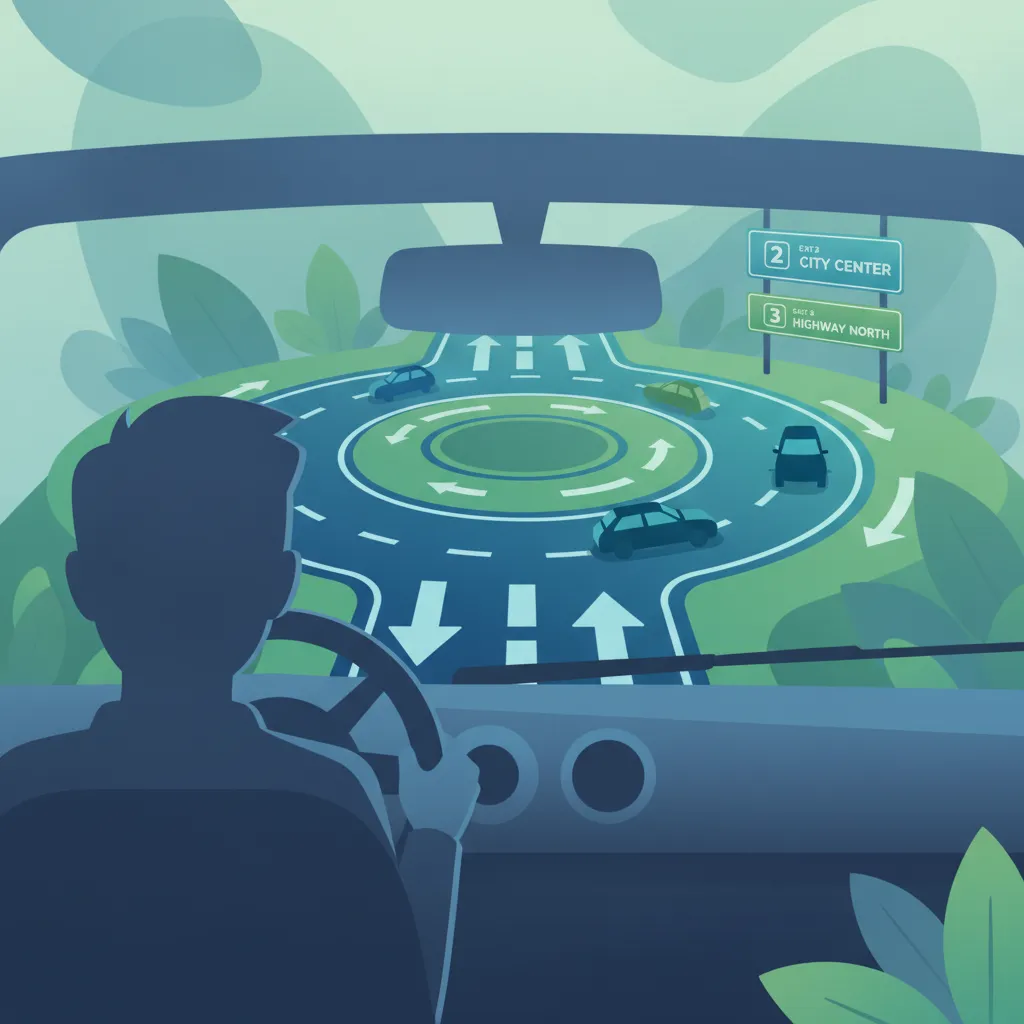
Navigating multi-lane roundabouts requires precise lane selection, continuous scanning, and timely signaling. This lesson teaches you the 'clock rule' for determining which lane to enter, how to yield to traffic already on the roundabout from your right, and when to activate your left indicator to exit. Mastering these procedures minimizes lane-drift accidents and ensures a seamless flow of traffic on busy roundabouts.
This lesson covers correct procedures for navigating roundabouts, which present significant risks for Category AM riders. It details lane selection rules, timely indicator signals for exiting, and the importance of checking blind spots before shifting lanes. Riders will learn to safely share the roundabout with large vehicles and vulnerable road users.
This lesson focuses on the safe approach and execution of turns at T-junctions, staggered intersections, and blind crossroads. It explains the critical mirror-signal-manoeuvre routine and how to select the best position for maximum visibility to cross-traffic. Motorcyclists will learn to identify potential hazards like vehicles pulling out suddenly or turning across their direct path.

This lesson addresses the mechanical dynamics of turning long-wheelbase and articulated commercial vehicles at intersections, junctions, and roundabouts. It covers the necessity of deep cornering lines, early mirror checks, and correct signaling to warn vulnerable road users of wide turn maneuvers. Drivers will learn how to minimize rear cut-in and ensure the entire vehicle clears urban obstacles safely.
This lesson details the sequential steps required to approach and exit junctions safely under the Irish driving rules. It teaches riders how to select the correct lane, utilize mirrors, apply early signals, and reduce speed appropriately. Effective observation strategies are highlighted to help riders identify crossing pedestrians or approaching side traffic.
This lesson provides a comprehensive guide to navigating single and multi-lane roundabouts safely in accordance with the Irish Rules of the Road. It covers correct lane selection on approach, signaling rules for exiting, and maintaining a steady path through traffic. Riders will learn to anticipate lane-changing mistakes made by other drivers and manage the unique banking angles of roundabouts.

Driving a coach through narrow urban streets or historic Irish town centers demands precise spatial judgment and low speed control. This lesson covers turning radii, rear tail-swing physics, and managing overhangs when navigating around tight, permanent obstacles. Drivers will learn to assess clearance gaps accurately, reducing damage risks to the vehicle exterior and public infrastructure.
Executing safe turns requires early preparation, correct road positioning, and clear communication with other road users. This lesson focuses on the mandatory Mirror-Signal-Manoeuvre (MSM) routine used across Ireland for turning at cross junctions and navigating roundabouts. You will learn how to choose the correct lane early, adjust your speed, and complete your turn smoothly without cutting corners or blocking trailing vehicles.

The length of a commercial passenger vehicle creates a wide rear-wheel track offset, requiring drivers to swing wide during tight turns. This lesson teaches cornering mechanics, mirror adjustment guidelines, and how to check blind spots for cyclists on the inside lane. Drivers will master intersection control, preventing collisions with stationary street furniture or curbs.

This lesson focuses on the physical mechanics of long-wheelbase and articulated vehicles when executing turns in restricted spaces. It explains concepts like swept path, rear overhang, and turning circles, which must be accounted for to prevent side-swiping collisions. Drivers will discover strategic route-planning techniques to avoid congested urban layouts and unsuitable rural corridors.
Understand the technical mirror classifications and visual field limitations for heavy goods vehicles. This lesson provides an in-depth look at active observation techniques and the use of Class IV, V, and VI mirrors to identify vulnerable road users during routine delivery operations and maneuvers.

This lesson explains the location, depth, and angle of the severe blind spots surrounding a standard heavy goods vehicle. It provides step-by-step guidance on setting up primary side mirrors, wide-angle lenses, and close-proximity front-view mirrors to eliminate blind areas. Drivers will learn systematic visual checking routines to ensure complete situational awareness before initiating any maneuver, lane shift, or turn.
The length of a commercial passenger vehicle creates a wide rear-wheel track offset, requiring drivers to swing wide during tight turns. This lesson teaches cornering mechanics, mirror adjustment guidelines, and how to check blind spots for cyclists on the inside lane. Drivers will master intersection control, preventing collisions with stationary street furniture or curbs.
Reversing a large passenger vehicle is a high-risk maneuver that must be avoided whenever possible or performed with extreme caution. This lesson teaches correct mirror alignment, the use of rear cameras, and establishing clear hand signals with an external spotter. Drivers will study safety protocols for backing into passenger bays, ensuring all blind zones remain completely clear.

This lesson explains the extensive blind spots of heavy goods vehicles, buses, and other large trucks on Irish roads. It teaches Category AM riders how to maintain safe following distances and position themselves where truck drivers can see them. Proper space cushion management is emphasized to protect riders from the wind turbulence of passing trucks.

This lesson teaches riders how to actively identify and eliminate blind spots through proper mirror adjustment and physical shoulder checks. It explains the concept of a safety cushion, which represents the defensive space maintained around the moped at all times. Managing these zones ensures adequate reaction time and mitigates the impact of sudden braking.
This lesson details the location of blind spots on passenger cars, commercial trucks, and buses, explaining how to avoid staying in these danger zones. It teaches the vital importance of the lifesaver glance or physical shoulder check before executing any lateral lane change or turn. Motorcyclists will learn how to monitor other drivers' mirrors to verify if their motorcycle is visible.
This lesson addresses the mechanical dynamics of turning long-wheelbase and articulated commercial vehicles at intersections, junctions, and roundabouts. It covers the necessity of deep cornering lines, early mirror checks, and correct signaling to warn vulnerable road users of wide turn maneuvers. Drivers will learn how to minimize rear cut-in and ensure the entire vehicle clears urban obstacles safely.

This lesson provides a comprehensive guide to reversing large vehicles and backing trailer setups safely into loading docks and industrial bays. It analyzes the mechanical physics of trailer articulation, steering inputs, and how to utilize modern backup cameras, mirrors, and assistants. Drivers will examine critical safety protocols, including visual checks and slow-speed controls, to avoid collisions with fixed objects.
Heavy vehicles require continuous visual scanning to identify small or slow-moving road users who may enter the path of travel. This lesson explores the typical behaviors of young children, elderly pedestrians, and visually impaired road users. Drivers will build strong hazard perception skills to anticipate sudden movements, ensuring they can brake safely and avoid serious accidents.

Motorcycles and bicycles are often hidden from view in the large blind spots of passenger buses and coaches during turns. This lesson covers safe lateral clearances when overtaking cyclists, recognizing advanced stop lines, and sharing narrow lanes. Drivers will understand how to signal clearly, giving riders enough room to navigate safely near busy public transit corridors.
Find clear answers to common questions learners have about Interactions with Pedestrians, Cyclists and Motorcyclists. Learn how the lesson is structured, which driving theory objectives it supports, and how it fits into the overall learning path of units and curriculum progression in Ireland. These explanations help you understand key concepts, lesson flow, and exam focused study goals.
Category C vehicles have higher driving positions and larger physical footprints. This creates significant areas around the front, sides, and rear of the vehicle that cannot be seen via standard mirrors, making it crucial to use auxiliary mirrors and sensors to detect cyclists.
Always scan your mirrors repeatedly before and during the maneuver. If a cyclist is approaching a junction, allow them to pass safely before beginning your turn, as your vehicle's sweep path can easily put a cyclist in danger.
Yes, you must provide sufficient room when overtaking. In Ireland, the Rules of the Road emphasize giving vulnerable users extra space, especially when driving a large vehicle that can cause significant air turbulence or 'vacuum effects' that might destabilize a cyclist.
In dense traffic, you should be checking your mirror sequence constantly. Because pedestrian and cyclist movements are unpredictable, maintaining a 'look-out' strategy is a core part of the professional Category C driving standard.
Use the practice question search tool to pinpoint specific topics, road signs, or rules you need to master for your official Driver Theory Test. Refine your study strategy and ensure comprehensive preparation for all aspects of the Irish driving exam. Start your focused revision now and build confidence for your learner permit test.