
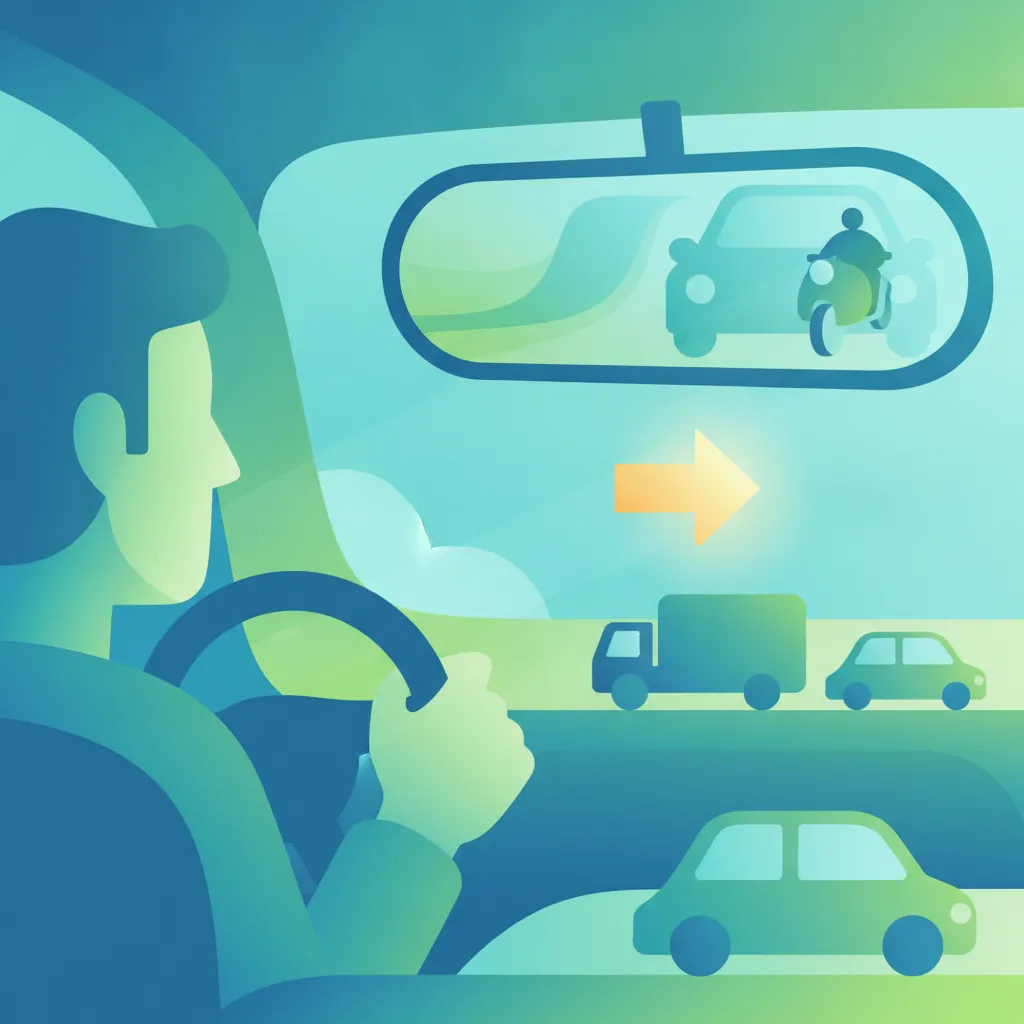
In Italian driving, effective mirror checks are fundamental for anticipating traffic movements and preventing collisions. This page clarifies when and how to use your central rear-view mirror and external side mirrors to stay aware of vehicles around you. Proper mirror use is a key observation skill tested in the Italian driving theory exam and vital for safe navigation in diverse Italian traffic conditions, from urban centers to the autostrada.
Theory topic content overview
Read the full theory topic guide for Driving Mirror Checks with structured, easy-to-scan content built for learners in Italy. This detailed section explains the exact rule, meaning, traffic context, comparison points, and exam logic behind this Italian driving theory topic so you can study faster, understand the concept more clearly, and avoid common interpretation mistakes on the theory test.
Driving mirror checks, or controllo specchietti in Italian driving terminology, refer to the essential habit of systematically scanning your vehicle's rear-view and side mirrors. This fundamental observation technique is paramount for every driver in Italy, allowing you to maintain continuous awareness of surrounding traffic, anticipate potential hazards, and execute maneuvers safely. It’s not just about looking; it’s about understanding what the mirrors show you and reacting accordingly.
Effective mirror use is a cornerstone of safe driving practice and a frequently tested topic in the Italian driving license theory exam (esame di teoria).
In the dynamic and often varied traffic conditions across Italy – from bustling city centers and narrow village streets to high-speed autostrade – the need for comprehensive observation is heightened. Mirror checks serve several vital purposes:
vigilanza costante (constant vigilance) is key to anticipating problems.Specchio Retrovisore Centrale and Specchietti Retrovisori EsterniEvery car in Italy is equipped with at least three mirrors, each designed to provide a specific view:
Central Rear-View Mirror (Specchietto Retrovisore Centrale):
lunotto posteriore (rear window).posizione antiriflesso), crucial for night driving or inside tunnels to reduce the dazzling effect of headlights from vehicles following behind. This is a common point in Italian theory quizzes.External Side Mirrors (Specchietti Retrovisori Esterni):
Specchio-Segnale-Manovra SequenceIn Italian driving, effective mirror checks are integrated into a systematic observation routine, often remembered as part of a specchio-segnale-manovra (mirror-signal-maneuver) sequence. You must check your mirrors before initiating any maneuver and also maintain continuous awareness while driving.
Key situations for mirror checks include:
Cambio Corsia): Crucial for ensuring the adjacent lane is clear and that no vehicle is rapidly approaching or in your angolo cieco (blind spot).Svolta): Check mirrors to monitor traffic behind and beside you, especially cyclists or motorcycles that might be overtaking on your inside or outside. This is explicitly stated in Italian theory questions.Frenata): Check your central mirror to assess following traffic. This allows you to brake smoothly or prepare for a sharp stop if needed, preventing rear-end collisions.Sorpasso): A critical sequence. Check central, then right side mirror (if overtaking left), then left side mirror, then perform a blind spot check. This ensures no one is already overtaking you and that the path is clear. Italian quizzes often stress this precise order.Immettere nel Flusso della Circolazione): When pulling out from the roadside, parking, or merging onto an autostrada, a thorough check of all mirrors and blind spots is essential.Parcheggio): Especially when reversing, check all mirrors for approaching vehicles or pedestrians. Relying only on parking sensors is a common mistake that Italian theory warns against.Angolo Cieco (Blind Spot) and the Controllo Visivo DirettoA critical distinction for Italian learners is understanding the angolo cieco (blind spot). These are areas around your vehicle that cannot be seen in any of your mirrors. Even perfectly adjusted mirrors leave small segments of the road unseen.
To cover these blind spots, you must perform a controllo visivo diretto (direct visual check), also known as a quick head check. This involves a brief glance over your shoulder in the direction of your intended maneuver.
sorpasso.prima di iniziare un sorpasso).Learners often make specific errors related to mirror checks, which are frequently targeted in the Italian driving theory exam:
angolo cieco and the need for a controllo visivo diretto. The exam will often present this as a false statement.specchietti retrovisori esterni) can distort distances, making vehicles appear further away.Posizione Antiriflesso: Overlooking the anti-glare function of the central mirror for night driving, a common theory question.Centri Abitati: The theory exam will present false statements claiming that mirror use is not necessary in urban areas. This is incorrect; vigilance is always required.Mastering mirror checks means developing a habit of proactive, continuous observation. Treat your mirrors as extensions of your eyes, constantly scanning and interpreting the traffic picture around you. Remember the "Mirror-Signal-Maneuver" routine, always perform a controllo visivo diretto for blind spots, and be aware of the specific challenges and nuances of Italian roads. This diligent practice is not only essential for passing your esame di teoria but, more importantly, for ensuring your safety and the safety of others on Italy's diverse road network.
Mirror checks are a fundamental observation skill for Italian drivers, involving systematic use of the central rear-view mirror and two external side mirrors to monitor surrounding traffic. The essential routine follows a mirror-signal-maneuver sequence, where mirrors must always be checked before signaling and executing any action. A critical distinction is understanding that mirrors leave blind spots requiring a direct visual head check before lane changes, turns, or overtaking maneuvers. External mirrors distort distance, making vehicles appear further away, so they cannot be relied upon for precise distance judgment. These observation skills are heavily tested in the Italian driving theory exam and are essential for safe driving across Italy's varied road conditions, from urban centers to high-speed autostrade.
A short set of high-value points that capture the most important ideas from this theory explanation.
The mirror-signal-maneuver sequence must always be performed in that exact order: check mirrors first, then signal, then execute the maneuver
All three mirrors provide different views and must all be checked before any maneuver to build a complete awareness picture
Blind spots exist that no mirror can show, requiring a quick head check before changing lanes, turning, or overtaking
External side mirrors, especially the passenger-side mirror, distort distance and make vehicles appear further away than they actually are
Mirror checks are not one-time actions but a continuous habit that should be performed every 5-8 seconds while driving
Central rear-view mirror shows traffic directly behind and can be set to anti-glare mode for night driving
External side mirrors should be adjusted to show only a small portion of your own vehicle, maximizing the road view beside you
The correct overtaking sequence is: central mirror, right side mirror, left side mirror, then blind spot check
Before braking, always check your central mirror to assess following traffic and brake smoothly to prevent rear-end collisions
Parking sensors and other technology are aids that supplement mirrors but cannot replace visual observation checks
Relying on mirrors alone without performing a direct head check to verify blind spots are clear
Checking mirrors after already signaling or initiating a maneuver, which defeats the purpose of the observation sequence
Forgetting that external mirrors distort distance perception and assuming a vehicle is further away than it actually is
Only checking mirrors when actively maneuvering rather than maintaining continuous awareness while driving straight
Assuming mirror checks are unnecessary in urban traffic or 'centri abitati', when in fact they are always required
Start with a short, direct summary of Driving Mirror Checks before reading the full explanation below.
Mirror checks involve systematically scanning your vehicle's mirrors (rear-view and side mirrors) to monitor surrounding traffic before and during maneuvers, and continuously while driving. This essential driving skill helps you detect vehicles behind and beside you, understand their intentions, and identify potential hazards like blind spots. It is a critical component of safe driving and a frequently tested topic in the Italian driving license theory exam.
Review the most important terms, rule signals, and traffic concepts linked to Driving Mirror Checks.
Explore related theory topic pages connected to Driving Mirror Checks and continue with the next useful rule explanation.
See the common search queries learners use when trying to understand Driving Mirror Checks in Italy.

Ready to deepen your knowledge? Explore specific Italian driving theory topics in detail, review challenging concepts, or test your understanding with practice questions. Build confidence for your official Italian driving licence exam by continuously learning and applying these essential road rules.
Explore Italian Driving TheoryTheory topic content overview
A short set of high-value points that capture the most important ideas from this theory explanation.
The mirror-signal-maneuver sequence must always be performed in that exact order: check mirrors first, then signal, then execute the maneuver
All three mirrors provide different views and must all be checked before any maneuver to build a complete awareness picture
Blind spots exist that no mirror can show, requiring a quick head check before changing lanes, turning, or overtaking
External side mirrors, especially the passenger-side mirror, distort distance and make vehicles appear further away than they actually are
Mirror checks are not one-time actions but a continuous habit that should be performed every 5-8 seconds while driving
Central rear-view mirror shows traffic directly behind and can be set to anti-glare mode for night driving
External side mirrors should be adjusted to show only a small portion of your own vehicle, maximizing the road view beside you
The correct overtaking sequence is: central mirror, right side mirror, left side mirror, then blind spot check
Before braking, always check your central mirror to assess following traffic and brake smoothly to prevent rear-end collisions
Parking sensors and other technology are aids that supplement mirrors but cannot replace visual observation checks
Relying on mirrors alone without performing a direct head check to verify blind spots are clear
Checking mirrors after already signaling or initiating a maneuver, which defeats the purpose of the observation sequence
Forgetting that external mirrors distort distance perception and assuming a vehicle is further away than it actually is
Only checking mirrors when actively maneuvering rather than maintaining continuous awareness while driving straight
Assuming mirror checks are unnecessary in urban traffic or 'centri abitati', when in fact they are always required
Start with a short, direct summary of Driving Mirror Checks before reading the full explanation below.
Mirror checks involve systematically scanning your vehicle's mirrors (rear-view and side mirrors) to monitor surrounding traffic before and during maneuvers, and continuously while driving. This essential driving skill helps you detect vehicles behind and beside you, understand their intentions, and identify potential hazards like blind spots. It is a critical component of safe driving and a frequently tested topic in the Italian driving license theory exam.
Review the most important terms, rule signals, and traffic concepts linked to Driving Mirror Checks.
Explore related theory topic pages connected to Driving Mirror Checks and continue with the next useful rule explanation.
See the common search queries learners use when trying to understand Driving Mirror Checks in Italy.
Ready to deepen your knowledge? Explore specific Italian driving theory topics in detail, review challenging concepts, or test your understanding with practice questions. Build confidence for your official Italian driving licence exam by continuously learning and applying these essential road rules.
Explore Italian Driving TheoryUse this exam-focused revision tip to understand how Driving Mirror Checks is likely to appear in theory questions for learners in Italy. This section helps you identify the most testable part of the rule, avoid common traps, and remember the concept more effectively during Italian driving theory exam preparation.
In the Italian theory exam, pay close attention to questions about observation sequences. Remember to always check your mirrors *before* signaling and executing any maneuver like changing lanes, turning, or braking. A common mistake is not checking mirrors early enough, or relying solely on mirrors without a quick head check for blind spots, especially before overtaking or merging into traffic.
Read direct answers to the most common learner questions about Driving Mirror Checks in Italy. This FAQ focuses on rule confusion, practical meaning, comparison with similar concepts, and the exact uncertainties that appear most often in Italian driving theory revision and exam preparation.
Mirror checks are the act of regularly looking into your vehicle's mirrors to monitor traffic around you. In Italian driving, they are crucial for maintaining continuous awareness, predicting other drivers' actions, and safely executing maneuvers, thereby preventing collisions.
You should check your mirrors before any maneuver such as braking, changing lanes, turning, overtaking, or merging into traffic. Additionally, regular checks are necessary even when driving straight to maintain overall traffic awareness, as emphasized in Italian theory tests.
The central rear-view mirror (specchio retrovisore centrale) provides a view directly behind your vehicle, typically with minimal distortion. Side mirrors (specchi retrovisori laterali) cover areas to the sides and rear, but the left side mirror, in particular, may give a less precise perception of distance for approaching vehicles.
External side mirrors, despite their wide angle, always have a 'blind spot' (angolo cieco) – an area not visible directly or through the mirrors. To compensate, Italian driving theory requires drivers to supplement mirror checks with a quick, direct glance over the shoulder, especially before overtaking or changing lanes.
Yes, proper mirror usage and observation techniques are a significant part of the Italian driving theory exam. Questions often focus on when to check mirrors during specific maneuvers or common situations, emphasizing their role in safe driving.
Absolutely. Before and during a reverse parking maneuver (manovra di parcheggio in retromarcia), you must use your mirrors to check for approaching vehicles or obstacles. Even with parking sensors, mirrors are essential for visual confirmation and safety.
The central rear-view mirror often has an anti-glare position (posizione antiriflesso) that can be activated, especially when driving at night or in tunnels. This function reduces the dazzling effect from the headlights of vehicles following behind, improving visibility and comfort.
Your mirrors (specchi retrovisori) should be adjusted after you have correctly positioned your driver's seat. The central mirror should provide a full view of the rear window. Side mirrors should be set to show a small portion of your vehicle's side, primarily observing the road alongside and behind.
Start searching now to pinpoint exactly which Italian driving theory topics, road signs, or traffic rules you need to master. Use our advanced filters to build a custom practice session and ensure you're fully prepared for every aspect of your official driving licence exam.