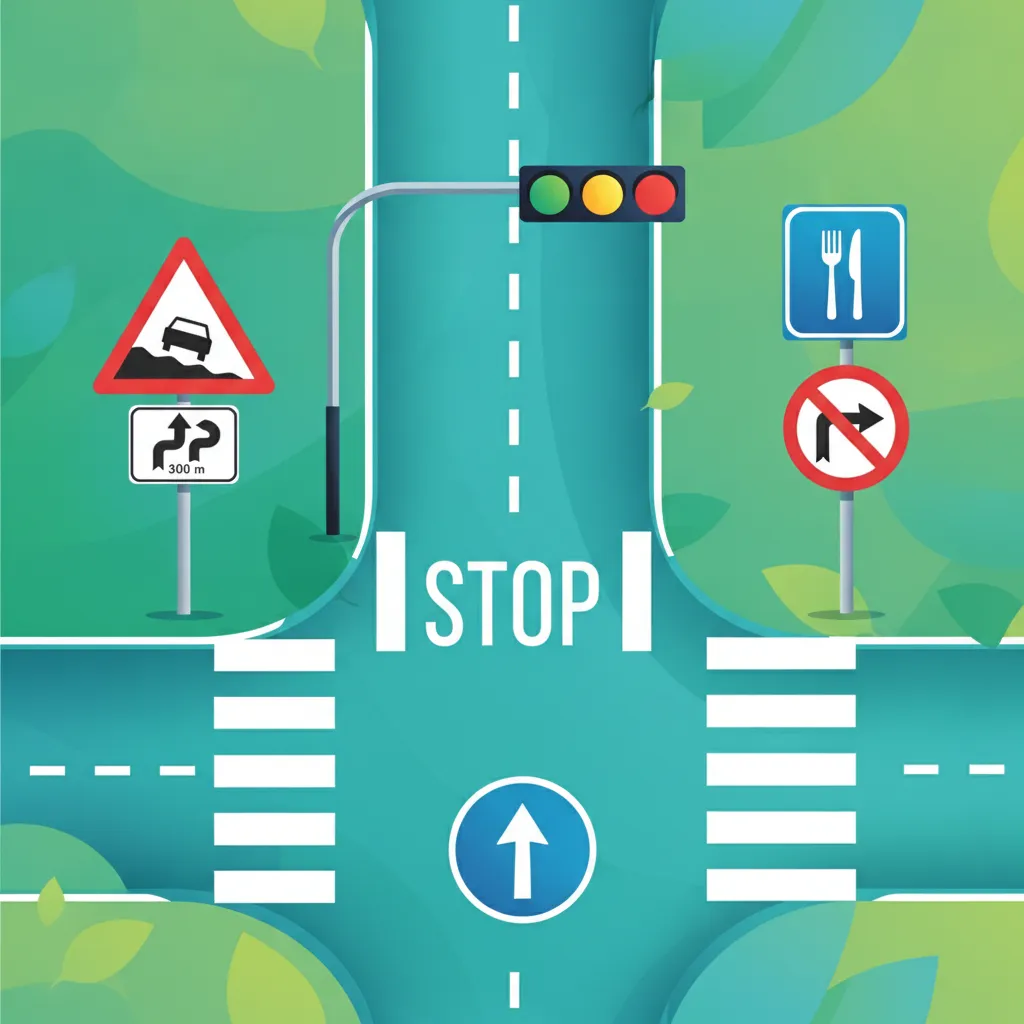
Navigate Italy's roads with confidence by mastering its visual language. This unit provides a comprehensive exploration of all official road signs, supplementary panels, traffic light signals, and road markings used across Italy. Understanding these elements is crucial for both passing your Patente B theory exam and ensuring safe, compliant driving.
Browse all lessons that make up Italian Signs, Supplementary Panels, Signals and Road Markings. Each lesson focuses on specific topics, learning objectives, and core concepts, helping you build essential knowledge and follow a clear, structured progression toward your study goals in Italy.
This lesson focuses on regulatory signs, which impose legal obligations and prohibitions on drivers. It explains the meaning of critical signs such as 'Stop', 'Yield' (dare la precedenza), and various speed limit signs. The content also covers signs that prohibit certain actions like overtaking, parking, or entry, as well as those that mandate a specific direction of travel or lane usage.
This lesson is dedicated to warning signs, which are designed to alert drivers to potential dangers or changes in road conditions ahead. It covers the interpretation of signs indicating sharp bends, steep inclines or declines, slippery surfaces, and the potential presence of animals or pedestrians. Understanding these signs allows drivers to anticipate hazards and adjust their speed and driving style accordingly for safety.
This lesson explains the function of informational and directional signs used for navigation and guidance on Italian roads. It covers how to read signs indicating upcoming cities, motorway exits, and the location of services like fuel stations, parking, and rest areas. The content also details the color-coding system used to differentiate between motorways (green), state roads (blue), and urban roads (white).
This lesson focuses on supplementary panels (pannelli integrativi) placed below primary road signs to provide additional context or modify their meaning. Learners will understand how these panels specify the distance to a hazard, the length over which a rule applies, or the specific times and vehicle types affected by a regulation. Correct interpretation of these panels is essential for full compliance with traffic laws.
This lesson provides a detailed guide to understanding road markings and pavement symbols in Italy. It explains the critical difference between continuous and broken lane lines regarding overtaking, the function of stop lines and yield markings at intersections, and the meaning of directional arrows painted in lanes. The content also covers markings for pedestrian crossings, bus lanes, and designated parking areas.
Explore high-intent keywords and long-tail search topics learners use when researching Italian Signs, Supplementary Panels, Signals and Road Markings. These terms reflect how people search for reliable study materials, structured explanations, and unit-level theory preparation support in Italy.
Find clear answers to the most common questions learners ask about Italian Signs, Supplementary Panels, Signals and Road Markings. Understand how the unit is organized, what learning goals it supports, and how it contributes to your study progression with structured explanations and practical guidance tailored for learners in Italy.
Italian road signs are primarily divided into three categories: Regulatory signs (segnali di prescrizione), which impose obligations or prohibitions; Warning signs (segnali di pericolo), which alert drivers to potential hazards; and Informational or Directional signs (segnali di indicazione), which provide guidance and information. Understanding the shape, color, and symbol of each category is key to interpretation.
Supplementary panels, often rectangular and placed below or beside a main sign, provide additional information that modifies the main sign's meaning. They can indicate the duration of a prohibition (e.g., 'only on working days'), specify the type of vehicle affected (e.g., 'except for residents'), clarify the distance to a hazard, or indicate the extent of a restricted zone.
Road markings provide essential guidance and reinforce traffic rules. Solid white lines often delineate lanes or indicate no-passing zones, while dashed lines allow for lane changes. Red markings usually indicate restricted areas, and yellow markings can denote temporary hazards or specific parking rules. Pedestrian crossings, cycle lanes, and stop lines are also critical markings to understand for safety.
The basic sequence of traffic lights in Italy follows international standards: green for go, red for stop, and amber as a warning of an impending red light. However, specific signals like flashing amber, arrows, or lights for trams and cyclists have precise meanings that must be understood to navigate intersections safely and legally.
Road signs, signals, and markings are extremely important for the Patente B theory test. A significant portion of the exam focuses on identifying and interpreting these visual cues. Correctly understanding them is essential for answering questions about right-of-way, prohibitions, hazards, and safe driving practices.
You must always consider the supplementary panel as an integral part of the main sign's instruction. If a panel modifies the sign, for example, by specifying 'except for emergency vehicles' on a 'no entry' sign, you must adhere to the modified instruction. Always read the main sign and any accompanying panel together.
All included lessons
Lessons in Italian Signs, Supplementary Panels, Signals and Road Markings
See who benefits most from studying Italian Signs, Supplementary Panels, Signals and Road Markings. This overview explains how the unit supports different learning needs, what level of knowledge is helpful before starting, and how it fits into the overall study path in Italy.
This unit is essential for all learners preparing for the Italian Patente B theory exam, especially those who need a thorough understanding of road signage and markings. It is also beneficial for drivers who want to refresh their knowledge of Italian traffic rules and visual communication on the road.

Begin your structured study today by exploring our Italian driving license theory curriculum. Browse comprehensive courses designed to cover all official exam topics, build your knowledge of road rules, and prepare effectively for your test.
Explore Italian Theory CurriculumExplore all units and lessons included in this driving theory course.
Begin your structured study today by exploring our Italian driving license theory curriculum. Browse comprehensive courses designed to cover all official exam topics, build your knowledge of road rules, and prepare effectively for your test.
Explore Italian Theory Curriculum