
In Italy's bustling urban centers, trams and other public transport vehicles operate under specific rules that grant them priority in many traffic situations. This is primarily due to their fixed routes, significant size, and limited maneuverability, which prevent them from reacting to hazards as quickly as other vehicles. Drivers must understand these rules to ensure safety and efficient traffic flow.
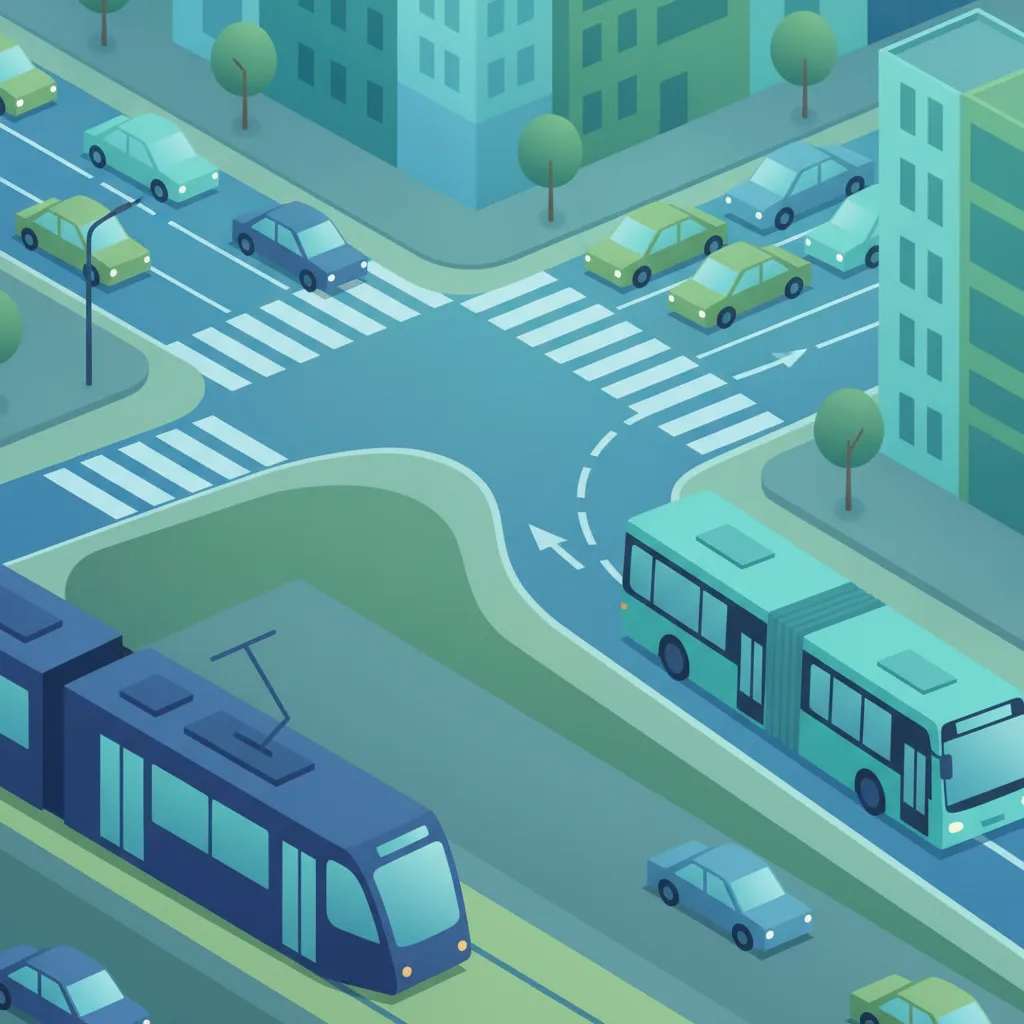
Theory topic content overview
Read the full theory topic guide for Tram Priority Rules with structured, easy-to-scan content built for learners in Italy. This detailed section explains the exact rule, meaning, traffic context, comparison points, and exam logic behind this Italian driving theory topic so you can study faster, understand the concept more clearly, and avoid common interpretation mistakes on the theory test.
In Italy, as in many urbanized countries, trams (tram) and certain other public transport vehicles like filobus (trolleybuses) are often granted specific priority rules in traffic. This is known as precedenza tram or precedenza filobus, and it's a fundamental concept for safe driving in Italian cities.
At its core, public transport priority means that other drivers are generally required to yield to these vehicles. This special status is not arbitrary; it's a practical necessity stemming from their operational characteristics:
Understanding these inherent limitations is key to correctly interpreting and applying Italian traffic rules concerning public transport.
The rules governing tram and public transport priority are vital for several reasons:
Esame di Teoria): Questions about tram and public transport priority are very common in the Italian driving licence theory test. Examiners frequently present scenarios involving trams at intersections, requiring candidates to know the correct precedenza application. Incorrect answers often stem from applying standard right-hand priority rules where they don't apply to trams.Codice della StradaThe Codice della Strada (Italian Highway Code) outlines specific provisions for interacting with trams and other public transport. Here's how these rules generally apply:
Trams typically have priority over all other vehicles at intersections, even if you are approaching from the right. This is a crucial distinction from the general precedenza a destra (right-hand priority) rule. You must always check for approaching trams and be prepared to yield, unless specific traffic lights or signage explicitly indicate otherwise.
When a tram or filobus is stopped to allow passengers to get on or off, drivers must exercise extreme caution.
Salvagente (Refuge Island): If there is a salvagente (a raised refuge island or platform for passengers) between the tram/bus and other traffic, you may overtake cautiously on the right, ensuring not to endanger pedestrians.Salvagente: If there is no salvagente and passengers are disembarking directly onto the roadway, overtaking on the right is strictly forbidden. You must stop and wait behind the tram or bus until it moves off or the passengers have safely cleared the road. This is a critical safety rule to protect vulnerable pedestrians and is often tested in the Italian exam.Corsie Riservate)Many Italian cities have corsie riservate (reserved lanes) specifically for buses and trams.
When a tram or filobus needs to make a turn, especially a left turn across opposing traffic, other vehicles must typically yield. Their size and limited agility make it difficult for them to wait or adjust.
For Italian driving theory, it's crucial to distinguish public transport priority from other rules:
Precedenza a Destra): This is the most common point of confusion. Remember: a tram's priority at an intersection generally overrides the standard precedenza a destra rule. Always prioritize the tram unless specific signs (like a "Stop" or "Give Way" sign specifically directed at the tram) indicate otherwise.Tram): Fixed on rails, always have high priority.Filobus): Trolleybuses, operate on electric overhead lines but use rubber tires. While not fixed to tracks, their size, mass, and role as public transport often grant them similar priority considerations, especially at intersections or when leaving designated stops.Autobus): Standard buses. While they have priority when leaving a bus stop, especially if indicated by signage, their general priority at intersections is usually governed by standard rules, unless they are using a corsia riservata or other specific signals apply. The key differentiating factor from trams is their full maneuverability.Piazza Intersection with Tram Tracks: You are driving in a bustling city center like Turin or Milan, approaching a large piazza intersection. You see tram tracks crossing your path and a tram approaching from your left, where you would normally have precedenza a destra over a car. Action: You must slow down and prepare to yield to the tram. The tram has priority, regardless of its direction relative to your right.salvagente. Action: You must stop behind the tram and wait. Attempting to overtake on the right would endanger pedestrians and is illegal.Corsia Riservata for Filobus: You are leaving a side street in Bologna and need to turn right onto a main road that has a dedicated corsia riservata for filobus. A filobus is approaching in its reserved lane. Action: You must yield to the filobus. Do not enter or obstruct the corsia riservata unless it is absolutely clear and safe, and your maneuver requires it (e.g., turning right immediately after entering), always giving priority to the public transport vehicle.Italian learners frequently make these errors regarding public transport priority:
Precedenza a Destra: The biggest mistake is assuming the standard right-hand priority rule applies to trams. Remember, trams often have special overriding priority.salvagente when passengers are boarding/alighting is a critical and dangerous error.Filobus Priority: Not realizing that filobus also have significant priority considerations due to their size and role, especially when leaving stops or in designated lanes.When encountering trams and public transport in Italy, adopt a mindset of precedenza preventiva (anticipatory yielding). Assume they have priority, especially trams. Always:
salvagente) is present.corsie riservate (reserved lanes) and only cross them when absolutely necessary and safe.By consistently applying these rules, you contribute to your own safety, the safety of others, and the smooth flow of Italian urban traffic, particularly for the thousands of passengers who rely on public transport daily. This understanding will be invaluable for both your esame di teoria and your real-world driving experience in Italy.
This topic covers the special priority rules for trams and public transport vehicles in Italian traffic under the Codice della Strada. Trams receive priority at intersections that overrides standard right-hand priority rules because they run on fixed tracks and cannot maneuver to avoid hazards. Drivers must yield to trams at intersections unless specific signals indicate otherwise, and overtaking stopped trams is only permitted on the right when a salvagente refuge island is present to protect boarding passengers. Reserved lanes (corsie riservate) must be respected, and similar priority considerations apply to filobus vehicles due to their size and limited maneuverability. These rules are frequently tested in the Italian driving theory exam and are essential for safe urban driving in cities with tram networks.
A short set of high-value points that capture the most important ideas from this theory explanation.
Trams have priority at intersections that overrides the standard precedenza a destra (right-hand priority) rule, even when approaching from the right
Trams cannot deviate from fixed tracks and require significantly longer stopping distances, making their path immutable and demanding yield from other vehicles
Overtaking a stopped tram without a salvagente (refuge island) is strictly forbidden when passengers are boarding or alighting
Corsie riservate (reserved lanes) for trams and buses may only be crossed when necessary and always with yield to public transport
Filobus have similar priority considerations to trams due to their size, mass, and limited maneuverability at intersections and stops
At uncontrolled intersections, trams almost always have right of way regardless of direction
With salvagente present, cautious right-side overtaking of stopped trams is permitted; without it, you must stop and wait
Tram-specific traffic signals (white bar or arrow) are separate from general traffic lights and must not be confused
Autobus (standard buses) have priority when leaving bus stops but follow standard intersection rules, unlike trams
When a tram or filobus needs to turn, other vehicles must yield due to their size and limited agility
Blindly applying precedenza a destra to situations involving trams, forgetting that tram priority overrides standard right-hand priority
Attempting to overtake a stopped tram on the right when no salvagente exists and passengers are disembarking
Not recognizing tram-specific traffic signals or mistaking them for general traffic lights
Failing to look far ahead for trams at complex intersections where tracks merge with regular traffic
Underestimating filobus priority, not realizing they have significant right-of-way considerations similar to trams due to size and role
Start with a short, direct summary of Tram Priority Rules before reading the full explanation below.
Trams and certain public transport vehicles in Italy often have priority due to their inability to deviate from fixed tracks or their sheer size and stopping distance. Drivers must yield to them in most cases, especially at intersections and crossings, to prevent accidents and maintain public transport schedules. Always pay close attention to road markings and signals indicating tram or bus lanes and stops.
Review the most important terms, rule signals, and traffic concepts linked to Tram Priority Rules.
Explore related theory topic pages connected to Tram Priority Rules and continue with the next useful rule explanation.
See the common search queries learners use when trying to understand Tram Priority Rules in Italy.

Ready to deepen your knowledge? Explore specific Italian driving theory topics in detail, review challenging concepts, or test your understanding with practice questions. Build confidence for your official Italian driving licence exam by continuously learning and applying these essential road rules.
Explore Italian Driving TheoryTheory topic content overview
A short set of high-value points that capture the most important ideas from this theory explanation.
Trams have priority at intersections that overrides the standard precedenza a destra (right-hand priority) rule, even when approaching from the right
Trams cannot deviate from fixed tracks and require significantly longer stopping distances, making their path immutable and demanding yield from other vehicles
Overtaking a stopped tram without a salvagente (refuge island) is strictly forbidden when passengers are boarding or alighting
Corsie riservate (reserved lanes) for trams and buses may only be crossed when necessary and always with yield to public transport
Filobus have similar priority considerations to trams due to their size, mass, and limited maneuverability at intersections and stops
At uncontrolled intersections, trams almost always have right of way regardless of direction
With salvagente present, cautious right-side overtaking of stopped trams is permitted; without it, you must stop and wait
Tram-specific traffic signals (white bar or arrow) are separate from general traffic lights and must not be confused
Autobus (standard buses) have priority when leaving bus stops but follow standard intersection rules, unlike trams
When a tram or filobus needs to turn, other vehicles must yield due to their size and limited agility
Blindly applying precedenza a destra to situations involving trams, forgetting that tram priority overrides standard right-hand priority
Attempting to overtake a stopped tram on the right when no salvagente exists and passengers are disembarking
Not recognizing tram-specific traffic signals or mistaking them for general traffic lights
Failing to look far ahead for trams at complex intersections where tracks merge with regular traffic
Underestimating filobus priority, not realizing they have significant right-of-way considerations similar to trams due to size and role
Start with a short, direct summary of Tram Priority Rules before reading the full explanation below.
Trams and certain public transport vehicles in Italy often have priority due to their inability to deviate from fixed tracks or their sheer size and stopping distance. Drivers must yield to them in most cases, especially at intersections and crossings, to prevent accidents and maintain public transport schedules. Always pay close attention to road markings and signals indicating tram or bus lanes and stops.
Review the most important terms, rule signals, and traffic concepts linked to Tram Priority Rules.
Explore related theory topic pages connected to Tram Priority Rules and continue with the next useful rule explanation.
See the common search queries learners use when trying to understand Tram Priority Rules in Italy.
Ready to deepen your knowledge? Explore specific Italian driving theory topics in detail, review challenging concepts, or test your understanding with practice questions. Build confidence for your official Italian driving licence exam by continuously learning and applying these essential road rules.
Explore Italian Driving TheoryUse this exam-focused revision tip to understand how Tram Priority Rules is likely to appear in theory questions for learners in Italy. This section helps you identify the most testable part of the rule, avoid common traps, and remember the concept more effectively during Italian driving theory exam preparation.
In the Italian driving theory exam, pay close attention to scenarios involving trams at intersections. Remember that a tram's priority often overrides standard right-hand priority rules due to its fixed path. Don't assume a tram will yield just because you are coming from the right; unless explicitly signed otherwise, the tram usually has the right of way. Also, be aware of rules regarding overtaking a stopped tram.
Read direct answers to the most common learner questions about Tram Priority Rules in Italy. This FAQ focuses on rule confusion, practical meaning, comparison with similar concepts, and the exact uncertainties that appear most often in Italian driving theory revision and exam preparation.
'Precedenza tram' refers to the specific right-of-way rules that grant trams priority over other vehicles in most traffic situations in Italy. This means drivers must yield to an approaching tram even if they might normally have priority according to standard rules.
Trams have special priority primarily because they run on fixed tracks and cannot swerve or change direction to avoid obstacles. Their large size and longer braking distances also necessitate that other road users yield to ensure safety and maintain public transport efficiency.
You should generally give priority to trams at intersections, crossings, and when they are entering or leaving designated stops. For buses and trolleybuses (filobus), priority rules vary but are often granted when they are leaving a stop within an urban area, especially when turning out into traffic.
Yes, trams may not have priority if specific road signs or traffic lights (e.g., tram-specific signals) indicate otherwise, or if a police officer directs traffic differently. Always observe all signals and instructions.
Overtaking a tram must be done with extreme caution. If a tram is moving, you can generally overtake it on the right if there is sufficient space and it's not turning left. If a tram is stopped to allow passengers to board or alight and there is no designated safety island ('salvagente'), overtaking on the right is generally prohibited. Always check for pedestrians and adhere to local signage.
Buses and filobus (trolleybuses) may be granted priority when re-entering traffic from a stop within urban areas, particularly if the road is marked to indicate this. However, their priority is generally less absolute than that of trams, which are bound to tracks. Always watch for turn signals and give way if necessary to facilitate their movement.
Be extremely careful when driving near tram tracks, especially in wet conditions as the rails can be slippery. Avoid driving with your wheels directly in the tracks. Maintain a safe distance from trams and be aware of pedestrians who may be crossing near stops or tracks.
Generally, lanes reserved for trams ('corsie riservate') are strictly for trams and other authorized public transport vehicles. Driving in these lanes is usually prohibited for private vehicles and can result in fines, unless specific signage indicates temporary permission (e.g., to turn).
Start searching now to pinpoint exactly which Italian driving theory topics, road signs, or traffic rules you need to master. Use our advanced filters to build a custom practice session and ensure you're fully prepared for every aspect of your official driving licence exam.