
The total distance required to stop your vehicle safely is directly influenced by your speed. This page explains how your reaction distance and braking distance both increase significantly with speed, particularly highlighting the squared relationship for braking distance. Understanding these physics is key to hazard perception and safe driving practices on Italian roads.
Theory topic content overview
Read the full theory topic guide for Speed & Stopping Distance with structured, easy-to-scan content built for learners in Italy. This detailed section explains the exact rule, meaning, traffic context, comparison points, and exam logic behind this Italian driving theory topic so you can study faster, understand the concept more clearly, and avoid common interpretation mistakes on the theory test.
The Relationship Between Speed and Stopping Distance
Understanding how your vehicle's speed fundamentally influences the distance required to stop is a cornerstone of safe driving, particularly crucial for aspiring drivers tackling the Italian driving theory exam. The higher your speed, the significantly longer it takes to bring your vehicle to a complete halt, drastically reducing your margin for error in unexpected situations.
Distanza di Arresto)?Stopping distance, or distanza di arresto in Italian driving theory, is the total distance your vehicle travels from the moment you perceive a hazard until it comes to a full stop. It is comprised of two distinct, yet interconnected, components:
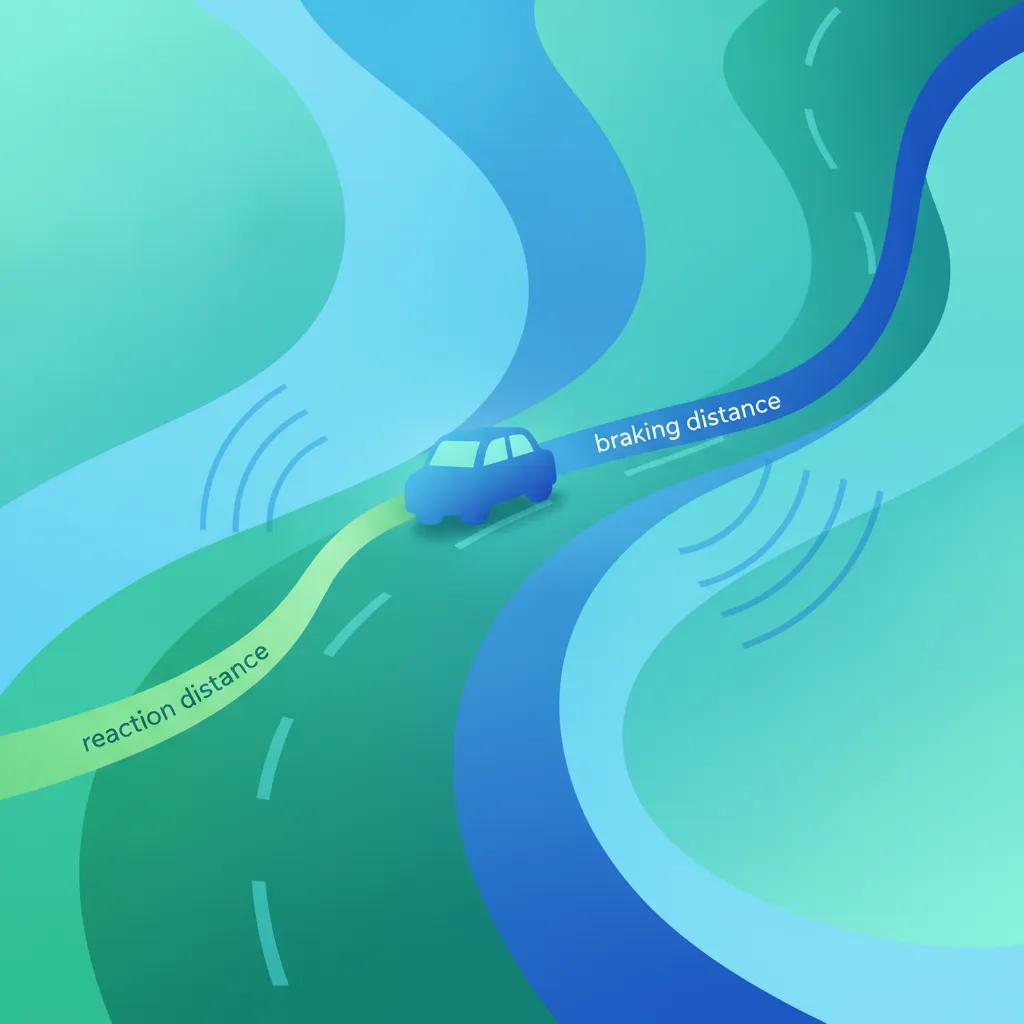
Distanza di Reazione): This is the distance your vehicle travels during your tempo di reazione (reaction time) – the interval from when you identify a hazard to when you physically apply the brakes.Distanza di Frenatura): This is the distance your vehicle covers from the moment you apply the brakes until it completely stops.The sum of these two distances dictates your total stopping capability.
Speed has a profound and disproportionate effect on both reaction and braking distances, making it the most critical factor influencing distanza di arresto.
Your reaction time typically remains relatively constant (around 0.5 to 1.5 seconds for an alert driver, though this varies). However, during that fixed reaction time, a faster vehicle covers a greater distance.
This is where the physics become most critical and often misunderstood by learners. Braking distance does not increase linearly with speed. Instead, it increases with the square of your speed. This is due to the kinetic energy of the vehicle, which is proportional to the square of its velocity. To shed this greater kinetic energy, more distance is required.
This exponential relationship is why even a small increase in speed can lead to a dramatically longer overall distanza di arresto and significantly heightened collision risk.
While speed is paramount, other factors also critically impact your ability to stop safely in Italy:
Aderenza):
aderenza (grip) between tyres and asphalt, increasing braking distance.in discesa (downhill) increases stopping distance, while driving in salita (uphill) can reduce it.Efficienza del Veicolo):
aderenza and braking efficiency.Condizioni del Conducente):
distanza di reazione.Distanza di Sicurezza)These two terms are frequently confused but serve different purposes:
Distanza di Arresto (Stopping Distance): The absolute minimum distance required for your vehicle to stop under specific conditions, from reaction to full stop. This is a physics-based concept.Distanza di Sicurezza (Safety Distance): The minimum safe gap you must maintain from the vehicle in front of you. This distance is always greater than or equal to your distanza di reazione and should allow you to stop safely even if the vehicle in front brakes suddenly. It takes into account your stopping distance plus an additional margin. Italian regulations stress that distanza di sicurezza must be commisurata (commensurate) with speed, road conditions, vehicle efficiency, and driver condition.Key takeaway: You need enough distanza di sicurezza so that if the car in front stops instantly, you have enough distanza di arresto to stop behind it without collision.
This is a critical error often tested in the Italian patente di guida theory exam. As explained, doubling your speed quadruples your braking distance due to the squared relationship. Understanding this proportional increase is more important than memorizing exact meters, as the principle is what the exam assesses.
Strada Provinciale (Provincial Road): You are driving at 90 km/h and suddenly encounter a sharp, unannounced curve. If your distanza di arresto is very long, you might not be able to slow down enough to navigate the bend safely, potentially veering off-road or into oncoming traffic. Reducing speed before the curve ensures you can stop within your visible range.Autostrada (Motorway): Traveling at the limite di velocità (speed limit) of 130 km/h, a sudden tailback appears. Your total stopping distance at this speed is significant. If you haven't maintained adequate distanza di sicurezza, the exponential increase in distanza di frenatura will make a rear-end collision almost inevitable.Passaggio Pedonale (Pedestrian Crossing) in Rain: Driving at 50 km/h in wet conditions, a pedestrian unexpectedly steps onto the crossing. Your reaction distance is already longer due to speed, and your braking distance is further extended by the reduced aderenza. A small reduction in speed to, say, 30 km/h, dramatically reduces your distanza di arresto, giving you a much better chance to stop safely.limite di velocità is a maximum, not a target. In adverse conditions (rain, fog, traffic), the safe speed (velocità di sicurezza) is often significantly lower than the posted limit to ensure you can stop within the visible distance.distanza di frenatura.distanza di reazione. Waiting until a hazard is immediate significantly increases the total distance needed to stop.For the Italian driving theory exam (esame di teoria della patente), understanding the relationship between speed and stopping distance is fundamental. Expect questions that test:
distanza di arresto, distanza di reazione, and distanza di frenatura.quattro volte maggiore for doubled speed).aderenza, strada in discesa, usura dei pneumatici (tyre wear), and driver condition affect stopping distances.distanza di arresto and distanza di sicurezza.In practice on Italian roads, always adjust your speed (adeguare la velocità) to ensure you can stop safely within the distance you can see to be clear ahead. This is especially vital when navigating busy urban centres, winding strade statali (state roads), or the high-speed autostrade.
The core principle to remember is simple: You must always be able to stop your vehicle within the distance you can see to be clear and safe ahead of you. Higher speeds reduce this safe zone exponentially. By understanding the profound impact of speed on distanza di reazione and distanza di frenatura, you can make informed decisions that drastically enhance your safety and the safety of others on Italian roads.
The relationship between speed and stopping distance is a fundamental concept in Italian driving theory, where stopping distance consists of reaction distance (distance traveled during reaction time) and braking distance (distance after brakes are applied). Braking distance increases with the square of speed due to kinetic energy physics, meaning doubling speed quadruples braking distance. Beyond speed, stopping distance is affected by road conditions, vehicle maintenance, driver condition, and visibility. Learners must understand the critical distinction between distanza di arresto (actual stopping distance) and distanza di sicurezza (safety gap to maintain), as Italian exam questions frequently test this difference and the exponential nature of braking distance increase.
A short set of high-value points that capture the most important ideas from this theory explanation.
Stopping distance (distanza di arresto) equals reaction distance plus braking distance
Braking distance increases with the square of speed, meaning doubling speed quadruples braking distance
Reaction distance increases linearly with speed during the fixed reaction time window
Safety distance (distanza di sicurezza) must always be greater than or equal to stopping distance
You must always be able to stop within the distance you can see to be clear ahead
Kinetic energy is proportional to speed squared, which is why braking distance grows exponentially
Speed limits (limite di velocità) are maximums, not targets—safe speed depends on conditions
Wet roads, icy conditions, and poor tyre condition all significantly increase braking distance
Safety distance must be commensurate (commisurata) with speed, road conditions, and vehicle efficiency
Reducing speed even slightly dramatically shortens your total stopping distance
Believing that doubling speed only doubles braking distance, when it actually quadruples it
Assuming the posted speed limit is always a safe speed regardless of conditions
Neglecting vehicle maintenance (tyres, brakes) which directly compromises braking efficiency
Failing to anticipate hazards early, which extends effective reaction distance
Confusing stopping distance with safety distance—they serve different purposes
Start with a short, direct summary of Speed & Stopping Distance before reading the full explanation below.
Stopping distance is the total distance a vehicle travels from the moment a driver perceives a hazard until it comes to a complete stop. It is composed of reaction distance and braking distance. As speed increases, both components grow, with braking distance increasing fourfold when speed doubles. This means higher speeds drastically reduce a driver's ability to react and stop in time, increasing collision risk on Italian roads.
Review the most important terms, rule signals, and traffic concepts linked to Speed & Stopping Distance.
Explore related theory topic pages connected to Speed & Stopping Distance and continue with the next useful rule explanation.
See the common search queries learners use when trying to understand Speed & Stopping Distance in Italy.

Ready to deepen your knowledge? Explore specific Italian driving theory topics in detail, review challenging concepts, or test your understanding with practice questions. Build confidence for your official Italian driving licence exam by continuously learning and applying these essential road rules.
Explore Italian Driving TheoryTheory topic content overview
A short set of high-value points that capture the most important ideas from this theory explanation.
Stopping distance (distanza di arresto) equals reaction distance plus braking distance
Braking distance increases with the square of speed, meaning doubling speed quadruples braking distance
Reaction distance increases linearly with speed during the fixed reaction time window
Safety distance (distanza di sicurezza) must always be greater than or equal to stopping distance
You must always be able to stop within the distance you can see to be clear ahead
Kinetic energy is proportional to speed squared, which is why braking distance grows exponentially
Speed limits (limite di velocità) are maximums, not targets—safe speed depends on conditions
Wet roads, icy conditions, and poor tyre condition all significantly increase braking distance
Safety distance must be commensurate (commisurata) with speed, road conditions, and vehicle efficiency
Reducing speed even slightly dramatically shortens your total stopping distance
Believing that doubling speed only doubles braking distance, when it actually quadruples it
Assuming the posted speed limit is always a safe speed regardless of conditions
Neglecting vehicle maintenance (tyres, brakes) which directly compromises braking efficiency
Failing to anticipate hazards early, which extends effective reaction distance
Confusing stopping distance with safety distance—they serve different purposes
Start with a short, direct summary of Speed & Stopping Distance before reading the full explanation below.
Stopping distance is the total distance a vehicle travels from the moment a driver perceives a hazard until it comes to a complete stop. It is composed of reaction distance and braking distance. As speed increases, both components grow, with braking distance increasing fourfold when speed doubles. This means higher speeds drastically reduce a driver's ability to react and stop in time, increasing collision risk on Italian roads.
Review the most important terms, rule signals, and traffic concepts linked to Speed & Stopping Distance.
Explore related theory topic pages connected to Speed & Stopping Distance and continue with the next useful rule explanation.
See the common search queries learners use when trying to understand Speed & Stopping Distance in Italy.
Ready to deepen your knowledge? Explore specific Italian driving theory topics in detail, review challenging concepts, or test your understanding with practice questions. Build confidence for your official Italian driving licence exam by continuously learning and applying these essential road rules.
Explore Italian Driving TheoryUse this exam-focused revision tip to understand how Speed & Stopping Distance is likely to appear in theory questions for learners in Italy. This section helps you identify the most testable part of the rule, avoid common traps, and remember the concept more effectively during Italian driving theory exam preparation.
Remember that for the Italian theory exam, questions often highlight how even small speed increases lead to disproportionately longer stopping distances. Focus on the concept that braking distance increases exponentially (e.g., four times when speed doubles), rather than memorizing exact distances, as this principle is key.
Read direct answers to the most common learner questions about Speed & Stopping Distance in Italy. This FAQ focuses on rule confusion, practical meaning, comparison with similar concepts, and the exact uncertainties that appear most often in Italian driving theory revision and exam preparation.
Stopping distance consists of reaction distance (the distance traveled while you react) and braking distance (the distance traveled from applying brakes until the vehicle stops).
Doubling your speed increases the braking distance by approximately four times, because the kinetic energy your vehicle possesses increases with the square of its speed.
Yes, reaction distance increases directly with speed because your vehicle covers more ground during the constant time it takes for you to react to a hazard.
The Italian driving theory exam (patente B) frequently tests your understanding of how speed affects stopping distance, emphasizing its critical role in safe driving and accident prevention.
On Italian roads, especially on autostradas or in adverse conditions, driving even slightly faster can dramatically reduce your ability to stop in time, making safe hazard avoidance much harder.
Beyond speed, factors like road surface (wet, dry, icy), tire condition, brake efficiency, vehicle weight, and road gradient (uphill/downhill) also significantly affect stopping distance.
Start searching now to pinpoint exactly which Italian driving theory topics, road signs, or traffic rules you need to master. Use our advanced filters to build a custom practice session and ensure you're fully prepared for every aspect of your official driving licence exam.