
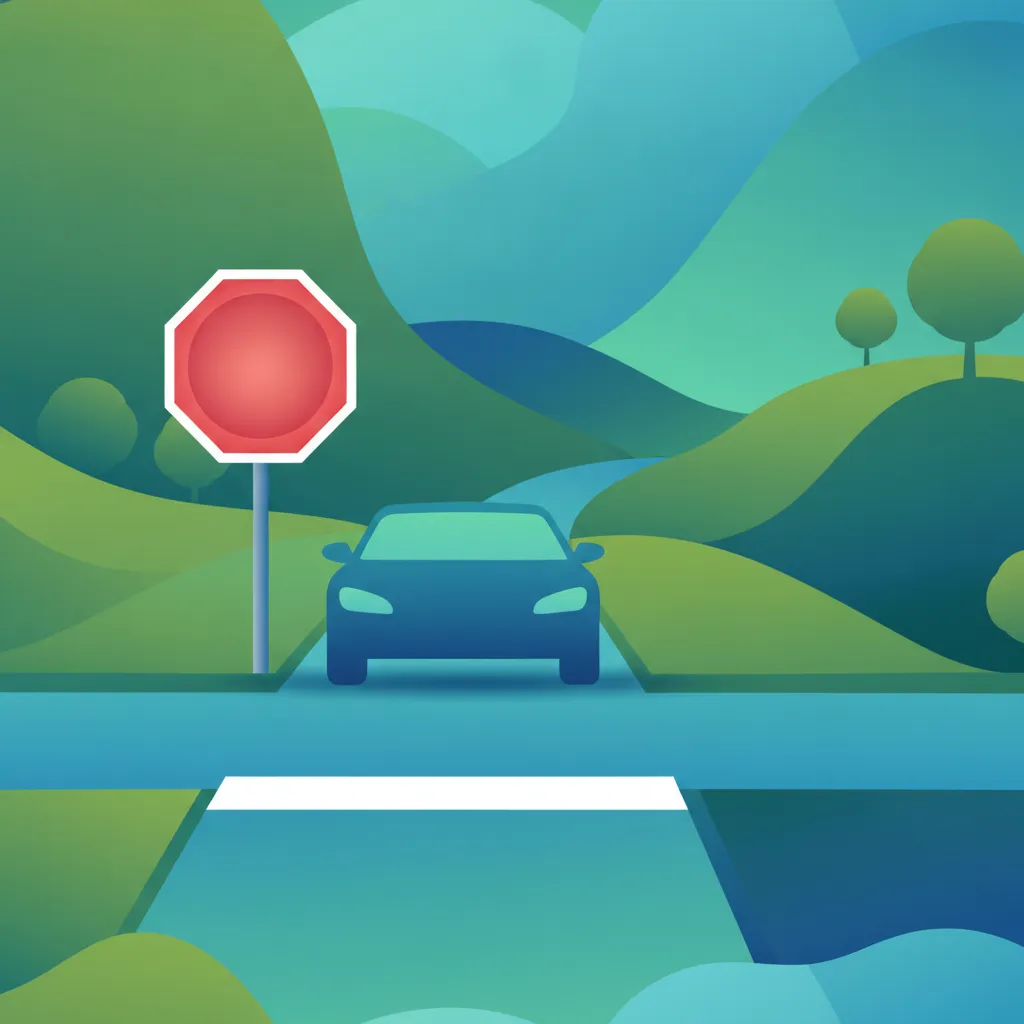
The 'Stop' sign, formally known as 'Segnale di Stop' in Italy, is one of the most crucial regulatory traffic signs. It demands that drivers bring their vehicle to a complete standstill before a specific line or the edge of an intersection. This mandatory pause ensures you can thoroughly check for approaching vehicles, cyclists, and pedestrians from all directions, especially at dangerous intersections or those with limited visibility, before safely rejoining or crossing traffic.
Theory topic content overview
Read the full theory topic guide for Stop Sign Rules (Italy) with structured, easy-to-scan content built for learners in Italy. This detailed section explains the exact rule, meaning, traffic context, comparison points, and exam logic behind this Italian driving theory topic so you can study faster, understand the concept more clearly, and avoid common interpretation mistakes on the theory test.
The Segnale di Stop, or Stop sign, in Italy is a fundamental regulatory traffic sign that imposes an absolute and mandatory obligation on drivers to bring their vehicle to a complete halt. This is not merely a suggestion to slow down or proceed with caution; it is a legal requirement for a full stop, regardless of whether traffic is immediately visible or not. Its primary purpose is to prevent collisions at high-risk intersections, especially those with limited visibility or where complex traffic flows demand explicit priority assignment.
The core concept of the Segnale di Stop is arresto, which translates to a complete stop. This means your vehicle's wheels must cease rotation entirely before a specific line or location. The sign is always triangular (inverted equilateral triangle with red border and white background) in its pre-warning form (Preavviso di fermarsi e dare precedenza) and octagonal (red background with white STOP lettering) for the sign at the intersection itself, as per the Italian Codice della Strada (Highway Code).
Sicurezza Stradale): The sign is placed at intersections deemed particularly dangerous or complex, ensuring drivers take the necessary time to observe all potential hazards – vehicles, cyclists, and pedestrians – from all directions before proceeding.Segnale di Stop rules is crucial for the Italian driving theory exam. Questions frequently test the precise definition of a complete stop, its distinction from a Dare Precedenza (Yield) sign, and the correct procedure for safely rejoining traffic.Stop sign is a serious traffic violation in Italy, carrying significant penalties, including fines and potential licence point deductions (decurtazione punti). It is considered a direct disregard for established priority rules.To correctly obey a Segnale di Stop, follow these steps:
Stop sign and any accompanying road markings.Striscia di Arresto): The Stop sign is almost always accompanied by a thick white transverse line painted across the road. This is the striscio di arresto (stop line), and it marks the precise point where your vehicle must stop.striscio di arresto. If no line is present (less common, but possible), you must stop at the edge of the intersection itself, ensuring you have the best possible view of traffic without obstructing it.Dare Precedenza): After stopping, carefully check for all other road users approaching from all directions – left, right, and any conflicting straight or turning traffic. This means giving way to everyone.Segnale di Stop still mandates a full halt. At some intersections, a slight forward creep after the initial stop might be necessary to improve visibility, but this must only occur after the initial, complete stop at the striscio di arresto.Segnale di Stop) vs. Yield Sign (Dare Precedenza)This is one of the most vital distinctions in Italian driving theory and a frequent source of exam questions and real-world confusion.
Segnale di Stop (Stop Sign):
arresto) before the striscio di arresto or intersection edge, regardless of traffic.striscio di arresto.Dare Precedenza (Yield Sign):
dare precedenza) to traffic on the main road you are joining or crossing. A complete stop is only necessary if there is traffic to yield to, or if visibility prevents safe assessment while moving. If the way is clear, you can proceed without stopping.The key difference: Stop = Always stop. Yield = Stop if necessary to give way.
Segnale di Stop. Tall buildings obscure your view to the left and right. You must bring your vehicle to a complete halt at the striscio di arresto. Then, you may slowly edge forward, if necessary, to gain a clear view, always ensuring you are not impeding any traffic on the main road, which now has priority.strada extraurbana), you encounter a Segnale di Stop where your road joins a busy national road. Even if there's a momentary gap in traffic, you are still required to make a full stop before the line, then carefully assess the speed and distance of approaching vehicles on the main road before accelerating to merge safely.Stop sign is flashing yellow (indicating caution), the Stop sign's obligation still prevails. You must still make a complete stop and give way to all traffic, treating the flashing yellow light as an additional warning, not an override of the Stop command.Segnale di Stop as a Dare Precedenza sign, where you only stop if traffic is present. This misunderstanding leads to dangerous and illegal entries into intersections.striscio di arresto (obstructing crossing traffic or pedestrians) or stopping too far back (limiting visibility and holding up traffic unnecessarily) are both incorrect.Stop sign, you have no inherent right of way; you must actively ensure the path is clear.In Italian driving theory, the Segnale di Stop is often framed in questions that test your understanding of:
Obbligo di arresto (obligation to stop): Emphasizing the mandatory nature.Striscia trasversale di arresto (transverse stop line): Identifying its purpose and correct stopping position.Dare la precedenza a tutti i veicoli (give way to all vehicles): Clarifying the comprehensive priority rule.The pre-warning sign, Preavviso di fermarsi e dare precedenza, is also important, typically placed at 150-320 meters before the actual Stop sign outside urban areas, giving drivers ample time to prepare for the mandatory halt.
Think of the Segnale di Stop not just as a sign, but as a command for a "Full Pause, Full View". In Italy, it means:
This mental model will help you consistently comply with the Segnale di Stop rules, ensure safety, and confidently pass your Italian driving theory and practical tests.
The Segnale di Stop is a mandatory regulatory sign requiring drivers to bring their vehicle to a complete standstill before the striscia di arresto or intersection edge, regardless of traffic conditions. Unlike the Dare Precedenza (Yield) sign which only requires stopping if necessary to give way, the Stop sign demands an absolute halt, followed by observation of all directions and giving precedence to every road user before proceeding. This distinction between Stop and Yield is a frequent exam topic, and violations carry significant penalties under the Italian Codice della Strada.
A short set of high-value points that capture the most important ideas from this theory explanation.
The Segnale di Stop mandates an absolute, mandatory complete halt of your vehicle, regardless of whether you can see other traffic
You must stop before the striscia di arresto (white transverse stop line) or at the intersection edge if no line exists
After stopping, you must give precedence to ALL road users from all directions before proceeding
The Stop sign and the Dare Precedenza (Yield) sign are fundamentally different: Stop always requires a complete stop; Yield only requires stopping if necessary
Your vehicle wheels must completely cease rotation - a rolling stop is illegal and dangerous
Stop = mandatory complete stop (arresto); Yield = stop only if necessary to give way
The octagonal red-and-white STOP sign marks the intersection; a triangular pre-warning sign appears 150-320 meters earlier outside urban areas
Always stop at the thick white transverse striscia di arresto, never past it or too far before it
Give precedence to all traffic, pedestrians, and cyclists from every direction - you have no inherent right of way
Visibility creep forward is only allowed AFTER the mandatory complete stop at the line
Performing a 'rolling stop' (slowing but not fully stopping) which fails the legal requirement
Treating the Segnale di Stop like a Dare Precedenza sign and only stopping if traffic is visible
Stopping in the wrong position: either past the stop line or so far back that visibility is obstructed
Only checking left and right traffic while ignoring cyclists, pedestrians, or oncoming vehicles
Proceeding after stopping because another vehicle hesitates, assuming you now have right of way
Start with a short, direct summary of Stop Sign Rules (Italy) before reading the full explanation below.
In Italy, a 'Stop' sign (Segnale di Stop) legally obligates drivers to make a full and complete stop before the white transverse stop line (striscio di arresto), or at the edge of the intersection if no line is marked. This halt is mandatory regardless of whether you see other traffic. After stopping, you must give precedence to all road users and only proceed when it is entirely safe, ensuring your movement does not impede others. Failing to stop is a serious traffic violation of priority rules.
Review the most important terms, rule signals, and traffic concepts linked to Stop Sign Rules (Italy).
Explore related theory topic pages connected to Stop Sign Rules (Italy) and continue with the next useful rule explanation.
See the common search queries learners use when trying to understand Stop Sign Rules (Italy) in Italy.

Ready to deepen your knowledge? Explore specific Italian driving theory topics in detail, review challenging concepts, or test your understanding with practice questions. Build confidence for your official Italian driving licence exam by continuously learning and applying these essential road rules.
Explore Italian Driving TheoryTheory topic content overview
A short set of high-value points that capture the most important ideas from this theory explanation.
The Segnale di Stop mandates an absolute, mandatory complete halt of your vehicle, regardless of whether you can see other traffic
You must stop before the striscia di arresto (white transverse stop line) or at the intersection edge if no line exists
After stopping, you must give precedence to ALL road users from all directions before proceeding
The Stop sign and the Dare Precedenza (Yield) sign are fundamentally different: Stop always requires a complete stop; Yield only requires stopping if necessary
Your vehicle wheels must completely cease rotation - a rolling stop is illegal and dangerous
Stop = mandatory complete stop (arresto); Yield = stop only if necessary to give way
The octagonal red-and-white STOP sign marks the intersection; a triangular pre-warning sign appears 150-320 meters earlier outside urban areas
Always stop at the thick white transverse striscia di arresto, never past it or too far before it
Give precedence to all traffic, pedestrians, and cyclists from every direction - you have no inherent right of way
Visibility creep forward is only allowed AFTER the mandatory complete stop at the line
Performing a 'rolling stop' (slowing but not fully stopping) which fails the legal requirement
Treating the Segnale di Stop like a Dare Precedenza sign and only stopping if traffic is visible
Stopping in the wrong position: either past the stop line or so far back that visibility is obstructed
Only checking left and right traffic while ignoring cyclists, pedestrians, or oncoming vehicles
Proceeding after stopping because another vehicle hesitates, assuming you now have right of way
Start with a short, direct summary of Stop Sign Rules (Italy) before reading the full explanation below.
In Italy, a 'Stop' sign (Segnale di Stop) legally obligates drivers to make a full and complete stop before the white transverse stop line (striscio di arresto), or at the edge of the intersection if no line is marked. This halt is mandatory regardless of whether you see other traffic. After stopping, you must give precedence to all road users and only proceed when it is entirely safe, ensuring your movement does not impede others. Failing to stop is a serious traffic violation of priority rules.
Review the most important terms, rule signals, and traffic concepts linked to Stop Sign Rules (Italy).
Explore related theory topic pages connected to Stop Sign Rules (Italy) and continue with the next useful rule explanation.
See the common search queries learners use when trying to understand Stop Sign Rules (Italy) in Italy.
Ready to deepen your knowledge? Explore specific Italian driving theory topics in detail, review challenging concepts, or test your understanding with practice questions. Build confidence for your official Italian driving licence exam by continuously learning and applying these essential road rules.
Explore Italian Driving TheoryUse this exam-focused revision tip to understand how Stop Sign Rules (Italy) is likely to appear in theory questions for learners in Italy. This section helps you identify the most testable part of the rule, avoid common traps, and remember the concept more effectively during Italian driving theory exam preparation.
In the Italian driving theory exam, pay close attention to questions distinguishing 'Stop' from 'Yield' signs. Remember, 'Stop' (Segnale di Stop) always means a complete *arresto* (stop) before the line. 'Yield' (Dare Precedenza) means *dare precedenza* (give way) but not necessarily a full stop. Many exam questions test this key difference and the correct stopping position and precedence rules.
Read direct answers to the most common learner questions about Stop Sign Rules (Italy) in Italy. This FAQ focuses on rule confusion, practical meaning, comparison with similar concepts, and the exact uncertainties that appear most often in Italian driving theory revision and exam preparation.
The 'Stop' sign (Segnale di Stop) always requires a complete halt before the stop line, even if the road appears clear. A 'Yield' sign (Dare Precedenza) requires you to slow down and give way, but you may proceed without stopping if the path is clear and safe.
Yes, the obligation to make a complete stop at a 'Stop' sign in Italy is absolute, regardless of whether you perceive other traffic. It is a legal requirement before assessing the situation for safety.
You must stop before the white transverse stop line (striscio di arresto). If no stop line is present, you must stop at the edge of the intersection where you have maximum visibility without entering the intersection area.
Yes, a 'Stop' sign is typically preceded by a 'Preavviso di fermarsi e dare precedenza' (Advance warning of stop and give way) sign. This sign indicates the distance to the 'Stop' sign, often 320m outside urban areas.
Failing to make a complete stop at a 'Stop' sign is a serious traffic violation (violazione del Codice della Strada) in Italy. It can result in significant fines, point deductions from your driving license, and greatly increases the risk of dangerous collisions.
The official Italian name for the 'Stop' sign is 'Segnale di Stop'.
Yes, after completing your mandatory stop, you must also give precedence to any pedestrians or cyclists who are crossing or intend to cross, just as you would for other vehicles, before proceeding.
Start searching now to pinpoint exactly which Italian driving theory topics, road signs, or traffic rules you need to master. Use our advanced filters to build a custom practice session and ensure you're fully prepared for every aspect of your official driving licence exam.