
Navigating narrow roads where space is limited requires a clear understanding of your legal and practical responsibilities. This guide breaks down how to apply the Portuguese Highway Code (Código da Estrada) to avoid accidents and common exam pitfalls, ensuring you know when to yield and when you have the right of way.
Article content overview
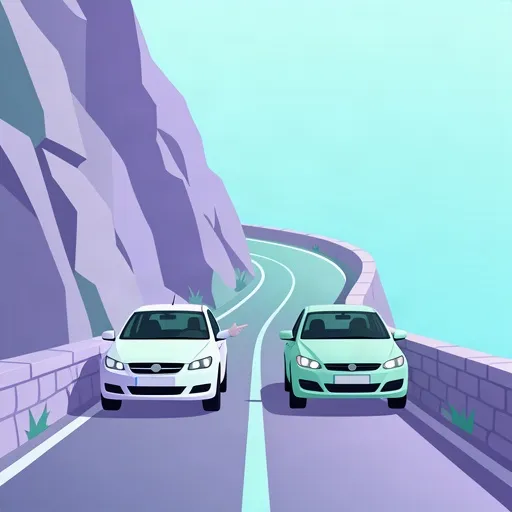
Navigating roads where the available space is insufficient for two vehicles to pass side-by-side is a common challenge for drivers in Portugal. Whether you are driving through the narrow, historic streets of an urban center or traversing rural, mountainous terrain in regions like the interior or the islands, understanding who has the right of way is critical for road safety and passing your IMT theory exam. Under the Código da Estrada, these situations are categorized as an "impossibilidade de cruzamento," or an impossibility of crossing.
When two vehicles meet on a narrow road where they cannot pass each other simultaneously, the law dictates a specific set of rules to determine which driver must yield. The priority is not based on speed or urgency, but rather on the physical and operational constraints of the vehicles involved.
In general, the driver who can more easily perform the necessary maneuver to allow the other to pass must do so. This often involves reversing to a wider part of the road or pulling into a designated passing area. As a rule of thumb, vehicles without trailers are expected to yield to those with trailers, and smaller vehicles generally yield to larger, heavier vehicles that have a much higher difficulty in maneuvering or reversing.
One of the most important concepts for your theory exam is the rule regarding steep gradients. When a road is so narrow that passing is impossible on a significant slope, the rules shift from convenience to physics. A vehicle ascending (going uphill) generally has priority over a vehicle descending (going downhill).
The reasoning behind this rule is purely practical: it is significantly more difficult, dangerous, and fuel-intensive for a vehicle to start moving uphill from a standstill than it is for one to hold position or move downhill. Therefore, the driver heading downhill must find a safe place to stop or reverse to allow the uphill vehicle to pass.
In the context of the IMT driving theory exam, you will often encounter scenarios testing your ability to identify the correct behavior in these moments. The exam focuses heavily on your ability to judge road conditions rather than just memorizing signs. Always look for the presence of road signs, but when none are present, apply the principle of "ease of maneuver." If you are the driver who can reverse more safely, or if you are on a flatter section of the road, you are expected to take the initiative to yield.
| Scenario | Expected Action |
|---|---|
| Steep Uphill vs. Downhill | Downhill vehicle yields to uphill vehicle. |
| Vehicle with Trailer vs. Solo | Solo vehicle yields to vehicle with trailer. |
| Large Vehicle vs. Small Vehicle | Small vehicle yields to large vehicle. |
| Presence of Sign B6 | Follow the sign's instruction regarding priority. |
Narrow passage priority in Portugal follows a clear hierarchy based on maneuverability rather than arrival time. On steep slopes, uphill vehicles have absolute priority over downhill vehicles because restarting from a standstill uphill is mechanically difficult and dangerous. Vehicles without trailers yield to those with trailers, and smaller vehicles yield to larger ones, since larger vehicles and those with trailers face greater difficulty reversing or repositioning. The Código da Estrada defines this situation as 'impossibilidade de cruzamento,' and drivers must apply the principle of ease of maneuver when no road sign B6 is present to determine who should yield.
A short set of high-value points that capture the most important ideas from this article.
When two vehicles cannot pass on a narrow road, the driver who can maneuver more easily must yield, typically by reversing to a wider section.
On steep slopes where passing is impossible, vehicles ascending uphill have priority over vehicles descending downhill.
Vehicles without trailers must yield to vehicles with trailers, as trailers significantly limit maneuverability.
Larger and heavier vehicles have priority over smaller vehicles because reversing or maneuvering large vehicles is more difficult and dangerous.
Always look for road sign B6 which indicates priority on narrow roads, but apply the ease-of-maneuver principle when no sign is present.
The rule 'uphill priority' applies only when the road is too narrow for two vehicles to pass simultaneously on a significant slope.
Vehicle priority hierarchy: trailers first, then large vehicles, then solo small vehicles.
The obligation to yield is based on maneuverability, not on who arrived first or who is in a hurry.
If you are descending on a steep slope, prepare early to stop or reverse to allow uphill traffic to pass.
Cedência de passagem is the Portuguese legal term for the act of yielding in these situations.
Assuming the driver who reached the narrow section first has the right of way, when in fact maneuverability determines priority.
Failing to recognize that uphill vehicles always have priority on steep narrow roads, even if the downhill driver arrived earlier.
Thinking that being on a main or wider road automatically grants priority in a narrow passage.
Not checking for road sign B6 before making assumptions about who should yield.
Assuming the smaller vehicle should always yield without considering specific circumstances like load or trailer presence.
Article content overview
A short set of high-value points that capture the most important ideas from this article.
When two vehicles cannot pass on a narrow road, the driver who can maneuver more easily must yield, typically by reversing to a wider section.
On steep slopes where passing is impossible, vehicles ascending uphill have priority over vehicles descending downhill.
Vehicles without trailers must yield to vehicles with trailers, as trailers significantly limit maneuverability.
Larger and heavier vehicles have priority over smaller vehicles because reversing or maneuvering large vehicles is more difficult and dangerous.
Always look for road sign B6 which indicates priority on narrow roads, but apply the ease-of-maneuver principle when no sign is present.
The rule 'uphill priority' applies only when the road is too narrow for two vehicles to pass simultaneously on a significant slope.
Vehicle priority hierarchy: trailers first, then large vehicles, then solo small vehicles.
The obligation to yield is based on maneuverability, not on who arrived first or who is in a hurry.
If you are descending on a steep slope, prepare early to stop or reverse to allow uphill traffic to pass.
Cedência de passagem is the Portuguese legal term for the act of yielding in these situations.
Assuming the driver who reached the narrow section first has the right of way, when in fact maneuverability determines priority.
Failing to recognize that uphill vehicles always have priority on steep narrow roads, even if the downhill driver arrived earlier.
Thinking that being on a main or wider road automatically grants priority in a narrow passage.
Not checking for road sign B6 before making assumptions about who should yield.
Assuming the smaller vehicle should always yield without considering specific circumstances like load or trailer presence.
Explore related topics, search based questions, and concepts that learners often look up when studying Priority in Portuguese Narrow Passages. These themes reflect real search intent and help you understand how this topic connects to wider driving theory knowledge in Portugal.
Find clear and practical answers to common questions learners often have about Priority in Portuguese Narrow Passages. This section helps explain difficult points, remove confusion, and reinforce the key driving theory concepts that matter for learners in Portugal.
Generally, the vehicle that can more easily reverse or pull over to the side must yield. This often means smaller or lighter vehicles yield to larger ones, and those without trailers yield to those towing them.
Under the Código da Estrada, the vehicle traveling downhill must yield to the vehicle traveling uphill, as the ascending driver has less control and more difficulty restarting on an incline.
Sign B6 indicates 'Priority over oncoming traffic at road narrows,' signaling that you have the right of way over vehicles approaching from the opposite direction.
Yes, if a specific passing place (refúgio) is designated, the vehicle closest to that space should move into it to allow the other vehicle to pass, regardless of the general downhill/uphill rules.
If you haven't found what you're looking for, use our powerful article search to explore related topics, refine your understanding of Portuguese road rules, or discover new insights for your IMT driving exam preparation. Continue building your knowledge effectively.