
Navigating narrow paths and steep gradients requires a clear understanding of legal priority to avoid collisions and traffic obstruction. This guide breaks down the criteria for determining which vehicle must yield, covering scenarios involving different vehicle sizes and road inclines. You will learn how to apply the official rules of the Codigo da Estrada to real-world driving situations, ensuring you are fully prepared for your theory examination.
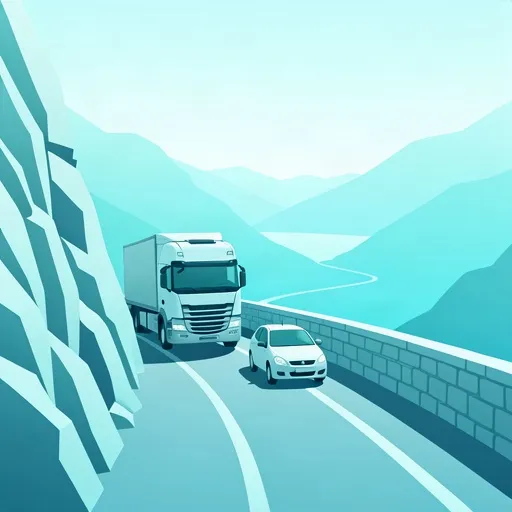
Article content overview
When driving across Portugal, you will encounter diverse road conditions, ranging from modern motorways to ancient, narrow village streets and steep mountain passes. Understanding who has the right of way in these challenging environments is not only a matter of road etiquette but a fundamental legal requirement under the Código da Estrada. Misjudging priority on narrow sections can lead to dangerous confrontations, obstructed traffic, and potential failure in your IMT theory examination.
In Portugal, when a road is too narrow for two vehicles to pass each other safely, the rules are governed by the principle of ease of maneuverability and vehicle characteristics. Generally, the driver who has the most space to maneuver or the vehicle that can more easily reverse should be the one to yield. However, the Código da Estrada sets a specific hierarchy to resolve these conflicts.
In the event of an inability to pass, priority is not granted simply by arrival time but by the physical characteristics of the vehicles involved and the road conditions, prioritizing the vehicle that faces the greatest difficulty in resuming movement or reversing.
Larger vehicles, such as buses, lorries, or those towing trailers, are often granted priority over smaller passenger cars because of their limited ability to reverse safely or move to the side of a narrow path. As a learner, you must be prepared to identify the vehicle type and adjust your speed early when you see a narrow passage ahead.
Steep gradients add another layer of complexity to traffic law. On roads with significant inclines where two vehicles cannot pass, the rule is clear: the vehicle traveling downhill must yield to the vehicle traveling uphill. This is because a vehicle climbing a slope is under greater mechanical strain and faces a much higher risk of losing control or failing to restart if it is forced to stop or reverse.
Always remember: on a steep slope, the vehicle going downhill stops or reverses to let the ascending vehicle pass. The only exception occurs if the downhill vehicle is significantly closer to a designated passing place or lay-by, in which case it should pull over to facilitate the passage.
Understanding specific road signs is critical for passing the Portuguese driving theory test. Some signs explicitly indicate who holds the right of way, while others warn you of the narrowing road conditions that require you to prepare for a potential conflict.
The theory exam provided by the Instituto da Mobilidade e dos Transportes (IMT) often uses visual scenarios to test these rules. You may be presented with a junction or a narrow bridge and asked to identify which vehicle must yield based on the sign present or the slope of the road.
Common exam traps involve "near misses" where a learner confuses a priority road sign with an instruction to ignore oncoming traffic. Always look for the presence of secondary signs or additional panels that might clarify that a specific lane is blocked or that a vehicle has a priority status due to its size or load.
To keep your driving safe and legally compliant, follow this systematic approach when approaching restricted passages.
This article explains the Portuguese priority rules for narrow roads and steep slopes as defined by the Código da Estrada. On narrow passages, priority goes to the vehicle that faces the greatest difficulty in maneuvering or reversing, typically larger vehicles. On steep gradients, the uphill vehicle always has priority because it risks losing control if forced to stop. Road signs B5 and B6 indicate who must yield at narrow points, and the IMT exam tests your ability to apply these rules in visual scenarios. A systematic five-step approach helps learners make correct yielding decisions: check signs, assess vehicle types, evaluate slope, identify passing places, and communicate intent.
A short set of high-value points that capture the most important ideas from this article.
Priority on narrow roads is determined by vehicle characteristics, not arrival time
On steep slopes, the vehicle traveling uphill always has priority over the vehicle going downhill
Larger vehicles (buses, lorries, vehicles with trailers) generally have priority because they cannot maneuver as easily
Always look for road signs B5 and B6 at narrow passages to determine right of way
When approaching a narrow passage, check signs, assess vehicle types, evaluate slope, and look for passing places before deciding who yields
B6 sign means you have priority over oncoming traffic at a narrow point; B5 means you must give way
The uphill vehicle on a steep gradient has priority because it faces greater mechanical strain and risk of losing control
The vehicle that can more easily reverse or maneuver should yield
Secondary signs or panels may modify the priority indicated by B5 or B6 signs
If the downhill vehicle is significantly closer to a passing place, it should pull over regardless of size
Assuming the first vehicle to arrive has priority, when actually vehicle type and maneuverability matter more
Confusing B5 and B6 signs and failing to correctly identify who must yield
Forgetting the uphill/downhill rule on steep gradients and expecting the larger vehicle to always have priority
Ignoring secondary panels that may indicate lane restrictions or modified priority at narrow points
Not reducing speed early when approaching a narrow passage, which prevents timely yielding decisions
Article content overview
A short set of high-value points that capture the most important ideas from this article.
Priority on narrow roads is determined by vehicle characteristics, not arrival time
On steep slopes, the vehicle traveling uphill always has priority over the vehicle going downhill
Larger vehicles (buses, lorries, vehicles with trailers) generally have priority because they cannot maneuver as easily
Always look for road signs B5 and B6 at narrow passages to determine right of way
When approaching a narrow passage, check signs, assess vehicle types, evaluate slope, and look for passing places before deciding who yields
B6 sign means you have priority over oncoming traffic at a narrow point; B5 means you must give way
The uphill vehicle on a steep gradient has priority because it faces greater mechanical strain and risk of losing control
The vehicle that can more easily reverse or maneuver should yield
Secondary signs or panels may modify the priority indicated by B5 or B6 signs
If the downhill vehicle is significantly closer to a passing place, it should pull over regardless of size
Assuming the first vehicle to arrive has priority, when actually vehicle type and maneuverability matter more
Confusing B5 and B6 signs and failing to correctly identify who must yield
Forgetting the uphill/downhill rule on steep gradients and expecting the larger vehicle to always have priority
Ignoring secondary panels that may indicate lane restrictions or modified priority at narrow points
Not reducing speed early when approaching a narrow passage, which prevents timely yielding decisions
Explore related topics, search based questions, and concepts that learners often look up when studying Narrow Roads and Slopes Priority. These themes reflect real search intent and help you understand how this topic connects to wider driving theory knowledge in Portugal.
Find clear and practical answers to common questions learners often have about Narrow Roads and Slopes Priority. This section helps explain difficult points, remove confusion, and reinforce the key driving theory concepts that matter for learners in Portugal.
Generally, the vehicle traveling downhill must yield to the vehicle climbing the slope. This is because it is significantly more difficult for an uphill vehicle to restart or maintain momentum.
When no signage exists, the vehicle that can more easily reverse or find a passing place must give way. Generally, smaller or lighter vehicles yield to larger, heavier vehicles, and those without trailers yield to those towing them.
The B6 sign indicates that you have priority of passage over vehicles coming from the opposite direction, meaning they must yield to you.
If you haven't found what you're looking for, use our powerful article search to explore related topics, refine your understanding of Portuguese road rules, or discover new insights for your IMT driving exam preparation. Continue building your knowledge effectively.