
This lesson focuses on the physical mechanics of cornering, an essential skill for all motorcyclists. By mastering body positioning, eye focus, and throttle control, you will gain the stability needed to navigate winding Irish roads safely and pass the motorcycle theory exam.

Lesson content overview
Cornering is one of the most dynamic, rewarding, and safety-critical skills a motorcyclist must master. Whether you are preparing for your Category A, A1, or A2 theory exams or seeking to navigate the challenging, winding roads of rural Ireland, understanding the science of turning is essential.
Correct cornering requires a precise blend of vehicle physics, body mechanics, visual discipline, and proactive hazard perception. This lesson provides a deep, textbook-quality breakdown of how correct body positioning, lean angle control, speed selection, and visual focus combine to ensure safe, stable turns under all road conditions.
To control a motorcycle through a turn, you must understand the natural physical forces acting upon the machine. When traveling in a straight line, a motorcycle is inherently stable due to gyroscopic forces and forward momentum. To change direction, the rider must intentionally disrupt this balance, causing the motorcycle to lean.
During a turn, two primary forces interact: gravity, which pulls the motorcycle and rider downward, and centripetal force, which is the inward force required to keep the motorcycle moving along its curved path. The friction (grip) between the tires and the road surface provides this centripetal force.
The physical limit of a tire's traction, representing the total grip available to be shared between cornering forces (lateral grip) and braking or accelerating forces (longitudinal grip).
If you attempt to turn too fast or lean too far, the lateral forces will exceed the tire's grip limit, causing a slide. Likewise, if you apply sudden braking or heavy acceleration while leaned over, you consume the available grip within the friction circle, leading to an immediate loss of control. Understanding that traction is a finite resource is the foundation of safe cornering.
The golden rule of cornering is simple: do all your braking and speed adjustment in a straight line before you enter the turn. Changing speed mid-corner destabilizes the motorcycle's suspension and reduces the available traction.
Every corner can be divided into three distinct phases. Approaching each phase with the correct speed and lane position is vital to navigating the bend safely.
Observation: Search the road ahead for warning signs, changes in road surface, and the curvature of the bend.
Speed Adjustment: Gently apply the front and rear brakes while the motorcycle is completely upright to reach your safe entry speed.
Gear Selection: Shift down to a gear that provides adequate engine braking and responsive power for the exit.
Initiation: Use gentle counter-steering and body lean to guide the motorcycle into the turn.
Roll-on: Maintain a steady throttle through the apex, then smoothly roll on the throttle as you exit the bend.
Your motorcycle goes where you look. This basic psychological and physical principle is the cornerstone of steering stability. If you look directly at the front wheel or the patch of asphalt immediately ahead of you, your steering inputs will be late, jerky, and unstable.
Instead, you must practice looking through the turn toward your intended exit path. As you approach a bend, your eyes should already be scanning the apex. Once you reach the apex, your gaze must move far down the road toward the exit or the next straightaway.
Target Fixation Hazard: If you look at a hazard (such as a pothole, loose gravel, or an oncoming vehicle), you will unconsciously steer directly toward it. Always keep your eyes focused on the clean path of escape, not the hazard.
On winding rural roads in Ireland, hedges, stone walls, and undulating terrain often obscure your view of what lies around a bend. To manage your speed safely, you must use the concept of the limit point (also known as the vanishing point).
The limit point is the furthest point along the bend where the left and right edges of the road appear to meet.
How you position your body on the motorcycle directly influences its balance, stability, and the amount of lean angle required to complete a turn. By shifting your weight strategically, you can keep the motorcycle more upright, leaving a larger safety margin of tire grip.
The lean angle is the angle of tilt of the motorcycle relative to a vertical line perpendicular to the road surface. As your speed increases or the radius of the turn decreases, you must increase the lean angle to counter the lateral forces pushing you outward.
       Vertical
          |
          |  /  <- Motorcycle Centerline
          | /
          |/  <- Lean Angle (e.g., 25 degrees)
----------+---------- Road Surface
To manage your lean angle safely, consider the following constraints:
On Irish roads, line selection is not just about finding the fastest path; it is about maximizing your visibility, maintaining a buffer zone from oncoming traffic, and avoiding road hazards. Because we drive on the left side of the road, your position must adapt to the direction of the bend.
When approaching a right-hand bend, your view around the corner is restricted by the roadside (hedges, walls, or embankments).
When approaching a left-hand bend, the danger comes from oncoming vehicles crossing the center line, as well as roadside debris that tends to collect on the left edge of the road.
Your motorcycle’s suspension is designed to absorb bumps and keep the tires in contact with the road. However, suspension geometry changes when you accelerate, brake, or steer. Smooth throttle management is essential to maintaining suspension equilibrium through a corner.
Irish motorcyclists must adapt their cornering techniques to handle rapid changes in weather, road surfaces, and visibility.
Rain reduces the coefficient of friction between rubber and asphalt by up to 50%.
Rural Irish roads present unique hazards, especially near farm entrances and during harvest seasons.
At night, your headlight shines straight ahead rather than into the bend, leaving the path ahead in darkness.
To ensure safe, consistent riding, commit these fundamental rules to memory. They represent the standard safety practices evaluated during both your theory examination and your practical riding test:
Explore all units and lessons included in this driving theory course.
Lesson content overview
Explore all units and lessons included in this driving theory course.
Explore search topics learners often look for when studying Cornering Techniques and Body Positioning. These topics reflect common questions about road rules, driving situations, safety guidance, and lesson level theory preparation for learners in Ireland.
Browse additional driving theory lessons that cover connected traffic rules, road signs, and common driving situations related to this topic. Improve your understanding of how different rules interact across everyday traffic scenarios.
Understand the defensive riding mindset required for safe navigation on Irish roads. This explanation covers core principles of hazard anticipation, route planning, and maintaining protective space around your motorcycle to minimize risks in diverse traffic environments and challenging weather conditions.

This lesson teaches how to cultivate a proactive defensive riding mindset, focusing on situational awareness and constant hazard scanning. It describes the system of motorcycle control, encouraging riders to anticipate potential mistakes from other drivers, pedestrians, and cyclists. Motorcyclists will learn to position themselves defensively, leaving clear escape routes in all driving environments.

This lesson covers the strategic aspects of journey management, emphasizing the safety benefits of proactive route planning and weather checks. It teaches riders how to select safer roads, avoid high-congestion zones during rush hour, and schedule regular rest intervals. Motorcyclists will learn to pack essential tools, emergency contacts, and spare safety gear to remain prepared for any roadside situation.

This lesson focuses on riding techniques suited for gravel, loose surfaces, and rural roads. Learners will understand how to maintain stability, adjust braking and cornering approaches, and anticipate hazards such as potholes and farm vehicles, following RSA guidance for safe riding in the Irish countryside.

This lesson outlines how motorcyclists should respond when permanent road signs are dirty, damaged, or hidden by overgrown trees and hedges. It introduces the temporary signage, warning cones, and detour markers commonly deployed at active roadwork zones in Ireland. Riders will learn to read the road ahead defensively, reducing speed when visual information is incomplete or compromised.

This lesson analyzes the crucial role of rider attitude, mental focus, and psychological factors in preventing motorcycle collisions on Irish roads. It addresses how overconfidence, fatigue, and peer pressure can negatively impact a rider's decision-making process and elevate risk levels. Motorcyclists will explore strategies to maintain a defensive mindset, exercise patience, and practice active situational awareness under all traffic conditions.

This lesson highlights the importance of smooth throttle adjustments for maintaining traction and stability on a moped. It teaches riders how to anticipate potential road hazards early, reducing the need for sudden emergency braking. Developing strong observation habits allows riders to adjust their speed smoothly and respond safely to traffic changes.

This lesson teaches riders how to create and preserve a protective safety envelope around their motorcycle under various traffic densities. It explains the two-second rule for dry conditions and how to expand this buffer zone in adverse weather or heavy traffic. Motorcyclists will learn to manage tailgaters by gradually increasing their following distance from the vehicle ahead to prevent sudden braking.

This lesson teaches riders how to manage extreme weather conditions such as high crosswinds, thick fog, and low sun glare. It details how wind forces can push a motorcycle off course and how to use minor body adjustments and lane placement to maintain stability. Riders will learn how to manage visibility limits in dense fog, utilizing specialized riding gear and reducing speeds safely.

This lesson explains how to modify riding techniques when navigating wet tarmac, focusing on the heightened risk of hydroplaning and reduced tire grip. It details the necessity of increasing following distances, avoiding painted road markings, and executing smoother control inputs. Riders will understand how surface water accumulates in ruts, presenting severe hazards during heavy rainstorms.

This lesson focuses on the critical techniques required to ride safely during severe rain or heavy fog in Ireland. It teaches riders how to handle aquaplaning risks, use headlights correctly, and significantly increase their following distances. Adapting speed to visibility ensures that riders can brake safely when road conditions deteriorate.
Learn the mechanics of emergency braking and skid recovery in different road conditions. This lesson explains how to maintain control during sudden deceleration, manage traction on slippery surfaces like gravel or wet asphalt, and perform safe emergency stops following standard Irish road safety protocols.
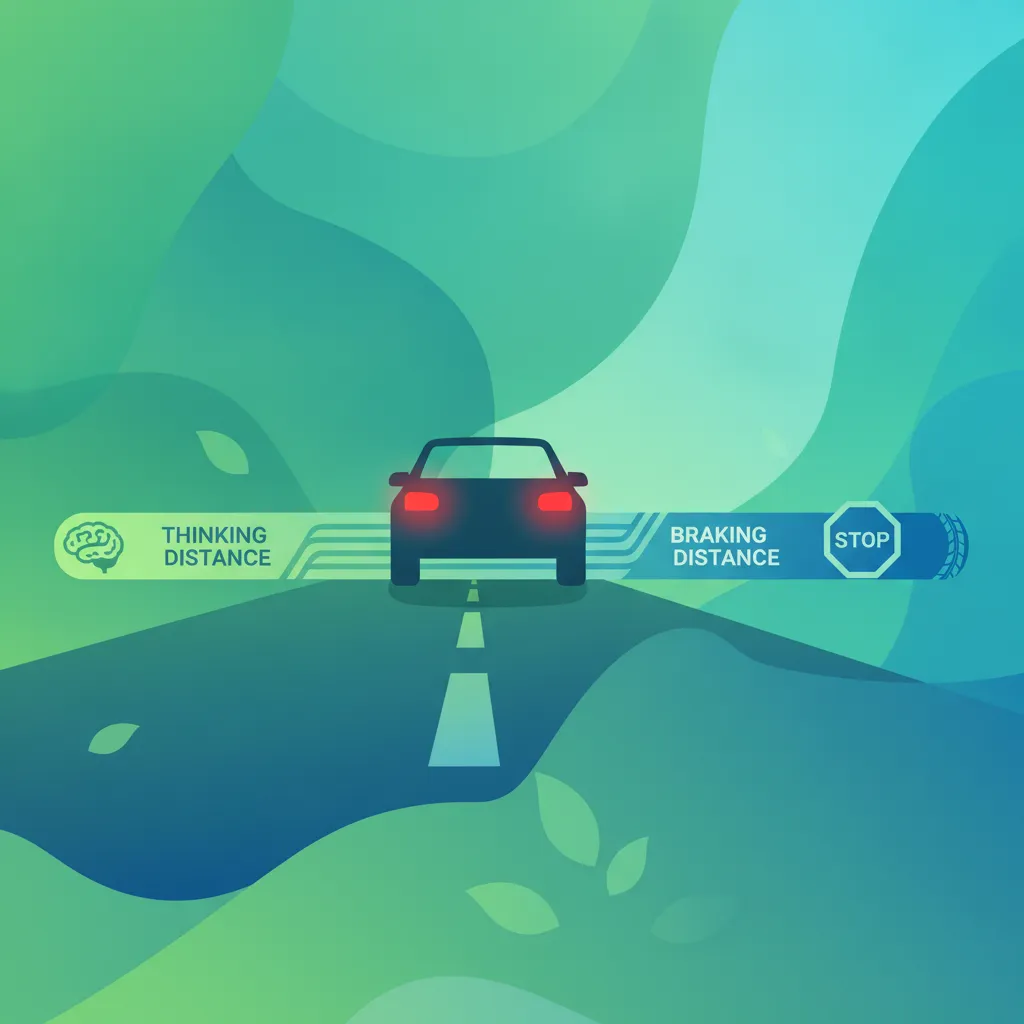
This lesson instructs riders on the correct application of the front and rear brakes to achieve smooth, controlled stopping. It explains how factors such as speed, reaction time, and tyre traction combine to determine total stopping distance. Learners will also study methods to prevent dangerous wheel lock-ups and skidding, especially in wet conditions.

This lesson covers the causes of front and rear-wheel skids and teaches the correct physical responses to regain control and stability. It describes how to recover from lockups caused by excessive braking or sudden downshifts on low-traction surfaces. Motorcyclists will learn how to react calmly during sudden deceleration events, maintaining straight-line stability under extreme pressure.

This lesson describes the physics of stopping a motorcycle, analyzing the distinct roles of the front and rear brakes during deceleration. It details how speed, road surface conditions, and vehicle weight distribution affect overall stopping distance and reaction times. Riders will learn how Anti-lock Braking Systems function and how to maximize braking force without locking the wheels.

This lesson outlines the immediate steps to take during a mechanical breakdown or a traffic collision on public roads. It covers how to secure the scene to prevent secondary accidents, apply basic first aid, and contact emergency services using 112 or 999. Riders will also study the legal obligations for reporting accidents to the Gardaí.
This lesson explains how to modify riding techniques when navigating wet tarmac, focusing on the heightened risk of hydroplaning and reduced tire grip. It details the necessity of increasing following distances, avoiding painted road markings, and executing smoother control inputs. Riders will understand how surface water accumulates in ruts, presenting severe hazards during heavy rainstorms.
This lesson highlights the importance of smooth throttle adjustments for maintaining traction and stability on a moped. It teaches riders how to anticipate potential road hazards early, reducing the need for sudden emergency braking. Developing strong observation habits allows riders to adjust their speed smoothly and respond safely to traffic changes.

This lesson explores common surface hazards encountered on municipal and rural Irish roads, including loose gravel and wet leaves. It explains how these surface conditions rapidly reduce tyre traction and affect overall handling and braking control. Riders will learn visual scanning techniques to identify these hazards early and execute safe evasion maneuvers.

This lesson analyzes how tyre contact patches generate grip and how different road surfaces affect stability. It explains the dangers of diesel spills, loose gravel, fallen leaves, and cold tyres, which drastically reduce traction limits. Motorcyclists will learn to identify these surface hazards early and modify their throttle, braking, and lean inputs to prevent loss of control.

This lesson outlines the immediate, structured actions a rider must take when witnessing or being involved in a road traffic collision in Ireland. It covers securing the scene, contacting emergency services via 999 or 112, and administering basic first aid while waiting for paramedics. Motorcyclists will learn how to handle injured riders safely, emphasizing that helmets must not be removed unless breathing is compromised.
This lesson focuses on riding techniques suited for gravel, loose surfaces, and rural roads. Learners will understand how to maintain stability, adjust braking and cornering approaches, and anticipate hazards such as potholes and farm vehicles, following RSA guidance for safe riding in the Irish countryside.
Find clear answers to common questions learners have about Cornering Techniques and Body Positioning. Learn how the lesson is structured, which driving theory objectives it supports, and how it fits into the overall learning path of units and curriculum progression in Ireland. These explanations help you understand key concepts, lesson flow, and exam focused study goals.
Eye focus dictates your path of travel. By looking through the turn toward your intended exit, your body naturally adjusts its position, which helps the motorcycle follow the desired line smoothly and safely.
Maintaining a steady, light throttle through a corner keeps the suspension settled and the bike balanced. Sudden changes in speed or jerky throttle inputs can upset the machine's balance, potentially leading to a loss of control.
The theory test focuses on the principles of safe riding. You must understand that leaning is a result of steering input and speed, and that correct body positioning helps maintain balance without excessive or unsafe lean angles.
You should always choose a line that maximizes your visibility and provides a buffer from hazards. This often involves staying wide at the entry to see further around the bend before tightening your line through the exit.
Use the practice question search tool to pinpoint specific topics, road signs, or rules you need to master for your official Driver Theory Test. Refine your study strategy and ensure comprehensive preparation for all aspects of the Irish driving exam. Start your focused revision now and build confidence for your learner permit test.