
Speed limits are critical traffic regulations in Italy that define the maximum permitted speed for vehicles on different road types. These limits are set to ensure road safety, manage traffic flow, and protect all road users. While a speed limit indicates the highest legal speed, drivers must always adjust their pace based on real-world factors like weather, visibility, traffic density, and road conditions, even if it means driving below the posted maximum.
Theory topic content overview
Read the full theory topic guide for Italian Speed Limits Explained with structured, easy-to-scan content built for learners in Italy. This detailed section explains the exact rule, meaning, traffic context, comparison points, and exam logic behind this Italian driving theory topic so you can study faster, understand the concept more clearly, and avoid common interpretation mistakes on the theory test.
Speed limits, known as limiti di velocità in Italy, are fundamental traffic regulations established by the Codice della Strada (Italian Highway Code). They define the maximum legal speed at which a vehicle is permitted to travel on a particular stretch of road or within a specific area. These limits are not arbitrary; they are set to significantly enhance road safety, manage traffic flow, and protect all road users, including pedestrians and cyclists.
In the context of Italian driving theory, understanding speed limits goes beyond memorising numbers. It requires comprehending their purpose, how they vary across different road types, and – crucially – how to adapt your driving speed to actual conditions, even if it means driving well below the posted maximum.
Adhering to speed limits and, more importantly, understanding the principles behind safe speed is paramount for several reasons:
esame di teoria) places a strong emphasis on understanding both general speed limits and the responsibility to adjust speed based on real-world factors. Questions often test the distinction between a legal maximum and a safe driving speed.The Codice della Strada sets out standard speed limits that apply unless otherwise indicated by specific road signs. These limits vary based on the type of road:
Centri Abitati):
Strade Extraurbane Secondarie):
Strade Extraurbane Principali):
Autostrade):
autostrade sections with three or more lanes plus an emergency lane in each direction, and equipped with average speed cameras, the limit can be raised to 150 km/h by the road owner/concessionaire, subject to traffic, weather, and accident data. This is rare and always clearly signposted.The most critical principle is that speed limits are maximums, not recommendations or targets. A responsible driver in Italy must always assess the prevailing conditions and reduce speed accordingly. This concept of adattamento della velocità (speed adaptation) is central to safe driving.
Key factors that demand a reduction in speed, even below the posted limit, include:
Pioggia): A crucial Italian rule: during any type of precipitation, the speed limit on autostrade is reduced to 110 km/h, and on strade extraurbane principali to 90 km/h.Nebbia), Snow (Neve), Ice (Ghiaccio): These conditions drastically reduce visibility and grip, requiring significant speed reductions, often to a crawl.centri abitati or near schools, a much lower speed is essential to prevent accidents.Neopatentati)Italy imposes specific, stricter speed limits for neopatentati (novice drivers) during their first three years of holding a driving licence. This is a vital point for the Italian theory exam:
Motorways): 100 km/h (instead of 130 km/h).Principal Extra-Urban Roads): 90 km/h (instead of 110 km/h).These reduced limits apply regardless of vehicle type (within the permitted categories for neopatentati) and are enforced to help new drivers gain experience safely.
Speed limits in Italy are primarily indicated by circular regulatory signs with a red border and a black number on a white background (e.g., a white circle with a red border and "50" in black indicates a 50 km/h maximum speed).
autostrade, electronic variable message signs can display temporary speed limits due to traffic or weather.Learners frequently make several errors when it comes to speed limits, which can lead to exam failure and dangerous driving:
autostrada, they must or should drive at that speed, even in adverse conditions. This is a common and dangerous misconception.Neopatentati Rules: New drivers often overlook their specific reduced limits on autostrade and strade extraurbane principali.Mastering limiti di velocità in Italy means more than just memorizing the numbers for each road type. It is about developing the judgment to constantly evaluate conditions – traffic, weather, visibility, road layout, and other road users – and choose a safe, appropriate speed. Always remember:
velocità di sicurezza) is determined by prevailing conditions.Neopatentati Rules are Strict: If you're a new driver, know and respect your specific reduced limits.autostrade and strade extraurbane principali whenever it rains.Prioritise safety over speed. This mindset is crucial for passing your Italian driving theory exam and for becoming a responsible and skilled driver on Italian roads.
Start with a short, direct summary of Italian Speed Limits Explained before reading the full explanation below.
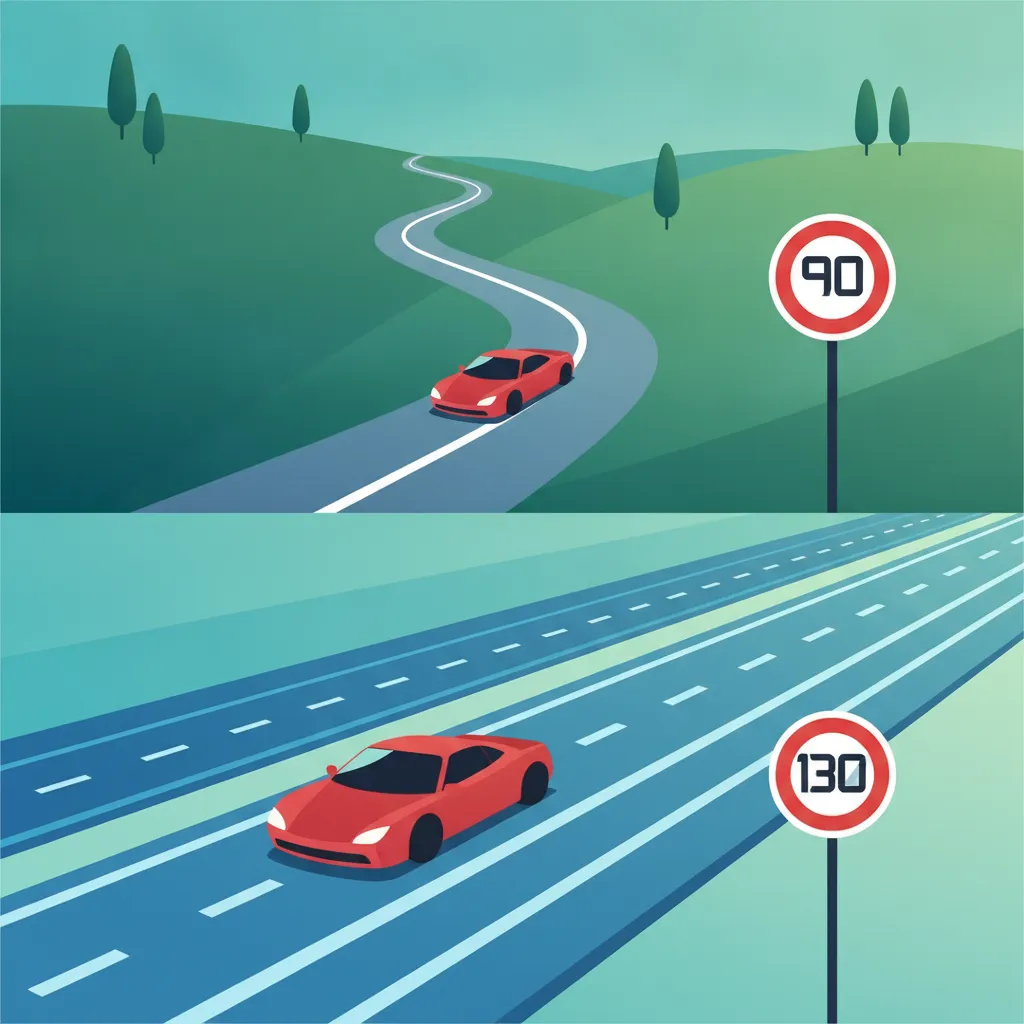
In Italy, speed limits vary significantly by road type: 50 km/h in urban areas, 90 km/h on secondary extra-urban roads, 110 km/h on principal extra-urban roads, and 130 km/h on autostrade. These are maximums; you must always adjust your speed for safety, especially in adverse conditions like rain, which lowers limits on autostrade to 110 km/h and principal extra-urban roads to 90 km/h.
Review the most important terms, rule signals, and traffic concepts linked to Italian Speed Limits Explained.
Explore related theory topic pages connected to Italian Speed Limits Explained and continue with the next useful rule explanation.
See the common search queries learners use when trying to understand Italian Speed Limits Explained in Italy.

Ready to deepen your knowledge? Explore specific Italian driving theory topics in detail, review challenging concepts, or test your understanding with practice questions. Build confidence for your official Italian driving licence exam by continuously learning and applying these essential road rules.
Explore Italian Driving TheoryTheory topic content overview
Start with a short, direct summary of Italian Speed Limits Explained before reading the full explanation below.
In Italy, speed limits vary significantly by road type: 50 km/h in urban areas, 90 km/h on secondary extra-urban roads, 110 km/h on principal extra-urban roads, and 130 km/h on autostrade. These are maximums; you must always adjust your speed for safety, especially in adverse conditions like rain, which lowers limits on autostrade to 110 km/h and principal extra-urban roads to 90 km/h.
Review the most important terms, rule signals, and traffic concepts linked to Italian Speed Limits Explained.
Explore related theory topic pages connected to Italian Speed Limits Explained and continue with the next useful rule explanation.
See the common search queries learners use when trying to understand Italian Speed Limits Explained in Italy.
Ready to deepen your knowledge? Explore specific Italian driving theory topics in detail, review challenging concepts, or test your understanding with practice questions. Build confidence for your official Italian driving licence exam by continuously learning and applying these essential road rules.
Explore Italian Driving TheoryUse this exam-focused revision tip to understand how Italian Speed Limits Explained is likely to appear in theory questions for learners in Italy. This section helps you identify the most testable part of the rule, avoid common traps, and remember the concept more effectively during Italian driving theory exam preparation.
Remember that speed limits are *maximums* set for ideal conditions, not targets. The Italian theory exam frequently tests your understanding of adapting speed to actual road, weather, and traffic conditions. Don't confuse the legal maximum with a safe speed in all circumstances, especially for new drivers or during rain.
Read direct answers to the most common learner questions about Italian Speed Limits Explained in Italy. This FAQ focuses on rule confusion, practical meaning, comparison with similar concepts, and the exact uncertainties that appear most often in Italian driving theory revision and exam preparation.
For cars in Italy, the general speed limits are 50 km/h in urban areas, 90 km/h on secondary extra-urban roads, 110 km/h on principal extra-urban roads, and 130 km/h on autostrade. These limits are subject to change by signage or specific conditions.
Yes, during precipitation (rain, snow, fog), the speed limits are reduced. On autostrade, the limit drops to 110 km/h, and on principal extra-urban roads, it drops to 90 km/h. Drivers must always adapt their speed to maintain safety, even if conditions don't explicitly lower the legal limit.
The general speed limit on an Autostrada (motorway) in Italy is 130 km/h. However, this reduces to 110 km/h during precipitation, and on specific modern sections with advanced safety features, it can be raised to 150 km/h if indicated by signs and conditions allow.
Yes, new drivers (Neopatentati) in Italy are subject to reduced speed limits for their first three years of holding a driving license. They must not exceed 100 km/h on autostrade and 90 km/h on principal extra-urban roads.
Adapting your speed is crucial for safety. The posted speed limit is a maximum, not a target. Factors like heavy traffic, poor visibility (fog, heavy rain), road hazards, or the presence of pedestrians and cyclists require you to drive at a speed significantly lower than the maximum to ensure you can stop safely and react to unexpected situations.
These are classifications of extra-urban roads in Italy. 'Strade extraurbane principali' are major out-of-town roads, often dual carriageways, with a general speed limit of 110 km/h (90 km/h in rain). 'Strade extraurbane secondarie' are other out-of-town roads, typically single carriageway, with a general speed limit of 90 km/h.
Speed limits are indicated by circular signs with a red border and a black number on a white background, representing the maximum speed in km/h. The end of a speed restriction is shown by a white circular sign with a black diagonal line and the previous limit number, or a 'via libera' sign.
Yes, within the national maximums, local authorities (enti proprietari della strada) can set different minimum and maximum speed limits on specific roads or sections where local conditions warrant it, provided they install appropriate signage and follow ministerial directives. This often occurs in urban areas, where 50 km/h limits can sometimes be elevated to 70 km/h on specific roads.
Start searching now to pinpoint exactly which Italian driving theory topics, road signs, or traffic rules you need to master. Use our advanced filters to build a custom practice session and ensure you're fully prepared for every aspect of your official driving licence exam.