
Reaction distance is the total distance your vehicle covers from the moment you perceive a hazard to the instant you begin to apply the brakes. This interval involves three distinct phases: perceiving the danger, processing the situation and making a decision, and physically moving your foot to the brake pedal. For driving in Italy, especially on varied roads from urban centers to autostrade, understanding this delay is vital for safety and passing your theory test.
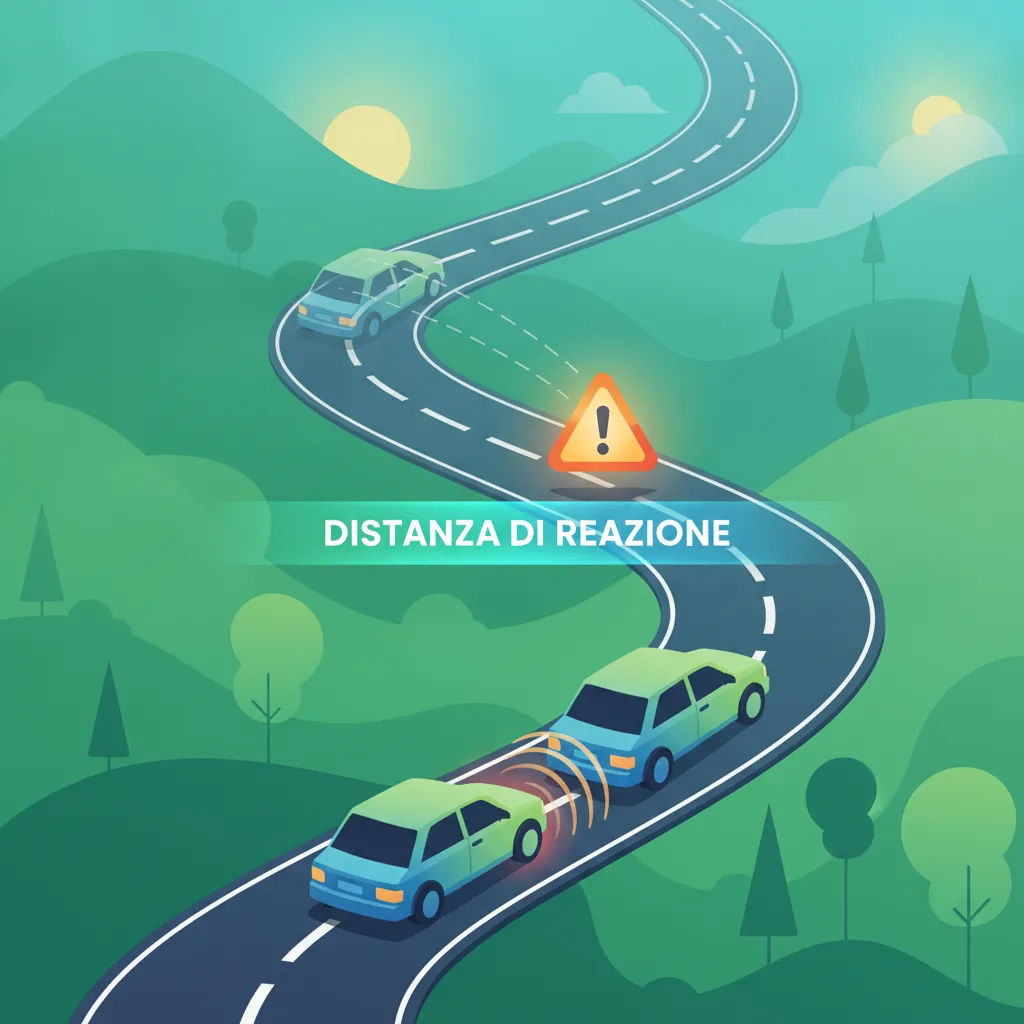
Theory topic content overview
Read the full theory topic guide for Reaction Distance Explained with structured, easy-to-scan content built for learners in Italy. This detailed section explains the exact rule, meaning, traffic context, comparison points, and exam logic behind this Italian driving theory topic so you can study faster, understand the concept more clearly, and avoid common interpretation mistakes on the theory test.
Distanza di Reazione)?Reaction distance is the crucial stretch your vehicle covers from the moment you perceive a hazard to the exact instant you begin to apply the brakes. It's the silent, often underestimated, travel time and distance before any active braking effort even starts.
This interval is made up of three essential phases in the driver's mind and body:
For an attentive driver, this entire process typically takes about one second. During this single second, your vehicle continues to travel at its current speed, covering a significant distance. This distance is what we call distanza di reazione in Italian driving theory.
Understanding distanza di reazione is not merely theoretical; it's fundamental to safe driving on Italian roads and a key component of your Italian driving licence theory exam.
autostrade or complex urban roads.esame di teoria della patente) frequently features questions designed to assess your comprehension of reaction time, its influencing factors, and its role within total stopping distance. Misinterpreting this concept can lead to incorrect answers.zone a traffico limitato (ZTLs) with unexpected pedestrians to reacting to sudden braking on a high-speed autostrada, your reaction distance is constantly at play. A keen awareness helps you maintain appropriate following distances and anticipate potential hazards.The fundamental principle of reaction distance is its direct proportionality to speed.
Imagine an unexpected hazard appears on a rural Italian road:
This shows that even a brief delay can have severe consequences at higher speeds.
While an attentive driver might react in about a second, many factors common in everyday driving can significantly lengthen this crucial time, leading to a much greater distanza di reazione. These are often highlighted in Italian road safety campaigns (Polizia di Stato educational materials) and theory test questions.
Distrazione): This is one of the most common causes of increased reaction time.
uso dello smartphone) for calls, texts, or navigation diverts your attention from the road.Affaticamento): Tiredness dulls your senses, slows cognitive processing, and makes physical reactions sluggish. Driving long distances, especially on autostrade, without adequate breaks significantly increases risk.Alcol e Droga): Even small amounts of alcohol or certain medications and illegal drugs impair judgment, coordination, and significantly extend reaction time, a serious offence in Italian traffic law.It's vital for Italian learners not to confuse distanza di reazione with distanza di frenata (braking distance). These are two distinct but consecutive phases of total stopping distance (spazio totale d'arresto).
Distanza di Reazione): The distance covered before you even touch the brake pedal. It's about driver response time.Distanza di Frenata): The distance covered from the moment you apply the brakes until the vehicle comes to a complete stop. It's about vehicle deceleration.Together, these two distances make up the Total Stopping Distance (Spazio Totale d'Arresto). Understanding this distinction is crucial for both the theory exam and safe driving in Italy.
Let's look at how reaction distance plays out in typical Italian driving situations:
Centro Storico: You're navigating narrow streets in a historic city centre (centro storico) at 30 km/h. A pedestrian unexpectedly steps out from between parked cars. Your one-second reaction time means you've covered about 8 metres before you even begin to brake. If you were distracted by tourists, that distance could easily double, making a collision almost inevitable.Incrocio) on a Main Road: You're driving on a strada extraurbana approaching an intersection. The traffic light ahead suddenly changes from green to amber. If you're tired or slightly distracted, your delayed reaction to the amber light means you continue towards the junction for longer, increasing the risk of entering on red or having to emergency brake sharply.Autostrada in Heavy Rain: At 110 km/h on a wet autostrada, visibility is poor. Your reaction time to a sudden slowdown ahead might be increased due to the conditions and potential fatigue from a long journey. A 1.5-second reaction time at this speed would mean travelling over 45 metres before even touching the brakes – a distance that could be the difference between avoiding a pile-up and becoming part of it.Learners often struggle with distanza di reazione in a few key ways during their esame di teoria:
PatenteThe most important takeaway for mastering distanza di reazione is to internalize this mental model: Your car is always moving during your reaction time, and that time is rarely zero.
Always:
cellulare).autostrada, the speed limit is a maximum, not always a safe speed.distanza di sicurezza (safe following distance) you choose should always account for both your reaction distance and the vehicle's braking distance under current conditions.By understanding distanza di reazione, you not only prepare effectively for your Italian driving theory exam but also cultivate a safer, more responsible approach to driving on Italian roads.
Reaction distance (distanza di reazione) is the distance a vehicle travels during the time it takes a driver to perceive a hazard, decide to brake, and physically move their foot to the brake pedal - typically about one second for an attentive driver. This distance increases directly with speed (14m at 50 km/h, 28m at 100 km/h, 36m at 130 km/h) and forms the first component of total stopping distance, followed by braking distance. Factors including distraction, fatigue, alcohol, stress, and poor visibility can significantly extend reaction time beyond the normal baseline, increasing the risk of collision. Understanding this concept is essential for safe driving in Italy and frequently tested in the Italian driving theory exam, where it is often confused with braking distance.
A short set of high-value points that capture the most important ideas from this theory explanation.
Reaction distance is the distance your vehicle travels during the ~1 second it takes to perceive a hazard, decide to brake, and physically move your foot from accelerator to brake
Reaction distance increases directly with speed - if you double your speed, you double your reaction distance
The three phases of reaction time are: perception (recognizing the hazard), decision-making (choosing to brake), and physical reaction (moving your foot to the brake pedal)
Reaction distance is distinct from braking distance and forms the first component of total stopping distance
Factors like distraction, fatigue, alcohol, and poor visibility significantly increase reaction time beyond the normal one-second baseline
At 50 km/h: ~14 metres; at 100 km/h: ~28 metres; at 130 km/h: ~36 metres - all covered in just one second of reaction time
Reaction distance is the distance covered BEFORE you even touch the brake pedal
Braking distance (distanza di frenata) is the distance from when brakes are applied until the vehicle stops
Total stopping distance equals reaction distance PLUS braking distance
An attentive driver reacts in about one second, but distractions, fatigue, alcohol, and poor visibility can extend this significantly
Assuming braking starts immediately when a hazard is seen, without accounting for reaction time delay
Thinking reaction distance increases with the square of speed (that rule applies to braking distance, not reaction distance)
Underestimating how much using a mobile phone or other distractions prolong reaction time in real driving
Confusing reaction distance with braking distance in exam questions that ask about their different factors
Not maintaining adequate following distances because they forget to account for reaction distance when calculating safe gaps
Start with a short, direct summary of Reaction Distance Explained before reading the full explanation below.
Reaction distance is the distance your vehicle travels during the time it takes for you to react to a hazard before you even touch the brake pedal. This reaction time typically lasts about one second for an attentive driver, but factors like speed, distractions, fatigue, or alcohol can significantly increase it, directly lengthening the distance traveled. It's the first crucial part of your total stopping distance and a core concept for safe driving on Italian roads.
Review the most important terms, rule signals, and traffic concepts linked to Reaction Distance Explained.
Explore related theory topic pages connected to Reaction Distance Explained and continue with the next useful rule explanation.
See the common search queries learners use when trying to understand Reaction Distance Explained in Italy.

Ready to deepen your knowledge? Explore specific Italian driving theory topics in detail, review challenging concepts, or test your understanding with practice questions. Build confidence for your official Italian driving licence exam by continuously learning and applying these essential road rules.
Explore Italian Driving TheoryTheory topic content overview
A short set of high-value points that capture the most important ideas from this theory explanation.
Reaction distance is the distance your vehicle travels during the ~1 second it takes to perceive a hazard, decide to brake, and physically move your foot from accelerator to brake
Reaction distance increases directly with speed - if you double your speed, you double your reaction distance
The three phases of reaction time are: perception (recognizing the hazard), decision-making (choosing to brake), and physical reaction (moving your foot to the brake pedal)
Reaction distance is distinct from braking distance and forms the first component of total stopping distance
Factors like distraction, fatigue, alcohol, and poor visibility significantly increase reaction time beyond the normal one-second baseline
At 50 km/h: ~14 metres; at 100 km/h: ~28 metres; at 130 km/h: ~36 metres - all covered in just one second of reaction time
Reaction distance is the distance covered BEFORE you even touch the brake pedal
Braking distance (distanza di frenata) is the distance from when brakes are applied until the vehicle stops
Total stopping distance equals reaction distance PLUS braking distance
An attentive driver reacts in about one second, but distractions, fatigue, alcohol, and poor visibility can extend this significantly
Assuming braking starts immediately when a hazard is seen, without accounting for reaction time delay
Thinking reaction distance increases with the square of speed (that rule applies to braking distance, not reaction distance)
Underestimating how much using a mobile phone or other distractions prolong reaction time in real driving
Confusing reaction distance with braking distance in exam questions that ask about their different factors
Not maintaining adequate following distances because they forget to account for reaction distance when calculating safe gaps
Start with a short, direct summary of Reaction Distance Explained before reading the full explanation below.
Reaction distance is the distance your vehicle travels during the time it takes for you to react to a hazard before you even touch the brake pedal. This reaction time typically lasts about one second for an attentive driver, but factors like speed, distractions, fatigue, or alcohol can significantly increase it, directly lengthening the distance traveled. It's the first crucial part of your total stopping distance and a core concept for safe driving on Italian roads.
Review the most important terms, rule signals, and traffic concepts linked to Reaction Distance Explained.
Explore related theory topic pages connected to Reaction Distance Explained and continue with the next useful rule explanation.
See the common search queries learners use when trying to understand Reaction Distance Explained in Italy.
Ready to deepen your knowledge? Explore specific Italian driving theory topics in detail, review challenging concepts, or test your understanding with practice questions. Build confidence for your official Italian driving licence exam by continuously learning and applying these essential road rules.
Explore Italian Driving TheoryUse this exam-focused revision tip to understand how Reaction Distance Explained is likely to appear in theory questions for learners in Italy. This section helps you identify the most testable part of the rule, avoid common traps, and remember the concept more effectively during Italian driving theory exam preparation.
In the Italian driving theory exam, pay close attention to questions that involve scenarios with increased reaction time. Remember that distractions, tiredness, or consuming alcohol significantly lengthen the distance needed to react, directly increasing your overall stopping distance and collision risk. Don't confuse it with braking distance; reaction distance comes first!
Read direct answers to the most common learner questions about Reaction Distance Explained in Italy. This FAQ focuses on rule confusion, practical meaning, comparison with similar concepts, and the exact uncertainties that appear most often in Italian driving theory revision and exam preparation.
Reaction time consists of three phases: perception (seeing or hearing the hazard), decision (processing the information and deciding to react), and physical reaction (moving your foot from the accelerator to the brake pedal).
Reaction distance increases directly with speed. If you double your speed, your reaction distance also doubles, because your vehicle covers more ground during the same reaction time.
Factors that increase reaction time include fatigue, distraction (e.g., mobile phone use), alcohol or drugs, stress, and poor visibility. These all lead to a longer reaction distance.
No, reaction distance is the distance traveled *before* braking begins. Braking distance is the distance traveled *after* the brakes are applied until the vehicle stops. Together, they make up the total stopping distance.
Understanding reaction distance is crucial for anticipating hazards, maintaining a safe following distance, and preventing collisions on Italian roads. It's also a frequently tested concept in the official Italian driving theory exam.
An attentive driver typically has a reaction time of about one second. However, this is an average and can vary greatly depending on the individual and external conditions.
Start searching now to pinpoint exactly which Italian driving theory topics, road signs, or traffic rules you need to master. Use our advanced filters to build a custom practice session and ensure you're fully prepared for every aspect of your official driving licence exam.