
This lesson explores the vital safety techniques required when riding a moped or light quadricycle in challenging conditions like fog, heavy rain, or darkness. By mastering these skills, you will ensure you meet the high safety standards required by the DVSA theory test and become a more responsible road user. This content builds on your knowledge of vehicle controls and prepares you for the risk management sections of your Category AM theory exam.
Lesson content overview
Reduced visibility poses one of the most significant challenges for moped and light quadricycle riders in Great Britain. Conditions where the rider's ability to see the road ahead, or to be seen by other road users, is significantly impaired dramatically increase the risk of collisions, misjudgments, and loss of control. This lesson is crucial for any rider taking the Great Britain AM Licence Theory Course, as it covers the essential strategies and legal requirements for navigating safely when natural light is diminished or obscured.
The primary goal in these situations is to maximise both your vision and your visibility to others. This involves a careful balance of using appropriate lighting, adapting your speed, utilising reflective gear, and understanding how to mitigate glare. Mastering these techniques is not just about passing your theory test; it is fundamental to safe riding on UK roads.
Reduced visibility can arise from various environmental factors:
In all these scenarios, your depth perception and the ability to distinguish contrasts are diminished. This means you must rely more heavily on auxiliary cues like road markings and reflectors, and adjust your riding behaviour accordingly.
The correct use of your moped or light quadricycle's lighting system is paramount when visibility is reduced. Headlights, fog lights, and hazard warning lights each have specific purposes and legal mandates to ensure you can see and be seen effectively without dazzling other road users.
Dipped beam headlights, also known as low beam, are your primary lights for riding at night and in conditions of reduced visibility. They provide a low-intensity, downward-angled beam that illuminates the road directly in front of you without dazzling oncoming traffic or vehicles ahead.
Highway Code Rule 46 mandates that you must use dipped headlights at night (from sunset to sunrise) and in any situation where visibility is seriously reduced, such as fog, heavy rain, or snowfall. It is essential to activate your dipped beam well before it gets completely dark or when adverse weather begins to obscure your view.
Main beam headlights, or high beam, provide a strong, far-reaching beam designed for maximum forward illumination. These lights should only be used in specific conditions where they will not impair the vision of other road users.
Highway Code Rule 51 states that main beam may be used on unlit roads where there is no oncoming traffic and no vehicle ahead within 200 metres. You must switch back to dipped beam as soon as you encounter oncoming traffic or approach another vehicle from behind. It is strictly prohibited to use main beam in fog or heavy rain, as the light scatters off the water droplets, creating severe glare that reduces your own visibility and blinds others.
Front fog lights are specially designed to illuminate the road surface in conditions of seriously reduced visibility, such as dense fog, heavy mist, or blowing snow. They emit a low, wide beam that cuts beneath the fog, rather than reflecting off it.
Highway Code Rule 54 specifies that you may only use front fog lights when visibility is seriously reduced, meaning you cannot see more than 100 metres (approximately 328 feet) ahead. They must be used in conjunction with your dipped beam headlights. It is illegal to use fog lights when visibility improves above this threshold, as they can dazzle other drivers and obscure your brake lights, potentially leading to a fine. Always remember to switch them off as soon as they are no longer necessary.
Using main beam headlights in fog or heavy rain is dangerous. The light reflects off the water droplets or snow, creating a 'white wall' effect that severely reduces your own visibility and can blind other road users. Always use dipped beam and, if necessary, fog lights in these conditions.
Hazard warning lights, or hazard lights, are flashing indicators designed to alert other road users to a stationary vehicle that may be obstructing traffic or presenting a hazard.
Highway Code Rule 57 explicitly states that hazard warning lights must not be used while moving, unless you are instructed to do so by the police or traffic officers. Using them while riding through fog, for example, can confuse other drivers about your intentions or whether you are stationary. If your moped or light quadricycle breaks down and becomes a hazard, then you should activate your hazard lights.
One of the most critical adjustments you must make in reduced visibility is to your riding speed. Your speed must always be appropriate for the distance you can see ahead, ensuring you can stop safely within that visual range.
Your total stopping distance is the sum of two components:
Highway Code Rule 73 implicitly dictates that you must not travel at a speed that prevents them from stopping safely within the visible distance ahead. This principle becomes paramount in fog, heavy rain, or darkness. If you can only see 30 metres ahead, you must be able to stop your moped within 30 metres. This often means reducing your speed significantly, sometimes to as low as 20-30 km/h in dense fog, even on roads with higher speed limits.
Failing to adapt your speed to the conditions is a major cause of collisions in reduced visibility. You might not see a stationary vehicle, a pedestrian, or an unexpected road hazard until it's too late to react and stop.
For vulnerable road users like moped and light quadricycle riders, being seen is just as important as seeing. Reflective and high-visibility clothing significantly enhances your conspicuity, making you easier to detect by other road users, especially in low-light conditions.
Reflective materials, also known as retroreflective materials, are designed to reflect light back towards its source. This means that when a vehicle's headlights shine on reflective clothing, the light is returned directly to the driver's eyes, making the rider stand out brightly.
Highway Code Rule 66 strongly recommends that riders wear high-visibility fluorescent and/or reflective clothing during night-time riding and in all conditions of reduced visibility (fog, rain, snow). While not legally mandatory for AM licence holders, it is considered best practice and is a critical safety measure.
Neglecting to wear reflective clothing significantly reduces your detection range for other road users, increasing the likelihood of an accident. Especially on unlit roads, a rider in dark clothing can be virtually invisible until another vehicle is very close.
Glare from oncoming headlights or even your own lights reflecting off wet surfaces can be temporarily blinding, impairing your vision and reaction time. Effective glare mitigation strategies are crucial for maintaining safety.
When bright light enters your eyes, it can cause discomfort, reduce your ability to see details and contrast, and even lead to temporary blindness or "whiteout." This effect is magnified in reduced visibility conditions where your eyes are already struggling to adapt to low light.
Situational awareness is the continuous process of gathering, interpreting, and anticipating information about your riding environment. In reduced visibility, this becomes even more critical for making proactive safety choices.
High situational awareness enables you to:
Neglecting situational awareness can lead to tunnel vision, where you focus only on an immediate hazard and miss others. Always maintain a broad view of your surroundings.
Understanding and adhering to the specific rules in the Highway Code is fundamental for safe riding and passing your AM licence theory test. Here's a summary of key regulations related to reduced visibility.
| Regulation | Rule Statement | Applicability | Legal Status | Rationale | Correct Application Example | Incorrect Application Example |
|---|---|---|---|---|---|---|
| Rule 46 | Use dipped headlights at night (from sunset to sunrise) and in reduced visibility. | All roads, night time, fog, heavy rain, snowfall. | Mandatory | Provides illumination without dazzling. | Turn on dipped beam at sunset before entering a dimly lit country lane. | Using main beam on a foggy road, creating glare. |
| Rule 51 | Main beam may be used on unlit roads when no oncoming traffic or vehicle ahead within 200m. | Rural roads without street lighting, night, clear. | Mandatory when used; otherwise prohibited in fog/rain. | Maximises visibility when it does not impair others. | Activating main beam on a country lane with no oncoming light, visibility clear. | Using main beam in dense fog, causing light scattering. |
| Rule 54 | Use fog lights only when visibility is seriously reduced (under 100m). | Fog, mist, heavy rain, snow where visibility compromised. | Mandatory in fog (if fitted). Prohibited if visibility not seriously reduced. | Low, wide beams illuminate road surface without reflecting back, improving visibility. | Activate fog lights plus dipped beam when visibility drops to ~30m. | Using fog lights in clear conditions, dazzling other drivers. |
| Rule 57 | Hazard warning lights may only be used when the vehicle is stationary and presents a hazard. | Stationary vehicles stopped on road shoulders, breakdowns. | Mandatory (when used); prohibited when moving. | Signals stationary hazard to other drivers. | Turn on hazard lights when vehicle is broken down on a hard shoulder. | Turning on hazard lights while riding through a fog bank. |
| Rule 66 | Recommended that riders wear high-visibility fluorescent and reflective clothing during night and reduced visibility. | All riding at night or in fog/rain/snow. | Recommended (Best Practice) | Improves rider’s conspicuity to other road users. | Wear a reflective high-visibility jacket on a dark country lane. | Riding without any reflective or fluorescent clothing on a dark, unlit road. |
| Rule 73 | Riders must not travel at a speed that prevents them from stopping within the visible distance ahead. | All reduced visibility situations. | Mandatory (implicit legal duty). | Prevents collisions caused by inability to stop in time. | Reduce speed to 30 km/h when visibility is 40m in heavy fog. | Continue at 50 km/h with visibility only 30m; risk of collision. |
| Rule 78 | Headlamp lenses must be kept clean of anything that reduces light output. | All weather conditions. | Mandatory | Ensures headlights work effectively and do not produce glare. | Clean lenses before a night ride after rain. | Driving with foggy or dirty headlamp lenses; reduced illumination. |
Even experienced riders can make mistakes in challenging conditions. Being aware of common pitfalls can help you avoid dangerous situations and potential legal penalties.
Using Main Beam Headlights in Fog or Heavy Rain:
Riding at Normal Daytime Speed in Reduced Visibility:
Leaving Fog Lights On in Clear Conditions:
Activating Hazard Warning Lights While Moving:
Neglecting Reflective Clothing at Night or in Low Light:
Different low-visibility conditions require tailored responses from a moped or light quadricycle rider. Being prepared for these variations is key to safe riding.
Riding a moped or light quadricycle in reduced visibility demands a heightened level of skill, caution, and adherence to the Great Britain Highway Code. The core safety principles revolve around ensuring you can see adequately and, crucially, that other road users can see you.
The fundamental safety logic dictates that your total stopping distance must always be less than the distance you can clearly see ahead. This is a non-negotiable rule that dictates your speed in adverse conditions. Light scattering physics explains why main beam headlights are ineffective and dangerous in fog or heavy rain, as the light reflects off atmospheric particles, creating glare. Dipped beam and low-mounted fog lights are designed to mitigate this effect.
Human factors, such as extended reaction times in low light and reduced contrast sensitivity, necessitate a further reduction in speed. Your conspicuity, significantly enhanced by reflective materials, is your primary defence against being overlooked by other drivers. According to DVSA data, accidents involving mopeds and light quadricycles rise in foggy conditions when riders fail to adapt their speed or use correct lighting.
By diligently applying these principles – managing your lighting, adapting your speed, making yourself visible, mitigating glare, and maintaining acute situational awareness – you can significantly reduce the risks associated with riding in fog, darkness, and poor lighting. These are not merely recommendations but essential practices for safe riding and successful navigation of the AM licence theory test.
Explore all units and lessons included in this driving theory course.
Lesson content overview
Explore all units and lessons included in this driving theory course.
Explore search topics learners often look for when studying Reduced Visibility: Fog, Darkness, and Poor Lighting. These topics reflect common questions about road rules, driving situations, safety guidance, and lesson level theory preparation for learners in Great Britain.
Browse additional driving theory lessons that cover connected traffic rules, road signs, and common driving situations related to this topic. Improve your understanding of how different rules interact across everyday traffic scenarios.
Understand the essential Great Britain Highway Code rules for using vehicle lights in fog, rain, and darkness. Learn about dipped beam, main beam, and fog light regulations for AM licence holders to ensure you are seen and can see.
This lesson details the legal requirements and best practices for using lights and reflectors on your moped or light quadricycle. It covers the correct operation of headlamps, daytime running lights, brake lights, and indicators to communicate your intentions clearly to other road users. You will also learn how to enhance your visibility further with strategically placed reflectors and reflective tape, ensuring you remain conspicuous in low-light conditions and compliant with British lighting regulations.
This lesson explains the functions and legal requirements for all exterior vehicle lights. You will learn when it is appropriate to use dipped and main beam headlights, the specific conditions for using fog lights, and the correct application of hazard warning lights. Proper use of lighting is vital for seeing and being seen by other road users.
This lesson provides essential techniques for safe riding during nighttime and in poor visibility conditions like dawn or dusk. It covers the correct use of your headlamp's main and dipped beams, strategies for reducing glare from oncoming traffic, and the critical role of reflective clothing. You will also learn how to identify common nighttime hazards and manage fatigue, ensuring you can navigate British roads safely after dark while complying with all relevant road rules.
Fog dramatically reduces how far you can see and be seen. This lesson explains why you must reduce your speed and increase your following distance in foggy conditions. It also covers the legal requirements and best practices for using your headlights and fog lights to maximize your visibility to others without dazzling them.
Riding at night requires different skills, as visibility is limited to the reach of your headlights. This lesson teaches you how and when to use main beam and dipped beam lights effectively. It also discusses the increased risk from fatigue and nocturnal animals, and emphasizes the importance of a clean visor and reflective gear for safety.
This lesson provides essential advice for riding safely in adverse weather conditions that reduce tyre grip. You will learn how rain, ice, and wet leaves dramatically increase braking distances and affect handling. Key strategies covered include reducing speed, increasing following distances, making smooth control inputs, and anticipating slippery areas to maintain control and avoid skidding on compromised road surfaces.
This lesson teaches strategic road positioning techniques to maximize your visibility and safety in traffic. You will learn how to choose the correct lane position to avoid the blind spots of larger vehicles and how to communicate your intentions through predictable riding. Key skills covered include effective use of shoulder checks, making eye contact with drivers, and maintaining a safe following distance, all of which are crucial for defensive riding on British roads.
This lesson addresses the increased risks associated with driving after dark. It explains when to switch between dipped and main beam headlights to maximise your own vision without dazzling other drivers. Techniques for reducing glare and spotting hazards like cyclists or pedestrians with poor visibility are also covered.
This lesson guides you through the compulsory insurance and tax obligations for Category AM vehicles in Great Britain. It differentiates between third-party and comprehensive insurance policies and explains the legal necessity of each. Furthermore, it details the process for vehicle tax and registration, highlighting the severe consequences of non-compliance, which can include fines, penalty points, and even vehicle seizure, ensuring you understand how to keep your vehicle road-legal.
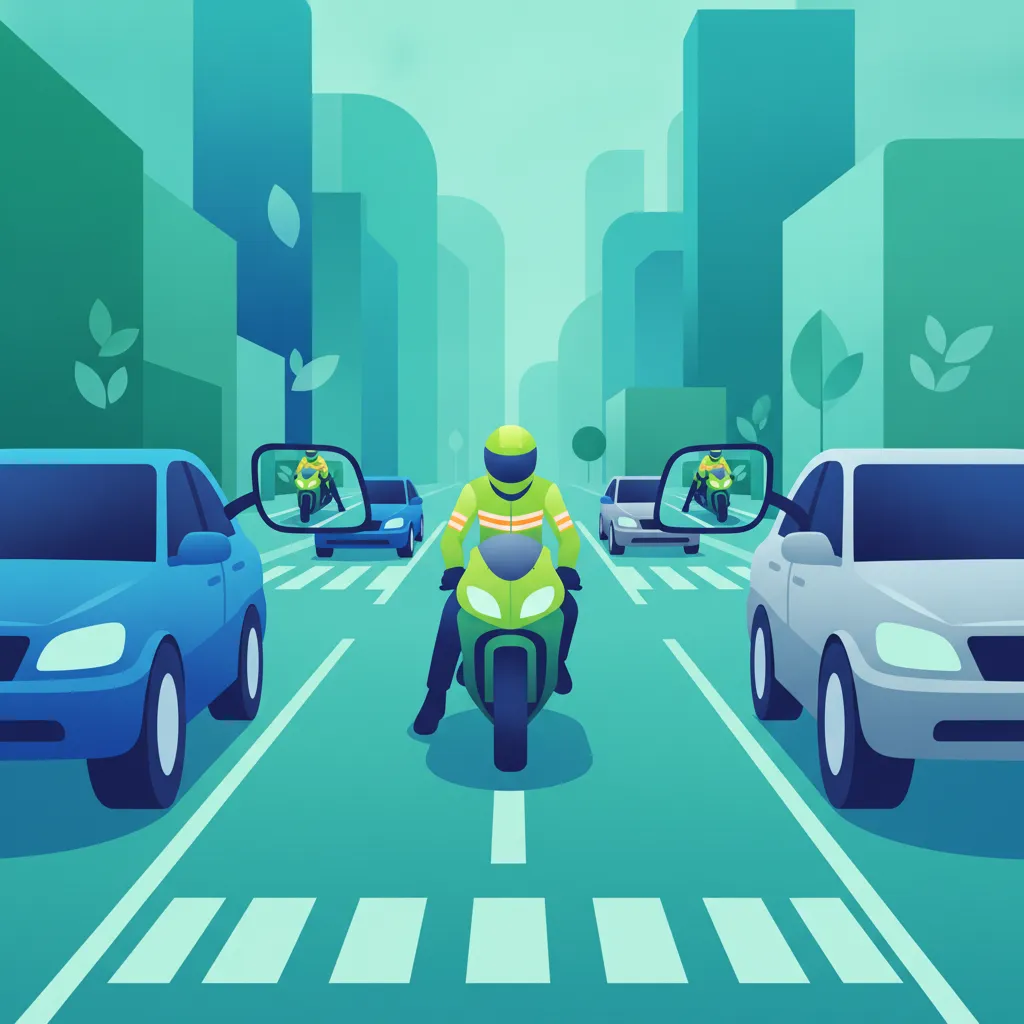
A key aspect of motorcycle safety is being seen by others. This lesson teaches techniques to increase your conspicuity on the road. Topics include the strategic use of high-visibility and reflective clothing, correct use of headlights and daytime running lights, and adopting lane positions that place you in the direct line of sight of other drivers.
Learn how to safely manage your speed and following distance when visibility is poor due to fog, rain, or darkness. Essential theory for AM licence holders on adapting to reduced sight distances and ensuring safe stopping.
Fog dramatically reduces how far you can see and be seen. This lesson explains why you must reduce your speed and increase your following distance in foggy conditions. It also covers the legal requirements and best practices for using your headlights and fog lights to maximize your visibility to others without dazzling them.
This lesson provides essential techniques for safe riding during nighttime and in poor visibility conditions like dawn or dusk. It covers the correct use of your headlamp's main and dipped beams, strategies for reducing glare from oncoming traffic, and the critical role of reflective clothing. You will also learn how to identify common nighttime hazards and manage fatigue, ensuring you can navigate British roads safely after dark while complying with all relevant road rules.
This lesson explains that safe driving often requires travelling at a speed lower than the legal limit. It covers how to adjust your speed for adverse conditions such as rain, which can double your stopping distance, or fog, which severely reduces visibility. The goal is to always be able to stop safely in the distance you can see to be clear.
This lesson provides essential advice for riding safely in adverse weather conditions that reduce tyre grip. You will learn how rain, ice, and wet leaves dramatically increase braking distances and affect handling. Key strategies covered include reducing speed, increasing following distances, making smooth control inputs, and anticipating slippery areas to maintain control and avoid skidding on compromised road surfaces.
This lesson provides essential advice for driving when weather conditions are poor. It explains how rain can cause aquaplaning and why you must double your following distance. You will also learn techniques for driving in icy conditions, including gentle use of controls to avoid skidding, and the correct use of lights in fog.
This lesson teaches strategic road positioning techniques to maximize your visibility and safety in traffic. You will learn how to choose the correct lane position to avoid the blind spots of larger vehicles and how to communicate your intentions through predictable riding. Key skills covered include effective use of shoulder checks, making eye contact with drivers, and maintaining a safe following distance, all of which are crucial for defensive riding on British roads.
This lesson details the legal requirements and best practices for using lights and reflectors on your moped or light quadricycle. It covers the correct operation of headlamps, daytime running lights, brake lights, and indicators to communicate your intentions clearly to other road users. You will also learn how to enhance your visibility further with strategically placed reflectors and reflective tape, ensuring you remain conspicuous in low-light conditions and compliant with British lighting regulations.

This lesson addresses the critical safety topics of impairment, distraction, and social pressures. It explains how alcohol and drugs severely affect judgment, coordination, and reaction time, outlining the strict legal limits and harsh penalties in Great Britain. The content also covers modern distractions like mobile phones and the importance of resisting negative peer pressure to maintain focus and make responsible decisions as a rider.
Riding at night requires different skills, as visibility is limited to the reach of your headlights. This lesson teaches you how and when to use main beam and dipped beam lights effectively. It also discusses the increased risk from fatigue and nocturnal animals, and emphasizes the importance of a clean visor and reflective gear for safety.
A key aspect of motorcycle safety is being seen by others. This lesson teaches techniques to increase your conspicuity on the road. Topics include the strategic use of high-visibility and reflective clothing, correct use of headlights and daytime running lights, and adopting lane positions that place you in the direct line of sight of other drivers.
Find clear answers to common questions learners have about Reduced Visibility: Fog, Darkness, and Poor Lighting. Learn how the lesson is structured, which driving theory objectives it supports, and how it fits into the overall learning path of units and curriculum progression in Great Britain. These explanations help you understand key concepts, lesson flow, and exam focused study goals.
You should use your dipped headlights during the day if visibility is seriously reduced, for example, in heavy rain or fog. This ensures that other road users can see your moped or light quadricycle more clearly.
In the theory test, you should always select the option that indicates reducing your speed significantly when visibility is poor. The Highway Code emphasizes that you must be able to stop well within the distance you can see to be safe.
Yes, your moped must have operational front and rear lights. If you are riding in conditions of reduced visibility, it is a legal requirement to use your lights to ensure you are as visible as possible to other motorists.
If you are dazzled at night, you should slow down or stop if necessary. Keep your eyes on the left side of the road to avoid looking directly into the glare of the oncoming vehicle's lights.
Dive into our comprehensive question bank to find exactly what you need for your Great Britain theory test. Use our advanced filters to pinpoint specific subjects or test your knowledge on challenging areas, ensuring you're fully prepared for success.