
This lesson focuses on the rules for navigating mini-roundabouts and small junctions, which are common features in British urban environments. Understanding these rules is a critical part of the Priority Rules unit, ensuring you can manage traffic flow effectively during your Category B practical driving and theory exam.
Lesson content overview
Mini-roundabouts are a common feature of urban and residential driving in Great Britain, designed to manage traffic flow efficiently in smaller spaces. Understanding how to navigate these junctions safely and correctly is fundamental for all drivers, especially those preparing for the Category B driving theory test. This lesson will provide comprehensive guidance on their definition, essential priority rules, correct signalling, and how to safely interact with other road users, particularly those who are more vulnerable.
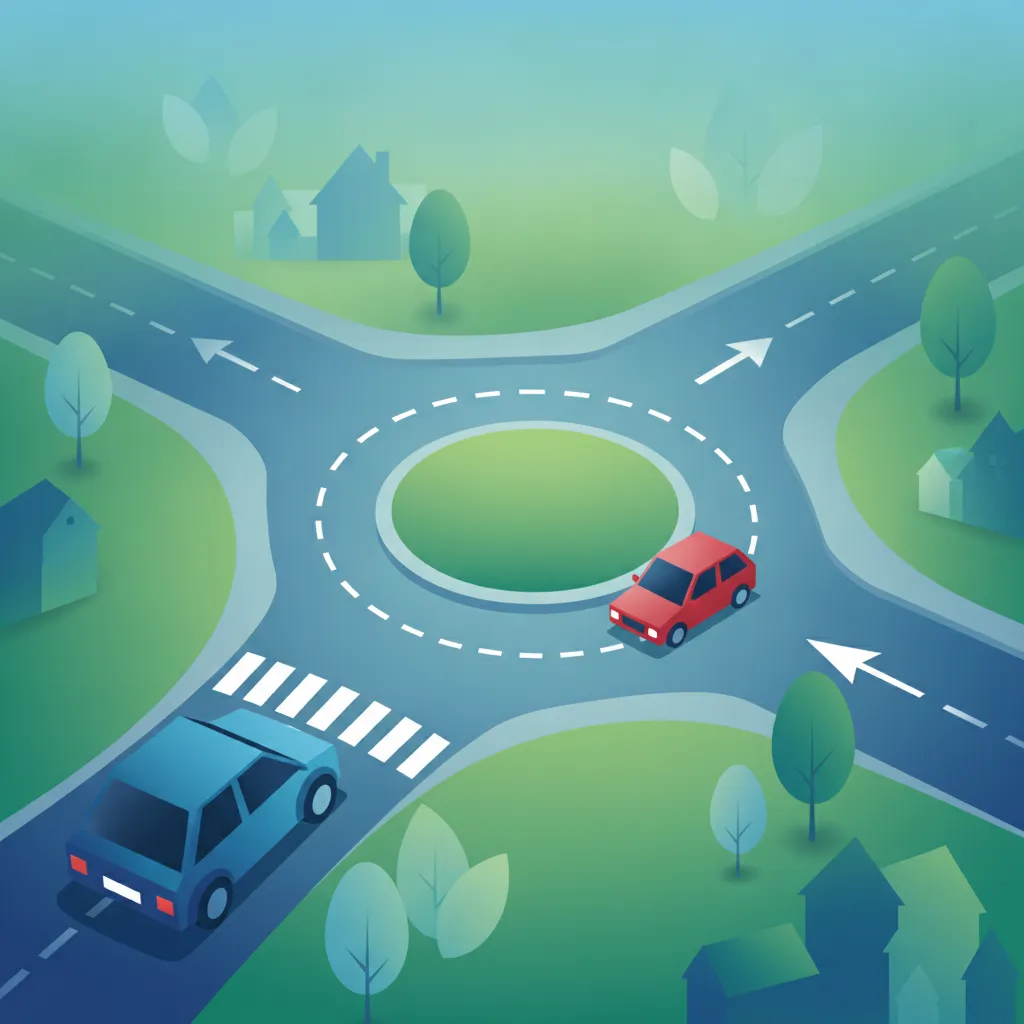
A mini-roundabout is a type of circular junction characterised by its small central island, which is often marked on the road surface with chevrons rather than being a raised physical structure. Unlike larger roundabouts, the central island of a mini-roundabout is typically small enough to be driven over by larger vehicles if absolutely necessary, though this should generally be avoided by cars. Their primary purpose is to reduce traffic speeds and facilitate continuous flow at intersections where full-sized roundabouts or traffic lights would be impractical.
Mini-roundabouts are primarily found in urban and residential areas, where they help to reduce the severity of potential collisions by encouraging lower speeds and more predictable vehicle paths. They are designed for low-capacity traffic, ensuring that even busy intersections can keep traffic moving smoothly without extensive queuing.
While the core principles remain consistent, mini-roundabouts can appear in slightly different forms:
A2) at each entry point. This sign explicitly reinforces the need to yield to traffic approaching from the right and already on the roundabout.The most crucial aspect of navigating mini-roundabouts is understanding and correctly applying priority rules. These rules are designed to ensure predictable interactions and minimise the risk of collisions at these compact junctions.
At any mini-roundabout, drivers approaching must give way to any traffic already on the roundabout that is approaching from their right. This rule is a cornerstone of safe driving at circular junctions and is explicitly covered by Highway Code Rule 170 for uncontrolled junctions and Rule 186 for all roundabouts. Failing to observe this rule is a common cause of accidents.
Always check your right-hand side thoroughly before entering a mini-roundabout. If a vehicle is approaching from your right or is already on the roundabout, you must wait for it to pass or clear your path before proceeding.
In addition to traffic from the immediate right, you must also yield to any vehicle already circulating on the mini-roundabout. This reinforces the principle that traffic already within the junction has priority. This applies even if the circulating vehicle initially entered from your left, as its presence on the roundabout grants it priority over vehicles waiting to enter.
While the primary give-way rule applies to vehicles, it is imperative to remember that pedestrians, cyclists, and motorcyclists are often present at or near mini-roundabouts. Highway Code Rule 181 mandates giving way to pedestrians who are crossing or waiting to cross the road into which you are turning. At mini-roundabouts, pedestrians may cross the road at any point, including the far side of the roundabout. Similarly, cyclists and motorcyclists have the same priority as other vehicles when on the island, but their smaller size makes them harder to see.
Approaching a mini-roundabout with caution and at an appropriate speed is paramount for safety. Due to their compact nature and the presence of various road users, mini-roundabouts demand careful observation and readiness to react.
As you approach a mini-roundabout, always reduce your speed significantly. A safe approach speed is typically between 15-20 mph, or even slower if conditions warrant it. This reduced speed allows you sufficient time to:
Always assume you might need to stop before entering the mini-roundabout. Even if you anticipate a clear path, be ready to apply your brakes smoothly and come to a complete stop if:
Your stopping distance is crucial here. Highway Code Rule 222 reminds drivers that total stopping distance comprises thinking distance and braking distance. By reducing your approach speed, you drastically reduce the distance required to stop, enhancing your safety margin.
Your approach speed and readiness to stop must be further adjusted based on prevailing road and weather conditions.
Effective communication with other road users through correct signalling and appropriate vehicle positioning is essential for safe navigation of mini-roundabouts. This helps prevent misunderstandings and ensures smooth traffic flow.
The Highway Code Rule 190 provides guidance on using indicators at roundabouts, which also applies to mini-roundabouts:
Failing to signal correctly can confuse other drivers, cyclists, and pedestrians, potentially leading to dangerous situations or collisions. Always ensure your indicators are clearly visible and used at the correct times.
Maintaining correct vehicle positioning is vital on a mini-roundabout to ensure you circulate safely and do not impede other traffic.
Mini-roundabouts, being in urban and residential settings, frequently involve interactions with vulnerable road users (VRUs). These include pedestrians, cyclists, and motorcyclists, who require particular attention and care from drivers.
Cyclists and motorcyclists may use mini-roundabouts at varying speeds and may not follow the exact same path as a car.
Pedestrians may cross the road at the exits of a mini-roundabout or even venture onto the central island itself.
Road markings and signs provide vital information about the layout, priority, and required actions at mini-roundabouts. Interpreting these correctly is essential for safe navigation.
A2): This inverted red triangle with a white background is the most common sign associated with mini-roundabouts. It explicitly instructs you to give way to traffic on the main road or roundabout.611.1): A circular blue sign with three white arrows pointing clockwise around a central circle indicates that the junction ahead is a mini-roundabout.Being aware of common errors can help you drive more safely and pass your driving theory test. Here are some frequent violations and misjudgements at mini-roundabouts:
Driving conditions can significantly impact how you should approach and navigate mini-roundabouts. Adapting your driving style is crucial for safety.
Mini-roundabouts are typically found on residential or urban streets, often with a 20 mph or 30 mph speed limit. While the principles remain constant, adapt to the specific context:
Mastering mini-roundabouts is not just about following rules; it's about understanding the underlying safety principles and legal obligations that govern their use.
Your ability to correctly navigate mini-roundabouts builds a crucial foundation for more complex junctions. The principles of priority, observation, signalling, and speed control learned here are directly transferable to larger roundabouts and traffic light controlled junctions, which you will encounter in future lessons.
Explore all units and lessons included in this driving theory course.
Lesson content overview
Explore all units and lessons included in this driving theory course.
Explore search topics learners often look for when studying Mini‑Roundabouts and Small Junctions. These topics reflect common questions about road rules, driving situations, safety guidance, and lesson level theory preparation for learners in Great Britain.
Browse additional driving theory lessons that cover connected traffic rules, road signs, and common driving situations related to this topic. Improve your understanding of how different rules interact across everyday traffic scenarios.
Learn how to safely navigate larger, multi-lane roundabouts and more complex junction layouts. This lesson builds on mini-roundabout principles, focusing on lane discipline, signalling, and priority at more challenging circular junctions in Great Britain.

This lesson tackles the complexities of large roundabouts, which often have multiple lanes and exits. It stresses the importance of reading signs on the approach to select the correct lane for your destination. You will learn about maintaining lane discipline while on the roundabout and signalling correctly as you pass exits and prepare to leave.
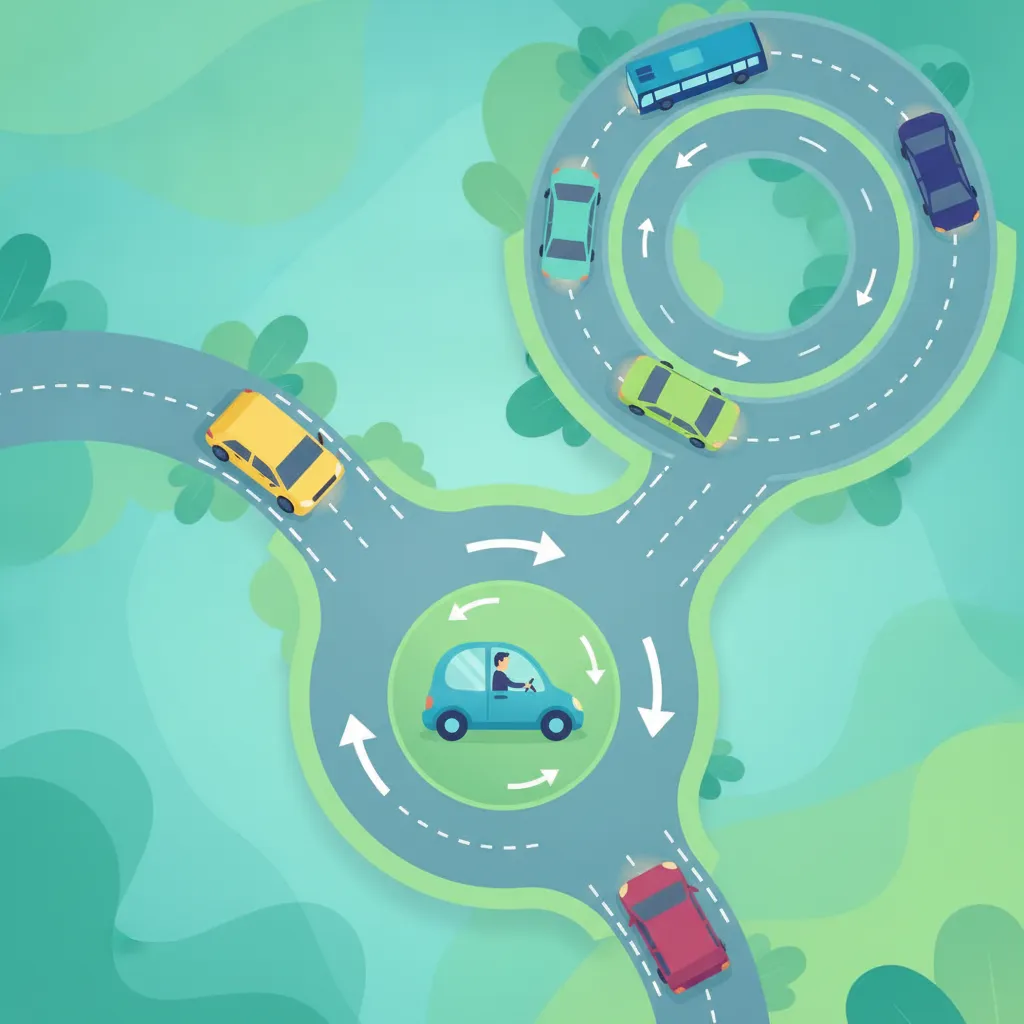
This lesson provides specific techniques for safely navigating the two main types of roundabouts in Great Britain. For multi-lane roundabouts, it covers how to choose the correct lane on approach, maintain your lane while circulating, and signal your exit correctly. It also explains the unique rules for mini-roundabouts, emphasizing the importance of giving way to traffic from the right and navigating them with caution due to their small size.

This lesson addresses the unique challenges of mini-roundabouts and large, multi-lane or spiral roundabouts. You will learn the subtle differences in rules and approach for mini-roundabouts and the importance of strict lane discipline on larger ones. The lesson stresses the need for advanced planning and awareness when navigating these complex junctions.

This lesson details how to safely navigate junctions controlled by traffic signals. It explains the meaning of filter arrows, which allow you to proceed in a specific direction even if the main light is red. You will also learn about respecting advanced stop lines for cyclists and how to approach a junction when the traffic lights are not working.
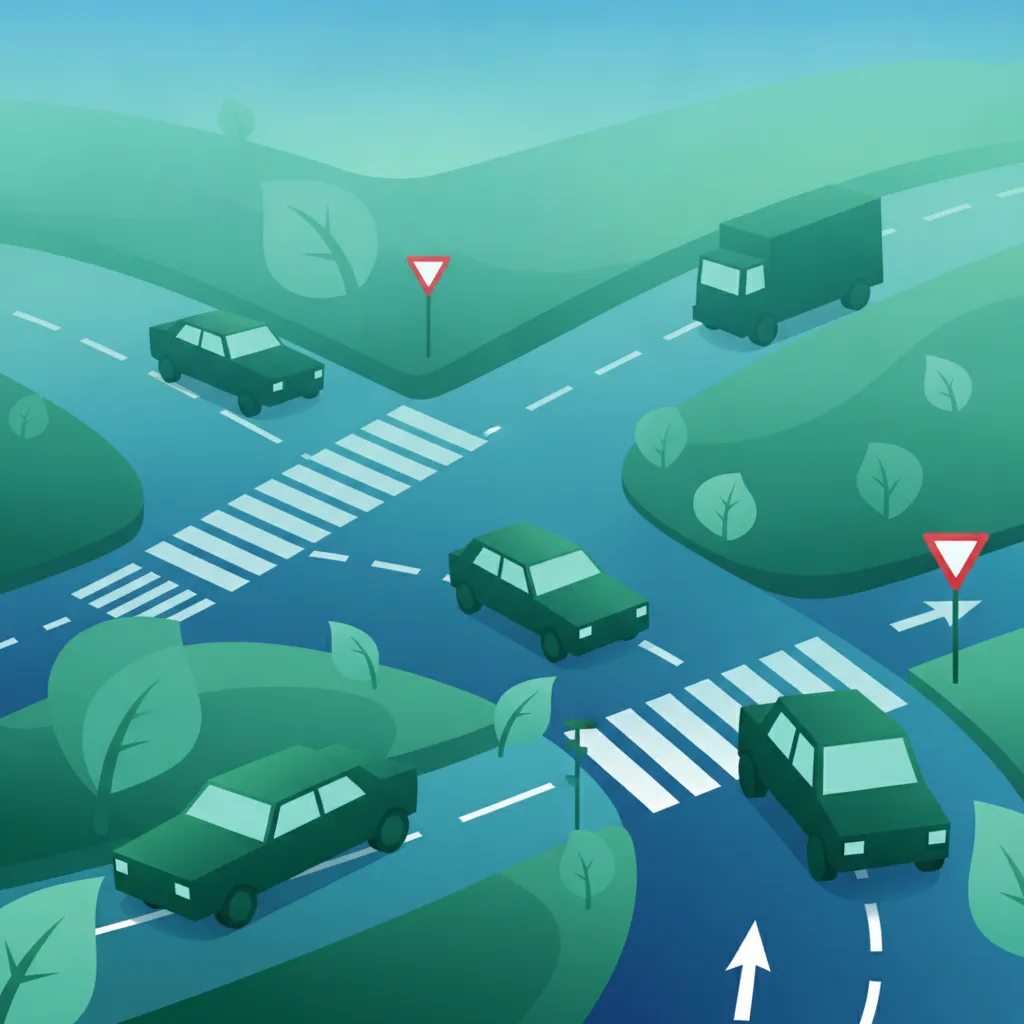
This lesson teaches the systematic approach to safely navigating junctions, emphasizing the importance of adjusting your speed and position well in advance. You will learn the 'Mirror-Signal-Manoeuvre' routine, how to perform effective all-round observation checks, and when to give way to other traffic. The content focuses on making safe judgments about gaps in traffic, a crucial skill for vulnerable AM riders when turning or emerging from a junction.

This lesson provides a step-by-step guide to dealing with roundabouts. It covers how to choose the correct lane on approach based on your destination, when and how to signal your intentions, and how to safely enter and exit the roundabout. Emphasis is placed on maintaining good observation and anticipating the actions of other drivers.

This lesson breaks down the process of navigating basic junctions. It emphasizes the importance of the Mirror-Signal-Manoeuvre (MSM) and Position-Speed-Look (PSL) routines. You will learn how to position your motorcycle correctly for turning, perform effective observation checks for traffic, and judge safe gaps before emerging.

This lesson focuses on the markings that control traffic at intersections. It explains the primary rule of a yellow box junction: do not enter unless your exit is clear. You will also learn the difference between the solid white 'Stop' line and the broken 'Give Way' line, which dictate your priority over other traffic.

This lesson addresses the unique challenges of driving a large vehicle on rural roads. It provides techniques for positioning the vehicle through sharp bends and on narrow lanes, and for safely navigating unmarked or uncontrolled junctions. Learners will be taught to anticipate hidden hazards common in the countryside, such as slow-moving farm vehicles, animals on the road, and concealed entrances. The correct use of passing places and strategies for meeting oncoming traffic are also covered.

This lesson teaches the skill of joining a major road like a dual carriageway or motorway. It explains how to use the slip road to build up your speed to match the traffic flow on the main road. The focus is on observation, signalling, and finding a safe gap before merging smoothly and decisively into the traffic stream.
Understand the frequent errors drivers make on mini-roundabouts, including priority issues, signalling problems, and overlooked hazards. Learn how to avoid these mistakes to drive more safely and confidently.
This lesson provides specific techniques for safely navigating the two main types of roundabouts in Great Britain. For multi-lane roundabouts, it covers how to choose the correct lane on approach, maintain your lane while circulating, and signal your exit correctly. It also explains the unique rules for mini-roundabouts, emphasizing the importance of giving way to traffic from the right and navigating them with caution due to their small size.
This lesson addresses the unique challenges of mini-roundabouts and large, multi-lane or spiral roundabouts. You will learn the subtle differences in rules and approach for mini-roundabouts and the importance of strict lane discipline on larger ones. The lesson stresses the need for advanced planning and awareness when navigating these complex junctions.
This lesson tackles the complexities of large roundabouts, which often have multiple lanes and exits. It stresses the importance of reading signs on the approach to select the correct lane for your destination. You will learn about maintaining lane discipline while on the roundabout and signalling correctly as you pass exits and prepare to leave.
This lesson provides a step-by-step guide to dealing with roundabouts. It covers how to choose the correct lane on approach based on your destination, when and how to signal your intentions, and how to safely enter and exit the roundabout. Emphasis is placed on maintaining good observation and anticipating the actions of other drivers.
This lesson teaches the systematic approach to safely navigating junctions, emphasizing the importance of adjusting your speed and position well in advance. You will learn the 'Mirror-Signal-Manoeuvre' routine, how to perform effective all-round observation checks, and when to give way to other traffic. The content focuses on making safe judgments about gaps in traffic, a crucial skill for vulnerable AM riders when turning or emerging from a junction.

This lesson clarifies who has priority at junctions, whether they are marked with signs and lines or are unmarked. It covers the fundamental rule for roundabouts in the UK: give priority to traffic approaching from your right. You will learn the correct procedures for approaching, signalling, and choosing the appropriate lane on roundabouts and at other junctions.
This lesson details how to safely navigate junctions controlled by traffic signals. It explains the meaning of filter arrows, which allow you to proceed in a specific direction even if the main light is red. You will also learn about respecting advanced stop lines for cyclists and how to approach a junction when the traffic lights are not working.
This lesson focuses on the markings that control traffic at intersections. It explains the primary rule of a yellow box junction: do not enter unless your exit is clear. You will also learn the difference between the solid white 'Stop' line and the broken 'Give Way' line, which dictate your priority over other traffic.
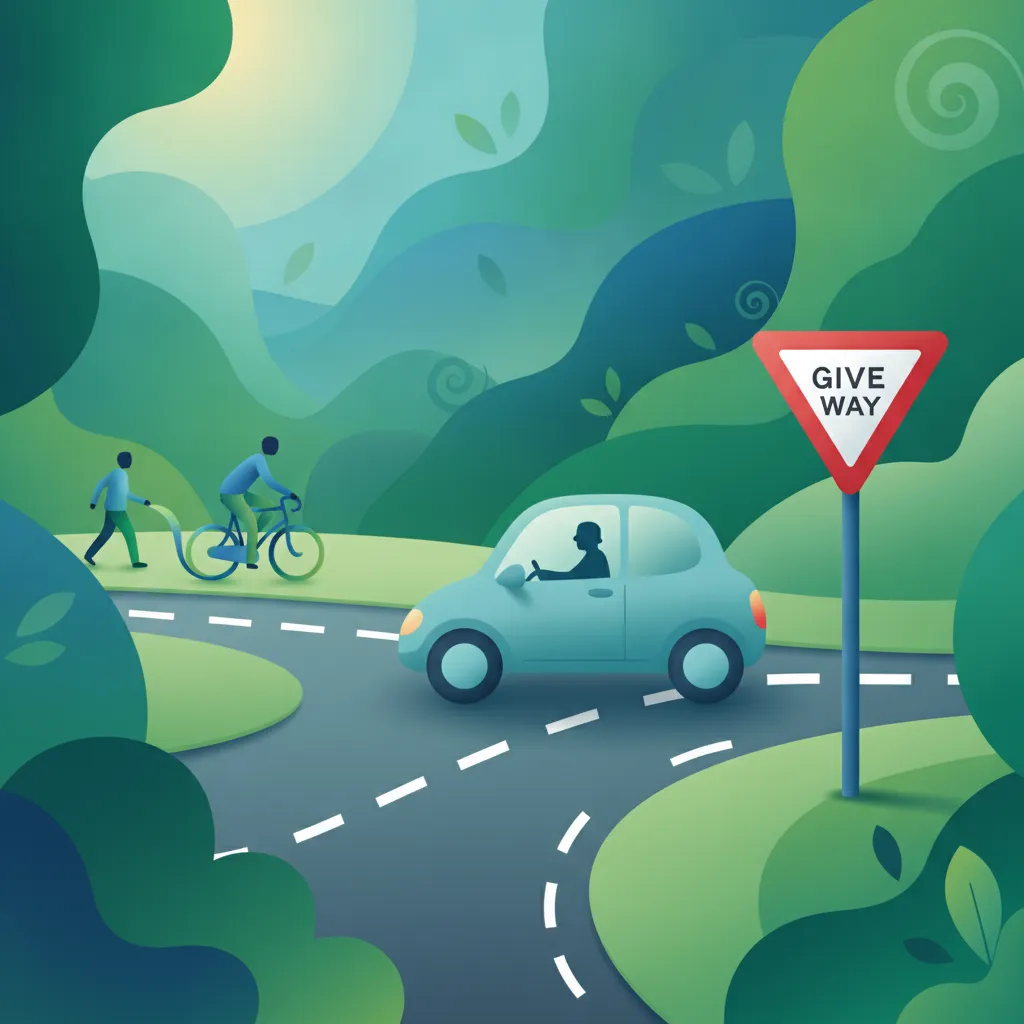
This lesson explains the critical rules of priority that govern traffic flow at junctions, roundabouts, and crossings throughout Great Britain. You will learn how to determine who has right-of-way at both marked and unmarked intersections, and the specific rules for giving way to traffic on roundabouts. The lesson also reinforces the hierarchy of road users from the Highway Code, ensuring you understand when to yield to pedestrians and other vulnerable users.
This lesson breaks down the process of navigating basic junctions. It emphasizes the importance of the Mirror-Signal-Manoeuvre (MSM) and Position-Speed-Look (PSL) routines. You will learn how to position your motorcycle correctly for turning, perform effective observation checks for traffic, and judge safe gaps before emerging.
Find clear answers to common questions learners have about Mini‑Roundabouts and Small Junctions. Learn how the lesson is structured, which driving theory objectives it supports, and how it fits into the overall learning path of units and curriculum progression in Great Britain. These explanations help you understand key concepts, lesson flow, and exam focused study goals.
Yes, you should signal your intentions as you would at a larger roundabout. Signal left for the first exit, follow the road for intermediate exits, and signal right if taking an exit beyond the halfway point.
You must give way to traffic approaching from your right. Always check for cyclists and motorcyclists who may be positioned close to the curb, as they are often more vulnerable at these junctions.
You should avoid driving over the painted circle of a mini-roundabout if it is physically possible to navigate around it. However, if your vehicle is too large to make the turn without driving over it, ensure you do so with extreme caution.
At small junctions without specific markings, treat the situation with caution, follow the Highway Code priority rules, and be prepared to stop if another vehicle has already established priority or is turning across your path.
Dive into our comprehensive question bank to find exactly what you need for your Great Britain theory test. Use our advanced filters to pinpoint specific subjects or test your knowledge on challenging areas, ensuring you're fully prepared for success.