
Driving in fog is one of the most challenging weather conditions on Austrian roads due to severely reduced visibility. This page explains how fog affects your ability to see and react, detailing the essential changes you must make to your speed, vehicle lighting, and following distance. Understanding these rules is vital for both your safety and success in the Austrian driving theory exam.
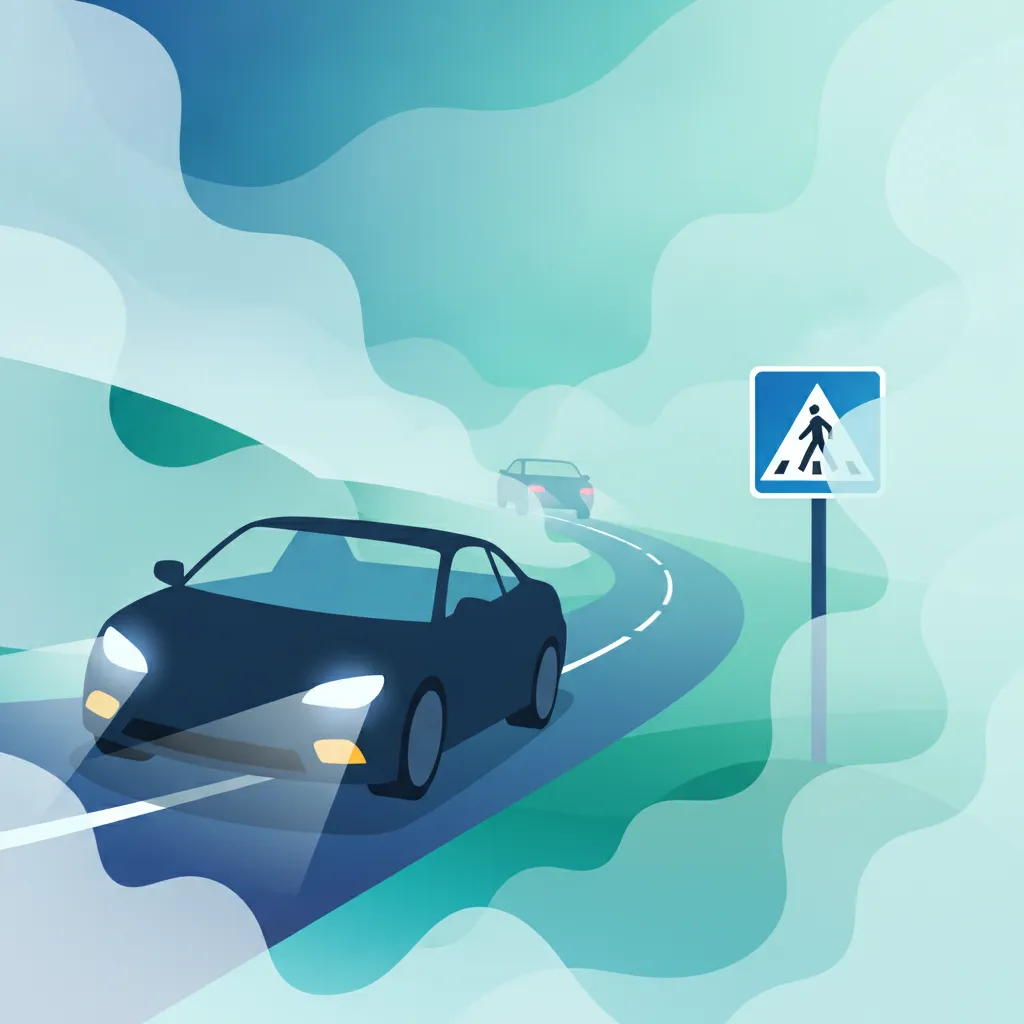
Theory topic content overview
Read the full theory topic guide for Driving in Fog with structured, easy-to-scan content built for learners in Austria. This detailed section explains the exact rule, meaning, traffic context, comparison points, and exam logic behind this Austrian driving theory topic so you can study faster, understand the concept more clearly, and avoid common interpretation mistakes on the theory test.
Driving in fog refers to operating a vehicle when atmospheric conditions cause severely reduced visibility. Fog, locally known as Nebel in Austria, is essentially a cloud at ground level, consisting of tiny water droplets suspended in the air. This phenomenon directly impacts a driver's ability to clearly see the road ahead, other vehicles, pedestrians, traffic signs, and road markings.
The primary danger of driving in fog is that it dramatically shortens your effective sight distance. This means you have less time to perceive hazards, react to changing traffic situations, or avoid unexpected obstacles. In Austria, where diverse terrain includes alpine passes and valley roads, fog can form rapidly and often, presenting a significant challenge for drivers and a key topic in the Austrian driving theory test.
Fog poses unique challenges on Austrian roads, impacting safety and requiring precise driver adaptation. Misjudging conditions in fog is a common cause of accidents, especially multi-vehicle collisions.
Nebel. A core principle tested is that your speed must always allow you to stop within the distance you can clearly see ahead.Navigating foggy conditions safely requires fundamental changes to your driving behavior. These adjustments are critical for both your safety and that of other road users on Austrian roads.
This is the most crucial adjustment. You must reduce your speed significantly so that you can stop your vehicle safely within the distance you can clearly see ahead. This principle is fundamental in Austrian traffic law and theory.
Proper lighting ensures you can see better and, crucially, allows other drivers to see your vehicle.
Abblendlicht): Always switch on your low beam headlights in fog. They illuminate the road ahead without causing excessive glare reflected by the fog itself.Nebelscheinwerfer): These can be used when visibility is significantly impaired by fog, heavy rain, or snow. They project a broad, low beam that helps illuminate the road surface directly in front of your vehicle and makes your car more visible from the front.Nebelschlussleuchte): This is a very bright red light at the rear of your vehicle, designed to make your car visible from behind in severely reduced visibility (typically below 50 meters, though the law states "severely impaired by fog, heavy rain, or snow"). Crucially, turn it off immediately when visibility improves to avoid dazzling following drivers. Misuse of the rear fog light is a common error and can create a hazard.Fernlicht): High beams will reflect off the fog particles and create a wall of light, worsening your visibility.In fog, the standard two-second rule is insufficient. You need a much larger gap between your vehicle and the one ahead.
Several factors influence the severity of the hazard posed by fog and dictate the level of adaptation required:
dichter Nebel), the required speed reduction and light use intensify with decreasing visibility.Autobahn and Schnellstraße) in fog are particularly dangerous due to higher speeds and traffic volumes. Rural roads can have unexpected hazards like wildlife or slow-moving agricultural vehicles. Urban areas present challenges with pedestrians, cyclists, and complex intersections.A common point of confusion for learners in Austria revolves around the difference between legal speed limits and the safe speed in adverse conditions, as well as the correct application of fog lights.
§ 20 StVO - Geschwindigkeit).Consider these common situations you might encounter when driving in fog in Austria:
Autobahn in fog is particularly challenging. You must accurately judge the speed and distance of approaching traffic in your mirrors, which are heavily obscured. Signal early, be decisive, and accelerate cautiously only when a safe gap is clear.Landstraßen with no streetlights, dense fog can completely obscure road edges, wildlife, or slow-moving agricultural vehicles. Drive cautiously, keep to the right, and be extra alert for animals on the road.Learners and even experienced drivers often make these mistakes in foggy conditions:
Standlicht) or Tagfahrlicht (daytime running lights), which are insufficient to be seen or to illuminate the road.Autobahnen.Austrian traffic regulations place strong emphasis on adapting to conditions. The general principle, "You must always choose your driving speed so that you can stop in time even before poorly recognizable obstacles," directly applies to fog.
Sichtfahrgebot (Visibility Command): This fundamental principle of Austrian law dictates that a driver must always be able to stop within the distance they can see. This applies strongly to fog.Nebel) exist, indicating areas prone to such conditions. However, fog can occur anywhere.Autobahnen might display warnings or reduced speed limits specifically for fog. Always heed these digital instructions.When faced with Nebel on Austrian roads, your guiding principle must be "See and be seen, and adapt your speed to what you can see."
Proactive decision-making is key:
Mastering driving in fog is not just about passing your Austrian theory exam; it's a vital skill for safe navigation in diverse weather conditions across the country.
Driving in fog in Austria requires significant adaptation because visibility is dramatically reduced, shortening your effective sight distance and reaction time. The core principle is the Sichtfahrgebot (visibility command), which legally requires you to always be able to stop within the distance you can clearly see ahead—your safe speed in fog is dictated by visibility, not the posted limit. Essential adjustments include using low beam headlights (never high beams), appropriate fog lights, and maintaining at least a four-second following distance. Common mistakes include driving too fast, improper lighting use (especially misusing the rear fog light), following too closely, and sudden braking. Austrian roads present additional challenges in alpine regions and on motorways where fog can form rapidly and traffic volumes are high.
A short set of high-value points that capture the most important ideas from this theory explanation.
Your speed in fog must always allow you to stop within the distance you can see ahead, regardless of the posted speed limit
Low beam headlights (Abblendlicht) are the minimum lighting requirement in fog; high beams reflect off fog particles and worsen visibility
The rear fog light (Nebelschlussleuchte) is a warning signal for traffic behind you—use it only when visibility is severely impaired and turn it off immediately when conditions improve
Following distance in fog must be at least double the normal two-second rule, ideally four seconds or more
Drive proactively as if a hidden hazard—stationary vehicle, pedestrian, or obstacle—exists just beyond your visible range
Sichtfahrgebot: Austrian law requires you to always be able to stop within your visible distance, a principle that directly applies to fog
Front fog lights improve your own vision and make you visible from the front; rear fog light warns traffic behind you only in severely reduced visibility
Parking lights or daytime running lights alone are insufficient in fog—you must switch on your low beam headlights
If you suddenly enter dense fog, reduce speed gradually rather than braking sharply to avoid surprising following drivers
Fog density, time of day, road type, and vehicle condition all influence how much you must adapt your driving behavior
Driving too fast for visibility conditions, assuming the posted speed limit is still safe in fog
Using only parking lights (Standlicht) or daytime running lights (Tagfahrlicht) instead of proper low beam headlights
Leaving the rear fog light on when visibility improves, dazzling drivers behind you
Following the vehicle ahead too closely without maintaining the increased gap required in fog
Relying solely on the tail lights of the vehicle in front (target fixation) and failing to scan for other hazards
Start with a short, direct summary of Driving in Fog before reading the full explanation below.
When driving in fog, you must significantly reduce your speed so you can stop within the visible distance ahead. Turn on your low beam headlights and, if available and appropriate, your fog lights to increase your visibility to other road users and improve your own sight. Always maintain a greater following distance than usual, and remain highly alert for unexpected obstacles or vehicles, especially at intersections and pedestrian crossings.
Review the most important terms, rule signals, and traffic concepts linked to Driving in Fog.
Explore related theory topic pages connected to Driving in Fog and continue with the next useful rule explanation.
See the common search queries learners use when trying to understand Driving in Fog in Austria.

Ready to delve deeper into specific theory topics? Continue exploring detailed explanations of Austrian road signs, traffic rules, and critical driving situations. Solidify your knowledge, clarify any doubts, and ensure you're fully prepared for every aspect of your official driving licence theory exam.
Austrian Driving Theory TopicsTheory topic content overview
A short set of high-value points that capture the most important ideas from this theory explanation.
Your speed in fog must always allow you to stop within the distance you can see ahead, regardless of the posted speed limit
Low beam headlights (Abblendlicht) are the minimum lighting requirement in fog; high beams reflect off fog particles and worsen visibility
The rear fog light (Nebelschlussleuchte) is a warning signal for traffic behind you—use it only when visibility is severely impaired and turn it off immediately when conditions improve
Following distance in fog must be at least double the normal two-second rule, ideally four seconds or more
Drive proactively as if a hidden hazard—stationary vehicle, pedestrian, or obstacle—exists just beyond your visible range
Sichtfahrgebot: Austrian law requires you to always be able to stop within your visible distance, a principle that directly applies to fog
Front fog lights improve your own vision and make you visible from the front; rear fog light warns traffic behind you only in severely reduced visibility
Parking lights or daytime running lights alone are insufficient in fog—you must switch on your low beam headlights
If you suddenly enter dense fog, reduce speed gradually rather than braking sharply to avoid surprising following drivers
Fog density, time of day, road type, and vehicle condition all influence how much you must adapt your driving behavior
Driving too fast for visibility conditions, assuming the posted speed limit is still safe in fog
Using only parking lights (Standlicht) or daytime running lights (Tagfahrlicht) instead of proper low beam headlights
Leaving the rear fog light on when visibility improves, dazzling drivers behind you
Following the vehicle ahead too closely without maintaining the increased gap required in fog
Relying solely on the tail lights of the vehicle in front (target fixation) and failing to scan for other hazards
Start with a short, direct summary of Driving in Fog before reading the full explanation below.
When driving in fog, you must significantly reduce your speed so you can stop within the visible distance ahead. Turn on your low beam headlights and, if available and appropriate, your fog lights to increase your visibility to other road users and improve your own sight. Always maintain a greater following distance than usual, and remain highly alert for unexpected obstacles or vehicles, especially at intersections and pedestrian crossings.
Review the most important terms, rule signals, and traffic concepts linked to Driving in Fog.
Explore related theory topic pages connected to Driving in Fog and continue with the next useful rule explanation.
See the common search queries learners use when trying to understand Driving in Fog in Austria.
Ready to delve deeper into specific theory topics? Continue exploring detailed explanations of Austrian road signs, traffic rules, and critical driving situations. Solidify your knowledge, clarify any doubts, and ensure you're fully prepared for every aspect of your official driving licence theory exam.
Austrian Driving Theory TopicsUse this exam-focused revision tip to understand how Driving in Fog is likely to appear in theory questions for learners in Austria. This section helps you identify the most testable part of the rule, avoid common traps, and remember the concept more effectively during Austrian driving theory exam preparation.
A common mistake in the Austrian driving theory test regarding fog is failing to recognize that your speed must allow you to stop within your visible range, not just below the posted limit. Remember that fog makes you see hazards much later, directly impacting your effective reaction time and requiring a proactive reduction in speed and increased following distance to remain safe.
Read direct answers to the most common learner questions about Driving in Fog in Austria. This FAQ focuses on rule confusion, practical meaning, comparison with similar concepts, and the exact uncertainties that appear most often in Austrian driving theory revision and exam preparation.
In Austria, you should use your low beam headlights whenever visibility is poor due to fog, rain, or snow. Front fog lights can be used if visibility is significantly reduced. Rear fog lights should only be used in very dense fog or heavy snowfall when visibility is less than 50 meters, to prevent dazzling drivers behind you when not absolutely necessary.
Fog does not physically change your vehicle's stopping distance. However, it drastically reduces your reaction distance by delaying the point at which you can perceive a hazard. This effectively means your overall safe stopping distance increases because you need more time to react to something you see later.
There is no fixed speed limit for driving in fog; instead, your speed must always be adjusted so you can stop safely within the distance you can clearly see ahead. If visibility is very poor, this may mean driving significantly slower than the posted speed limit.
No, you should not use high beam headlights in fog. High beams reflect off the fog droplets, creating a glare that makes visibility even worse for you and can blind oncoming drivers. Always use low beams and fog lights if equipped and appropriate.
In foggy conditions, you should significantly increase your following distance. The standard two-second rule is insufficient. Aim for at least a four-second gap, or even more in very dense fog, to give yourself enough time to react if the vehicle ahead brakes suddenly.
Besides reducing speed and adjusting lights, ensure your windows and mirrors are clean for maximum visibility. Avoid sudden braking or steering. Be extra cautious at intersections, pedestrian crossings, and railway crossings. Listen for traffic you cannot see, and if the fog becomes too dense, consider pulling over safely until conditions improve.
While there isn't a specific 'fog' road sign, signs indicating 'danger' (Dreieck mit Ausrufezeichen) or 'reduced visibility' may appear, reminding drivers to be extra careful. The general rule of adapting to conditions always applies, regardless of specific signage.
In Austria, rear fog lights (Nebelschlussleuchte) may only be used when visibility is severely impaired by fog, heavy rain, or snowfall, specifically if the visibility is less than 50 meters. Using them when visibility is better can dazzle following drivers and is illegal.
Refine your study plan by searching for specific Austrian driving theory practice sets. Pinpoint questions related to particular road rules, signs, or challenge levels, and begin practicing immediately to reinforce your knowledge and excel in your official exam with confidence. Get started with focused revision today.