
Understanding how to effectively scan for hazards around parked cars is a fundamental requirement for passing the Great Britain hazard perception test. This guide explains the mental process of identifying developing hazards, where a parked vehicle might obscure children, pedestrians, or sudden movements that force you to adjust your speed or direction. By refining these observational skills, you will be better prepared to react correctly in both your theory exam and real-world urban driving.
Article content overview
In the Great Britain theory test, the hazard perception component is designed to assess your ability to scan the road for potential dangers. One of the most common and critical scenarios you will encounter involves parked vehicles in urban environments. Understanding how to differentiate between a static object and a developing hazard is the key to achieving a high score and, more importantly, ensuring your safety on the road.
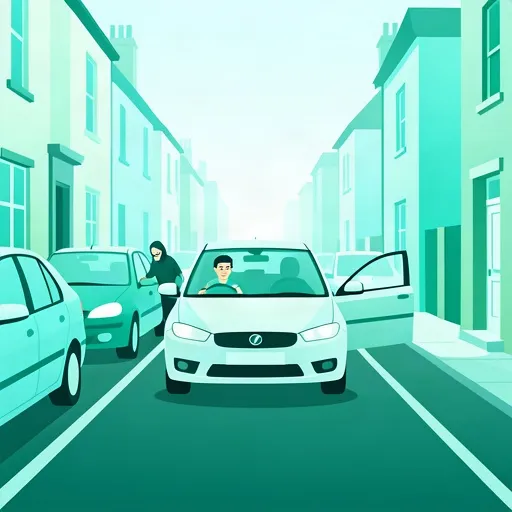
The DVSA theory test defines a developing hazard as an event that would cause you to take action, such as changing your speed or altering your direction. A stationary car parked legally at the side of the road is not inherently a hazard. However, it can quickly become one if the driver begins to move away, opens a door, or if a pedestrian emerges from behind the vehicle.
A developing hazard is any situation where a change in speed or direction is required. For example, a parked car becomes a developing hazard as soon as it shows signs of movement, such as a flickering indicator, or when a person or animal moves into your path from behind it.
Your goal during the hazard perception test is to identify these risks as early as possible. If you wait until you are forced to slam on your brakes, you have reacted too late to maximize your potential score. Early anticipation allows for smoother, safer driving, which is exactly what the examiners are looking for in both the theory and practical assessment.
When driving through British towns and cities, you must constantly scan for clues that a parked vehicle is about to present a danger. These clues are often subtle, such as brake lights coming on, an exhaust plume appearing in cold weather, or the front wheels of the car angling away from the kerb.
Beyond the vehicle itself, parked cars act as massive visual obstructions. They frequently hide children, cyclists, or other pedestrians who may attempt to cross the road. When approaching such areas, you should always be prepared to adjust your speed, assuming that someone might step out into your path without warning.
Always be mindful of the "door zone." When driving past parked cars, aim to leave enough space—ideally at least a door's width—to avoid being struck by a vehicle door suddenly opening into your path.
To score well in the hazard perception test, you must cultivate a disciplined observation technique. Avoid the temptation to click sporadically; instead, focus on tracking potential hazards as they evolve. If you click on every parked car you see, you risk being penalized for "clicking patterns."
| Hazard Clue | Risk Level | Recommended Action |
|---|---|---|
| Exhaust fumes | Moderate | Prepare to slow down/check mirrors |
| Indicator flashing | High | Prepare to stop or change lanes |
| Child near vehicle | Very High | Reduce speed immediately |
| Car door opening | High | Steer away/brake if necessary |
While the hazard perception test is a simulation, it is rooted in the rules established by The Highway Code. Road users have a shared responsibility to ensure that their actions do not jeopardize the safety of others. As a learner, you must understand that the responsibility to avoid a collision often falls on the person with the most time to react.
Understanding these principles will help you not only in the theory test but also when you transition to your practical lessons. The ability to identify hazards like parked vehicles before they become an immediate danger is the hallmark of a skilled and safe driver.
Hazard perception tests your ability to spot developing dangers early, and parked vehicles are a primary source of hidden hazards in urban areas. A stationary car only becomes a hazard when it shows signs of movement or when a pedestrian or cyclist emerges from behind it. Effective scanning means watching for subtle clues like exhaust fumes, brake lights, or angled wheels, and adjusting your speed proactively. The door zone reminds you to leave adequate clearance when passing parked cars. Consistent observation and early anticipation not only improve your theory test score but are the foundation of safe urban driving.
A short set of high-value points that capture the most important ideas from this article.
A stationary parked car is not a hazard; it becomes one when signs of movement or hidden pedestrians emerge
Early hazard detection earns higher scores; waiting until you must brake means you've reacted too late
Parked vehicles create visual obstructions that can hide children, cyclists, and pedestrians
Tell-tale signs of a developing hazard include brake lights, exhaust fumes, angled wheels, or flickering indicators
The door zone is the space beside a parked car where an opening door poses a risk to passing traffic
A developing hazard is any situation that would require you to change speed or direction
Hazard perception scoring rewards early identification, not reaction to obvious dangers
Use the five-step scanning method: scan ahead, watch for movement signs, check gaps between vehicles, adjust speed, maintain consistent observation
Clicking on every parked car results in penalty for predictable clicking patterns
The Highway Code underpins all hazard perception principles tested in the DVSA theory test
Clicking on every parked vehicle as if it were automatically a hazard, rather than waiting for signs of development
Waiting too long to react, scoring zero because the hazard was already at its peak when identified
Failing to check the spaces between parked vehicles where pedestrians or cyclists may be hidden
Only reacting to obvious stimuli instead of continuously scanning for subtle developing hazards
Making mechanical, rhythmic clicks during the test, which the DVSA system flags as a pattern and penalises
Article content overview
A short set of high-value points that capture the most important ideas from this article.
A stationary parked car is not a hazard; it becomes one when signs of movement or hidden pedestrians emerge
Early hazard detection earns higher scores; waiting until you must brake means you've reacted too late
Parked vehicles create visual obstructions that can hide children, cyclists, and pedestrians
Tell-tale signs of a developing hazard include brake lights, exhaust fumes, angled wheels, or flickering indicators
The door zone is the space beside a parked car where an opening door poses a risk to passing traffic
A developing hazard is any situation that would require you to change speed or direction
Hazard perception scoring rewards early identification, not reaction to obvious dangers
Use the five-step scanning method: scan ahead, watch for movement signs, check gaps between vehicles, adjust speed, maintain consistent observation
Clicking on every parked car results in penalty for predictable clicking patterns
The Highway Code underpins all hazard perception principles tested in the DVSA theory test
Clicking on every parked vehicle as if it were automatically a hazard, rather than waiting for signs of development
Waiting too long to react, scoring zero because the hazard was already at its peak when identified
Failing to check the spaces between parked vehicles where pedestrians or cyclists may be hidden
Only reacting to obvious stimuli instead of continuously scanning for subtle developing hazards
Making mechanical, rhythmic clicks during the test, which the DVSA system flags as a pattern and penalises
Explore related topics, search based questions, and concepts that learners often look up when studying Handling Parked Vehicle Hazards. These themes reflect real search intent and help you understand how this topic connects to wider driving theory knowledge in Great Britain.
Find clear and practical answers to common questions learners often have about Handling Parked Vehicle Hazards. This section helps explain difficult points, remove confusion, and reinforce the key driving theory concepts that matter for learners in Great Britain.
A static hazard is an object like a parked car that is not currently posing a threat. It becomes a 'developing hazard' when it starts to change, such as a driver's door opening or the car signaling to pull out, requiring you to change your speed or direction.
They create blind spots where pedestrians, especially children, or cyclists can emerge suddenly into your path, forcing you to make immediate adjustments to your driving.
You should maintain a safe distance, reduce your speed, and look for signs of movement, such as reflections in car windows, people sitting in vehicles, or shadows between cars that could indicate a pedestrian is about to cross.
Explore our extensive library of Great Britain driving theory articles to clarify any topic, review specific road rules, or gain deeper insights into vehicle safety and the Highway Code. Use the search to find exactly what you need for comprehensive DVSA theory test preparation.