
Navigating road markings near school zones is a crucial safety skill that directly impacts your performance in the DVSA theory test. This guide clarifies the official Highway Code rules regarding yellow zigzag lines, explaining why stopping or parking in these areas is strictly prohibited to ensure the safety of children. You will learn the correct approach to drop-offs and the legal implications of ignoring these vital safety zones.
Article content overview
Navigating the roads near schools requires a heightened level of awareness and a strict adherence to traffic regulations. In Great Britain, the safety of vulnerable road users—especially children—is a primary focus of the DVSA theory test. Understanding the legal implications of school keep clear markings is not just an exam requirement; it is a fundamental skill for every responsible driver in England, Scotland, and Wales.
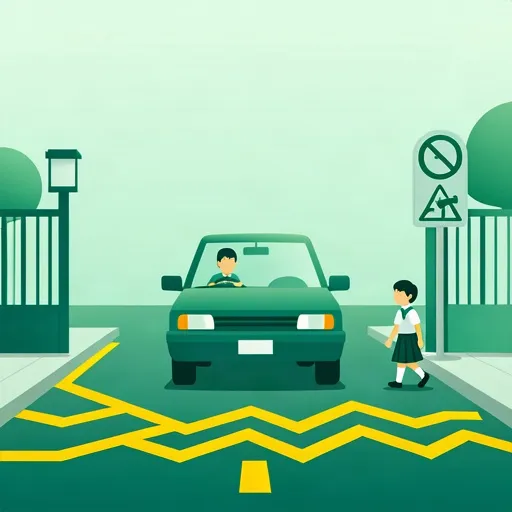
School keep clear markings are identified by yellow zigzag lines painted on the carriageway outside school entrances. These markings are designed to ensure that the area remains free of parked vehicles, providing an unobstructed view for both drivers and children who are crossing the road. When you see these markings, you must understand that they are not merely advisory; they are a clear directive regarding your conduct as a motorist.
Many learners mistakenly believe that stopping for a moment to let a child out of the car is acceptable. However, any form of stopping or parking in these zones is strictly prohibited during the operational hours stated on the accompanying upright sign. By blocking these areas, you create a significant safety hazard by obstructing the sightlines of children attempting to cross the road and forcing other road users to take potentially dangerous evasive action.
Under the Highway Code, there is a vital distinction between waiting and parking. However, for school keep clear zones, the rule is unambiguous: you are not permitted to do either. Rule 243 of the Highway Code explicitly advises against stopping or parking near school entrances. If you are caught stopping in a restricted area, you may be issued with a Penalty Charge Notice (PCN) or, in more serious instances, face prosecution for causing an obstruction.
Never use school keep clear markings as a temporary drop-off point. Even if you remain in the driver's seat with the engine running, you are 'waiting' and are therefore in breach of the traffic regulation.
The overarching principle of the Highway Code is to prevent danger to others. When you stop near a school entrance, you are creating a "blind spot" for children who may be stepping out into the road. Whether you are driving a car, a motorcycle, or a larger vehicle, the rules remain the same. The goal is to keep the path clear so that the movement of children remains predictable and visible to all oncoming traffic.
| Scenario | Allowed/Prohibited | Reason |
|---|---|---|
| Dropping off a child | Prohibited | Creates a hazard by obstructing views |
| Waiting for a friend | Prohibited | Causes unnecessary obstruction |
| Emergency stop | Allowed | Only in genuine safety-critical situations |
| Loading/Unloading | Prohibited | The restriction applies to all stationary vehicles |
In the DVSA theory test, you will likely encounter questions that challenge your knowledge of road markings and vulnerable road user safety. Examiners want to see that you prioritize child safety over your personal convenience. You may be presented with a scenario where you are asked to identify the correct action to take when approaching a school zone.
If you see a flashing amber signal below a school warning sign, this acts as a specific alert that children are likely to be crossing. At this point, your speed must be reduced to a level that allows you to stop safely if necessary. Always remain vigilant for 'School Bus' signs, as children frequently step out from behind or in front of stationary buses.
School keep clear markings consist of yellow zigzag lines that impose a strict prohibition on both stopping and parking near school entrances under Highway Code Rule 243. These markings ensure children have clear sightlines when crossing and protect vulnerable road users from blind spot hazards. The restriction applies to all scenarios including drop-offs, waiting for someone, and loading, with only genuine emergency stops permitted. Theory test questions will assess your understanding that even remaining in the vehicle with the engine running constitutes 'waiting' and breaches the regulation, potentially resulting in a Penalty Charge Notice or prosecution.
A short set of high-value points that capture the most important ideas from this article.
Yellow zigzag lines outside school entrances indicate a strict no-stopping zone during operational hours, regardless of how briefly you plan to stop.
Under Highway Code Rule 243, both waiting (remaining in the vehicle) and parking are prohibited in school keep clear zones.
Stopping in these zones creates dangerous blind spots for children crossing the road and forces other drivers to take evasive action.
A flashing amber signal below a school warning sign means you must reduce speed and be prepared to stop for children crossing.
Even staying in the driver's seat with the engine running counts as 'waiting' and breaches the traffic regulation.
School keep clear markings are yellow zigzag lines painted on the carriageway outside school entrances.
Rule 243 of the Highway Code explicitly prohibits stopping or parking near school entrances to protect children.
Only a genuine emergency stop is permitted in these marked zones.
When approaching a school zone, observe for warning signs, reduce speed, scan for children, and watch for school crossing patrol officers.
A Penalty Charge Notice or prosecution may result from stopping in a restricted school zone.
Assuming a quick stop to drop off a child is acceptable if you stay in the car—it is not.
Confusing 'waiting' with 'parking' and thinking remaining in the vehicle makes it permissible.
Failing to reduce speed appropriately when encountering a flashing amber signal near schools.
Not recognizing that loading and unloading is also prohibited in these marked areas.
Overlooking children stepping out from behind stationary school buses.
Article content overview
A short set of high-value points that capture the most important ideas from this article.
Yellow zigzag lines outside school entrances indicate a strict no-stopping zone during operational hours, regardless of how briefly you plan to stop.
Under Highway Code Rule 243, both waiting (remaining in the vehicle) and parking are prohibited in school keep clear zones.
Stopping in these zones creates dangerous blind spots for children crossing the road and forces other drivers to take evasive action.
A flashing amber signal below a school warning sign means you must reduce speed and be prepared to stop for children crossing.
Even staying in the driver's seat with the engine running counts as 'waiting' and breaches the traffic regulation.
School keep clear markings are yellow zigzag lines painted on the carriageway outside school entrances.
Rule 243 of the Highway Code explicitly prohibits stopping or parking near school entrances to protect children.
Only a genuine emergency stop is permitted in these marked zones.
When approaching a school zone, observe for warning signs, reduce speed, scan for children, and watch for school crossing patrol officers.
A Penalty Charge Notice or prosecution may result from stopping in a restricted school zone.
Assuming a quick stop to drop off a child is acceptable if you stay in the car—it is not.
Confusing 'waiting' with 'parking' and thinking remaining in the vehicle makes it permissible.
Failing to reduce speed appropriately when encountering a flashing amber signal near schools.
Not recognizing that loading and unloading is also prohibited in these marked areas.
Overlooking children stepping out from behind stationary school buses.
Explore related topics, search based questions, and concepts that learners often look up when studying School Keep Clear Rules. These themes reflect real search intent and help you understand how this topic connects to wider driving theory knowledge in Great Britain.
Find clear and practical answers to common questions learners often have about School Keep Clear Rules. This section helps explain difficult points, remove confusion, and reinforce the key driving theory concepts that matter for learners in Great Britain.
These lines indicate that you must not stop or park your vehicle in that area. They are designed to keep the space clear so that children can cross the road safely with a clear view of traffic.
No, you must not stop or park on the yellow zigzag lines at any time, even for a short duration to drop off or pick up children. Doing so creates a dangerous obstruction and restricts visibility for pedestrians and other drivers.
Under the Highway Code, both waiting and parking are prohibited on school keep clear markings. Regardless of whether you remain in the vehicle or leave it unattended, stopping on these lines is a violation of traffic safety rules.
Rule 243 explicitly states that you should not stop or park near a school entrance. This is to prevent congestion and ensure that the area immediately outside the school gate remains accessible and safe for children.
Explore our extensive library of Great Britain driving theory articles to clarify any topic, review specific road rules, or gain deeper insights into vehicle safety and the Highway Code. Use the search to find exactly what you need for comprehensive DVSA theory test preparation.