
While the MOT test is a mandatory annual check, it is only a snapshot of your vehicle's condition at a specific moment in time. Drivers must understand that the legal responsibility for ensuring a vehicle remains roadworthy lies with them daily, covering everything from tyre tread depth to light functionality. This guide will help you grasp the essential maintenance standards required by the Highway Code and the DVSA to keep you and your passengers safe on the road.
Article content overview
Many learner drivers believe that an MOT pass certificate is a "green light" for vehicle safety for the entire year. However, this is a dangerous misconception that could lead to vehicle failure, legal penalties, or even serious collisions. In Great Britain, the law is clear: the registered keeper is responsible for ensuring their vehicle is in a roadworthy condition every single time they drive it on a public road, regardless of whether the MOT is still valid.
The MOT test is merely a minimum safety and environmental check—a "snapshot" of your vehicle at the time of the inspection. It does not account for the wear and tear that occurs between tests. Under the Road Vehicles (Construction and Use) Regulations, you are legally required to maintain your vehicle to a standard that prevents it from being a danger to yourself or other road users.
The legal state of a vehicle being in a condition that meets all safety and environmental standards required by law, including functional brakes, steering, lights, and tyres with sufficient tread depth, at all times while in use on public roads.
If you are stopped by the police and your vehicle is found to have a defect—such as bald tyres or a faulty brake light—you are liable for prosecution. This applies even if you passed an MOT test only a week prior. As a driver, you must cultivate a habit of regular self-inspection to catch faults before they become legal or safety hazards.
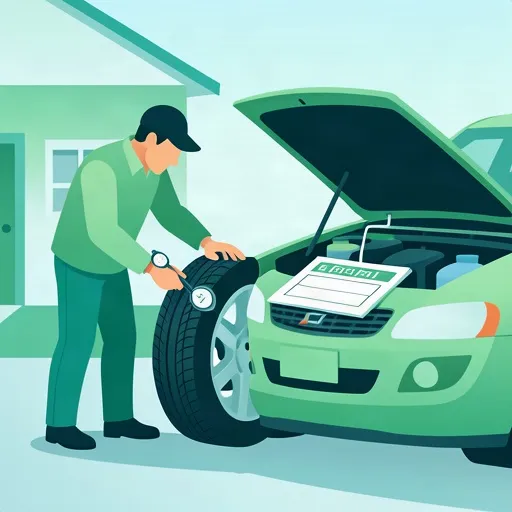
For the DVSA theory test, you are expected to understand the essential checks required to maintain vehicle condition. These go beyond the internal systems and include the "external" checks that any driver can perform with little to no mechanical knowledge. Following a simple routine, often referred to as "POWDER" (Petrol/Fuel, Oil, Water, Damage, Electrics, Rubber), can help you identify common issues before you set off.
If your MOT has expired, you cannot legally drive your vehicle on the road except to go to a pre-booked MOT test. Furthermore, you cannot renew your vehicle tax if your MOT is out of date, which can result in significant fines and the clamping or impounding of your vehicle.
Mechanics often see the "unseen" dangers that drivers neglect, such as suspension components that are nearing the end of their life or subtle brake pad wear that isn't yet obvious to the driver. By developing an understanding of how your vehicle operates, you become a more observant and proactive driver. This mindset is highly valued by the DVSA, as it indicates a driver who respects their responsibilities and understands the risks associated with modern traffic.
Ignoring minor maintenance tasks often leads to catastrophic failures. For instance, tyres worn below the legal limit of 1.6mm across the central three-quarters of the tyre are not only illegal but significantly increase your stopping distance, especially in wet conditions common in England, Scotland, and Wales. The Highway Code explicitly states that your vehicle must be kept in a condition that does not cause unnecessary danger to others, and failing to do so can result in penalty points, heavy fines, and the potential for a driving ban.
In the Great Britain theory test, you will encounter questions regarding vehicle documents and safety checks. Remember that the MOT is only one part of the wider responsibility of vehicle ownership. Always ensure you distinguish these rules from those in Northern Ireland, where testing procedures at DVA centres differ from the Great Britain system.
Vehicle roadworthiness in Great Britain is a daily legal responsibility that goes far beyond the annual MOT test. While the MOT provides a minimum safety checkpoint, drivers and registered keepers must continuously ensure their vehicle meets legal standards including functional brakes, lights, tyres with at least 1.6mm tread depth, and proper fluid levels. The POWDER routine offers a practical framework for daily checks covering fuel, oil, water, damage, electrics, and rubber components. Failure to maintain roadworthiness can result in police prosecution, penalty points, fines, and potential vehicle impoundment, regardless of a recent MOT pass. For the DVSA theory test, learners should understand that the MOT is merely one component of the broader legal duty of care that applies every time a vehicle is used on a public road.
A short set of high-value points that capture the most important ideas from this article.
An MOT pass is only a snapshot of your vehicle's condition at one moment and does not guarantee roadworthiness for the rest of the year
The registered keeper is legally responsible for ensuring their vehicle is roadworthy every time it is driven on a public road
Daily self-inspection habits are a legal requirement under the Road Vehicles (Construction and Use) Regulations
Tyres must maintain at least 1.6mm tread depth across the central three-quarters of the tyre to remain legal
Neglecting minor maintenance can result in penalty points, fines, and potentially a driving ban
Roadworthiness is a continuous legal duty, not just an annual MOT checkpoint
The POWDER routine (Petrol/Fuel, Oil, Water, Damage, Electrics, Rubber) provides a practical daily check framework
A valid MOT is required for vehicle tax renewal; an expired MOT results in fines and potential vehicle clamping
Tyre tread depth has a specific legal minimum of 1.6mm, which can be checked using a 20p coin
Police can prosecute you for vehicle defects even if your MOT passed only days before
Assuming an MOT pass means the vehicle is safe to drive for a full year without further checks
Only inspecting the vehicle before the MOT test rather than maintaining regular checks
Ignoring minor faults like worn brake pads or slight tread wear until they become serious issues
Driving the vehicle normally when the MOT has expired, rather than only to a pre-booked test
Not knowing the specific legal minimum tread depth requirement of 1.6mm
Article content overview
A short set of high-value points that capture the most important ideas from this article.
An MOT pass is only a snapshot of your vehicle's condition at one moment and does not guarantee roadworthiness for the rest of the year
The registered keeper is legally responsible for ensuring their vehicle is roadworthy every time it is driven on a public road
Daily self-inspection habits are a legal requirement under the Road Vehicles (Construction and Use) Regulations
Tyres must maintain at least 1.6mm tread depth across the central three-quarters of the tyre to remain legal
Neglecting minor maintenance can result in penalty points, fines, and potentially a driving ban
Roadworthiness is a continuous legal duty, not just an annual MOT checkpoint
The POWDER routine (Petrol/Fuel, Oil, Water, Damage, Electrics, Rubber) provides a practical daily check framework
A valid MOT is required for vehicle tax renewal; an expired MOT results in fines and potential vehicle clamping
Tyre tread depth has a specific legal minimum of 1.6mm, which can be checked using a 20p coin
Police can prosecute you for vehicle defects even if your MOT passed only days before
Assuming an MOT pass means the vehicle is safe to drive for a full year without further checks
Only inspecting the vehicle before the MOT test rather than maintaining regular checks
Ignoring minor faults like worn brake pads or slight tread wear until they become serious issues
Driving the vehicle normally when the MOT has expired, rather than only to a pre-booked test
Not knowing the specific legal minimum tread depth requirement of 1.6mm
Explore related topics, search based questions, and concepts that learners often look up when studying Vehicle Roadworthiness and Maintenance. These themes reflect real search intent and help you understand how this topic connects to wider driving theory knowledge in Great Britain.
Find clear and practical answers to common questions learners often have about Vehicle Roadworthiness and Maintenance. This section helps explain difficult points, remove confusion, and reinforce the key driving theory concepts that matter for learners in Great Britain.
No. An MOT certificate only confirms that your vehicle met minimum safety and environmental standards at the time of the test. You are legally required to ensure your vehicle remains roadworthy at all times between tests.
Under the Road Vehicles (Construction and Use) Regulations and the Highway Code, you must ensure your vehicle is in a safe and roadworthy condition whenever you use it on a public road.
You should regularly check your tyre pressure and tread depth, fluid levels (oil, coolant, brake fluid), light bulbs, indicators, windscreen wipers, and the effectiveness of your braking and steering systems.
If your current MOT has expired and your vehicle fails the test, you cannot drive it on the road unless you are taking it to a pre-booked appointment for repairs or a retest. Otherwise, it must be kept off the road.
Explore our extensive library of Great Britain driving theory articles to clarify any topic, review specific road rules, or gain deeper insights into vehicle safety and the Highway Code. Use the search to find exactly what you need for comprehensive DVSA theory test preparation.