
Defensive driving is a mindset and a set of techniques focused on proactively identifying and responding to potential dangers on the road. It means assuming that other road users might make mistakes and preparing yourself to react safely. This approach is fundamental to passing your French driving theory exam (ETG) and ensuring your safety in diverse French traffic conditions.
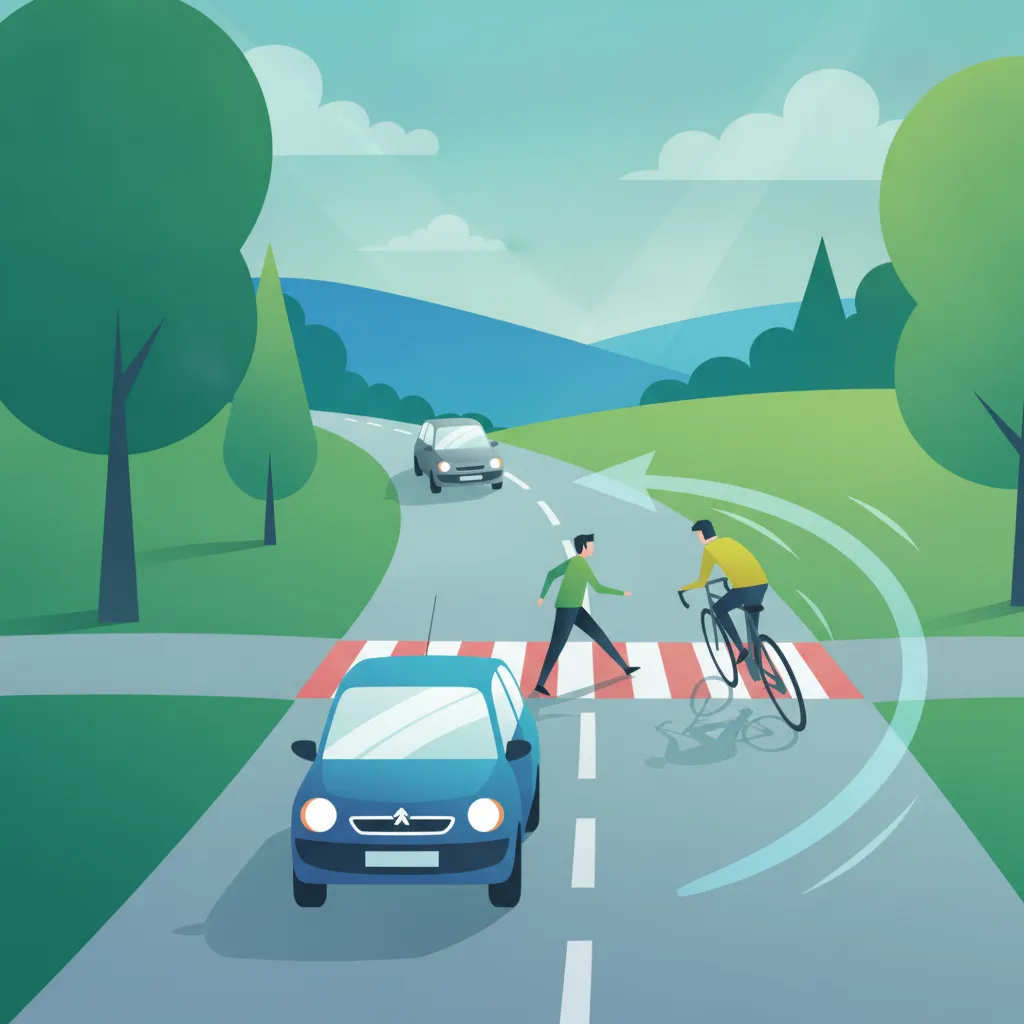
Theory topic content overview
Read the full theory topic guide for Defensive Driving with structured, easy-to-scan content built for learners in France. This detailed section explains the exact rule, meaning, traffic context, comparison points, and exam logic behind this French driving theory topic so you can study faster, understand the concept more clearly, and avoid common interpretation mistakes on the theory test.
Defensive driving is a proactive approach to operating a vehicle, designed to minimize accident risk by anticipating potential hazards and adapting your driving behaviour accordingly. It's a mindset that assumes other road users might make mistakes or behave unpredictably, requiring you to be constantly prepared to react safely. In France, mastering defensive driving is not just about personal safety; it's a fundamental principle embedded in the Code de la route and a crucial aspect for success in the permis de conduire (driving license) theory exam (ETG).
Instead of merely reacting to dangers as they arise, a defensive driver actively scans the environment, predicts possible conflicts, and creates a safety margin – in terms of time, space, and visibility – to avoid incidents.
The diverse and often dynamic traffic conditions in France, from busy Parisian streets to high-speed autoroutes and complex giratoires (roundabouts), make defensive driving indispensable. It’s not just about knowing the rules; it's about applying them with foresight.
Defensive driving revolves around several interconnected principles that guide a driver's actions:
This means constantly scanning your surroundings – far ahead, to the sides, and behind – not just focusing on the vehicle directly in front. On French roads, this includes looking for pedestrians stepping into crosswalks (passages piétons), cyclists in urban areas, or vehicles merging onto autoroutes.
A defensive driver predicts what could happen. Instead of waiting for a car to signal a lane change, you notice a driver looking in their mirror or drifting slightly and prepare for a potential manoeuvre. Anticipate sudden braking, unexpected turns, or pedestrians distracted by phones.
Known in France as the "distance de sécurité," this principle dictates leaving enough space between your vehicle and the one ahead to react safely to sudden stops. The Code de la route suggests a minimum of two seconds in good conditions, which must be increased in rain, fog, or on wet roads.
The posted speed limit (limitation de vitesse) is the maximum legal speed, not necessarily a safe speed. Defensive drivers adjust their speed based on visibility, road surface (e.g., wet chaussée), traffic density, and proximity to vulnerable road users.
Beyond the following distance, create a "buffer zone" around your car. Avoid driving in other vehicles' blind spots (angles morts), especially large poids lourds (heavy goods vehicles), and try to position your vehicle so you have an escape route if necessary.
Use your indicators (clignotants) clearly and in advance, make eye contact with pedestrians or cyclists, and use your horn sparingly but effectively when necessary to warn others of your presence.
Applying defensive driving principles means employing specific techniques:
autoroutes or rural roads. This gives you time to react to changes, like traffic slowing or a panneau de signalisation (road sign).contrôle des angles morts) before changing lanes or turning, especially near cyclists in city traffic.Understanding defensive driving is easier when contrasted with other driving styles:
Giratoire (Roundabout): Instead of rushing in, a defensive driver approaches slowly, observes traffic already in the roundabout (which generally has priority), and anticipates which exit other drivers might take based on their indicators. They avoid committing until a safe gap is certain.Autoroute in Rain: While the speed limit may be 130 km/h in dry conditions, a defensive driver will significantly reduce speed (e.g., to 110 km/h or even 90 km/h if visibility is poor) and double their safe following distance due to reduced grip and visibility.Passages Piétons: A defensive driver expects children to dart out or pedestrians to cross without looking. They reduce speed, cover the brake, and maintain a wide field of vision, ready to stop instantly.Périphérique (Ring Road): Instead of forcing their way in, a defensive driver plans the lane change well in advance, signals early, checks all mirrors and blind spots thoroughly, and waits for a safe and ample gap to appear, often adjusting their speed to match the target lane's flow.Learners and even experienced drivers often make mistakes by not fully embracing defensive driving principles:
Code de la route sets rules, but real drivers make mistakes. Defensive driving means anticipating these errors.angles morts, leading to dangerous lane changes.distance de sécurité) dramatically reduces reaction time and leaves no room for error, especially on fast-moving autoroutes.To integrate defensive driving into your daily routine and excel in your permis de conduire exam:
angles morts.By consistently applying these principles, you'll not only enhance your safety on French roads but also demonstrate the advanced hazard perception skills valued in the Code de la route and the practical driving test.
Defensive driving in France is a proactive, anticipatory approach embedded in the Code de la route that focuses on preventing accidents even when other road users make mistakes. Core techniques include continuous 360-degree observation, the Two-Second Rule for safe following distance, scanning 12-30 seconds ahead depending on road type, covering the brake near potential hazards, and always planning an escape route. The French ETG exam tests your ability to identify hazards and choose the safest defensive action. Key differences from aggressive or passive driving include balancing caution with assertiveness, adapting speed to conditions rather than following limits blindly, and maintaining adequate space around your vehicle at all times.
A short set of high-value points that capture the most important ideas from this theory explanation.
Defensive driving is a proactive mindset that assumes other road users may make mistakes and requires constant preparation to react safely
Continuous observation means scanning 360 degrees, not just focusing on the vehicle ahead
Maintaining safe following distance (distance de sécurité) gives you crucial reaction time on French autoroutes and urban roads
Speed limits are maximum legal speeds, not targets; defensive drivers always adapt to current conditions
Effective hazard anticipation prevents incidents rather than just reacting to dangers as they occur
The Two-Second Rule (minimum) must be increased in rain, fog, or on wet roads (chaussée mouillée)
Speed limits (limitation de vitesse) are legal maximums, not recommended speeds, especially near schools or passages piétons
Mirrors alone cannot detect cyclists or vehicles in angles morts; head checks are mandatory before lane changes
The Code de la route sets rules, but real drivers make errors; defensive driving means anticipating violations
Creating a safety buffer (space around your vehicle) gives you an escape route when hazards develop
Assuming other road users will always follow the Code de la route is the biggest defensive driving error
Relying only on mirrors and skipping blind spot (angles morts) head checks, especially near cyclists in cities
Driving at the speed limit regardless of rain, fog, visibility, or traffic density
Tailgating with insufficient distance de sécurité dramatically reduces reaction time on fast autoroutes
Focusing narrowly on the vehicle directly ahead while ignoring peripheral hazards developing at the sides
Start with a short, direct summary of Defensive Driving before reading the full explanation below.
Defensive driving is a proactive approach where you anticipate potential hazards, adapt your speed and position, and maintain situational awareness to minimize accident risk. It emphasizes driving with the assumption that other road users may behave unpredictably, giving you more time and space to react safely, which is a critical skill for driving in France.
Review the most important terms, rule signals, and traffic concepts linked to Defensive Driving.
Explore related theory topic pages connected to Defensive Driving and continue with the next useful rule explanation.
See the common search queries learners use when trying to understand Defensive Driving in France.

Continue your journey by exploring specific French driving theory topics, from road signs and priority rules to vehicle safety and administrative procedures. Deepen your understanding of the Code de la route and prepare effectively for your permis de conduire ETG exam to ensure success and safe driving practices.
French Driving Theory Topics & RulesTheory topic content overview
A short set of high-value points that capture the most important ideas from this theory explanation.
Defensive driving is a proactive mindset that assumes other road users may make mistakes and requires constant preparation to react safely
Continuous observation means scanning 360 degrees, not just focusing on the vehicle ahead
Maintaining safe following distance (distance de sécurité) gives you crucial reaction time on French autoroutes and urban roads
Speed limits are maximum legal speeds, not targets; defensive drivers always adapt to current conditions
Effective hazard anticipation prevents incidents rather than just reacting to dangers as they occur
The Two-Second Rule (minimum) must be increased in rain, fog, or on wet roads (chaussée mouillée)
Speed limits (limitation de vitesse) are legal maximums, not recommended speeds, especially near schools or passages piétons
Mirrors alone cannot detect cyclists or vehicles in angles morts; head checks are mandatory before lane changes
The Code de la route sets rules, but real drivers make errors; defensive driving means anticipating violations
Creating a safety buffer (space around your vehicle) gives you an escape route when hazards develop
Assuming other road users will always follow the Code de la route is the biggest defensive driving error
Relying only on mirrors and skipping blind spot (angles morts) head checks, especially near cyclists in cities
Driving at the speed limit regardless of rain, fog, visibility, or traffic density
Tailgating with insufficient distance de sécurité dramatically reduces reaction time on fast autoroutes
Focusing narrowly on the vehicle directly ahead while ignoring peripheral hazards developing at the sides
Start with a short, direct summary of Defensive Driving before reading the full explanation below.
Defensive driving is a proactive approach where you anticipate potential hazards, adapt your speed and position, and maintain situational awareness to minimize accident risk. It emphasizes driving with the assumption that other road users may behave unpredictably, giving you more time and space to react safely, which is a critical skill for driving in France.
Review the most important terms, rule signals, and traffic concepts linked to Defensive Driving.
Explore related theory topic pages connected to Defensive Driving and continue with the next useful rule explanation.
See the common search queries learners use when trying to understand Defensive Driving in France.
Continue your journey by exploring specific French driving theory topics, from road signs and priority rules to vehicle safety and administrative procedures. Deepen your understanding of the Code de la route and prepare effectively for your permis de conduire ETG exam to ensure success and safe driving practices.
French Driving Theory Topics & RulesUse this exam-focused revision tip to understand how Defensive Driving is likely to appear in theory questions for learners in France. This section helps you identify the most testable part of the rule, avoid common traps, and remember the concept more effectively during French driving theory exam preparation.
The French driving exam often presents scenarios where you must identify hazards and choose the safest action. Always choose the option that demonstrates proactive anticipation, maintaining a safe distance, and adapting your speed or position, even if other drivers seem to be ignoring the rules. Think 'what if' and prepare for the worst, particularly concerning vulnerable road users.
Read direct answers to the most common learner questions about Defensive Driving in France. This FAQ focuses on rule confusion, practical meaning, comparison with similar concepts, and the exact uncertainties that appear most often in French driving theory revision and exam preparation.
Defensive driving is a proactive strategy where drivers constantly anticipate potential dangers and adjust their behavior to reduce the risk of accidents, even if other drivers make mistakes.
It's crucial for navigating diverse French road conditions, from busy city streets to autoroutes, helping drivers stay safe by being prepared for unpredictable situations and adhering to the spirit of the Code de la route.
Key principles include maintaining situational awareness, anticipating hazards, managing speed, maintaining safe following distances, and avoiding distractions. It's about creating a safety buffer around your vehicle.
By continuously observing and predicting potential dangers, such as a pedestrian stepping out or a car braking suddenly, you gain precious seconds to react safely, reducing the likelihood of a collision.
Not necessarily. It means adapting your speed appropriately to conditions, traffic, and potential hazards, rather than strictly adhering to the maximum speed limit regardless of circumstances.
Yes, concepts related to hazard perception, maintaining safe distances, adapting speed, and responsible driving behavior are frequently assessed in the ETG, often through scenario-based questions.
Practice scanning the road far ahead, checking mirrors frequently, being aware of blind spots, and recognizing potential risk factors like distracted drivers or children playing near the road.
This refers to the extra space and time you create around your vehicle by maintaining safe following distances, avoiding crowded lanes, and giving yourself room to maneuver away from danger.
Ready to focus your study? Use the practice search to find exactly the French driving theory questions you need for the Code de la route and permis de conduire ETG. Refine your knowledge on specific topics or challenging rules to boost your confidence and exam readiness.