
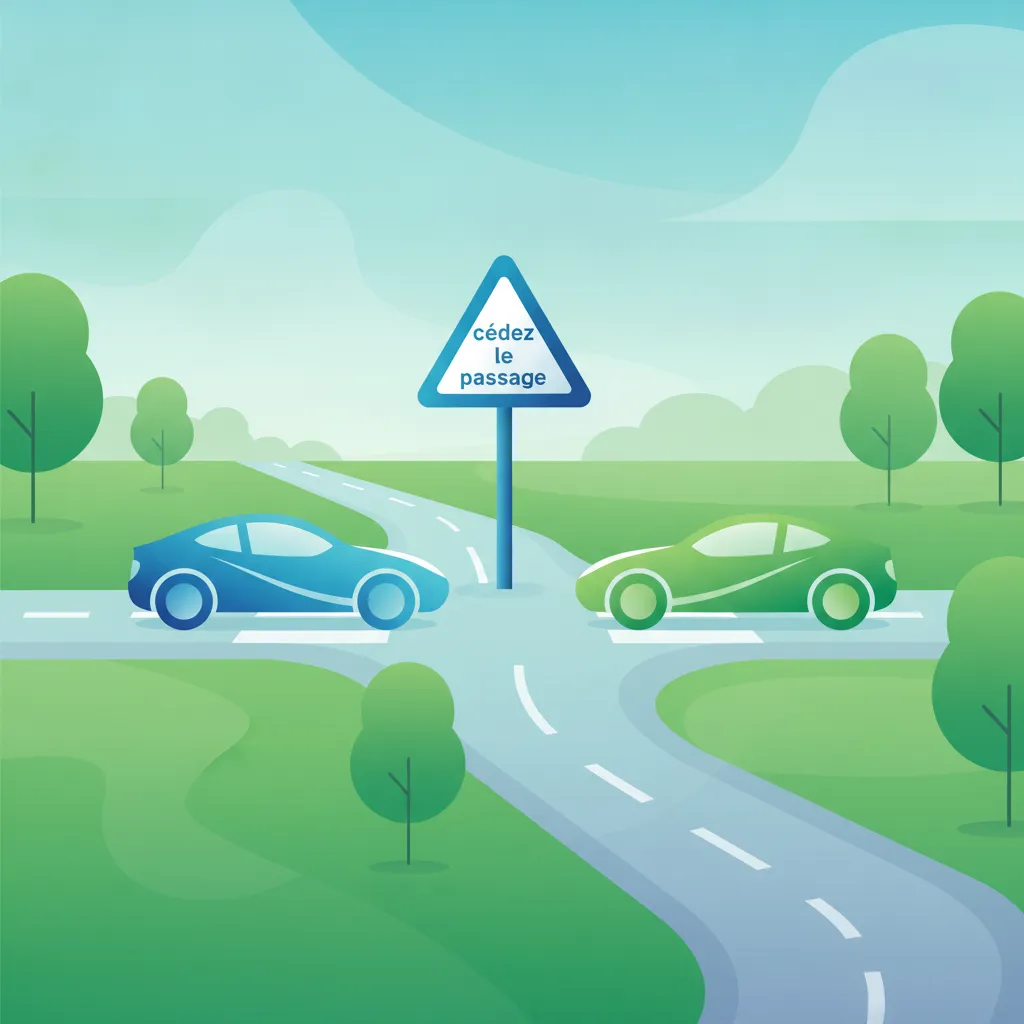
In France, 'giving way' (céder le passage) means allowing another road user to proceed first to ensure safety and maintain traffic flow. This concept is vital for navigating intersections, roundabouts, and pedestrian crossings. This page details the specific situations where you must yield, based on French road signs, markings, and the Code de la route.
Theory topic content overview
Read the full theory topic guide for Give Way Rules with structured, easy-to-scan content built for learners in France. This detailed section explains the exact rule, meaning, traffic context, comparison points, and exam logic behind this French driving theory topic so you can study faster, understand the concept more clearly, and avoid common interpretation mistakes on the theory test.
Céder le Passage (Giving Way) in French TrafficIn France, "giving way" (known as céder le passage in the Code de la route) is a fundamental principle of safe driving that requires you to yield priority to other road users in specific situations. It means allowing another vehicle, pedestrian, or cyclist to proceed first, ensuring their safe passage and preventing potential collisions. Mastering these rules is not just about avoiding accidents; it's absolutely crucial for passing your permis de conduire theory exam (ETG).
This concept goes beyond simply stopping; it involves careful observation, anticipation, and making a clear decision to allow others their right of way. Failing to céder le passage when required is known as a refus de priorité, a serious offense that can lead to significant penalties and is a common cause of accidents in France.
The robust framework of céder le passage rules underpins the entire traffic system in France. Its importance is multifaceted:
autoroutes.Permis de Conduire Success: A significant portion of the ETG (French theory test) focuses on correctly interpreting and applying priority rules in various scenarios. Misunderstanding these rules is a primary reason for failing the exam.Céder le passage is a legal requirement. Failure to comply can result in fines, penalty points on your license, and even license suspension.Céder le Passage Works in PracticeThe obligation to give way in France is determined by a combination of road signs, markings, traffic lights, and unwritten rules that apply by default.
Cédez le Passage SignThis is the most direct instruction to give way. It's an inverted triangular sign with a red border and a white background, often accompanied by a dashed white line on the road.
STOP SignWhile similar to cédez le passage, a STOP sign (panneau STOP) imposes an additional, mandatory requirement. It's an octagonal red sign with "STOP" in white, accompanied by a solid white line on the road.
cédez le passage, you only stop if necessary. With STOP, you always stop.Priorité à Droite (Priority to the Right)This is a cornerstone of French traffic law and often a source of confusion for new drivers. Priorité à droite applies by default at unmarked intersections where no signs, traffic lights, or road markings indicate otherwise.
cédez le passage for one direction.Priorité à droite typically does not apply:
giratoires) – see below.STOP / Cédez le passage signs.rocade (ring road) or autoroute (motorway).Giratoires)French roundabouts (giratoires) generally operate with a specific priority rule:
cédez le passage sign (or sometimes a STOP sign in older, less common roundabouts) at each entry point, confirming this.Passages Piétons)In France, pedestrians at designated crossings (passages piétons) have absolute priority.
When joining a main road, rocade, or autoroute from an acceleration lane, you must céder le passage to traffic already on the main carriageway.
To avoid common mistakes on the French roads and in your permis de conduire exam, understand these key differences:
Cédez le Passage vs. STOP:
Cédez le Passage: Slow down, be prepared to stop, and yield if necessary. You don't have to stop if the way is clear.STOP: You must come to a complete, momentary halt before the white line, then yield, even if the way seems clear.Priorité à Droite vs. Priority Road:
Priorité à Droite: The default rule at unmarked intersections, where you yield to traffic from your right.panneau de priorité). If you are on a priority road, you have priority over traffic joining from the left or right, unless a specific sign (like STOP or cédez le passage) indicates otherwise for you. If a priority road ends, a specific sign will inform you.céder le passage to the vehicle from your right due to priorité à droite.Giratoire (Roundabout) on a Route Nationale: As you approach a busy roundabout on a main road, you see the inverted triangular cédez le passage sign. You must observe the traffic circulating inside the roundabout. You can only enter when there is a sufficiently large gap, without forcing any vehicles already in the roundabout to brake or swerve.Passage Piéton: You are driving in a city and see a pedestrian waiting at a designated passage piéton. As you approach, the pedestrian makes eye contact or clearly indicates their intention to cross. You must slow down and stop before the crossing to allow them to cross safely.Refus de Priorité)Priorité à Droite: This is perhaps the most common and dangerous mistake. Learners often assume a larger road automatically grants priority, or they forget the rule at seemingly minor intersections. Always look for signs; if none, assume priorité à droite.STOP Sign: Failing to make a full, complete stop at a STOP sign. Many treat it like a cédez le passage, which is a serious fault in the permis de conduire test and dangerous in practice.giratoire without a safe gap, causing other drivers to brake sharply, is a clear refus de priorité.passages piétons. Always anticipate pedestrians, especially in urban areas.cédez le passage sign for a STOP sign, or vice versa. Always identify the specific sign and obey its command.Céder le passage is not merely a suggestion; it's a critical safety directive embedded in the Code de la route. To drive safely and pass your French driving theory and practical tests, always:
cédez le passage signs, STOP signs, and situations where priorité à droite applies by default.Your ability to correctly interpret and apply these céder le passage rules demonstrates your understanding of French traffic principles and your commitment to road safety.
In France, giving way (céder le passage) is a fundamental legal requirement under the Code de la route that drivers must master for both road safety and the permis de conduire theory exam. The key to understanding French priority rules lies in distinguishing between céder le passage (yield if necessary), STOP (always stop), and priorité à droite (yield to traffic from your right at unmarked intersections). Roundabouts operate on the rule that circulating traffic has priority, and pedestrians at designated crossings always have absolute priority. Common mistakes include ignoring priorité à droite, rolling through STOP signs, misjudging gaps in roundabouts, and failing to yield to pedestrians, all of which constitute refus de priorité—a serious offense that can result in fines and penalty points.
A short set of high-value points that capture the most important ideas from this theory explanation.
Giving way (céder le passage) is a legal obligation requiring you to allow other road users to proceed first to prevent collisions.
Cédez le Passage means slow down and yield if necessary; STOP means you must always come to a complete halt before proceeding.
Priorité à droite (priority to the right) applies at unmarked intersections where no signs or markings indicate otherwise.
Traffic already circulating inside a roundabout has priority over vehicles attempting to enter.
Pedestrians at designated crossings (passages piétons) have absolute priority and drivers must stop for them.
Priorité à droite applies only at unmarked intersections; it does not apply at roundabouts, on priority roads, or when exiting private driveways.
A yellow diamond sign marks a priority road where you have priority over joining traffic unless a STOP or céder le passage sign applies to you.
With céder le passage you stop only if necessary; with STOP you must always stop completely, even if the road appears clear.
When merging onto an autoroute or rocade, you must yield to traffic already on the main carriageway.
The术语 céder le passage and the concept of priorité à droite are unique to French traffic law and frequently tested on the ETG exam.
Assuming a larger or faster road has automatic priority and ignoring priorité à droite at unmarked intersections.
Treating a STOP sign like céder le passage by rolling through without a complete stop.
Entering a roundabout without a safe gap, forcing vehicles already inside to brake.
Failing to anticipate pedestrians at crossings, especially in urban areas or near schools.
Confusing céder le passage signs with STOP signs when reading intersection signs quickly.
Start with a short, direct summary of Give Way Rules before reading the full explanation below.
Giving way in France requires drivers to yield priority to other road users in specific situations, ensuring safe passage and preventing conflicts. This often involves slowing down or stopping to allow traffic on a priority road, in a roundabout, or pedestrians at a crossing to proceed first. Key indicators include triangular give way signs (panneau 'cédez le passage'), stop signs, and specific rules like 'priorité à droite' where applicable.
Review the most important terms, rule signals, and traffic concepts linked to Give Way Rules.
Explore related theory topic pages connected to Give Way Rules and continue with the next useful rule explanation.
See the common search queries learners use when trying to understand Give Way Rules in France.

Continue your journey by exploring specific French driving theory topics, from road signs and priority rules to vehicle safety and administrative procedures. Deepen your understanding of the Code de la route and prepare effectively for your permis de conduire ETG exam to ensure success and safe driving practices.
French Driving Theory Topics & RulesTheory topic content overview
A short set of high-value points that capture the most important ideas from this theory explanation.
Giving way (céder le passage) is a legal obligation requiring you to allow other road users to proceed first to prevent collisions.
Cédez le Passage means slow down and yield if necessary; STOP means you must always come to a complete halt before proceeding.
Priorité à droite (priority to the right) applies at unmarked intersections where no signs or markings indicate otherwise.
Traffic already circulating inside a roundabout has priority over vehicles attempting to enter.
Pedestrians at designated crossings (passages piétons) have absolute priority and drivers must stop for them.
Priorité à droite applies only at unmarked intersections; it does not apply at roundabouts, on priority roads, or when exiting private driveways.
A yellow diamond sign marks a priority road where you have priority over joining traffic unless a STOP or céder le passage sign applies to you.
With céder le passage you stop only if necessary; with STOP you must always stop completely, even if the road appears clear.
When merging onto an autoroute or rocade, you must yield to traffic already on the main carriageway.
The术语 céder le passage and the concept of priorité à droite are unique to French traffic law and frequently tested on the ETG exam.
Assuming a larger or faster road has automatic priority and ignoring priorité à droite at unmarked intersections.
Treating a STOP sign like céder le passage by rolling through without a complete stop.
Entering a roundabout without a safe gap, forcing vehicles already inside to brake.
Failing to anticipate pedestrians at crossings, especially in urban areas or near schools.
Confusing céder le passage signs with STOP signs when reading intersection signs quickly.
Start with a short, direct summary of Give Way Rules before reading the full explanation below.
Giving way in France requires drivers to yield priority to other road users in specific situations, ensuring safe passage and preventing conflicts. This often involves slowing down or stopping to allow traffic on a priority road, in a roundabout, or pedestrians at a crossing to proceed first. Key indicators include triangular give way signs (panneau 'cédez le passage'), stop signs, and specific rules like 'priorité à droite' where applicable.
Review the most important terms, rule signals, and traffic concepts linked to Give Way Rules.
Explore related theory topic pages connected to Give Way Rules and continue with the next useful rule explanation.
See the common search queries learners use when trying to understand Give Way Rules in France.
Continue your journey by exploring specific French driving theory topics, from road signs and priority rules to vehicle safety and administrative procedures. Deepen your understanding of the Code de la route and prepare effectively for your permis de conduire ETG exam to ensure success and safe driving practices.
French Driving Theory Topics & RulesUse this exam-focused revision tip to understand how Give Way Rules is likely to appear in theory questions for learners in France. This section helps you identify the most testable part of the rule, avoid common traps, and remember the concept more effectively during French driving theory exam preparation.
Many exam questions on giving way test your ability to interpret complex intersection scenarios quickly. Pay close attention to road signs, markings, and the presence of traffic lights or roundabouts. Remember that 'priorité à droite' (priority to the right) applies at unmarked intersections unless otherwise indicated, a frequent point of confusion.
Read direct answers to the most common learner questions about Give Way Rules in France. This FAQ focuses on rule confusion, practical meaning, comparison with similar concepts, and the exact uncertainties that appear most often in French driving theory revision and exam preparation.
'Céder le passage' is the French term for 'give way' or 'yield priority', meaning you must allow other road users to proceed before you, to avoid a collision.
You must give way at intersections when there is a 'cédez le passage' sign, a stop sign, or when 'priorité à droite' (priority to the right) applies at an unmarked intersection.
'Priorité à droite' means 'priority to the right' and requires you to yield to vehicles coming from your right at unmarked intersections in France, unless signs indicate otherwise.
Pedestrians have priority when they are already on a designated crossing or clearly intending to cross. Drivers must always be prepared to stop for them.
A 'Stop' sign requires you to come to a complete halt before proceeding safely, while a 'Cédez le Passage' (give way) sign requires you to slow down or stop only if necessary to yield to priority traffic.
In most French roundabouts, traffic already circulating within the roundabout has priority. You must give way to vehicles approaching from your left as you enter.
Failing to give way (refus de priorité) is a serious offense in France, which can result in fines, penalty points on your permis de conduire, and is a major cause of accidents.
Ready to focus your study? Use the practice search to find exactly the French driving theory questions you need for the Code de la route and permis de conduire ETG. Refine your knowledge on specific topics or challenging rules to boost your confidence and exam readiness.